
Machine à rainurer verticale ou à portique : laquelle convient le mieux à votre atelier ?

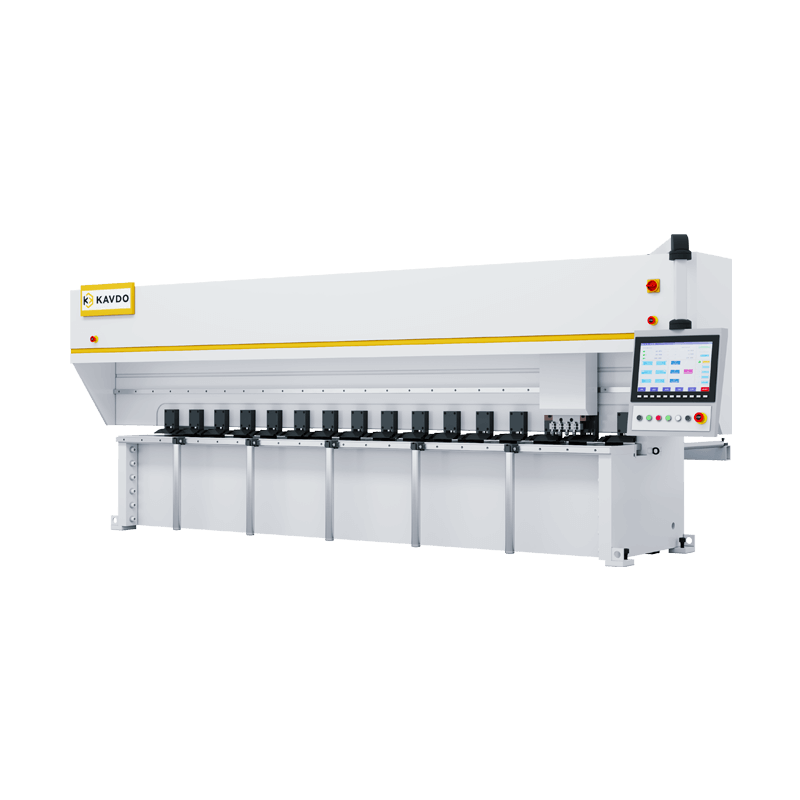
The difference between a vertical and a gantry V grooving machine is how the sheet is held. A gantry (horizontal) machine clamps the sheet flat on a large table and moves a bridge carrying the tool head over it, which suits wide, long panels and high volumes. A vertical machine clamps the sheet upright and moves the tool head horizontally along it, which saves floor space and suits smaller shops. Both cut the same kind of V groove for sharp bends; the right choice depends on your sheet sizes, volume and floor space.
Vertical vs Gantry V Grooving Machine at a Glance
| Vertical V grooving machine | Gantry (horizontal) V grooving machine | |
|---|---|---|
| Sheet position | Clamped upright against a reference surface | Clamped flat on a table |
| What moves | Tool head traverses horizontally along the sheet | Gantry beam carries the tool head over the stationary sheet |
| Floor space | Compact: the sheet stands up, so less floor area is needed | Large: the machine is longer and wider than the biggest sheet (KAVDO 1500 × 6000 model: about 8.3 × 2.6 m) |
| Sheet size and thickness | KAVDO models: 1600–6000 mm working length, 0.4–8 mm thick | KAVDO models: 3200–6000 mm long, 1250 or 1500 mm wide, 0.4–5 mm thick |
| Loading | Easier for one operator with smaller sheets | Large sheets are loaded flat, often with a crane or vacuum lifter |
| Chip removal | Chips fall away from the groove by gravity | Chips stay on the sheet and need extraction or cleaning |
| Meilleur pour | Job shops, door frames, signage, cabinet parts, limited floor space | Elevator panels, architectural cladding, high-volume production of large panels |
How a Gantry V Grooving Machine Works
The sheet lies flat on a precision table and is held by pneumatic clamps. A rigid gantry beam spans the table; the tool holder on the beam travels along the groove (X axis) and steps down for each pass (Z axis), while the CNC positions each groove line (Y axis). Because the whole sheet is supported, the gantry layout handles large, thin panels without sagging and keeps groove depth consistent over long lengths. KAVDO gantry models groove 0.4–5 mm sheet up to 1500 × 6000 mm with ±0.01 mm positioning accuracy and an X-axis speed of 90 m/min.
The trade-off is size: a 6000 mm gantry machine weighs about 12.5 tonnes and needs a long, level floor area plus space to load full sheets.
How a Vertical V Grooving Machine Works
The sheet is clamped upright against a precision reference surface and the tool head traverses horizontally along it. Standing the sheet up cuts the floor area the machine needs and lets chips fall away from the groove. Servo-driven axes with CNC programming give the same multi-line grooving as a gantry machine. A vertical machine is often the more cost-effective choice for workshops that groove smaller panels or have limited space.
Which One Should You Choose?
- Choose a gantry machine if you regularly groove full-size sheets (1250 or 1500 mm wide, 3 m and longer), run high volumes for elevator or cladding projects, or need the whole panel supported flat during grooving.
- Choose a vertical machine if floor space is limited, most of your parts are small to medium panels, one operator does the loading, or you are adding V-grooving to an existing shop for the first time.
- Either way, match the working length to your longest panel, check the thickness range for your materials, and make sure your press brake or folder can bend the grooved parts to the same length.
Questions to Answer Before You Buy
- What is the largest sheet (length × width) you need to groove?
- Which materials and thicknesses, and which finishes (mirror, brushed, coated)?
- How many groove lines per sheet and how many sheets per shift?
- How much floor space and crane access do you have?
- Which groove angles do you need (30°, 45°, 60°, 90°)?
New to V-grooving? Start with What Is a V Grooving Machine? for how grooving works and how to set groove angle and depth.
Choose the grooving layout from part support and access
Use the longest and heaviest current jobs to compare loading, gauging, finished groove measurements and handling space. Verify access and support through the full routing sequence.
FAQ
Is a horizontal V grooving machine the same as a gantry V grooving machine?
Yes, in most cases. “Horizontal” refers to the sheet lying flat on the table, and that layout almost always uses a gantry beam to carry the tool head.
Which is more accurate, vertical or gantry?
Both reach high accuracy with CNC servo control. KAVDO gantry machines are specified at ±0.01 mm positioning on all axes. Groove quality depends more on frame rigidity, table flatness and tooling than on the layout.
Can a vertical V grooving machine handle long sheets?
Yes. KAVDO vertical models are available with working lengths up to 6000 mm. For wide, thin full-size panels, a gantry machine supports the sheet better.
Compare KAVDO gantry V grooving machines et vertical V grooving machines, or send your sheet sizes and production volume to nos ingénieurs for a recommendation.
