
Что такое V-образный канавочный станок? Как работает V-образное канавочное сечение, угол и глубина канавки.

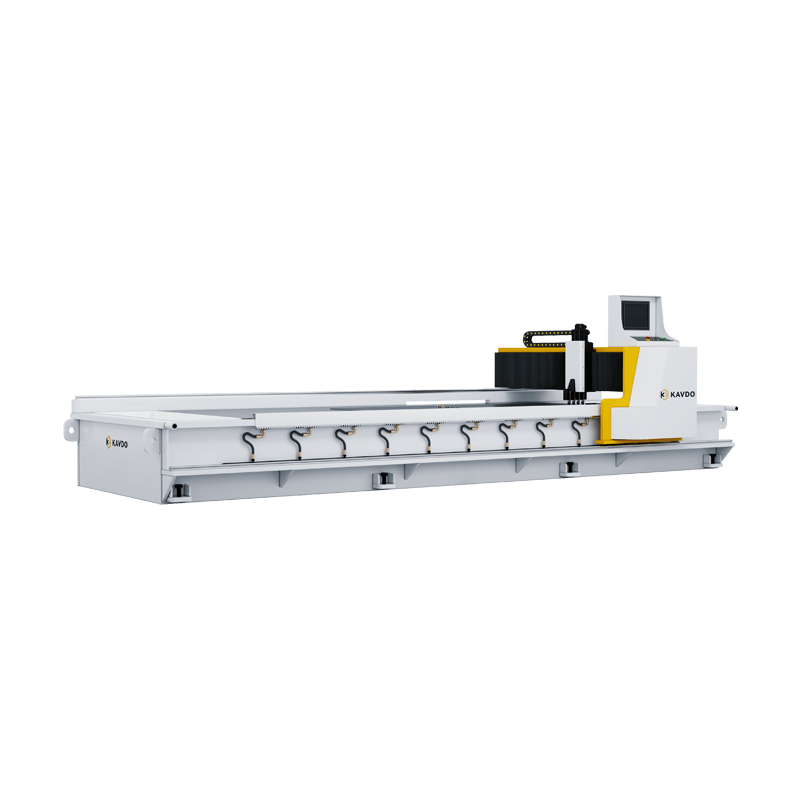
A V grooving machine (also called a V-cutting machine or V-groover) cuts a precise V-shaped groove along the bend line of a metal sheet before it is bent. Because most of the thickness is removed at the bend line, the sheet folds into a sharp, almost radius-free corner with far less bending force and springback than a normal press brake bend. V-grooving is used mainly on stainless steel, aluminum and copper sheet for elevator panels, signage, architectural cladding, door frames and kitchen equipment.
How V-Grooving Works
- Clamp the sheet. The sheet is clamped flat on the table (gantry type) or upright against a reference surface (vertical type), usually with pneumatic clamps.
- Position the groove line. The CNC moves the sheet or the tool to the first groove position (Y axis). Groove positions come from the flat-pattern drawing.
- Cut in several passes. A carbide tool travels along the line (X axis) like a planer. Each pass takes a small depth (Z axis) until the programmed groove depth is reached. Several tools on one holder can rough and finish in the same stroke.
- Repeat for every bend line. CNC machines store dozens of groove lines per sheet, each with its own depth and angle.
- Bend. The grooved sheet is then folded on a гибочном прессе or folding machine. Because the material left at the groove is thin, the bend needs much less force.
Why Groove Before Bending?
A normal air bend always leaves an outside radius at least as large as the sheet thickness, and often larger. For visible decorative parts, that rounded edge looks heavy and makes panels hard to line up. Grooving trades some corner strength for a crisp edge.
| Normal press brake bend | V-grooved bend | |
|---|---|---|
| Outside corner | Rounded, radius ≈ thickness or more | Sharp, near-zero radius |
| Bending force | Full tonnage for the sheet thickness | Much lower: only the remaining material is bent |
| Springback | Noticeable, needs angle correction | Small |
| Flat-length calculation | Needs bend allowance and K-factor | Close to the outside dimensions |
| Corner strength | Full | Reduced: not for load-bearing corners |
| Extra process step | No | Yes, grooving before bending |
For ordinary brackets and structural parts a normal bend is better. For flat-pattern calculation of those bends, use our bend allowance calculator.
Groove Angle and Depth
Groove angle: the included angle of the V groove is matched to the angle the sheet will be bent through, so the two groove faces close together when the bend is finished. Common tools are 30°, 45°, 60° and 90°.
| Finished part angle | Bend (angle bent through) | Groove angle |
|---|---|---|
| 90° corner | 90° | 90° |
| 120° corner | 60° | 60° |
| 135° corner | 45° | 45° |
| 150° corner | 30° | 30° |
Groove depth: the depth is set by how much material you leave at the bottom of the groove (the residual thickness). A thinner residual gives a sharper edge but a weaker corner and a higher risk of cracking or breaking through. As a starting point for 1–2 mm decorative stainless steel, many shops leave roughly 0.3–0.6 mm and fine-tune it with test bends; thicker sheets and corners that carry load keep more material. A CNC machine holds the depth consistently along the full length, which is what keeps long panel edges straight.
Materials and Applications
- Materials: stainless steel (including mirror, brushed and colored finishes), aluminum, copper and brass, and mild steel sheet.
- Elevator industry: car panels, landing doors and door frames, where sharp, uniform edges are visible.
- Architecture and interiors: wall cladding, column covers, ceiling panels and handrail trims.
- Signage and display: letter returns, light boxes and store fixtures.
- Kitchen and hospitality equipment: counters, cabinet doors and hotel or bank counter fronts.
- Enclosures: decorative cabinets and electrical boxes where a sharp edge is part of the design.
Types of V Grooving Machines
There are two main layouts. A gantry (horizontal) V grooving machine clamps the sheet flat on a table and moves a gantry beam carrying the tool head over it. It suits large, wide panels. A vertical V grooving machine clamps the sheet upright and moves the tool head horizontally along it, which saves floor space. See our detailed comparison: Vertical vs Gantry V Grooving Machine.
Key Specifications to Compare
| Specification | What it means | Example: KAVDO gantry V grooving machine |
|---|---|---|
| Processing length × width | Largest sheet you can groove | 3200–6000 mm × 1250 or 1500 mm |
| Sheet thickness | Thickness range the machine can groove | 0.4–5 mm |
| Positioning accuracy (X, Y, Z) | Groove position and depth accuracy | ±0.01 mm |
| X-axis speed | Cutting and return speed along the groove | 90 m/min |
| Z-axis speed | Tool depth movement | 30 m/min |
| Workbench parallelism | Flatness of the table, affects depth consistency | ±0.03 mm |
| Machine weight | Rigidity and foundation needs | 6,500–12,500 kg |
Also check the CNC controller (how many groove lines it stores and how easy programming is), the number of tools per holder, the clamping system and the dust and chip extraction.
Limitations
- Grooved corners are weaker. Do not groove corners that carry structural loads or vibration without reinforcement.
- Grooving adds a process step and a machine to the line, so it only pays off where the sharp edge matters.
- Protective film should usually be removed or cut along the groove line, and chips must be cleaned before bending to avoid marks.
Measure groove depth and remaining material on a test bend
Use the released groove geometry, stock thickness and required corner appearance. Record the finished groove, remaining web and bent angle before approving the process for repeat parts.
Часто задаваемые вопросы
What is V-grooving used for?
V-grooving is used to make sharp, almost radius-free bends on sheet metal, mainly for decorative stainless steel and aluminum parts such as elevator panels, signage, cladding, door frames and kitchen equipment.
Is V-grooving the same as grooving metal on a lathe?
No. Lathe grooving cuts a groove around a rotating part. V-grooving cuts straight V-shaped grooves into flat sheet so that the sheet can be folded sharply.
Can you bend a V-grooved sheet on a press brake?
Yes. Grooved sheets are usually bent on a press brake or folding machine. Because the material at the groove is thin, the bend needs much less tonnage than bending the full thickness.
What thickness can a V grooving machine handle?
Most V grooving work is on sheet from about 0.4 mm to 5 mm. KAVDO gantry V grooving machines groove 0.4 to 5 mm sheet up to 1500 × 6000 mm, and KAVDO vertical models handle 0.4 to 8 mm.
KAVDO производит CNC V grooving machines дюйм gantry и vertical configurations. Send your sheet size, material and groove pattern to нашим инженерам for a recommendation and quotation.
