
كيفية لف مخروط على آلة لف الألواح (مرفق حاسبة للنمط المسطح)

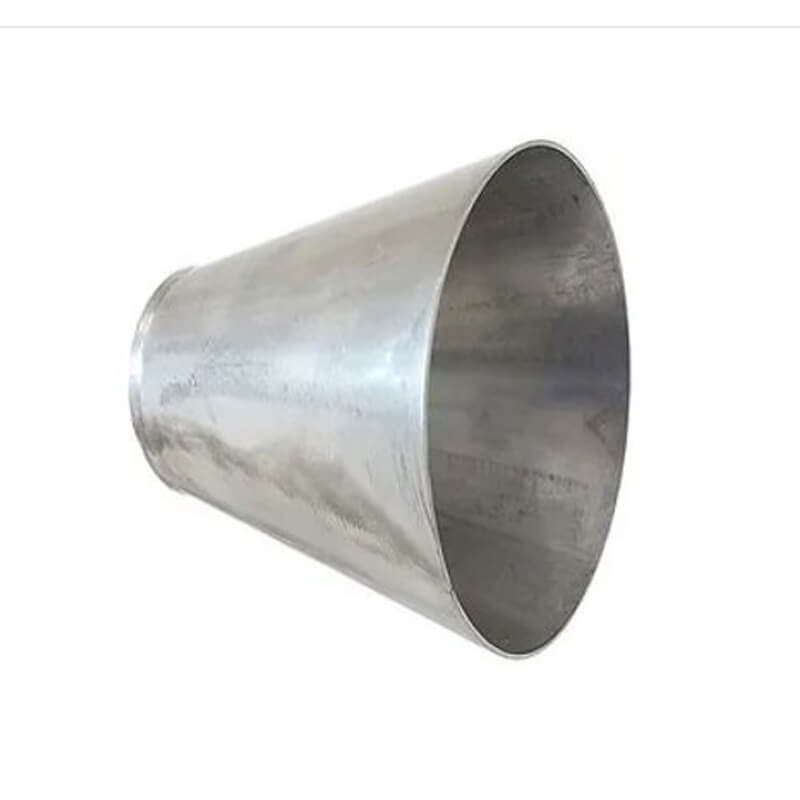
إجابة قصيرة: to roll a cone, first cut a flat pattern shaped like a fan (an annular sector), then roll it with the plate rolls set so the small end is bent more tightly than the large end. On a 3-roll machine you tilt the top or side roll and feed the small end more slowly, often with a cone-rolling device that brakes the small end. On a 4-roll machine you tilt the side rolls and the plate stays clamped. The flat pattern is calculated from the mean diameters and height. Use the calculator below to get the outer radius, inner radius and sector angle.
حاسبة نمط المخروط المسطح
Calculated on the mean (neutral) diameter. Add allowances for welding preparation and trimming.
More free calculators: KAVDO sheet metal tools
Cone Flat Pattern Formulas
| Value | Formula |
|---|---|
| Mean diameters | D1 = large outside diameter − t; D2 = small outside diameter − t |
| Slant height | L = √(H² + ((D1 − D2) ÷ 2)²) |
| Outer pattern radius | R = L × D1 ÷ (D1 − D2) |
| Inner pattern radius | r = R − L |
| Sector angle | θ = 180 × D1 ÷ R (degrees) |
Example: mean diameters 1,000 and 500 mm, height 500 mm. L = √(500² + 250²) = 559.0 mm; R = 559.0 × 1000 ÷ 500 = 1,118.0 mm; r = 559.0 mm; θ = 180 × 1000 ÷ 1118 = 161.0°.
Always calculate on the mean (neutral) diameter. Using outside dimensions on thick plate makes the cone too large at the seam.
How to Roll a Cone: Step by Step
- Cut the blank accurately by laser, plasma or shear. The radii and angle must be exact; errors cause a twisted cone or a seam that won’t close.
- Mark radial lines on the blank (every 10–15°). These “lines of contact” must stay parallel to the rolls while rolling.
- Set the rolls: tilt the top roll (3-roll) or the side rolls (4-roll) so the small end receives more bending than the large end.
- Use a cone-rolling device if available. It slows the small end, so the plate rotates around the cone apex instead of feeding straight through.
- Pre-bend both ends (4-roll or pre-bending 3-roll) to avoid flat spots at the seam.
- Roll in several passes, keeping the radial lines aligned with the rolls. Check both ends with templates after each pass.
- Close and tack the seam, then make a final rounding pass if needed.
3-Roll vs 4-Roll for Cones
4-roll machines are easier for cones: the plate is clamped, the side rolls tilt independently and CNC can control the geometry. 3-roll machines can roll cones well but need more operator skill to keep the radial lines aligned. See 3-roll vs 4-roll plate rolling machines.
Common Problems When Rolling Cones
| Problem | Cause | Fix |
|---|---|---|
| Cone twists, seam edges don’t meet | Plate walks off the radial lines | Use a cone device, reduce feed speed, realign radial lines each pass |
| Small end too large | Not enough roll tilt | Increase tilt; roll the small end more |
| Flat spots at the seam | No pre-bending | Pre-bend both ends |
| Seam gap or overlap | Pattern calculated on the wrong diameter, or cutting error | Recalculate on mean diameters; check the blank angle |
For other rolling problems, see plate rolling defects.
Need the blank length or shell weight for a cylinder? Use the plate rolling calculator.
Verify a cone flat pattern against the actual seam and drawing
Confirm the intended small and large diameters, height and seam allowance. Check a template or finished trial against the specified inspection positions before reusing the calculated layout.
أسئلة شائعة
How do you calculate a cone flat pattern?
Calculate the slant height L from the height and the difference in mean radii, then the outer radius R = L × D1 ÷ (D1 − D2), the inner radius r = R − L, and the sector angle θ = 180 × D1 ÷ R.
Can you roll a cone on a 3-roll machine?
Yes. Tilt the top roll and slow the small end, ideally with a cone-rolling device, and keep the radial lines parallel to the rolls.
What if the sector angle is more than 180°?
The blank becomes very wide. It is often more economical to make the cone from two or more segments.
Roll Cones with KAVDO
KAVDO تبني four-roll و three-roll plate benders. Send us your cone dimensions, thickness and material through the صفحة الاتصال, and we’ll confirm which machine and options (such as a cone-rolling attachment) suit the job.
