
Laser Welding Thickness Chart: How Thick Can a 1000W, 1500W, 2000W and 3000W Laser Weld?

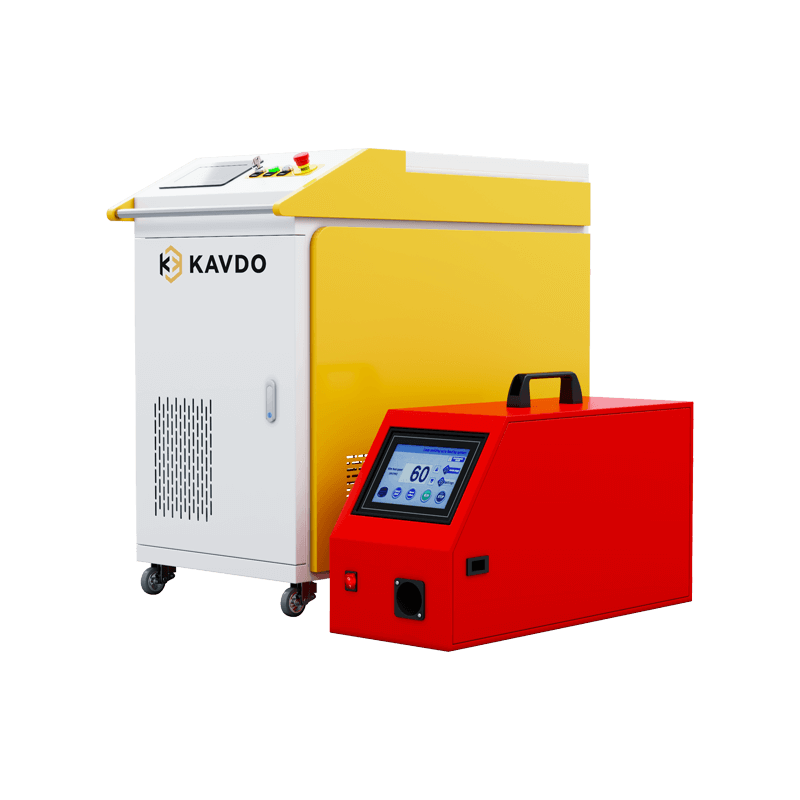
Resposta curta: as a practical guide for single-pass handheld fiber laser welding with good fit-up, a 1000W laser welds stainless and carbon steel up to about 2 mm, 1500W up to about 3 mm, 2000W up to about 4 mm, e 3000W up to about 5–6 mm. Aluminum needs roughly one power step more for the same thickness, and copper and brass need even more. Thicker sections are possible with beveled joints, filler wire and multiple passes. The charts below give thickness limits by material, starting parameters and tips for each power level.
Laser Welding Thickness Chart by Power
Typical single-pass penetration for butt and fillet welds with a handheld fiber laser welder and a tight joint gap (under about 10% of thickness):
| Material | 1000W | 1500W | 2000W | 3000W |
|---|---|---|---|---|
| Aço inoxidável | 0.5–2 mm | 0.5–3 mm | 0.5–4 mm | 0.5–6 mm |
| Carbon / mild steel | 0.5–2 mm | 0.5–3 mm | 0.5–4 mm | 0.5–5 mm |
| Aço galvanizado | 0.5–1.5 mm | 0.5–2.5 mm | 0.5–3 mm | 0.5–4 mm |
| Aluminum alloys | 0.5–1.5 mm | 0.5–2 mm | 0.5–3 mm | 0.5–4 mm |
| Latão | 0.5–1 mm | 0.5–1.5 mm | 0.5–2 mm | 0.5–3 mm |
| Cobre | – | 0.5–1 mm | 0.5–1.5 mm | 0.5–2.5 mm |
Typical values for planning. Actual penetration depends on the laser source, welding head, wobble settings, travel speed, joint design and fit-up. Always run test welds on your material.
Which Power Should You Choose?
| Typical work | Recommended power |
|---|---|
| Thin stainless products: kitchen equipment, cabinets, signage (0.5–2 mm) | 1000–1500W |
| General fabrication, enclosures, brackets, mixed steel and stainless up to 3 mm | 1500W |
| Thicker steel frames, aluminum parts, faster welding on 2–3 mm | 2000W |
| Steel up to 5–6 mm, aluminum 3–4 mm, high-speed production | 3000W |
More power also means higher welding speed on thin material. Many shops choose 1500W or 2000W as the best balance of capability and price.
Starting Parameters (Handheld, Stainless Steel)
| Espessura | Laser power | Wobble width | Filler wire | Shielding gas |
|---|---|---|---|---|
| 1 mm | ≈ 500–800 W | ≈ 2–3 mm | Not required with good fit-up | Argon or nitrogen, 15–20 L/min |
| 2 mm | ≈ 1000–1300 W | ≈ 2.5–3.5 mm | 0.8–1.0 mm wire for gaps | 15–20 L/min |
| 3 mm | ≈ 1400–1800 W | ≈ 3–4 mm | 1.0–1.2 mm wire | 15–25 L/min |
| 4 mm | ≈ 1800–2500 W | ≈ 3–4 mm | 1.0–1.2 mm wire | 20–25 L/min |
Start from the machine’s built-in process library, then fine-tune power and travel speed. For aluminum, increase power by roughly 30–50% and clean the oxide layer immediately before welding.
Shielding Gas
- Argon: universal; best for aluminum and a clean appearance.
- Nitrogen: lower cost; works well on stainless steel, giving bright welds.
- Avoid compressed air for quality welds: oxidation and porosity increase.
Joint Fit-Up Matters
A laser beam is very narrow. Without filler wire, the joint gap should be under about 10% of the thickness (≈ 0.1–0.2 mm on thin sheet). With wire feed, handheld lasers can bridge gaps of about 0.5–1 mm. Clean oil, paint and oxide from the joint area to prevent porosity.
Validate weld capacity using the joint rather than power alone
Confirm the alloy, actual thickness, joint orientation and approved process. Inspect penetration and the resulting joint under the qualified criteria before applying a stated machine capability to a production job.
Perguntas frequentes
How thick can a 1500W laser welder weld?
About 3 mm stainless or carbon steel in a single pass with good fit-up, and about 2 mm aluminum.
Can a handheld laser weld 6 mm steel?
A 3000W handheld laser can weld about 5–6 mm in one pass with a good joint. Thicker plate needs beveled joints and multiple passes, or a TIG/MIG process.
Is 2000W or 3000W better for aluminum?
For aluminum above 2–3 mm, 3000W gives more stable penetration. For thin aluminum sheet, 2000W is enough.
Do I need filler wire for laser welding?
Not for tight-fitting thin joints. Use wire when there are gaps, for fillet welds that need reinforcement, and for crack-sensitive aluminum alloys.
Related
Compare laser welding with conventional processes in handheld laser welder vs TIG vs MIG. KAVDO offers 1500W, 2000W e 3kW handheld laser welding machines, plus 3-in-1 weld/cut/clean models. Contact us for test welds on your parts.
