
Máquina laminadora de chapas de 3 rodillos frente a máquina laminadora de chapas de 4 rodillos: diferencias, precurvado y cómo elegir la más adecuada.


Respuesta corta: a 3-roll plate rolling machine is simpler and cheaper, and it is ideal for job shops rolling a variety of cylinders. Depending on the design, though, it leaves flat ends that must be pre-bent separately, and the plate often has to be turned over. A 4-roll plate rolling machine clamps the plate between the top and bottom rolls, pre-bends both ends without removing the plate, rolls in fewer passes, is easier to automate with CNC and is safer for less experienced operators. It costs more. Choose 4-roll for production, thick or high-value parts and CNC; choose 3-roll for flexible, lower-volume work and tight budgets.
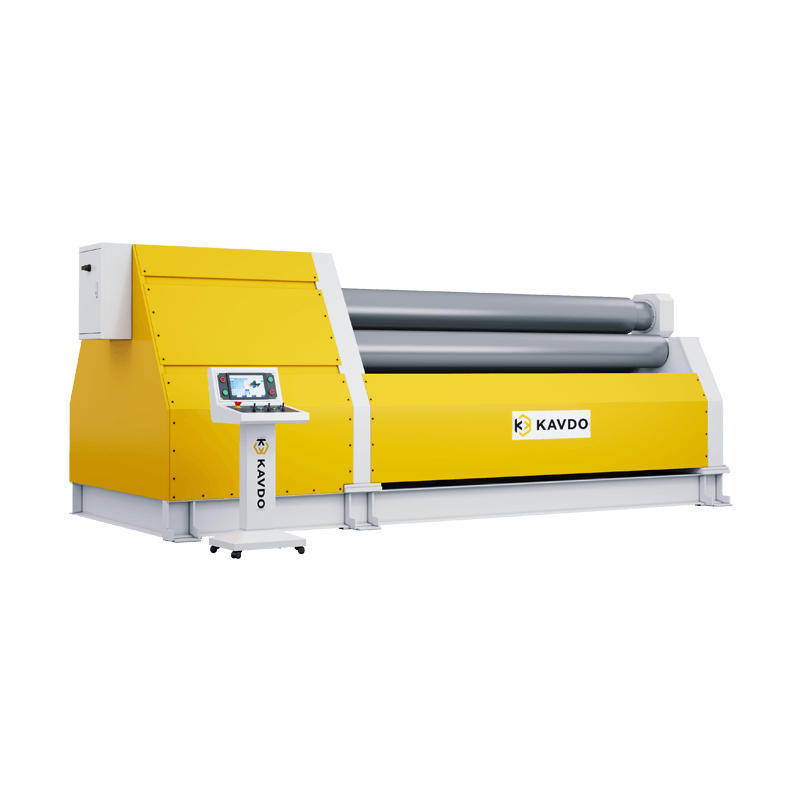
3-Roll vs 4-Roll: Comparison Table
| 3-roll | 4-roll | |
|---|---|---|
| Roll layout | One top roll, two bottom (or side) rolls | Top and bottom pinch rolls plus two side rolls |
| Pre-bending | Symmetrical: not possible; asymmetric and variable-geometry: yes, but usually by repositioning the plate | Both ends pre-bent in one setup |
| Residual flat ends | Larger (symmetrical: about half the bottom roll center distance) | Smallest, typically about 1–2 × thickness |
| Plate squaring | Manual | Plate is clamped and squared against the side roll |
| Cycle time | Longer; plate often turned or reinserted | Shorter; single loading |
| Operator skill | Higher | Lower; easier to program |
| CNC and automation | Possible | Best suited |
| Cones | Possible with conical roll tilt; skill-dependent | Easier with tilting side rolls |
| Price | Lower | Higher (often 1.5–2× a comparable 3-roll) |
Types of 3-Roll Machines
| Type | How it works | Pre-bending | Mejor para |
|---|---|---|---|
| Symmetrical (pyramid) | Top roll moves down between two fixed bottom rolls | No; ends need a press brake or pre-bending tool | Light gauge, budget, simple cylinders |
| Asymmetric (initial pinch) | Top and one bottom roll pinch; the side roll bends | Yes; turn the plate to pre-bend the other end | Small to medium shops, ducts, tanks |
| Variable geometry (double pinch / hydraulic upper roll universal) | Bottom rolls move horizontally; top roll vertically | Yes, without turning the plate | Thick plate, heavy fabrication |
See KAVDO’s three-roll, asymmetric y four-roll plate benders.
Why Flat Ends Matter
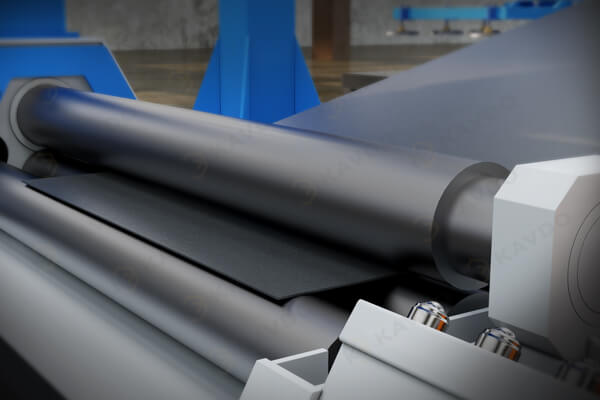
A plate can only be bent where it is supported by rolls on both sides. Without pre-bending, the leading and trailing ends stay flat, leaving a flat spot (“peaking”) at the longitudinal seam. That causes poor fit-up for welding and out-of-roundness. 4-roll and pre-bending 3-roll machines reduce the flat end to about 1–2 times the plate thickness. See plate rolling defects.
How to Choose
| Tu situación | Recomendación |
|---|---|
| Thin sheet (≤ 3 mm), ducts, small budget | Symmetrical 3-roll (mechanical or hydraulic) |
| Varied cylinders up to medium thickness, job shop | Asymmetric 3-roll or 4-roll |
| Thick plate, wind towers, pressure vessels | Variable-geometry 3-roll or heavy 4-roll |
| Repeated production, CNC, less skilled operators | 4-roll with CNC |
| Frequent cones | 4-roll with tilting side rolls and a cone-rolling device |
Capacity: Reading the Rating
Plate rolls are rated as thickness × width (for example 20 × 2500 mm) for a given material yield strength (often 235–245 MPa) and a minimum diameter, usually about 1.2–1.5 times the top roll diameter at full capacity. For other materials, an approximate equivalent thickness is t × √(245 ÷ yield strength). Stainless steel and high-strength steel therefore reduce capacity. Always check the manufacturer’s capacity chart, especially for pre-bending, which needs more force than rolling.
Need the blank length or shell weight for a cylinder? Use the plate rolling calculator.
Compare three-roll and four-roll layouts on a real shell
Use a recurring shell drawing and the actual material. Compare loading, handling, pre-bending, straight ends and the inspected shell geometry on the proposed configurations.
Preguntas frecuentes
What is the main advantage of a 4-roll plate rolling machine?
It clamps the plate and pre-bends both ends in a single setup, giving smaller flat ends, faster cycles and easier CNC operation.
Can a 3-roll machine pre-bend?
Asymmetric and variable-geometry 3-roll machines can. A symmetrical (pyramid) 3-roll machine cannot, so its ends must be pre-bent another way.
Is a 4-roll machine worth the extra cost?
For production rolling, thick plate and CNC, usually yes: shorter cycles and less rework pay back the difference. For occasional rolling of thin sheet, a 3-roll machine is enough.
Get a Plate Rolling Recommendation
KAVDO construye máquinas de enrollado de placas in 3-roll, asymmetric and 4-roll designs. Send us your maximum thickness, width, minimum diameter and material through the contact page. See also how to roll a cone.
