
Defectos en el laminado de chapas: deformación en forma de barril, reloj de arena, extremos planos y torsión: causas y soluciones.

Respuesta corta: most plate rolling defects come from four causes: roll deflection (barrel or hourglass shapes), misalignment (twist, taper and helix), missing pre-bend (flat ends and peaking at the seam) and wrong settings or material (out-of-round, cracking, surface marks). Identify the shape of the defect with a template, use the table below to find the cause, then correct the roll setting, crowning, plate squaring or pre-bending.
Plate Rolling Defects: Causes and Fixes
| Defect | What it looks like | Cause | Fix |
|---|---|---|---|
| Barrel shape | Middle of the shell has a larger radius than the ends | Rolls deflect under load (not enough crowning), plate near full capacity | Use machine crowning or more roll support; reduce thickness or width relative to capacity; roll in more passes |
| Hourglass (waist) | Middle tighter than the ends | Too much crowning for this plate width or thickness, or rolling a narrow plate on a crowned roll | Reduce crowning; use the correct roll for narrow parts |
| Flat ends / peaking at the seam | Flat zone or “peak” where the seam closes | No pre-bending, or pre-bend too short | Pre-bend both ends; on symmetrical 3-roll machines pre-bend in a press brake |
| Twist / helix | Seam edges don’t meet; shell spirals | Plate not square to the rolls when entering | Square the plate against the side roll or a stop before rolling |
| Taper (unintended cone) | One end diameter larger than the other | Rolls not parallel, unequal hydraulic positions on each side | Check and calibrate roll parallelism and position sensors |
| Out-of-round (oval) | Diameter varies around the circumference | Uneven feed, inconsistent roll setting between passes | Roll in several smaller passes; make a final rounding pass after tacking |
| Cracking on the outside | Cracks along the rolling direction | Radius too tight for thickness and material, cold or brittle material, edge defects | Respect minimum radius (often ≥ 10–20 × t for high-strength steel), warm plate in cold conditions, grind cut edges |
| Surface marks, scratches | Indentations, scale pressed into the surface | Dirty rolls, scale, chips | Clean rolls and plate; use protective film for stainless and aluminum |
| Spring-out (diameter too large) | Shell opens after release | Springback, especially high-strength steel and stainless | Roll slightly tighter, then check; increase passes |
Barrel vs Hourglass: Why It Happens
The top roll is supported only at its ends. Under load, it bends like a beam, so the middle of the plate receives less bending force and ends up with a larger radius: a barrel. Machines compensate with roll crowning (a slightly larger roll diameter in the middle) or with hydraulic support rolls. If you roll plate much thinner or narrower than the crowning was designed for, you get the opposite effect: an hourglass. For best results, roll plates close to the machine’s design range, or use a machine with adjustable support.
Preventing Flat Ends
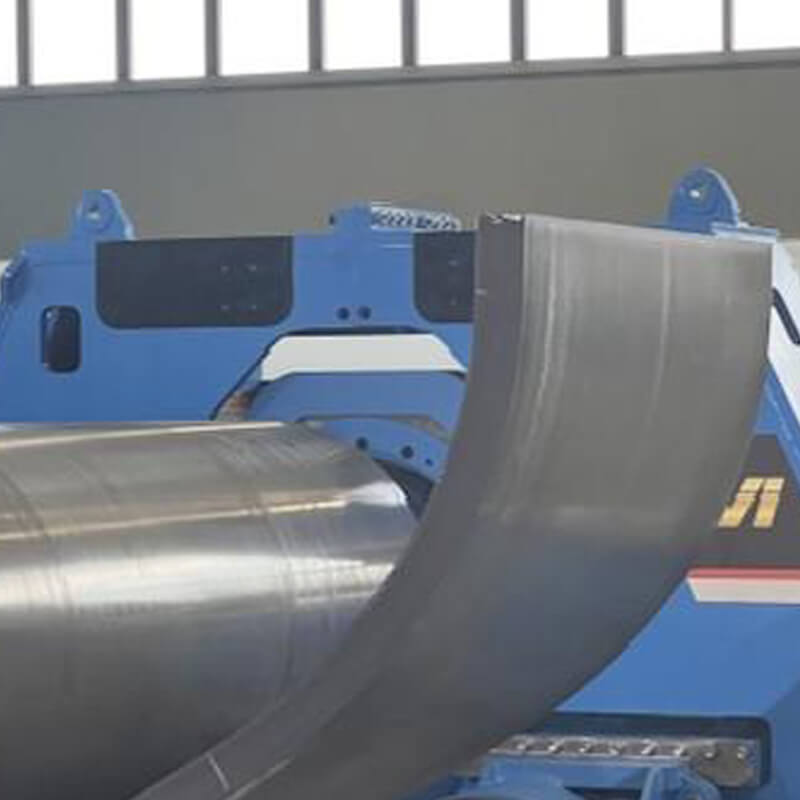
A plate can only bend where rolls support it on both sides, so the ends stay flat unless they are pre-bent. Typical residual flats:
| Máquina | Pre-bending | Typical residual flat |
|---|---|---|
| Symmetrical 3-roll | No | About half the bottom roll center distance |
| Asymmetric / variable-geometry 3-roll | Yes (plate repositioned) | About 1.5–3 × thickness |
| 4-roll | Yes (single setup) | About 1–2 × thickness |
See 3-roll vs 4-roll plate rolling machines.
Checklist Before Rolling
- Confirm thickness, width, material yield strength and minimum diameter are within the machine’s capacity chart.
- Cut the plate square, and grind flame-cut or sheared edges on high-strength material.
- Clean the rolls and the plate.
- Square the plate against the side roll or a stop.
- Pre-bend both ends.
- Roll in several passes; check with templates at both ends and the middle.
- For cones, follow the cone rolling guide.
Need the blank length or shell weight for a cylinder? Use the plate rolling calculator.
Identify the rolling defect by where the contour changes
Record whether the variation appears along the shell, near the ends or around its circumference. Use the same drawing and measurement positions for each test and document material and support before evaluating the cause.
Preguntas frecuentes
Why is my rolled cylinder bigger in the middle?
The top roll deflects under load, so the middle is bent less (barrel shape). Use crowning or roll support, or roll closer to the machine’s design range.
How do I stop flat spots at the seam?
Pre-bend both plate ends before rolling, on a 4-roll machine, a pre-bending 3-roll machine or a press brake.
Why does my shell spiral (helix)?
The plate entered the rolls at an angle. Square it against the side roll or a stop before rolling.
Need a Plate Roll That Avoids These Problems?
KAVDO construye four-roll, asymmetric y three-roll plate benders. Tell us your thickness, width, minimum diameter and material through the contact page.
