
كيفية لفّ طبق على شكل أسطوانة: دليل خطوة بخطوة

إجابة قصيرة: to roll a plate into a cylinder: (1) calculate the blank length from the mean diameter (π × (outside diameter − thickness)), (2) cut and square the plate, (3) pre-bend both ends, (4) roll in several passes, tightening the rolls a little each time and checking with a template, (5) close and tack the seam, and (6) make a final rounding pass. The steps below work on 3-roll and 4-roll machines; the differences are noted.
Before You Start: Check Capacity
- Thickness × width: within the machine rating for your material. Ratings usually assume mild steel with a yield strength of about 235–245 MPa; stronger steels reduce capacity (approximate equivalent thickness = t × √(245 ÷ yield strength)).
- Minimum diameter: usually about 1.2–1.5 × the top roll diameter at full capacity.
- Pre-bending capacity: usually lower than rolling capacity; check the chart.
Step 1: Calculate the Blank Length
استخدم mean diameter (the neutral axis), not the inside or outside diameter:
Blank length = π × (Doutside − t) أو π × (Dinside + t)
Example: 1,000 mm outside diameter, 10 mm plate: π × 990 = 3,110 mm. Subtract the weld root gap if your joint design has one. To skip the math, use the plate rolling calculator for blank length and shell weight.
Step 2: Cut and Square the Plate
Cut the plate accurately, with square corners. Grind flame-cut or sheared edges on high-strength steel to prevent cracks. Clean the plate and rolls; scale and chips cause marks.
Step 3: Pre-Bend Both Ends
| آلة | How to pre-bend |
|---|---|
| 4-roll | Clamp the plate between the top and bottom rolls, raise the side roll to pre-bend the leading edge, then roll through and pre-bend the trailing edge, all in one setup |
| Asymmetric 3-roll | Pinch the plate, pre-bend one end with the side roll, then turn the plate to pre-bend the other end |
| Variable-geometry 3-roll | Move the bottom rolls to pre-bend each end without turning the plate |
| Symmetrical 3-roll | Cannot pre-bend; pre-bend the ends on a press brake or with a pre-bending tool |
Without pre-bending, the ends stay flat and the seam “peaks”. See plate rolling defects.
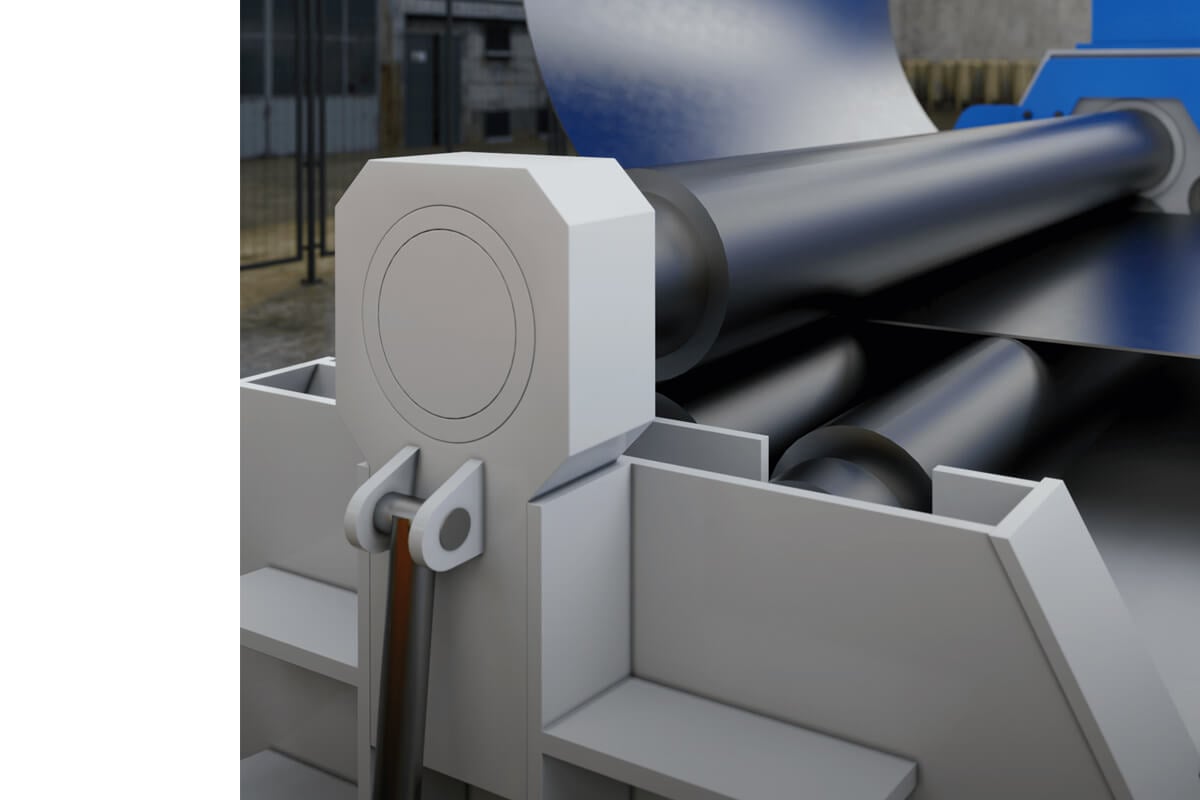
Step 4: Square the Plate and Roll in Passes
- Square the plate against the side roll or a stop so it enters exactly perpendicular to the rolls; otherwise the shell will twist.
- Set the rolls for a radius slightly larger than the final one and make the first pass.
- Check the radius with a template at both ends and the middle.
- Tighten the rolls a little and roll again. Repeat until the radius is right, allowing for springback.
- For thick plate, roll more passes with smaller adjustments.
Step 5: Close and Tack the Seam
When the edges meet, align them and tack-weld the seam while the shell is still in the rolls (or supported by the top roll support on larger machines).
Step 6: Final Rounding
After tacking (or after welding, for heavy shells), make one or two final passes to correct out-of-roundness and remove any remaining peaking at the seam.
Quick Troubleshooting
| Problem | Fix |
|---|---|
| Flat ends at the seam | Pre-bend both ends |
| Shell is bigger in the middle (barrel) | Roll deflection: use crowning or support; stay within capacity |
| Twisted shell, edges don’t meet | Square the plate before rolling |
| One end larger than the other | Check roll parallelism |
Confirm cylinder dimensions at more than one section
Mark the ends and middle, measure diameters or gaps at consistent positions and compare with the drawing. Keep plate orientation, process record and inspection method for repeat cylinders.
أسئلة شائعة
How do you calculate the plate length for a cylinder?
Multiply π by the mean diameter: π × (outside diameter − thickness).
Can I roll a plate without pre-bending?
Yes, but the ends will stay flat over a length of up to about half the bottom roll center distance, giving a poor seam. Pre-bending is strongly recommended.
How many passes does it take to roll a plate?
Thin plate may need 2–3 passes; thick or high-strength plate often needs 5 or more, with small adjustments each time.
How do I roll a cone instead?
Cones need a fan-shaped blank and tilted rolls. See how to roll a cone.
Plate Rolling Machines from KAVDO
Choose between 3-roll and 4-roll machines, or browse KAVDO’s آلات لف الصفائح. Send your thickness, width, diameter and material through the صفحة الاتصال.
