
Achieving Perfection: A Press Brake Case Study for Stainless Steel Bending Precision and Repeatability


Introduction: The Challenge of Stainless Steel Precision
In the modern landscape of high-end metal fabrication, stainless steel remains one of the most challenging yet rewarding materials to process. Its high tensile strength, work-hardening characteristics, and aesthetic requirements demand a level of accuracy that standard machinery often struggles to maintain. This article explores a comprehensive Press Brake Case Study for Stainless Steel Bending Precision and Repeatability, focusing on how HARSLE’s advanced hydraulic systems solve common production bottlenecks.
For many manufacturers, the primary hurdle in stainless steel fabrication is the material’s ‘springback’ effect. Because stainless steel has a higher yield strength than mild steel, it tends to return toward its original shape after the bending force is released. Achieving consistent angles across a production run of hundreds or thousands of parts requires more than just a powerful machine; it requires a sophisticated control system capable of real-time adjustments.
This case study examines a mid-sized fabrication shop that struggled with inconsistent bend angles in their architectural stainless steel panels. By integrating a HARSLE CNC press brake, the facility was able to transform its production output. We will analyze the technical specifications, the selection process, and the operational strategies that led to a 40% increase in production efficiency and a near-zero scrap rate.
Understanding the nuances of stainless steel bending is essential for any shop aiming to compete in aerospace, medical, or high-end architectural markets. Precision is not merely a quality metric; it is a financial necessity. When parts fail to meet tolerance specifications, the cost of rework and material waste can quickly erode profit margins. This guide provides the technical roadmap for achieving repeatable results in every bend.

Key Considerations for Stainless Steel Bending
When approaching a project involving stainless steel, the first consideration must be the material’s mechanical properties. Unlike carbon steel, stainless steel requires significantly higher bending forces. If the press brake is not rated for the specific thickness and grade of the stainless steel being used, the machine frame may deflect, leading to inconsistent bend angles across the length of the part.
Another critical factor is the tooling selection. Stainless steel is abrasive and prone to galling. Using standard tooling can result in surface marring, which is unacceptable for polished or brushed stainless steel finishes. Fabricators must utilize high-quality, hardened tooling with specific radii to minimize stress concentrations and prevent surface damage during the bending process.
The ‘springback’ factor mentioned earlier must be compensated for through the CNC controller. Modern HARSLE press brakes utilize advanced algorithms that calculate the required over-bend angle based on the material thickness, tensile strength, and the desired final angle. This automation removes the guesswork from the operator, ensuring that every piece is bent to the exact specification regardless of minor variations in material batches.
Finally, environmental and maintenance factors play a role. Stainless steel bending generates significant heat and stress on the machine’s hydraulic components. Regular maintenance, including oil temperature monitoring and hydraulic system calibration, is essential to maintain the repeatability of the machine over long production shifts. A machine that is not properly maintained will lose its precision as the hydraulic fluid thins or as mechanical tolerances drift.
Technical Details: The HARSLE Advantage
In our featured case study, the client transitioned from a legacy mechanical press brake to a HARSLE CNC hydraulic press brake equipped with a multi-axis backgauge system. The technical leap was significant. The new machine featured a synchronized Y1/Y2 axis control, which ensures that the ram remains perfectly parallel to the bed throughout the entire stroke, even under off-center loading conditions.
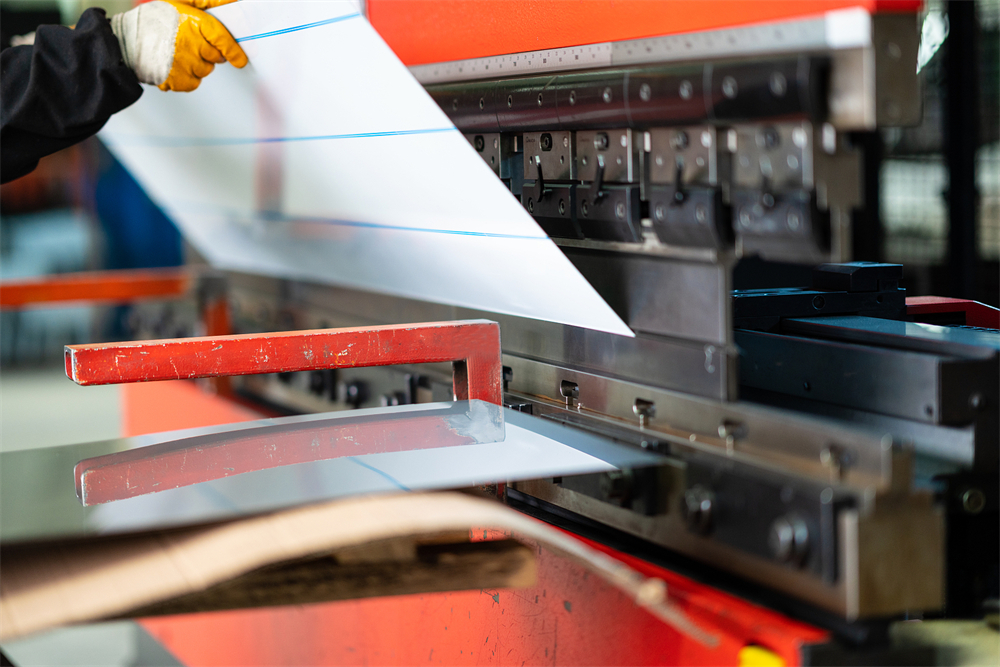
The backgauge system is the unsung hero of repeatability. By utilizing a high-precision, servo-driven backgauge, the operator can position the stainless steel sheet with micron-level accuracy. In the case study, the client utilized a 6-axis backgauge, allowing for complex, multi-bend parts to be processed in a single handling cycle. This reduced the time spent on manual measurements and repositioning, which are the primary sources of human error.
Furthermore, the integration of a laser angle measurement system provided real-time feedback to the CNC controller. As the punch enters the die, the laser monitors the bend angle and instructs the hydraulic system to adjust the stroke depth instantaneously. This ‘active bending’ technology is the gold standard for achieving high-precision results in stainless steel, as it accounts for material thickness variations that would otherwise cause angle deviations.
The hydraulic system itself was optimized for high-pressure performance. HARSLE’s proprietary valve technology allows for smooth, controlled movement, preventing the ‘jerking’ motion that can occur when bending high-strength materials. This stability is crucial for maintaining the structural integrity of the stainless steel and ensuring that the bend line remains crisp and clean, without the micro-cracking that can occur with inferior bending equipment.
Selection Advice: Choosing the Right Equipment
Selecting the right press brake for stainless steel bending is a strategic investment. The first step is to perform a thorough analysis of your current and future production needs. Do not simply buy a machine that handles your current maximum thickness; consider the future growth of your product line. If you anticipate moving into thicker stainless steel or more complex geometries, invest in a machine with higher tonnage and more axes of control.
Consider the software integration capabilities. A press brake is only as good as the software driving it. Look for systems that support offline programming, allowing your engineers to simulate the bending process before the material ever touches the machine. This ‘virtual bending’ capability identifies potential collisions and calculates the optimal bending sequence, significantly reducing setup time and material waste.
Evaluate the manufacturer’s support network. Stainless steel bending is a technical discipline that requires expert guidance. HARSLE provides comprehensive training and remote diagnostic support, ensuring that your team can troubleshoot issues quickly and maintain the machine’s precision over its entire service life. A machine is a long-term asset; the partnership with the manufacturer is just as important as the hardware itself.
Finally, look for modularity in the machine design. As your business evolves, you may need to add specialized tooling, robotic loading systems, or advanced safety features. A machine that is designed with an open architecture allows for these upgrades, protecting your initial investment and ensuring that your fabrication capabilities remain at the cutting edge of the industry.
FAQ: Common Questions on Stainless Steel Bending
- Why does stainless steel spring back more than mild steel? Stainless steel has a higher yield strength, meaning it requires more force to deform and has a greater tendency to return to its original shape once that force is removed.
- How can I prevent surface damage on polished stainless steel? Use protective films during the bending process and ensure your tooling is clean and free of debris. Using urethane film or specialized non-marring tooling inserts can also help.
- What is the benefit of Y1/Y2 synchronization? It ensures the ram remains perfectly parallel to the bed, preventing uneven bends across the length of the part, which is critical for long stainless steel panels.
- How often should I calibrate my press brake for precision? Calibration frequency depends on usage, but for high-precision shops, a quarterly check of the backgauge accuracy and ram parallelism is recommended.
- Can a press brake be retrofitted for better precision? While some upgrades are possible, it is generally more cost-effective to invest in a modern CNC press brake designed for high-precision applications from the ground up.
Conclusion: Elevating Your Fabrication Standards
The Press Brake Case Study for Stainless Steel Bending Precision and Repeatability highlights a fundamental truth in modern manufacturing: precision is a result of integrated technology, proper material handling, and a commitment to quality. By moving away from legacy systems and embracing the advanced capabilities of HARSLE CNC press brakes, the featured fabrication shop was able to overcome the inherent challenges of stainless steel and achieve a level of consistency that set them apart in their market.
Achieving repeatability in stainless steel bending is not a one-time task but a continuous process of optimization. From selecting the right tonnage and tooling to leveraging real-time laser measurement and sophisticated CNC software, every step in the workflow contributes to the final quality of the product. As the demand for high-quality stainless steel components continues to grow, shops that invest in the right equipment and expertise will find themselves at a significant competitive advantage.
We encourage all fabricators to review their current bending processes and identify areas where precision can be improved. Whether it is through upgrading your machinery, refining your tooling selection, or investing in operator training, the path to perfection is paved with deliberate, data-driven decisions. HARSLE remains dedicated to providing the tools and support necessary to help you achieve your production goals and maintain the highest standards of metal fabrication excellence.


