Hydraulic vs CNC Press Brake: Key Differences for Fabrication Efficiency


Technical Overview: Understanding the Evolution of Bending Technology
In the modern metal fabrication landscape, the choice between a traditional hydraulic (often referred to as NC or torsion bar) press brake and a high-precision CNC (Computer Numerical Control) press brake is one of the most significant decisions a shop owner can make. At HARSLE, we recognize that this choice directly impacts your production throughput, part accuracy, and long-term profitability. While both machines utilize hydraulic power to drive the ram, the method of control and synchronization differs fundamentally.
A traditional hydraulic press brake typically utilizes a mechanical torsion bar to link both ends of the ram. This physical connection ensures that the two cylinders move in unison. However, this system is inherently limited by mechanical tolerances and the inability to compensate for frame deflection under heavy loads. It is a robust, cost-effective solution for simple bending tasks where high-speed repetition of the same angle is the primary goal. For many workshops, the ‘Hydraulic Vs CNC Press Brake: Key Differences Fabrication Efficiency’ debate begins here: simplicity versus sophistication.
Conversely, a CNC press brake—specifically the electro-hydraulic synchronous type—replaces the mechanical torsion bar with advanced electronics. Each cylinder is controlled by its own independent proportional valve and monitored by high-resolution linear encoders. This allows the CNC controller to adjust the position of each cylinder thousands of times per second, ensuring perfect parallelism even when bending off-center. This level of control is the cornerstone of modern fabrication efficiency, allowing for complex, multi-step bending sequences without manual intervention.
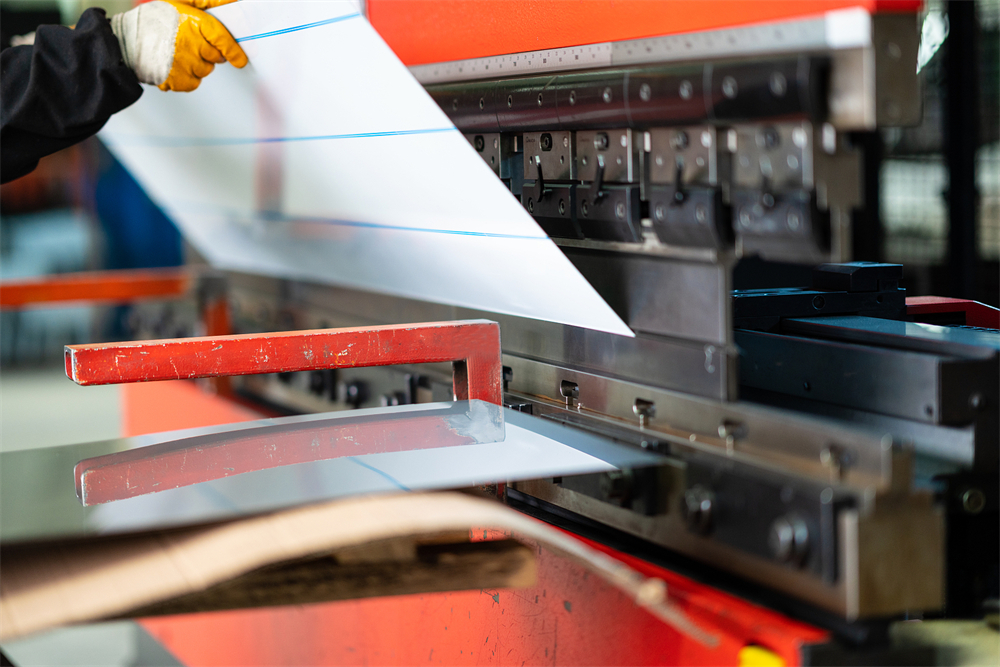
The integration of CNC technology also introduces the concept of ‘axes.’ While a basic hydraulic machine might only control the depth of the ram (Y-axis) and the position of the backgauge (X-axis), a CNC machine can control Y1, Y2 (independent cylinder control), X, R (height), Z1, and Z2 (lateral movement). This multi-axis capability drastically reduces setup times, as the machine automatically adjusts for different bend lengths and angles within a single program.
Core Parameters: Defining Performance and Capability
When evaluating ‘Hydraulic Vs CNC Press Brake: Key Differences Fabrication Efficiency,’ one must look closely at the core parameters that define machine performance. The first and most obvious is Tonnage. Tonnage represents the maximum pressure the machine can exert. While both types of machines can offer high tonnage, CNC machines utilize that force more intelligently through ‘crowning’ systems. Crowning compensates for the natural deflection of the machine bed, ensuring that the bend angle remains consistent across the entire length of the workpiece.
Bending Length is another critical parameter. Standard machines range from 1.2 meters to over 6 meters. In a traditional hydraulic machine, bending a long piece often results in a ‘canoe effect’ where the center of the bend is less acute than the ends. CNC machines solve this through hydraulic or mechanical crowning tables integrated into the lower bolster. This feature is a primary driver of fabrication efficiency, as it eliminates the need for manual shimming—a time-consuming process common in older hydraulic shops.
Backgauge Speed and Precision are where CNC machines truly outshine their NC counterparts. A CNC backgauge moves at significantly higher speeds and with micron-level precision. In a high-volume environment, the seconds saved during each backgauge movement accumulate into hours of gained productivity over a week. Furthermore, the ability of the backgauge to move in the R-axis (up and down) allows for bending flanges with different heights without stopping to manually adjust the gauge fingers.
Finally, the Controller Interface serves as the brain of the operation. Modern HARSLE CNC press brakes feature touch-screen interfaces (like Delem or Cybelec) that allow for 2D or 3D visualization of the part. Operators can simulate the bending sequence to check for collisions before the first piece of metal is even touched. This ‘right-first-time’ approach is the ultimate metric for fabrication efficiency, reducing scrap and maximizing material utilization.
Calculation Method: Determining the Right Force for the Job
To achieve maximum efficiency, engineers must accurately calculate the required bending force. The standard formula for air bending (the most common method in CNC fabrication) is essential for preventing machine overload and ensuring part quality. The formula is generally expressed as:
P = (650 * S² * L) / V
- P: Bending force in Kilonewtons (kN).
- S: Material thickness in millimeters (mm).
- L: Bending length in meters (m).
- V: V-die opening width (typically 8 to 10 times the material thickness).
For example, if you are bending 4mm thick mild steel over a length of 2 meters using a 32mm V-die, the calculation would be: (650 * 4² * 2) / 32 = 650 kN (or approximately 65 tons). It is crucial to note that stainless steel requires roughly 50% more pressure than mild steel due to its higher tensile strength. A CNC press brake allows the operator to input these variables directly into the controller, which then automatically calculates the required pressure and adjusts the Y-axis depth accordingly.
Another critical calculation is the Minimum Flange Length (b). To ensure the material does not slip into the V-opening before the bend is completed, the flange must be long enough to bridge the die. The general rule is b = 0.7 * V. Understanding these calculations is vital for fabrication efficiency because it prevents the production of ‘impossible’ parts that lead to machine downtime and tool damage.
Parameter Table: Hydraulic (NC) vs. CNC Comparison
| Feature | Hydraulic (NC Torsion Bar) | CNC (Electro-Hydraulic) |
|---|---|---|
| Synchronization | Mechanical Torsion Bar | Independent Y1/Y2 Proportional Valves |
| Accuracy | +/- 0.1mm (Manual Adjustment) | +/- 0.01mm (Automated) |
| Crowning | Manual Shimming Required | Automatic Hydraulic/Mechanical Crowning |
| Backgauge Axes | Typically 1-2 (X, R manual) | Up to 6+ (X, R, Z1, Z2, X-Prime) |
| Setup Time | High (Manual tool & depth setting) | Low (Program loading & auto-calibration) |
| Complexity | Simple Bends Only | Complex, Multi-step Sequences |
| Energy Efficiency | Standard (Constant motor run) | High (Servo-hybrid options available) |
Common Engineering Mistakes in Press Brake Operation
One of the most frequent mistakes in metal fabrication is incorrect V-die selection. Using a V-die that is too narrow for the material thickness increases the required tonnage exponentially, leading to excessive wear on the machine and potential cracking of the workpiece. Conversely, a V-die that is too wide results in poor angle accuracy and a larger internal radius than specified. CNC systems often include tool libraries that warn the operator if the selected die is inappropriate for the programmed bend.
Another common error is ignoring material springback. Every metal has a degree of elasticity; when the pressure is released, the metal ‘springs back’ slightly toward its original shape. In a manual hydraulic machine, the operator must guess the over-bend required and adjust the depth manually. In a CNC system, springback compensation is often built into the material database, or can be measured in real-time using laser angle-measuring systems, ensuring the final part is perfect every time.

Neglecting hydraulic oil maintenance is a mistake that affects both NC and CNC machines but is more critical for the sensitive proportional valves of a CNC system. Contaminated oil can cause the valves to stick or respond sluggishly, leading to a loss of synchronization between Y1 and Y2. Regular filter changes and oil quality checks are non-negotiable for maintaining fabrication efficiency. Furthermore, failing to warm up the machine in cold environments can lead to inconsistent bends during the first hour of production.
Finally, many shops fail to utilize offline programming. In a traditional setup, the machine sits idle while the operator figures out the bending sequence. With a CNC press brake, the engineering department can create the program on a PC and transfer it via USB or network. This allows the machine to keep running while the next job is being prepared, significantly boosting the overall equipment effectiveness (OEE).
Selection Checklist: Choosing the Right Machine for Your Shop
Choosing between a hydraulic and CNC press brake requires a clear understanding of your current needs and future growth. Use this checklist to guide your decision:
- Material Variety: Do you work with a wide range of thicknesses and types? (CNC is better for frequent changes).
- Part Complexity: Are your parts simple 90-degree bends or complex shapes with multiple angles? (CNC is required for complexity).
- Precision Requirements: Does your client demand tolerances tighter than +/- 0.5mm? (CNC is essential for high precision).
- Production Volume: Are you running small batches of many different parts or thousands of the same part? (CNC excels at small-batch flexibility).
- Operator Skill Level: Do you have highly experienced ‘old-school’ operators, or are you looking for a system that is easier for newer staff to learn? (CNC interfaces are more intuitive for the modern workforce).
- Budget vs. ROI: While a CNC machine has a higher upfront cost, the reduction in setup time and scrap often leads to a faster Return on Investment (ROI) in high-production environments.
Frequently Asked Questions (FAQ)
1. Is a CNC press brake always faster than a hydraulic NC press brake?
In terms of raw cycle speed for a single bend, they may be similar. However, in terms of ‘fabrication efficiency’—which includes setup, tool changes, and multi-bend sequences—a CNC press brake is significantly faster. It eliminates the ‘trial and error’ phase of setup.
2. Can I upgrade my old hydraulic press brake to CNC?
While some retrofitting kits exist for backgauges, converting a torsion-bar hydraulic machine to a full electro-hydraulic synchronous CNC machine is usually not cost-effective. The fundamental hydraulic architecture is different. It is generally better to invest in a new HARSLE CNC system.
3. What is ‘crowning’ and why does it matter for efficiency?
Crowning is the process of compensating for the deflection of the machine’s frame under load. Without it, the middle of a long bend will be ‘flatter’ than the ends. CNC machines automate this, ensuring the part is straight without the operator having to manually place paper or metal shims under the die.
4. How many axes do I really need?
For most standard fabrication, a 4-axis machine (Y1, Y2, X, R) is the ‘sweet spot’ for efficiency. If you do a lot of tapered bending or work with parts of varying widths, Z1 and Z2 (lateral movement of fingers) become very beneficial.
5. Does a CNC press brake require more maintenance?
It requires *different* maintenance. While the mechanical components are similar, the electronic systems and proportional valves require clean hydraulic oil and a stable power supply. However, the self-diagnostic capabilities of a CNC controller often make troubleshooting faster than on a manual machine.
6. What material thickness can HARSLE press brakes handle?
HARSLE offers a wide range of machines, from light-duty 30-ton models for thin electronics enclosures to heavy-duty 1000+ ton machines for shipbuilding and construction. The efficiency of the CNC system scales with the tonnage, providing even greater benefits on large, expensive workpieces where mistakes are costly.