How to Select the Right Press Brake for Stainless Steel, Carbon Steel, and Aluminum


Technical Overview: Understanding Material Dynamics in Metal Bending
Selecting the right press brake is not a one-size-fits-all decision. The mechanical properties of the material being processed—specifically stainless steel, carbon steel, and aluminum—dictate the machine’s required specifications. In the world of metal fabrication, the interaction between the machine’s force and the material’s resistance is governed by yield strength, tensile strength, and ductility. For instance, carbon steel is often considered the industry baseline, but when a fabricator transitions to stainless steel or high-grade aluminum, the physical demands on the press brake change significantly.
Stainless steel, particularly the 300 series, exhibits high work-hardening rates and significantly higher yield strength than mild steel. This means that for the same thickness, a stainless steel sheet requires approximately 50% to 60% more pressure to bend. Conversely, aluminum is much softer but presents its own set of challenges, such as a tendency to crack if the bend radius is too tight or the material grain is not considered. Understanding these nuances is the first step in ensuring that your HARSLE press brake performs efficiently without premature wear or structural failure.
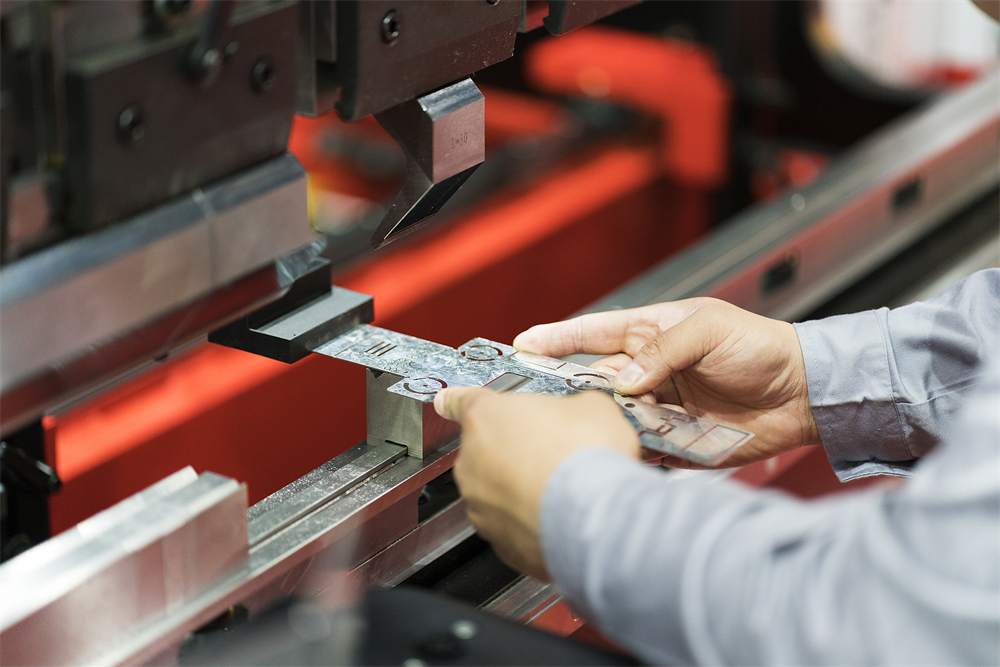
Furthermore, the concept of springback—the tendency of a metal to return to its original shape after the bending force is removed—varies wildly across these materials. Carbon steel has a predictable springback of about 0.5 to 1 degree. Stainless steel can spring back by as much as 3 to 10 degrees depending on the alloy and thickness. Aluminum also exhibits significant springback, often requiring specialized CNC compensation. Therefore, selecting a press brake involves more than just picking a tonnage; it requires a deep dive into the machine’s control systems, frame rigidity, and tooling compatibility.
Core Parameters for Press Brake Selection
1. Tonnage (Bending Force)
Tonnage is the most critical parameter. It represents the maximum pressure the press brake can exert. If you underestimate the tonnage required for stainless steel, you risk stalling the machine or damaging the hydraulic system. HARSLE machines are designed with a safety margin, but operating at the limit of a machine’s capacity for extended periods will reduce its lifespan. Always calculate your maximum required tonnage based on your thickest and hardest material, then add a 20% safety buffer.
2. Bending Length and Distance Between Uprights
The bending length refers to the maximum width of the sheet metal the machine can handle. However, fabricators must also consider the distance between the side frames (uprights). If you are bending a long part that needs to pass through the machine, the distance between uprights is more important than the total bed length. For deep box bending or complex geometries, ensure the throat depth is sufficient to accommodate the flange height without interference.
3. CNC Control Systems and Precision
Modern fabrication demands high precision. For materials like aluminum and stainless steel, where springback is a major factor, a high-end CNC system (such as Delem DA-53T or DA-66T) is essential. These systems can automatically calculate the required depth of the punch (Y-axis) to compensate for material properties. They also manage the backgauge (X, R, Z1, Z2 axes) to ensure consistent part dimensions across large production runs.
4. Crowning Systems (Deflection Compensation)
When a press brake applies pressure, the bed and the ram naturally deflect or “bow” slightly in the center. This results in a “canoe effect” where the bend angle in the middle of the sheet is different from the ends. For long-bed machines (over 2.5 meters), a crowning system—either hydraulic or mechanical—is mandatory to ensure a uniform angle across the entire length of the workpiece. This is especially vital for stainless steel, where even minor deviations are highly visible.
Calculation Method: Determining the Required Tonnage
The standard formula for calculating bending force (P) for mild steel is: P = (650 * S² * L) / V. In this formula, S is the material thickness in millimeters, L is the length of the bend in meters, and V is the V-die opening width. The V-die opening is typically 8 times the material thickness (V=8S) for standard applications.
When switching materials, you must apply a multiplier to this baseline:
- Carbon Steel (Mild Steel): Multiplier = 1.0. This is the standard reference point.
- Stainless Steel: Multiplier = 1.5 to 2.0. Because of its higher tensile strength, you need significantly more force. For example, if a 4mm mild steel plate requires 100 tons, a 4mm stainless steel plate may require 150 to 170 tons.
- Aluminum: Multiplier = 0.4 to 0.6. Aluminum requires less force, but you must use a larger V-die opening to prevent cracking, which in turn changes the calculation dynamics.
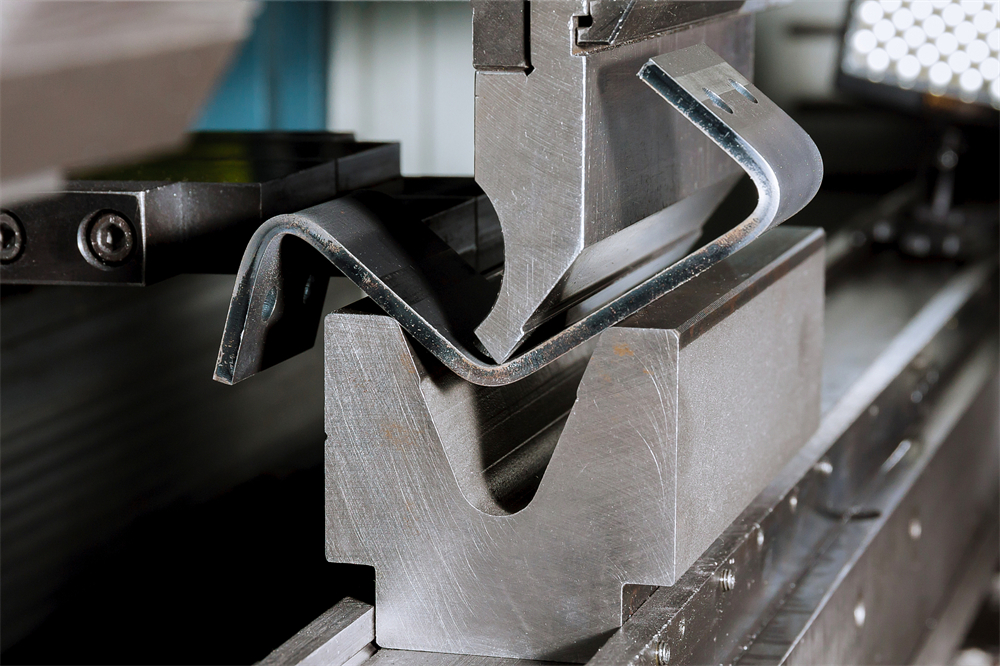
It is also important to consider the “K-factor” and the minimum bend radius. For aluminum, the minimum bend radius is often larger than for steel. If you attempt to bend aluminum with a sharp punch, the outer surface will stretch beyond its limit and crack. Therefore, the choice of tooling is just as important as the tonnage calculation itself.
Parameter Table: Material Thickness vs. V-Opening vs. Tonnage
The following table provides a general guideline for bending 1 meter of material using a standard V-die opening (V=8S). Note that these values are for mild steel; for stainless steel, multiply the tonnage by 1.5.
| Material Thickness (mm) | Recommended V-Opening (mm) | Tonnage per Meter (Mild Steel) | Min. Flange Length (mm) |
|---|---|---|---|
| 1.0 | 8 | 8 | 5.5 |
| 1.5 | 12 | 13 | 8.5 |
| 2.0 | 16 | 18 | 11.5 |
| 3.0 | 24 | 30 | 17.0 |
| 4.0 | 32 | 42 | 22.0 |
| 6.0 | 48 | 70 | 34.0 |
| 8.0 | 64 | 100 | 45.0 |
| 10.0 | 80 | 150 | 56.0 |
When selecting a machine, always look at your most demanding job. If your primary work is 6mm stainless steel at 3 meters long, you would need: 70 (tons/m) * 1.5 (SS factor) * 3 (meters) = 315 tons. In this case, a 400-ton HARSLE press brake would be the appropriate choice to ensure longevity and precision.
Common Engineering Mistakes in Press Brake Selection
One of the most frequent mistakes is ignoring the “Point Loading” limit. Even if a machine is rated for 200 tons, applying all that force over a very short length (e.g., 100mm) can deform the ram or the bed. When bending small, thick parts of stainless steel, ensure your machine and tooling can handle the concentrated pressure. High-tonnage applications require specialized, hardened tooling to prevent indentation and wear.
Another common error is failing to account for the surface finish. Stainless steel and aluminum are often used for aesthetic purposes. Using standard steel dies will leave “die marks” or scratches on the surface. To prevent this, engineers should specify urethane inserts or specialized “no-mark” tooling. Additionally, the carbon migration from steel dies to stainless steel can cause localized rusting (contamination) if the parts are not cleaned or if the dies are not dedicated to stainless work.
Finally, many buyers overlook the importance of the backgauge speed and complexity. For aluminum parts, which are often light and used in high-volume electronics or aerospace components, a fast 4-axis or 6-axis backgauge can significantly reduce cycle times. Conversely, for heavy carbon steel plates, the robustness and load-bearing capacity of the backgauge fingers are more important than raw speed.
Selection Checklist: How to Choose Your HARSLE Press Brake
- Identify Material Range: List the maximum thickness and length for Stainless, Carbon Steel, and Aluminum.
- Calculate Peak Tonnage: Use the formula with the 1.5x multiplier for stainless steel.
- Determine Bed Length: Ensure the bed is long enough for your widest part, plus room for maneuvering.
- Check Throat Depth: Verify that your largest flange can fit inside the throat during the bend.
- Select Control Level: Choose NC for simple, repetitive bends or CNC (Delem/ESA) for complex, multi-step parts with varying angles.
- Evaluate Crowning Needs: If the bed is over 2.5m, insist on a crowning system to maintain accuracy.
- Tooling Compatibility: Ensure the machine uses a standard clamping system (like Amada/Promecam) for easy tool sourcing.
- Safety Features: Confirm the inclusion of laser guards (like DSP or Lazersafe) to protect operators during high-speed production.
Frequently Asked Questions (FAQ)
Q1: Can I bend aluminum on a machine designed for steel?
Yes, but you must change the tooling. Aluminum requires a larger punch radius to prevent cracking. You also need to adjust the pressure settings downward to avoid over-bending or marking the material.
Q2: Why does my stainless steel bend angle change from morning to afternoon?
This is usually due to thermal expansion of the hydraulic oil or variations in the material batch. High-end HARSLE CNC press brakes include oil temperature compensation and can be fitted with angle-measuring systems to correct this in real-time.
Q3: Is mechanical crowning better than hydraulic crowning?
Mechanical crowning is often considered more precise and consistent over time because it is not affected by oil temperature or seal wear. However, hydraulic crowning is more easily integrated into the CNC’s automatic calculations. For most high-precision stainless steel work, mechanical crowning is preferred.
Q4: How often should I maintain my press brake when working with stainless steel?
Stainless steel produces fine, hard dust that can be abrasive. You should clean the guide rails and lubricate the backgauge more frequently. Also, inspect the dies for wear, as stainless steel is much harder on tooling than mild steel or aluminum.
Q5: What is the benefit of a Servo-Hybrid press brake for these materials?
Servo-hybrid systems (like the HARSLE Eco-Bend series) offer extreme precision and energy savings. They are particularly good for aluminum and thin stainless steel because they provide much better control over the ram speed and positioning, leading to higher repeatability and less scrap.