
Handheld Laser Welder vs TIG vs MIG: Speed, Quality, Cost and When to Use Each

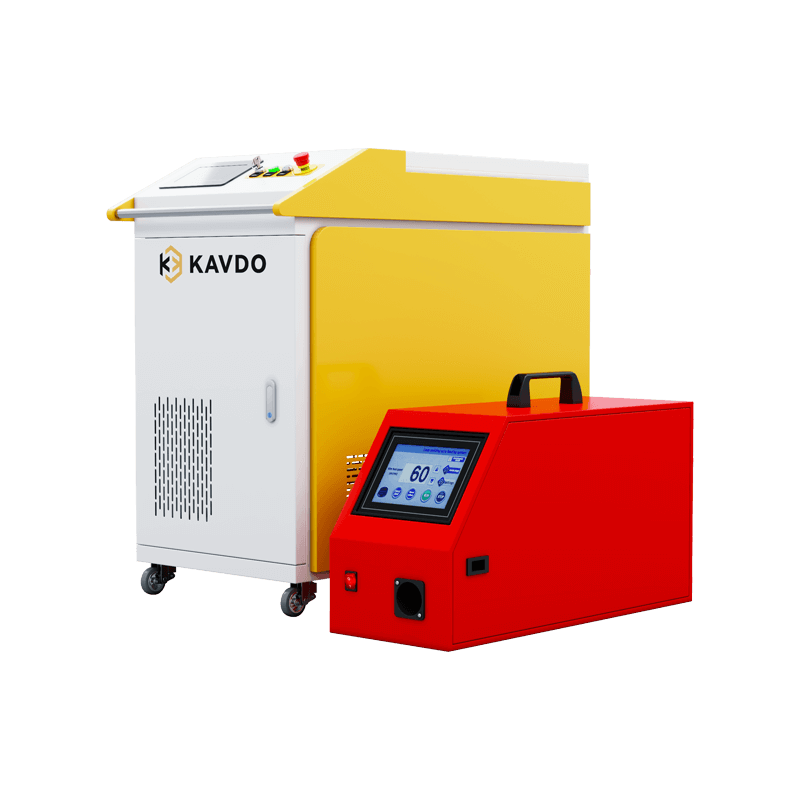
Short answer: a handheld fiber laser welder is typically 2–4 times faster than TIG on thin sheet, produces a narrow weld with little heat distortion and needs far less post-weld grinding, and new operators learn it in days rather than months. TIG remains the best choice for thick sections, code and structural welding, and the highest-quality manual welds. MIG is the fastest and most economical process for thicker carbon steel and heavy fabrication. Choose a laser welder when most of your work is 0.5–4 mm sheet metal with visible welds; keep TIG or MIG for thick, structural or field work.
Laser vs TIG vs MIG: Comparison Table
| Handheld fiber laser | TIG (GTAW) | MIG (GMAW) | |
|---|---|---|---|
| Welding speed on 1–3 mm sheet | Very fast (typically 2–4× TIG) | Slow | Fast |
| Heat input and distortion | Very low; narrow heat-affected zone | Medium–high | High |
| Weld appearance | Narrow, smooth; little or no grinding | Excellent with a skilled welder | Spatter; usually needs cleanup |
| Best thickness range | ≈ 0.5–5 mm (power-dependent) | ≈ 0.5–6 mm single pass; thicker multi-pass | ≈ 1.5 mm to thick plate |
| Joint fit-up tolerance | Tight (wire feed helps) | Tolerant | Most tolerant |
| Operator skill / training | Low; productive within days | High; months to master | Medium |
| Equipment cost | ≈ $3,000–15,000 (China-made, 1–3 kW) | ≈ $1,000–5,000 | ≈ $1,000–6,000 |
| Safety requirements | Class 4 laser: enclosed area, laser-rated eyewear | Arc protection | Arc protection, fumes |
| Field / outdoor work | Limited | Good | Good |
Where Laser Welding Wins
- Thin stainless and aluminum: kitchen equipment, cabinets, enclosures, signage, furniture.
- Visible welds: narrow, smooth seams that need little or no grinding and polishing.
- Distortion-sensitive parts: low heat input keeps thin panels flat.
- Labor shortage: new operators become productive quickly.
- Total time per part: one vendor example compares about 12 minutes of TIG welding plus 20 minutes of grinding with about 3 minutes of laser welding plus 2 minutes of cleaning. Results vary by part, but the reduction in finishing time is typical.
Where TIG or MIG Is Still Better
- Thick sections (above about 6–8 mm) needing multiple passes.
- Code and structural welding with qualified procedures (pressure vessels, structural steel).
- Poor fit-up and large gaps.
- Field and outdoor repair, where a laser safety zone isn’t practical.
- Heavy fabrication of carbon steel, where MIG deposition rate is unbeatable.

Weld Strength
With correct parameters and fit-up, laser welds on stainless and carbon steel sheet reach tensile strength comparable to TIG welds in the same material, with a smaller heat-affected zone. As with any process, verify strength with test pieces for critical parts.
Cost and Payback
A laser welder costs more to buy than a TIG set, but it is usually justified by labor savings: faster welding, much less grinding and polishing, and less rework from distortion. Shops with a steady flow of thin-sheet welding often recover the difference within months. If most of your work is thick plate or field repair, the payback is weaker.
Safety Requirements
- Handheld fiber lasers are Class 4: use a designated welding area with laser-safe curtains or walls.
- Everyone in the area needs eyewear rated for the laser wavelength (about 1,070 nm).
- Use the interlocks and grounding clamp; never point the head away from the workpiece.
- Extract welding fumes as with any welding process.
Compare welding methods on a qualified joint and production task
Use the same joint, material, preparation and acceptance checks. Include setup, operator time, finishing and safety provisions before comparing laser welding, TIG and MIG.
Frequently Asked Questions
Is laser welding stronger than TIG?
With good fit-up and correct parameters, laser welds on thin sheet are comparable in strength to TIG welds, with less heat distortion.
Can a laser welder replace TIG completely?
For most thin-sheet work, yes. Many shops keep one TIG machine for thick sections, poor fit-up and code welding.
How hard is it to learn handheld laser welding?
Much easier than TIG. With preset parameters, operators can produce good welds after a few days of training.
What thickness can a handheld laser weld?
About 2 mm at 1000W, 3 mm at 1500W, 4 mm at 2000W and 5–6 mm at 3000W for steel. See the laser welding thickness chart.
Try Laser Welding on Your Parts
KAVDO supplies 1500W, 2000W and 3kW handheld laser welders and 3-in-1 welding, cutting and cleaning machines. Send us your material, thickness and joint type through the contact page, and we’ll weld samples for you.
