CNC Shearing Machine vs Conventional Shearing Machine: A Practical Comparison

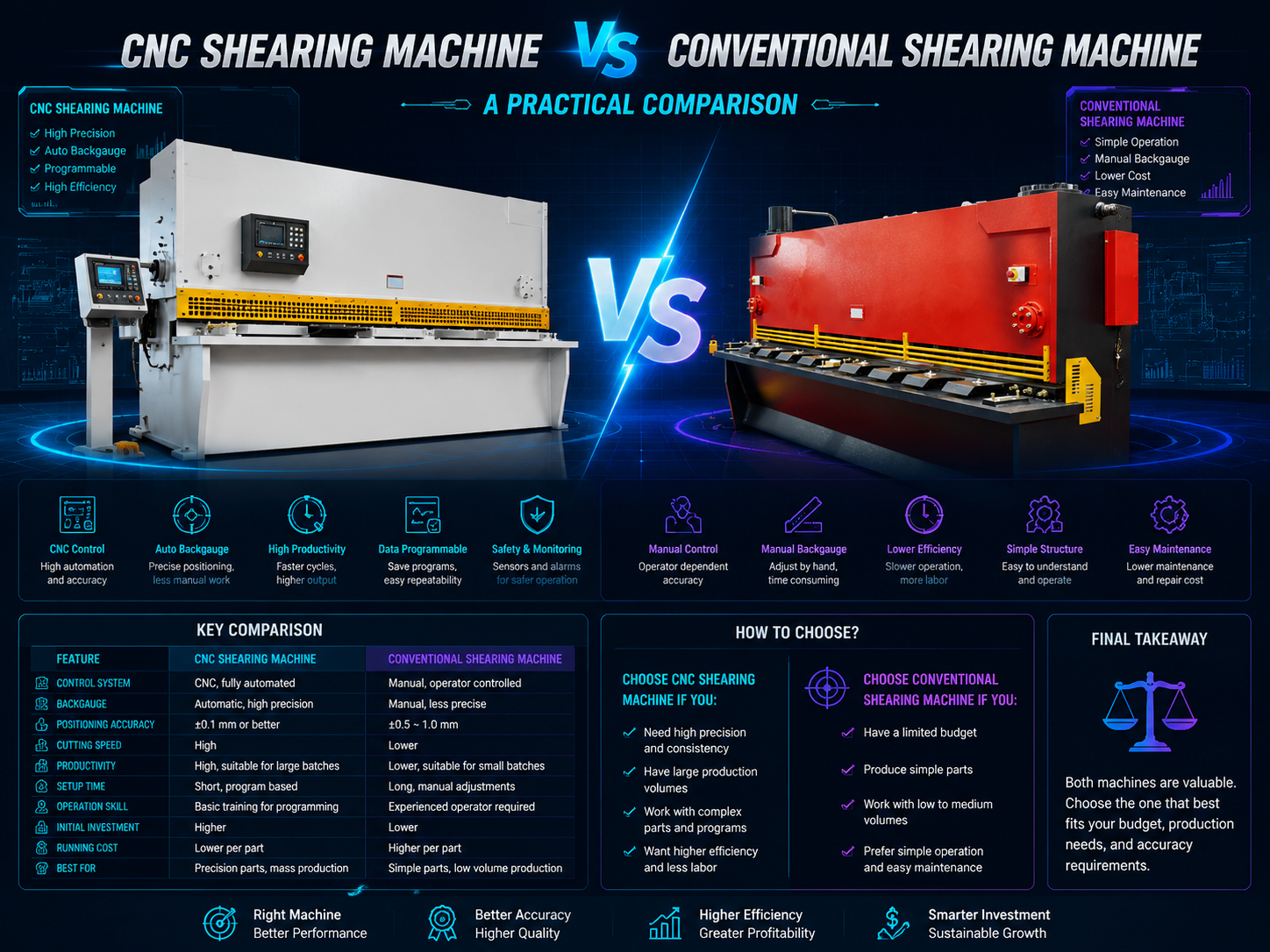
Comparison Summary: Navigating the Choice Between CNC and Conventional Shearing
In the modern metal fabrication landscape, the choice between a CNC (Computer Numerical Control) shearing machine and a conventional (manual or basic hydraulic) shearing machine is a pivotal decision that impacts production efficiency, accuracy, and long-term profitability. While both machines serve the fundamental purpose of cutting sheet metal by applying a high-pressure shearing force, the methodology and technology behind them differ significantly. A CNC shearing machine utilizes advanced software and automated backgauges to execute precise cuts with minimal operator intervention. In contrast, a conventional shearing machine relies heavily on the operator’s manual adjustments and visual alignment to achieve the desired results.
For high-volume production environments where precision is non-negotiable, the CNC shearing machine has become the industry standard. It offers programmable features that allow for rapid transitions between different cut lengths and material thicknesses. On the other hand, conventional shearing machines remain a staple in smaller workshops or maintenance facilities where the volume of work does not justify the higher initial investment of a CNC system. These machines are prized for their simplicity, durability, and ease of repair. Understanding the practical differences between these two categories is essential for any business looking to optimize its workshop capabilities.
HARSLE, a leader in metal fabrication machinery, provides both high-end CNC solutions and robust conventional hydraulic shears. This comparison aims to dissect the technical specifications, operational workflows, and economic factors that define each machine type. By the end of this guide, fabricators will have a clear roadmap for selecting the equipment that aligns with their specific production goals, material requirements, and budget constraints.
CNC Shearing Machine Overview: Precision Through Automation
The CNC shearing machine represents the pinnacle of modern cutting technology. At its core, the machine is integrated with a sophisticated control unit—such as the Delem DAC-360T or Cybelec systems—which manages every aspect of the shearing process. The primary advantage of a CNC shear is its ability to automatically adjust the blade gap, rake angle, and stroke length based on the material type and thickness entered by the operator. This automation eliminates the guesswork and human error associated with manual setups, ensuring that every cut is clean, square, and consistent.
One of the standout features of a CNC shearing machine is the motorized backgauge system. In a CNC environment, the backgauge moves with high-speed precision, often driven by ball screws and servo motors. This allows the machine to position the sheet metal within microns of the target dimension. Furthermore, CNC controllers can store hundreds of programs, enabling the operator to switch from cutting 2mm stainless steel to 6mm mild steel in seconds. This flexibility is a game-changer for job shops that handle a diverse range of projects daily.
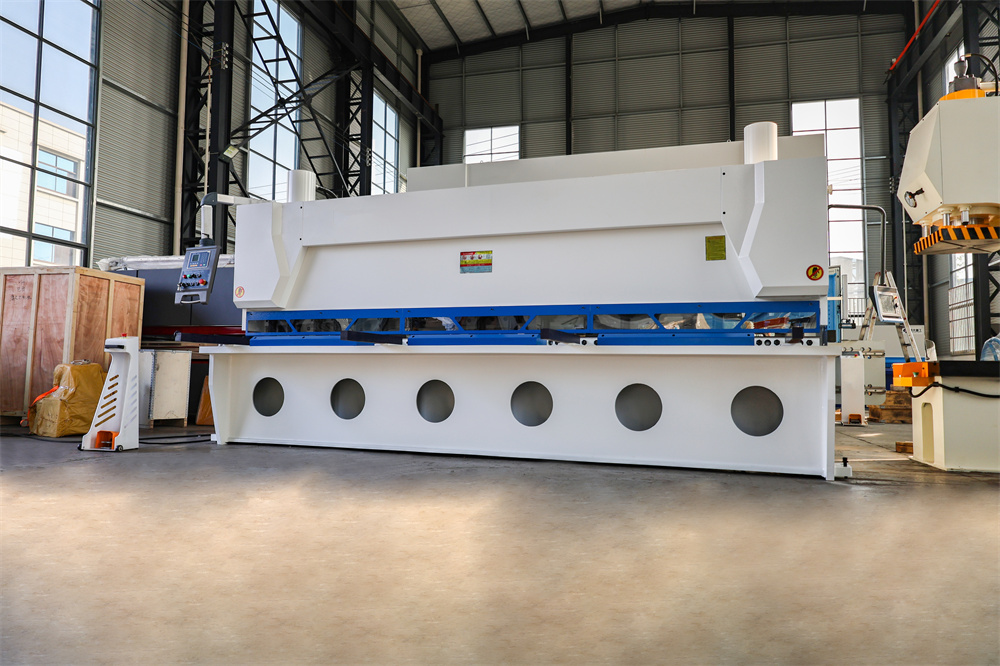
Beyond accuracy, CNC shearing machines are designed for safety and ergonomics. Many models include light curtains, emergency stop buttons integrated into the software, and shadow-line lighting to assist the operator. The hydraulic system in a CNC shear is also more refined, often utilizing proportional valves to control the pressure and speed of the cutting beam. This results in smoother operation and reduced wear on the mechanical components. For industries like aerospace, automotive, and high-end electronics, where tolerances are extremely tight, the CNC shearing machine is the only viable option.
Conventional Shearing Machine Overview: Reliability and Simplicity
Conventional shearing machines, often referred to as hydraulic swing beam shears or manual guillotine shears, have been the workhorse of the fabrication industry for decades. These machines operate on a straightforward principle: a hydraulic pump drives the upper blade downward to shear the metal against a fixed lower blade. Unlike their CNC counterparts, conventional machines require the operator to manually set the backgauge using a handwheel or a basic digital readout (DRO) and adjust the blade gap using a side-mounted lever or dial.
The beauty of a conventional shearing machine lies in its simplicity. Because there are fewer electronic components and no complex software to navigate, these machines are incredibly easy to learn and operate. A skilled operator can achieve impressive results through experience, feeling the machine’s response and making micro-adjustments on the fly. For straightforward tasks like cutting large sheets into smaller rectangular blanks, a conventional shear is often just as fast as a CNC model once the initial setup is complete.
Maintenance is another area where conventional machines shine. With fewer sensors, encoders, and circuit boards, troubleshooting is usually a mechanical or basic hydraulic issue that can be resolved by a general maintenance technician. This makes them ideal for regions where specialized CNC technicians might be difficult to find. While they lack the high-tech bells and whistles, HARSLE’s conventional hydraulic shears are built with heavy-duty steel frames and high-quality blades, ensuring they can withstand years of rigorous use in demanding environments.
Specification Comparison Table
To better understand the technical divergence, the following table compares the typical specifications of a CNC shearing machine versus a conventional hydraulic shearing machine.
| Feature | CNC Shearing Machine | Conventional Shearing Machine |
|---|---|---|
| Control System | Full CNC (e.g., DAC-360T) | Manual or Basic Digital Readout (E21S) |
| Backgauge Drive | Servo Motor / Ball Screw | AC Motor / Lead Screw or Manual |
| Blade Gap Adjustment | Automatic via Controller | Manual via Lever or Handwheel |
| Rake Angle Adjustment | Programmable / Automatic | Fixed or Manual Adjustment |
| Accuracy | ± 0.05mm to ± 0.1mm | ± 0.2mm to ± 0.5mm |
| Setup Time | Very Fast (Program Loading) | Moderate (Manual Measurements) |
| Operator Skill Level | Requires Software Training | Requires Mechanical Experience |
| Production Volume | High / Mass Production | Low to Medium / Job Shop |
Best-fit Applications: Choosing Based on Production Needs
The decision between CNC and conventional shearing often comes down to the specific applications and the variety of materials being processed. CNC shearing machines are the preferred choice for “High-Mix, Low-Volume” or “High-Volume” production. If your facility produces parts that require frequent changes in dimensions or if you are working with expensive materials where scrap must be minimized, the CNC’s precision pays for itself. It is also ideal for complex nesting strategies where multiple different sizes are cut from a single large sheet.
Conventional shearing machines are best suited for “Low-Mix, High-Volume” tasks or general utility work. For example, if a factory consistently cuts 3mm mild steel into the same three sizes all day, the advanced features of a CNC controller might go unused. Conventional shears are also excellent for construction sites, small repair shops, and educational institutions where the primary goal is to teach the fundamentals of metalwork without the complexity of programming.

Furthermore, the material type plays a role. When shearing delicate materials like polished stainless steel or aluminum, a CNC machine’s ability to precisely control the hold-down pressure prevents marking and deformation. Conversely, for heavy-duty plate shearing where the finish is less critical than the structural integrity of the cut, a robust conventional hydraulic shear provides the raw power needed to get the job done efficiently.
Cost and Maintenance Comparison
When evaluating the cost, one must look beyond the initial purchase price. A CNC shearing machine typically carries a price tag 30% to 60% higher than a conventional machine of the same capacity. This premium covers the cost of the controller, servo drives, and the sophisticated hydraulic valves. However, the Return on Investment (ROI) for a CNC machine is often faster in a busy shop due to reduced labor costs, faster cycle times, and significantly lower material waste.
Maintenance for a CNC machine requires a proactive approach. The electronic components must be kept clean and cool, and the software may occasionally require updates. Calibration of the backgauge and sensors is critical to maintaining accuracy. In contrast, a conventional machine’s maintenance is largely centered on the hydraulic system—changing oil, replacing filters, and ensuring the blades are sharp. While the parts for a conventional machine are generally cheaper, the labor required for manual setups can be a hidden ongoing cost that exceeds the maintenance savings over time.
Energy consumption is another factor. Modern CNC shears often feature “Eco-modes” or variable speed pumps that only consume significant power during the actual cutting stroke. Conventional machines with older hydraulic designs may run the motor at full speed whenever the machine is powered on, leading to higher electricity bills in the long run. Fabricators should conduct a Total Cost of Ownership (TCO) analysis before making a final commitment.
Recommendation: Which Machine Should You Buy?
Choosing the right machine depends on your business’s current state and future trajectory. If you are a growing fabrication shop looking to compete on precision and speed, or if you plan to integrate your shearing process into a larger automated workflow (such as with a CNC press brake), the CNC Shearing Machine is the superior investment. It future-proofs your operations and allows you to take on high-tolerance contracts that would be impossible with manual equipment.
However, if you are operating on a tight budget, or if your shearing needs are secondary to other processes like welding or assembly, a Conventional Shearing Machine is a reliable and cost-effective choice. It provides the necessary cutting power without the steep learning curve or the higher upfront cost. For many shops, a high-quality conventional shear from HARSLE serves as a dependable workhorse for twenty years or more with basic care.
Ultimately, we recommend assessing your average daily number of setups. If you change your cutting dimensions more than five times a day, the time saved by a CNC backgauge will likely pay for the machine’s price difference within the first year of operation. If you rarely change settings, stick with the simplicity of a conventional hydraulic shear.
FAQ: Frequently Asked Questions
1. Can a conventional shearing machine be upgraded to CNC?
While it is technically possible to retrofit a CNC backgauge and controller onto a conventional machine, it is often not cost-effective. The mechanical structure of a CNC machine is specifically designed to handle the speed and precision of servo motors. Retrofitting often results in a machine that is neither as fast as a true CNC nor as simple as a conventional one.
2. How often do the blades need sharpening on these machines?
Blade longevity depends on the material being cut. Cutting stainless steel will dull blades faster than mild steel. Generally, for both CNC and conventional machines, blades should be rotated or sharpened every 1,000 to 2,000 hours of operation. CNC machines often have a stroke counter in the software to help track this maintenance interval.
3. Is a CNC shearing machine harder to learn?
The initial learning curve involves understanding the software interface. However, once the operator learns how to input dimensions and material types, the machine is actually easier to use because it automates the difficult manual adjustments. Most operators can become proficient with a HARSLE CNC controller in just a few days of training.
4. Does the rake angle adjustment really matter?
Yes, significantly. The rake angle is the angle of the upper blade relative to the lower blade. A higher rake angle allows the machine to cut thicker material with less force but can cause the cut strip to twist or bow. CNC machines can automatically optimize this angle to balance cutting power and part quality, which is much harder to achieve manually.
5. Which machine is safer for the operator?
Both machines are safe when used correctly, but CNC machines often include more integrated safety features like programmable limits and advanced light curtain integration. Because the operator spends less time manually measuring and adjusting near the blades, the risk of accidental injury is statistically lower with CNC equipment.