How to Calculate Press Brake Bending Force for Different Materials and Thicknesses


Technical Overview of Press Brake Bending Force
In the world of precision metal fabrication, understanding how to calculate press brake bending force for different materials and thicknesses is not just a technical requirement—it is a fundamental necessity for safety, machine longevity, and part accuracy. Bending force, often referred to as tonnage, is the amount of pressure the press brake must exert on the workpiece to achieve a permanent plastic deformation. If the force is underestimated, the machine will fail to complete the bend; if it is overestimated or applied incorrectly, it can lead to tool breakage, machine frame deformation, or catastrophic failure of the hydraulic system.
HARSLE, as a leader in metalworking machinery, emphasizes that every material reacts differently under pressure. The physics of bending involves overcoming the material’s internal yield strength. When the punch descends into the V-die, the sheet metal undergoes tensile stress on the outer radius and compressive stress on the inner radius. The force required to reach the desired angle depends on the geometric relationship between the punch, the die, and the material properties. This guide provides a comprehensive breakdown of the variables involved in determining the correct tonnage for any given job.
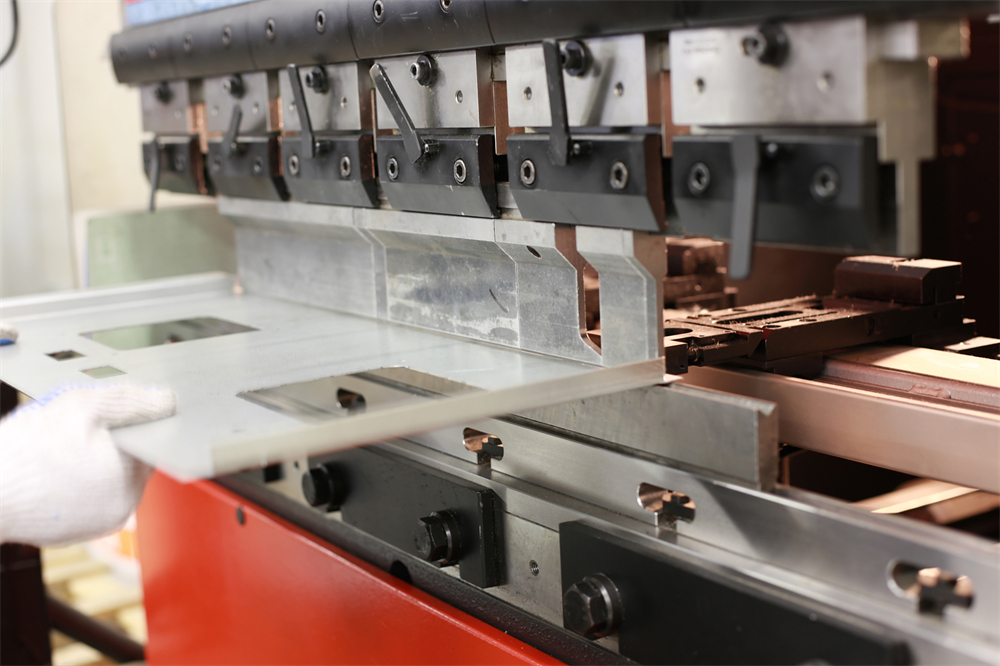
Modern CNC press brakes often come with integrated software that calculates these values automatically. However, manual verification is crucial for custom setups, older machines, or when working with exotic alloys. By mastering the manual calculation, operators can better understand the limits of their equipment and optimize the production process for efficiency and quality. This technical overview serves as the foundation for the specific parameters and formulas discussed in the following sections.
Core Parameters Influencing Bending Force
To accurately calculate press brake bending force for different materials and thicknesses, one must first identify the four primary variables that dictate the physics of the bend. These are the material thickness (S), the bending length (L), the V-die opening width (V), and the material’s tensile strength (Rm). Each of these factors has a non-linear relationship with the required tonnage, meaning a small change in one can lead to a significant change in the required force.
1. Material Thickness (S): This is perhaps the most critical variable. In the standard bending formula, the thickness is squared ($S^2$). This means that doubling the thickness of a plate does not just double the required force; it quadruples it. For example, bending a 4mm plate requires significantly more than twice the force of a 2mm plate, assuming all other factors remain constant.
2. Bending Length (L): The force required is directly proportional to the length of the bend. If you are bending a 1-meter sheet and then switch to a 2-meter sheet of the same material and thickness, the required tonnage will double. It is essential to ensure that the press brake’s total tonnage capacity is rated for the full length of the bed to avoid localized overloading.
3. V-Die Opening (V): The width of the bottom die significantly impacts the leverage the punch has over the material. A wider V-die reduces the required bending force but increases the internal bend radius. Conversely, a narrow V-die requires much higher force and can lead to “coining” or marking the material. The industry standard for choosing a V-die is typically $V = 8 \times S$ for materials up to 6mm, and $V = 10 \times S$ or $V = 12 \times S$ for thicker plates.
4. Tensile Strength ($R_m$): Different metals offer varying levels of resistance. Mild steel is the baseline for most calculations (approx. 450 N/mm²). Stainless steel (SS304 or SS316) typically requires 50% more force due to its higher yield strength and work-hardening properties. Aluminum, being softer, requires significantly less force, usually around 50% to 60% of the force needed for mild steel.
The Standard Calculation Method
The most widely accepted formula to calculate press brake bending force for different materials and thicknesses is based on the principles of air bending. The formula is expressed as:
P = (650 × S² × L) / V
Where:
- P: Bending Force in Kilonewtons (kN). To convert to Tons, divide by 9.8 (or roughly 10 for a quick estimate).
- 650: A constant factor for mild steel with a tensile strength of approximately 450 N/mm².
- S: Material thickness in millimeters (mm).
- L: Bending length in meters (m).
- V: V-die opening width in millimeters (mm).
Let’s look at a practical example. Suppose you need to bend a 4mm thick mild steel plate over a length of 2 meters using a 32mm V-die ($V = 8 \times S$). The calculation would be: $P = (650 \times 4^2 \times 2) / 32$. This results in $P = (650 \times 16 \times 2) / 32 = 20,800 / 32 = 650$ kN. Converting this to tons, we get approximately 66 tons. If you were to use a narrower 24mm die, the force would jump to approximately 87 tons, illustrating how die selection directly affects machine load.
When working with materials other than mild steel, you must apply a material factor (K). For Stainless Steel, the factor is usually 1.5. For Aluminum, the factor is 0.5. Therefore, the adjusted formula becomes $P_{adj} = P \times K$. Using the previous example, if the 4mm plate was Stainless Steel, the required force would be $66 \times 1.5 = 99$ tons. This adjustment is vital to prevent stalling the machine or damaging the hydraulic seals when switching between material types.
Bending Force Parameter Table
The following table provides a quick reference for the required tonnage (in tons per meter) for mild steel ($R_m = 450$ N/mm²) using standard V-die openings. This table assumes air bending. For bottoming or coining, the force required can be 3 to 10 times higher.
| Thickness (S) mm | V-Die Opening (V) mm | Internal Radius (r) mm | Force (Tons/Meter) |
|---|---|---|---|
| 1.0 | 8 | 1.3 | 7 |
| 1.2 | 10 | 1.6 | 8 |
| 1.5 | 12 | 2.0 | 11 |
| 2.0 | 16 | 2.6 | 17 |
| 2.5 | 20 | 3.3 | 21 |
| 3.0 | 25 | 4.0 | 24 |
| 4.0 | 32 | 5.3 | 33 |
| 5.0 | 40 | 6.7 | 41 |
| 6.0 | 50 | 8.0 | 48 |
| 8.0 | 63 | 10.5 | 68 |
| 10.0 | 80 | 13.3 | 83 |
| 12.0 | 100 | 16.7 | 100 |
Note: The internal radius (r) is typically calculated as $V/6$ for air bending. If your specific application requires a tighter radius, you will need a smaller V-die, which will significantly increase the tonnage required. Always consult your HARSLE machine manual for the specific load limits of your model.
Common Engineering Mistakes in Tonnage Calculation
Even with a clear formula, several common mistakes can lead to errors when you calculate press brake bending force for different materials and thicknesses. One of the most frequent errors is ignoring the “Concentrated Load” limit. Press brakes are designed to handle their full tonnage across the entire length of the bed. If you apply 100 tons of force to a very short piece (e.g., 100mm wide) in the center of the machine, you risk deforming the ram or the bed. This is known as “point loading” and can permanently ruin the machine’s accuracy.

Another mistake is failing to account for the “Springback” effect. Springback occurs when the metal is released from the pressure of the punch and slightly returns to its original shape. To compensate, operators often over-bend the material. Over-bending requires slightly more force and deeper penetration into the die. If the tonnage calculation is right at the machine’s limit, there may not be enough “headroom” to achieve the necessary over-bend, resulting in parts that do not meet angle specifications.
Furthermore, neglecting the condition of the tooling can lead to inaccurate force requirements. Worn dies increase friction, which in turn increases the force needed to push the material into the V-opening. Lubrication also plays a role; unlubricated, rusty, or scaled plates require more force to slide over the die shoulders. Engineers should always include a safety margin—typically 20%—when selecting a machine or calculating force to account for these real-world variables.
Selection Checklist for Press Brake Tonnage
When choosing a HARSLE press brake or setting up a new job, use this checklist to ensure your calculations are robust and your machine is protected:
- Verify Material Specs: Do you have the actual tensile strength ($R_m$) from the material mill certificate? Standard values are just averages.
- Check V-Die Ratio: Is the V-die opening at least 8 times the material thickness? If it is smaller, have you recalculated for the increased force?
- Calculate Total Tonnage: Multiply the tons-per-meter by the total length of your part. Does it exceed 80% of the machine’s rated capacity?
- Assess Tooling Limits: Check the maximum load rating (tons/meter) stamped on your punches and dies. Do not exceed the tool’s limit even if the machine can handle it.
- Consider the Bending Method: Are you air bending, bottoming, or coining? Remember that bottoming requires 3-5x the force of air bending.
- Evaluate Machine Deflection: For long bends, does your machine have a crowning system (mechanical or hydraulic) to compensate for bed deflection under the calculated load?
- Safety Margin: Always add a 15-20% buffer to your calculated tonnage to account for material thickness tolerances and friction.
Frequently Asked Questions (FAQ)
1. Why does stainless steel require so much more force than mild steel?
Stainless steel has a higher carbon content and alloying elements like chromium and nickel, which increase its yield strength. Additionally, stainless steel work-hardens very quickly. As the material begins to bend, it becomes stiffer, requiring more pressure to continue the deformation process compared to mild steel.
2. Can I bend a 10mm plate on a 100-ton press brake?
It depends on the length and the V-die. According to the table, 10mm mild steel requires 83 tons per meter using an 80mm V-die. If your part is 1 meter long, a 100-ton machine is sufficient. However, if the part is 1.5 meters long, you would need approximately 125 tons, making the 100-ton machine inadequate.
3. How does the internal radius affect the bending force?
The internal radius is a byproduct of the V-die width in air bending. If you need a smaller internal radius, you must use a narrower V-die. As shown in the formula, a smaller ‘V’ value is in the denominator, meaning as ‘V’ decreases, the force ‘P’ increases significantly. Attempting a very tight radius on thick material can easily exceed machine limits.
4. What happens if I exceed the calculated bending force?
Exceeding the rated force can lead to several issues: the hydraulic relief valves may trip, stopping the machine; the frame may flex excessively, causing “boat-shaped” bends; or in extreme cases, the punch or die may shatter, posing a serious safety risk to the operator.
5. Does the speed of the bend affect the tonnage?
In hydraulic press brakes, the speed of the ram does not significantly change the required tonnage, but it does affect the flow of the material. However, bending at high speeds can increase the risk of “whip-up” on large sheets, and very slow speeds might be necessary for heavy plates to allow the material to deform without cracking.
6. How do HARSLE CNC controllers help with these calculations?
HARSLE CNC systems, such as those equipped with Delem or Cybelec controllers, allow operators to input the material type, thickness, and desired angle. The software automatically references a built-in database to calculate the required tonnage, determines the correct crowning compensation, and sets the depth of the ram (Y-axis) to achieve the bend accurately on the first try.