Hydraulic Press Vs Pneumatic Press: Key Differences for Industrial Buyers


Comparison Summary: Navigating the Press Selection Process
In the world of metal fabrication and industrial manufacturing, selecting the right press is a foundational decision that impacts production speed, part quality, and long-term operational costs. When evaluating a Hydraulic Press Vs Pneumatic Press: Key Differences Industrial Buyers must consider, the primary distinction lies in the medium used to transmit power. Hydraulic presses utilize incompressible liquid (usually oil), while pneumatic presses rely on compressed air. This fundamental difference dictates everything from the maximum tonnage the machine can exert to the speed at which the ram moves.
For high-tonnage applications such as deep drawing, heavy-duty forging, and large-scale metal forming, the hydraulic press is the undisputed champion. Its ability to maintain constant pressure throughout the entire stroke makes it indispensable for complex geometries. Conversely, pneumatic presses are the go-to solution for high-speed, low-tonnage tasks like riveting, punching small holes, and light assembly. They offer a level of cleanliness and rapid cycling that hydraulics struggle to match in small-scale environments.
Understanding these nuances is critical for industrial buyers who need to balance initial capital expenditure (CAPEX) with operational efficiency. While a pneumatic press might seem cheaper upfront, its limitations in force might render it useless if your product line expands to thicker materials. Similarly, investing in a massive hydraulic press for simple light-gauge assembly is an inefficient use of energy and floor space. This guide provides a deep dive into both technologies to help you make an informed investment for your facility.
Hydraulic Press Overview: The Powerhouse of Fabrication
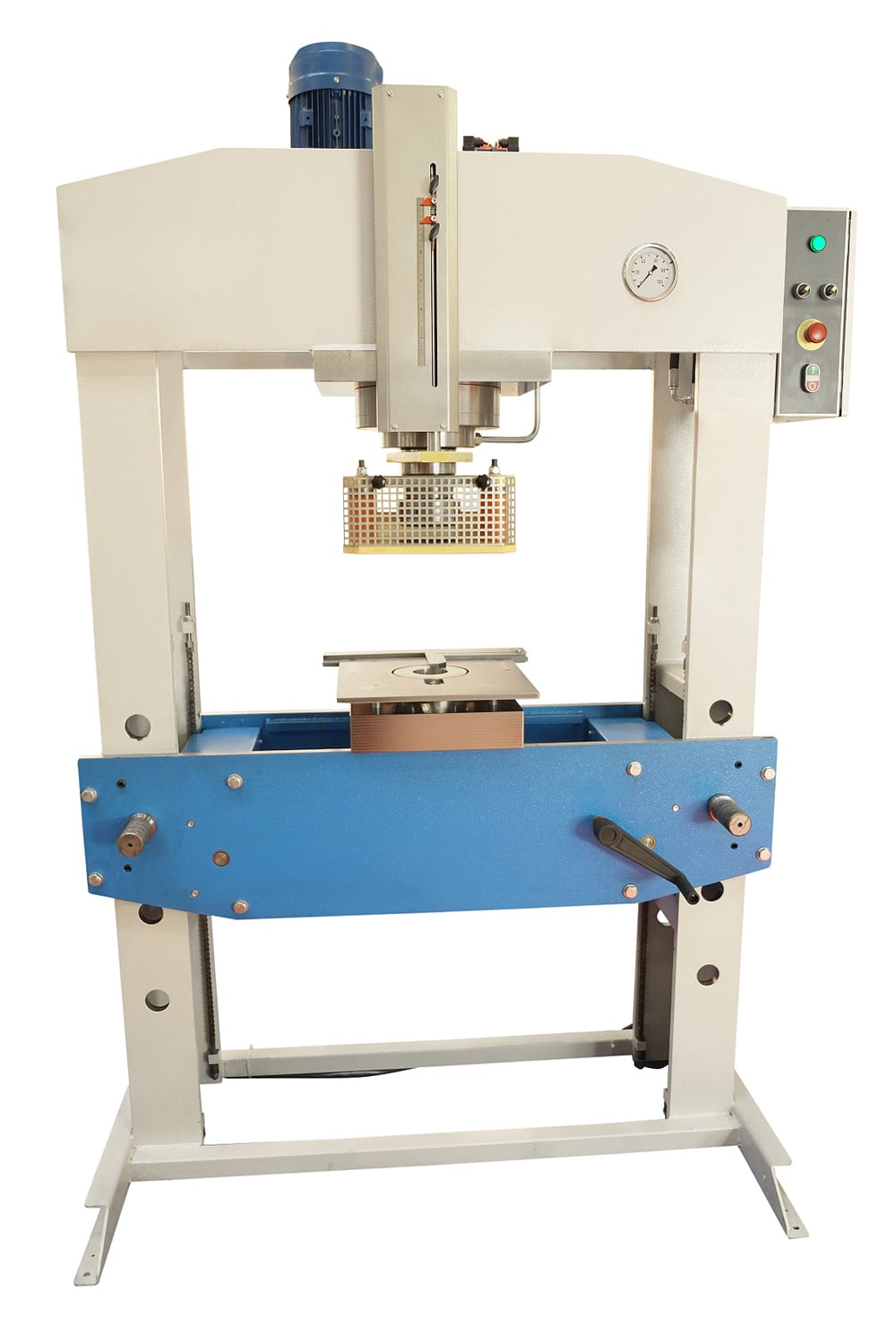
A hydraulic press operates based on Pascal’s Law, which states that pressure applied to a confined fluid is transmitted undiminished in every direction. In practical terms, this allows a small amount of force generated by a pump to be converted into massive amounts of pressure at the ram. The system typically consists of a large cylinder, a reservoir for hydraulic oil, a high-pressure pump, and a series of valves to control the flow and direction of the fluid. Because oil is virtually incompressible, the hydraulic press can deliver extremely high force with incredible precision.
One of the standout features of a hydraulic press is its versatility in stroke control. Unlike mechanical presses that have a fixed stroke length, a hydraulic press allows the operator to adjust the stroke to any length within its physical limits. Furthermore, the press can deliver its full rated tonnage at any point during the stroke. This is particularly beneficial for processes like deep drawing, where the material needs to be formed gradually under consistent pressure to prevent tearing or thinning.
Modern hydraulic presses, such as those manufactured by HARSLE, incorporate advanced PLC (Programmable Logic Controller) systems. these systems allow for multi-stage pressing cycles, where the ram can move quickly to the workpiece, slow down for the actual forming process, and then dwell at the bottom of the stroke to ensure the part sets correctly. This level of control is essential for aerospace and automotive components where tolerances are tight and material integrity is paramount.
However, the power of hydraulics comes with specific trade-offs. These machines are generally slower than their pneumatic counterparts because moving viscous oil through valves and cylinders takes more time than moving air. Additionally, hydraulic systems are prone to leaks over time, requiring a robust maintenance schedule to ensure seals are intact and the oil remains free of contaminants. Despite these factors, for any application requiring over 50 tons of force, the hydraulic press remains the industry standard.
Pneumatic Press Overview: Speed and Simplicity
Pneumatic presses utilize compressed air to generate motion and force. The setup is significantly simpler than a hydraulic system, usually consisting of an air cylinder, a control valve, and a connection to a factory-wide compressed air line. Because air is compressible and moves very quickly, pneumatic presses are capable of extremely high cycle speeds. This makes them ideal for high-volume production lines where thousands of small parts need to be processed every hour.
The “snap” action of a pneumatic press is one of its greatest advantages. In applications like marking, stamping, or shearing thin materials, the rapid impact provided by the air cylinder creates a clean finish that might be harder to achieve with the slower, more deliberate movement of a hydraulic ram. Furthermore, pneumatic presses are inherently cleaner. There is no risk of oil leaks contaminating the work area or the workpiece, which is a critical requirement in the electronics, medical device, and food packaging industries.
From a maintenance perspective, pneumatic presses are relatively low-effort. The primary concerns are ensuring the air supply is dry and lubricated (if required by the cylinder design) and replacing air seals as they wear out. Because they have fewer moving parts and no complex hydraulic pumps or reservoirs, the initial cost of a pneumatic press is significantly lower than a hydraulic press of comparable size. They also occupy a smaller footprint, making them easy to integrate into modular assembly cells.
The main limitation of pneumatic technology is force capacity. Because air is compressible, it is difficult to generate and maintain extremely high pressures. Most pneumatic presses are capped at around 10 to 20 tons of force. Beyond this point, the size of the air cylinder required becomes impractically large. Additionally, pneumatic presses lack the fine-tuned pressure control found in hydraulics; once the air is released, the ram moves with a high degree of kinetic energy that is harder to modulate mid-stroke.
Specification Comparison Table
To better understand the Hydraulic Press Vs Pneumatic Press: Key Differences Industrial Buyers should analyze, the following table compares the two technologies across several critical performance metrics.
| Feature | Hydraulic Press | Pneumatic Press |
|---|---|---|
| Force Capacity | Very High (Up to 50,000+ tons) | Low to Medium (Typically < 20 tons) |
| Operating Speed | Slower, controlled movement | Very fast, rapid cycling |
| Pressure Control | Excellent (Full force at any point) | Limited (Force depends on air pressure) |
| Maintenance | High (Oil changes, seal leaks) | Low (Air filters, simple seals) |
| Initial Cost | Higher | Lower |
| Cleanliness | Potential for oil leaks | Very clean (Air-based) |
| Noise Level | Moderate (Pump noise) | High (Air exhaust noise) |
Best-fit Applications: Choosing the Right Tool for the Job
Identifying the best-fit application is the most important step for any industrial buyer. For Hydraulic Press Vs Pneumatic Press: Key Differences Industrial Buyers often find that the material thickness and the complexity of the operation dictate the choice. Hydraulic presses are the workhorses of the heavy metal industry. They are used extensively for deep drawing, where a flat sheet of metal is transformed into a three-dimensional shape like a kitchen sink or an automotive oil pan. The ability to control the speed and pressure prevents the metal from wrinkling or cracking during this intense deformation.
Other hydraulic applications include powder compacting, where consistent pressure is needed to bond metallic or ceramic powders into a solid form, and heavy-duty forging. In the recycling industry, massive hydraulic balers are used to crush cars and scrap metal into dense blocks. The sheer force required for these tasks is simply beyond the capabilities of pneumatic systems. If your production involves steel plates thicker than 3mm or requires precision molding of plastics and composites, a hydraulic press is likely your best option.
Pneumatic presses, on the other hand, excel in the “light and fast” category. They are ubiquitous in the electronics industry for pressing connectors onto circuit boards or assembling small plastic housings. Because they are fast, they are often integrated into automated conveyor systems where a part arrives, is pressed, and moves on in a matter of seconds. Riveting and eyeleting are also classic pneumatic tasks, as the quick strike of the air cylinder effectively flares the rivet head without the need for the prolonged pressure of a hydraulic ram.
Furthermore, pneumatic presses are ideal for laboratory environments or cleanrooms where hydraulic oil is strictly prohibited. They are also used for simple jewelry making, leather embossing, and light-gauge foil stamping. If your manufacturing process involves high-volume, repetitive tasks on small components, the energy efficiency and speed of a pneumatic press will provide a much higher return on investment than a hydraulic alternative.
Cost and Maintenance Comparison
When discussing Hydraulic Press Vs Pneumatic Press: Key Differences Industrial Buyers must look beyond the sticker price. The total cost of ownership (TCO) includes energy consumption, routine maintenance, and potential downtime. Hydraulic presses are more expensive to purchase because they require a complex power unit, including a motor, pump, and large quantities of specialized hydraulic fluid. The energy consumption is also higher, as the motor often needs to run to maintain pressure in the system, although modern variable-frequency drives (VFDs) have significantly improved this efficiency.
Maintenance for hydraulic systems is a specialized task. You must regularly monitor the quality of the oil, as dirt or moisture can destroy the pump and valves. Oil changes can be expensive and messy, and disposing of used hydraulic fluid requires adherence to environmental regulations. Additionally, hydraulic seals are under immense pressure and will eventually leak. A leaking hydraulic press is not just a maintenance issue; it’s a safety hazard and a source of product contamination.
Pneumatic presses have a much lower entry barrier. The machines themselves are simpler and cheaper to manufacture. Since most industrial facilities already have a centralized compressed air system, the “power unit” cost is shared across the entire plant. However, compressed air is often cited as one of the most expensive utilities in a factory due to the energy losses inherent in air compression. While the press itself is efficient, the system providing the air must be well-maintained to prevent leaks that bleed money.
Maintenance for pneumatic presses is generally limited to the “FRL” unit (Filter, Regulator, Lubricator). Keeping the air dry is the most critical factor, as moisture can lead to internal corrosion of the cylinders. Compared to the hours required for a hydraulic oil change and system flush, pneumatic maintenance can often be completed in minutes. For small shops or facilities without a dedicated maintenance team, the simplicity of pneumatics is a major selling point.
Recommendation: Which One Should You Buy?
The decision between a hydraulic and pneumatic press ultimately comes down to your specific production requirements. As a general rule of thumb, if your application requires more than 15 tons of force, you should almost certainly look at a hydraulic press. The stability, control, and sheer power of hydraulics cannot be matched by air-driven systems at high tonnages. HARSLE offers a wide range of hydraulic presses that are perfect for buyers looking for durability and precision in heavy-duty environments.
If your operations are centered around high-speed assembly of small parts, and you require a clean, low-maintenance solution, the pneumatic press is the winner. It will offer faster cycle times and a lower initial investment, allowing you to scale your production lines more cost-effectively. Always consider the future of your product line; if you anticipate moving to thicker materials or more complex shapes, the versatility of a hydraulic press might make it a more “future-proof” investment despite the higher initial cost.
Before making a final purchase, we recommend conducting a “Force vs. Stroke” analysis. Map out exactly how much force you need at every millimeter of the ram’s travel. If you need a high force at the very beginning or middle of the stroke, hydraulics are necessary. If you only need a quick burst of force at the very end, a pneumatic or even a hydro-pneumatic (a hybrid of both) might suffice. Consulting with a specialist at HARSLE can help you navigate these technical requirements to ensure you get the machine that fits your workflow perfectly.
FAQ: Common Questions from Industrial Buyers
1. Can a pneumatic press be as precise as a hydraulic press?
In terms of stroke depth, pneumatic presses can be very precise if they are equipped with mechanical stops. However, in terms of pressure control and the ability to vary speed during the stroke, hydraulic presses are significantly more precise. Hydraulics allow for fine-tuning that pneumatics simply cannot achieve due to the compressibility of air.
2. Which press is safer for operators?
Both machines require strict safety protocols, including light curtains, two-hand start buttons, and physical guarding. Hydraulic presses are often perceived as “safer” because their movement is slower and more predictable. Pneumatic presses move very quickly, which increases the risk of pinch-point injuries if safety features are bypassed. However, both are safe when operated according to manufacturer guidelines.
3. Are there hybrid options available?
Yes, hydro-pneumatic presses (often called air-over-oil presses) exist. They use compressed air to move the ram quickly to the workpiece and then use a small hydraulic intensifier to deliver high force for the final few millimeters of the stroke. These offer a middle ground between the speed of pneumatics and the power of hydraulics.
4. How do I calculate the tonnage I need?
Tonnage is calculated based on the material type, thickness, and the length of the cut or the area of the form. The formula typically involves the shear strength of the material multiplied by the cross-sectional area being worked. It is always advisable to buy a press with at least 20% more capacity than your maximum requirement to avoid straining the machine.
5. What is the lifespan of these machines?
A well-maintained hydraulic press can last 20 to 30 years or more, as the components are heavy-duty and the oil provides internal lubrication. Pneumatic presses also have long lifespans, but the cylinders may need to be replaced or rebuilt every 5 to 10 years depending on the cycle count and air quality.