2D Laser Cutting Machine vs 3D Laser Cutting Machine: Application Comparison in Industry

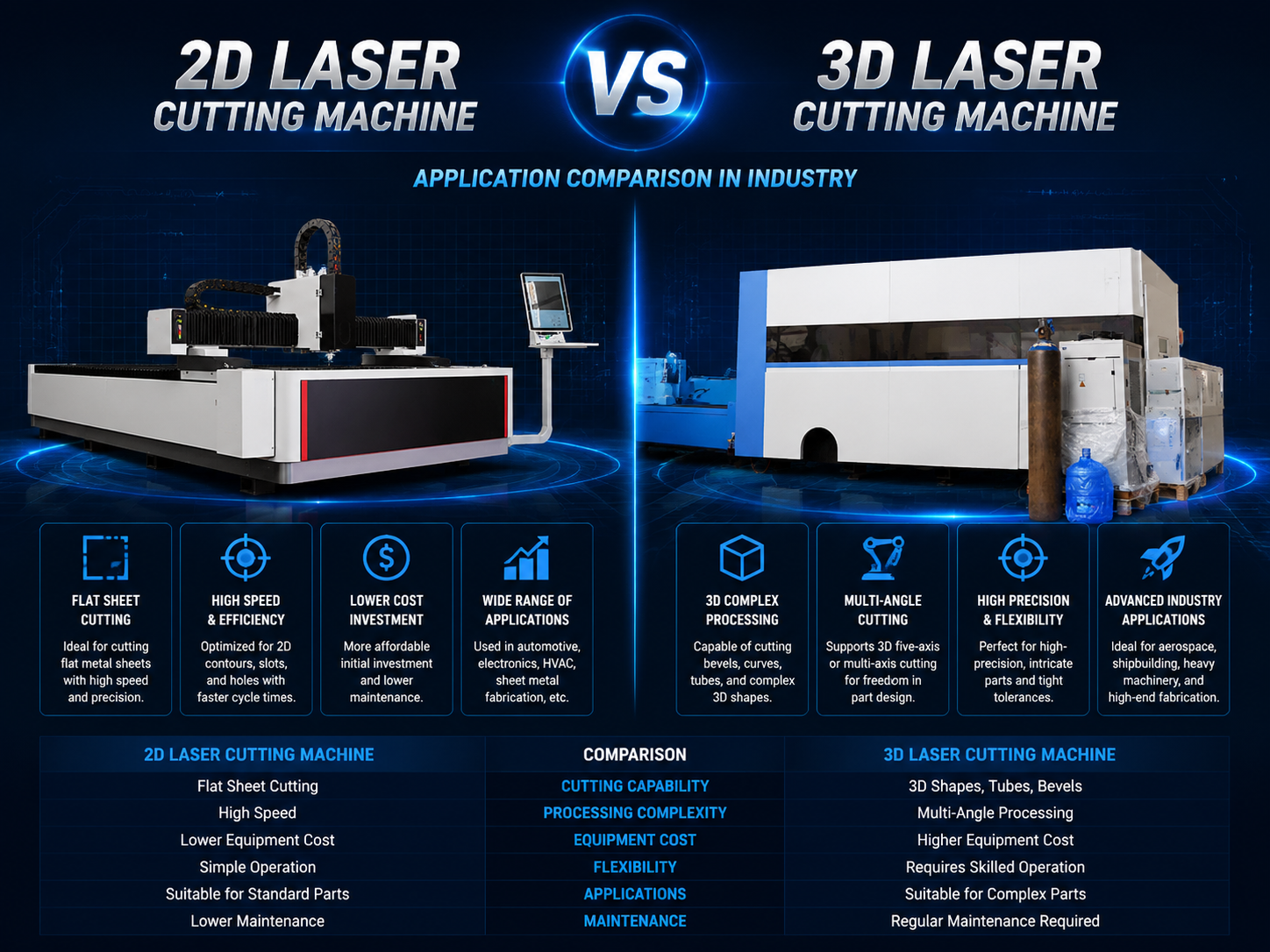
Comparison Summary: The Evolution of Precision Cutting
In the rapidly evolving landscape of metal fabrication, the choice between a 2D laser cutting machine and a 3D laser cutting machine represents a pivotal decision for manufacturers. While both technologies utilize high-energy laser beams to melt and vaporize material, their mechanical structures and intended applications differ significantly. 2D laser cutting, often referred to as flatbed cutting, is the industry standard for processing sheet metal. It operates on a Cartesian coordinate system (X and Y axes), moving the laser head over a stationary or moving sheet of material. This technology has revolutionized industries by providing high-speed, high-precision cuts for flat components, ranging from simple brackets to intricate decorative panels.
On the other hand, 3D laser cutting introduces a new dimension of flexibility. By incorporating additional axes of movement—typically through a 5-axis gantry system or a 6-axis robotic arm—3D laser machines can process workpieces with complex geometries, such as stamped parts, hydroformed tubes, and curved profiles. The primary distinction lies in the ability of the 3D laser head to maintain a perpendicular orientation to the material surface at all times, even as the surface contours change. This capability eliminates the need for multiple secondary operations like drilling, milling, or manual trimming, which are often required when processing pre-formed parts with traditional 2D systems.
The industrial shift toward 3D laser cutting is largely driven by the automotive and aerospace sectors, where lightweighting and complex structural designs are paramount. However, 2D laser cutting remains the backbone of general manufacturing due to its unmatched efficiency in high-volume sheet metal production. Understanding the nuances of 2D Laser Cutting Machine Vs 3D Laser Cutting Machine: Application Comparison In Industry is essential for optimizing production workflows, reducing waste, and ensuring the highest quality of the final product. This guide provides a deep dive into the technical specifications, application strengths, and cost-benefit analyses of both systems.
2D Laser Cutting Machine Overview: The Workhorse of Sheet Metal
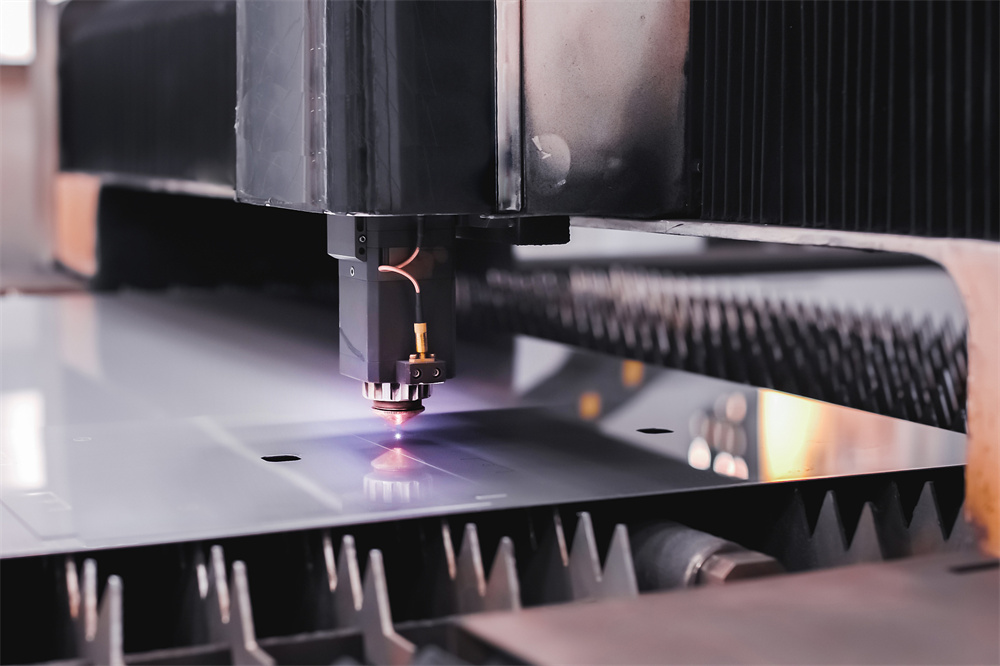
The 2D laser cutting machine is the most common type of laser equipment found in modern fabrication shops. Its design is optimized for speed and accuracy on flat surfaces. Most modern 2D systems utilize fiber laser technology, which offers superior energy efficiency and cutting speeds compared to older CO2 lasers, especially when processing thin to medium-thickness metals like carbon steel, stainless steel, and aluminum. The machine typically consists of a large cutting bed, a CNC controller, a laser source, and a cutting head that moves along a bridge (gantry) in the X and Y directions.
One of the key advantages of 2D laser cutting is its simplicity in programming and setup. Using CAD/CAM software, operators can easily nest multiple parts on a single sheet of metal to maximize material utilization. This process, known as nesting, is a critical factor in reducing production costs. Furthermore, 2D machines are capable of achieving extremely tight tolerances, often within ±0.05mm, making them ideal for components that require high precision for subsequent assembly or welding. The high-speed piercing and cutting capabilities of fiber lasers allow for rapid turnaround times, which is essential in a competitive manufacturing environment.
However, the limitations of 2D laser cutting become apparent when dealing with non-flat workpieces. If a part has already been bent, stamped, or formed into a three-dimensional shape, a standard 2D machine cannot follow its contours. Attempting to cut such parts on a 2D bed would result in distorted edges and inaccurate dimensions because the laser beam would not remain perpendicular to the material. Therefore, 2D machines are strictly limited to flat stock or very simple profiles that can be laid flat on the cutting slats. Despite this, for the vast majority of industrial components—from HVAC ducting to electronic enclosures—the 2D laser cutting machine remains the most cost-effective and efficient solution.
3D Laser Cutting Machine Overview: Mastering Complex Geometries
3D laser cutting machines represent the pinnacle of flexibility in laser processing. Unlike their 2D counterparts, these machines are designed to navigate the complex topography of three-dimensional objects. This is achieved through advanced kinematics, where the laser head is mounted on a multi-axis system. In a 5-axis gantry configuration, the head can rotate and tilt (A and B axes) while moving in X, Y, and Z. Alternatively, many 3D systems utilize a 6-axis industrial robot arm, which provides an even greater range of motion and can reach into tight spaces or around large, bulky workpieces.
The core technology that enables 3D cutting is the specialized cutting head equipped with sophisticated sensors. These sensors maintain a constant distance between the nozzle and the workpiece, even as the head moves over curves and angles. This “height sensing” or “following” technology is crucial for maintaining the focal point of the laser, ensuring a clean and consistent cut across the entire geometry. 3D laser cutting is particularly transformative for the automotive industry, where it is used to trim excess material from stamped body panels or to cut holes in high-strength steel structural components after they have been formed.
Programming a 3D laser cutting machine is significantly more complex than 2D programming. It requires specialized 3D CAM software that can simulate the movement of the robotic arm or gantry to prevent collisions with the workpiece or the machine’s own structure. Offline programming and simulation are standard practices to ensure safety and efficiency. While the initial investment and operational complexity are higher, the ability to perform multiple operations—such as cutting, trimming, and hole-punching—in a single setup on a complex part provides a massive boost to productivity and reduces the margin for error associated with moving parts between different machines.

Specification Comparison Table
To better understand the technical differences between these two systems, the following table compares the key specifications of standard industrial 2D and 3D laser cutting machines.
| Feature | 2D Laser Cutting Machine | 3D Laser Cutting Machine |
|---|---|---|
| Movement Axes | 2 or 3 Axes (X, Y, and Z for height) | 5 or 6 Axes (X, Y, Z, A, B, C) |
| Workpiece Geometry | Flat sheets, plates, and simple tubes | Stamped parts, hydroformed tubes, curved profiles |
| Programming Complexity | Low to Medium (2D CAD/CAM) | High (3D Simulation & Robotic CAM) |
| Cutting Speed (Flat) | Very High | Moderate |
| Precision | High (±0.05mm) | High (±0.1mm depending on robot) |
| Initial Investment | Lower to Moderate | High to Very High |
| Flexibility | Limited to flat stock | Extremely High for complex shapes |
| Typical Laser Source | Fiber Laser (1kW – 30kW+) | Fiber Laser (1kW – 6kW) |
Best-fit Applications: Where Each Machine Excels
2D Laser Cutting Applications
2D laser cutting is the dominant force in industries where flat sheet metal is the primary raw material. In the HVAC industry, 2D lasers are used to cut intricate patterns for ductwork and ventilation housings with incredible speed. The signage and decorative metalwork sector relies on 2D lasers for their ability to execute complex artistic designs in stainless steel, brass, and aluminum. Because these machines can handle large sheets (often up to 6 meters or more), they are also essential in shipbuilding and heavy machinery for cutting large structural plates.
In the electronics industry, 2D lasers provide the precision needed for small, delicate components like chassis for servers and control boxes. The ability to switch between different materials and thicknesses quickly makes 2D machines ideal for job shops that handle a wide variety of customer orders. Furthermore, the integration of automated loading and unloading systems (towers) allows 2D machines to operate in “lights-out” manufacturing environments, maximizing throughput and reducing labor costs.
3D Laser Cutting Applications
The automotive industry is the largest consumer of 3D laser cutting technology. It is used extensively for trimming thermoformed parts and high-strength steel (HSS) components like B-pillars and roof rails. These parts are often too hard to be trimmed with traditional dies, and their complex shapes make 2D cutting impossible. 3D lasers allow manufacturers to make design changes quickly without the need for expensive new tooling. In the aerospace sector, 3D lasers are used to cut cooling holes in turbine blades and to trim curved fuselage components made of titanium or specialized alloys.
Another growing application is in the furniture and fitness equipment industries, where 3D lasers (specifically tube lasers with 3D heads) are used to create complex joints in tubular frames. This allows for “tab-and-slot” assembly, which simplifies welding and improves structural integrity. The medical device industry also utilizes small-scale 3D laser systems for cutting intricate shapes in stents and surgical instruments. Essentially, whenever a part has a non-linear surface or requires processing after it has been shaped, 3D laser cutting is the superior choice.
Cost and Maintenance Comparison
When evaluating the total cost of ownership, 2D and 3D laser cutting machines present different financial profiles. A 2D laser cutting machine generally has a lower entry price. The maintenance is relatively straightforward, focusing on the laser source, the chiller, and the optical path (protective lenses and nozzles). Because the movement is restricted to a flat plane, there is less mechanical wear on the joints compared to a multi-axis system. Consumables like cutting gas (Nitrogen or Oxygen) and nozzles are the primary ongoing costs.
3D laser cutting machines involve a significantly higher initial investment, often two to three times the cost of a high-end 2D machine. This is due to the advanced robotics, specialized 3D cutting heads, and the sophisticated software required. Maintenance is also more intensive; the robotic arm or 5-axis gantry requires regular calibration to maintain precision. The 3D cutting head is a complex piece of equipment that is more susceptible to damage if a collision occurs during the learning phase of a new program. However, the ROI for a 3D machine is found in the elimination of secondary processes. By replacing manual trimming, drilling, and deburring, a 3D laser can significantly reduce the total production time per part.
Operator skill is another cost factor. A 2D machine can be operated by someone with basic CNC training, whereas a 3D machine requires a highly skilled technician capable of managing complex 3D environments and troubleshooting robotic movements. For many companies, the decision comes down to volume: if you are processing thousands of flat sheets, 2D is the winner. If you are processing complex, high-value formed parts, the 3D machine’s ability to consolidate operations makes it the more profitable choice in the long run.
Recommendation: Choosing the Right Machine for Your Facility
Choosing between a 2D and 3D laser cutting machine requires a thorough analysis of your current product line and future growth goals. If your business primarily involves fabricating enclosures, brackets, or flat panels from sheet metal, a 2D Fiber Laser Cutting Machine is the most logical investment. It offers the highest speed-to-cost ratio and is easier to integrate into a standard production line. For those looking to enter the 2D market, focusing on machines with high-power laser sources (12kW and above) can provide a competitive edge in cutting thicker materials faster.
If your production involves pre-formed parts, stamped components, or complex tubular structures, a 3D Laser Cutting Machine is indispensable. It is particularly recommended for Tier 1 and Tier 2 automotive suppliers or aerospace contractors. Before purchasing, ensure that your engineering team is prepared for the steeper learning curve of 3D CAM software. Additionally, consider a hybrid approach: many modern facilities utilize 2D machines for the bulk of their flat work and a single 3D robotic cell for specialized finishing and complex part processing. At HARSLE, we recommend evaluating your part geometry first; if the part cannot be laid flat without losing its functional shape, 3D is your path forward.
Frequently Asked Questions (FAQ)
1. Can a 2D laser cutting machine cut tubes?
Yes, many 2D laser machines can be equipped with a rotary axis attachment to cut standard round, square, or rectangular tubes. However, they are limited to “2D” cuts where the laser head stays at a fixed vertical angle. For complex tube intersections or beveled edges, a 3D tube laser or a 3D robotic laser is required.
2. Which machine is faster for thin sheet metal?
The 2D laser cutting machine is significantly faster for thin sheet metal. Its gantry system is optimized for rapid X-Y movement, reaching speeds that a 6-axis robot arm cannot match when performing simple flat cuts. 2D machines are designed for maximum throughput on flat planes.
3. Is the laser source different for 2D and 3D machines?
Both typically use Fiber laser sources today. However, 2D machines often use much higher power levels (up to 30kW or 40kW) to cut through very thick plates. 3D machines usually operate in the 1kW to 6kW range because they are typically used for trimming thinner, formed components where extreme power is not necessary.
4. How difficult is it to switch from 2D to 3D programming?
It is a significant jump. 2D programming involves nesting shapes on a flat plane, which is largely automated. 3D programming requires understanding 3D space, tool paths, and collision avoidance. It requires operators who are comfortable with 3D modeling software like SolidWorks or Inventor and specialized CAM packages.
5. What are the safety considerations for 3D laser cutting?
3D laser cutting, especially with robotic arms, requires a fully enclosed safety cabin. Because the laser head can point in almost any direction, the risk of stray reflections is higher than with a 2D machine where the beam is always pointed down. Modern 3D cells include interlocked doors and laser-rated viewing windows to protect personnel.