4-Column Hydraulic Press vs Frame-Type Hydraulic Press: Pros and Cons

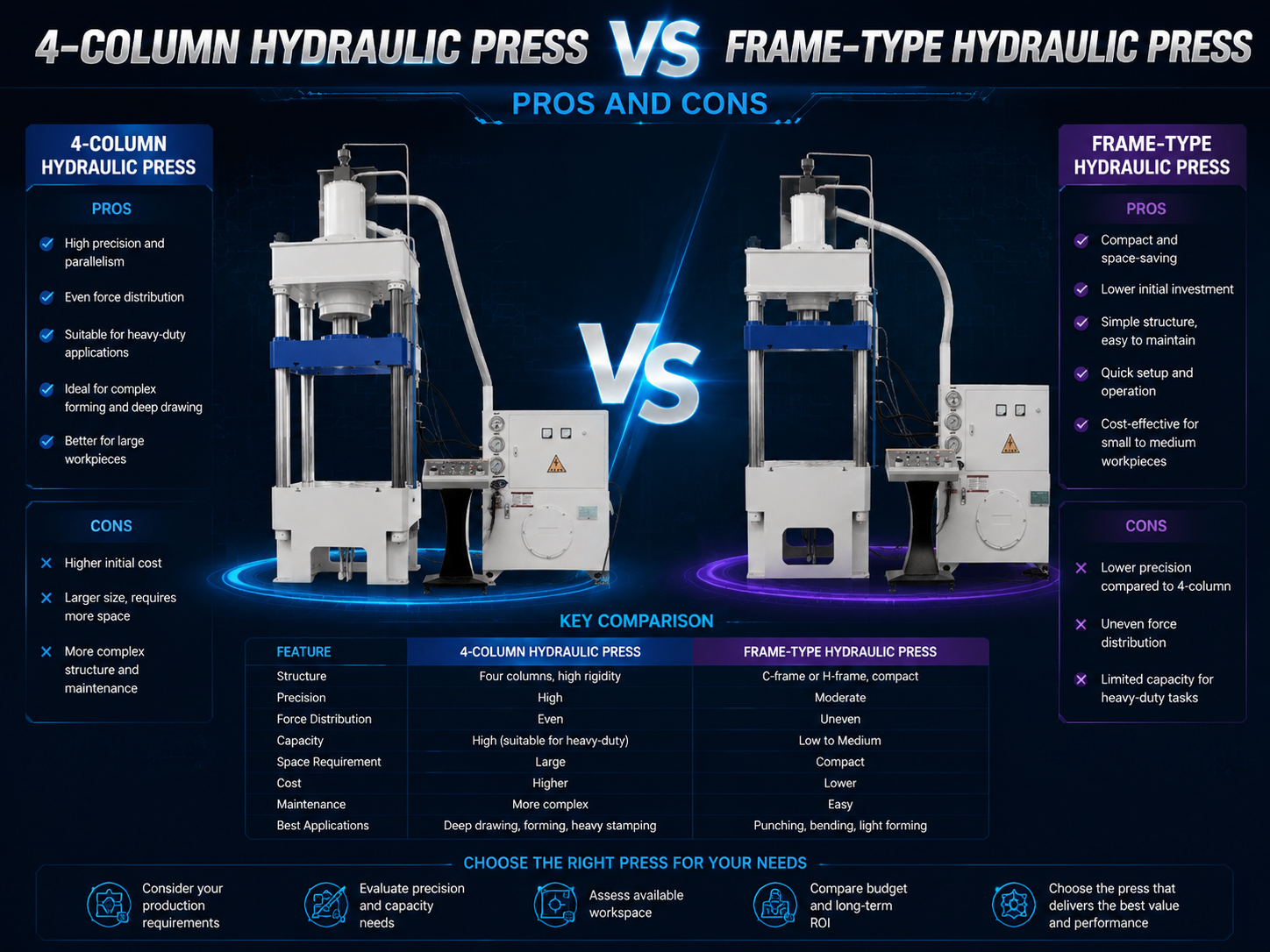
Comparison Summary: Navigating the Choice Between 4-Column and Frame-Type Presses
In the world of industrial metal fabrication, selecting the right hydraulic press is a foundational decision that impacts production efficiency, part accuracy, and long-term operational costs. The debate often centers on two primary structural designs: the 4-column hydraulic press and the frame-type (often referred to as H-frame or gantry-type) hydraulic press. While both machines utilize hydraulic fluid to generate massive force for forming, bending, and punching, their structural architectures offer distinct advantages and limitations.
The 4-column hydraulic press is renowned for its versatility and accessibility. Its design features four precision-ground pillars that guide the moving bolster, allowing for 360-degree access to the work area. This makes it a favorite for complex die setups and automated production lines where material feeding from multiple angles is required. Conversely, the frame-type hydraulic press is built for maximum rigidity and resistance to deflection. By utilizing a heavy-duty welded steel frame, these machines provide superior stability under high-tonnage loads, making them ideal for high-precision stamping and heavy-plate processing.
Choosing between these two requires a deep understanding of your specific manufacturing requirements. Factors such as the required tonnage, the complexity of the workpiece, the need for automation, and the available floor space all play a role. HARSLE, a leader in metal fabrication machinery, provides both configurations, ensuring that whether you prioritize accessibility or structural stiffness, there is a solution tailored to your shop’s needs. This guide will break down the technical nuances, pros, and cons of each type to help you make an informed investment.
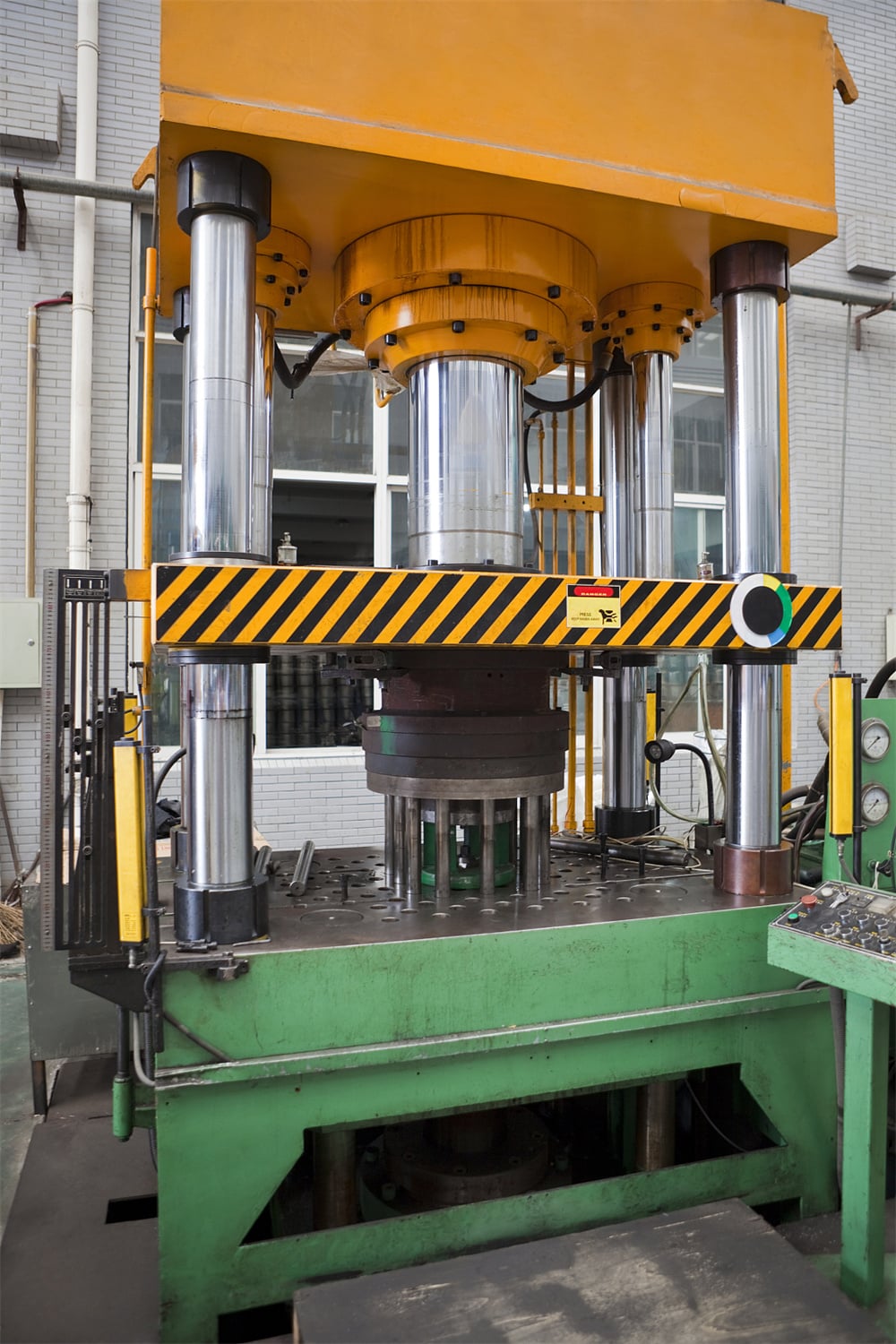
4-Column Hydraulic Press Overview: Versatility and Accessibility
The 4-column hydraulic press, often categorized under the Y32 series in industrial nomenclature, is perhaps the most recognizable form of hydraulic machinery. Its structure consists of a top crown, a bottom bed, and four vertical columns that connect the two. The slide (or moving platen) travels up and down these columns, guided by high-precision bushings. This design is inherently balanced, distributing the pressing force across the four pillars, which helps maintain parallelism between the upper and lower bolsters.
One of the primary advantages of the 4-column design is its open architecture. Because there are no side walls, operators and automated systems can access the die area from the front, back, left, and right. This is particularly beneficial for deep drawing applications, where large blanks need to be loaded and finished parts removed efficiently. Furthermore, the 4-column press is generally more cost-effective to manufacture in the mid-to-high tonnage range compared to a frame-type press of the same capacity, offering an excellent return on investment for general-purpose fabrication.
However, the 4-column design does have its drawbacks. Under extreme pressure, the columns can experience slight “stretching” or lateral movement if the load is significantly off-center. While modern HARSLE machines utilize advanced finite element analysis (FEA) to minimize this, the inherent design is slightly less rigid than a fully enclosed frame. This makes the 4-column press better suited for applications where absolute micron-level rigidity is less critical than operational flexibility and ease of maintenance.
Maintenance on a 4-column press is relatively straightforward. The columns require regular lubrication to ensure the bushings slide smoothly, and the hydraulic seals are easily accessible. For shops that handle a wide variety of parts and require frequent die changes, the 4-column press remains the industry standard for flexibility. It is widely used in the production of household appliances, automotive components, and plastic products through compression molding.
Frame-Type Hydraulic Press Overview: Rigidity and Precision
The frame-type hydraulic press, often referred to as an H-frame or Gantry press (Y27 or Y28 series), is engineered for applications where structural integrity is the highest priority. Instead of four independent columns, this machine features a unified, heavy-duty welded frame. This “closed-loop” structure is designed to absorb the massive stresses generated during the pressing cycle, virtually eliminating the risk of frame deflection or “yawning” that can occur in open-frame designs.
The slide in a frame-type press is typically guided by long, adjustable gibs (usually 4-point or 8-point guiding systems) located on the inner walls of the frame. This guiding system is significantly more robust than the bushings used in 4-column presses. It allows the machine to handle significant off-center loads without compromising the alignment of the die. This makes the frame-type press the go-to choice for high-precision stamping, fine blanking, and heavy-duty forging where the slightest misalignment could result in tool damage or defective parts.
While the frame-type press offers unmatched precision, it does come with trade-offs in terms of accessibility. The side walls of the frame restrict access to the front and back of the machine. While windows can be cut into the side frames for material feeding, the overall workspace is more confined than that of a 4-column press. Additionally, because of the massive amount of steel required to build a rigid frame, these machines are typically heavier and more expensive than their 4-column counterparts.
For manufacturers working with high-strength alloys or performing complex multi-stage forming, the frame-type press is often the only viable option. The rigidity ensures that the energy of the hydraulic ram is directed entirely into the workpiece rather than being lost to frame flex. HARSLE’s frame-type presses are built with stress-relieved steel plates, ensuring that the machine maintains its accuracy over decades of heavy industrial use.
Specification Comparison Table
To better understand the technical differences, the following table compares the standard characteristics of HARSLE’s 4-column and frame-type hydraulic presses.
| Feature | 4-Column Hydraulic Press | Frame-Type Hydraulic Press |
|---|---|---|
| Structural Design | Four vertical pillars with a moving slide. | Welded H-frame or Gantry with internal guides. |
| Rigidity | Moderate; prone to slight flex under off-center loads. | High; designed to resist deflection and vibration. |
| Accessibility | Excellent (360-degree access). | Limited (Front and back access only). |
| Guiding Precision | Bushing-based; good for general forming. | Gib-based (4/8-point); superior for precision. |
| Off-Center Loading | Limited tolerance; requires centered loads. | High tolerance; handles asymmetrical loads well. |
| Typical Applications | Deep drawing, molding, general assembly. | Heavy stamping, forging, high-accuracy blanking. |
| Cost | Generally lower for the same tonnage. | Higher due to material and construction complexity. |
Best-fit Applications: Choosing the Right Tool for the Job
The choice between a 4-column and a frame-type press is often dictated by the specific part being manufactured. For 4-column hydraulic presses, the ideal applications involve large, relatively thin workpieces that require deep drawing or complex material handling. For example, in the production of stainless steel sinks or automotive body panels, the ability to feed large sheets from the side and remove the finished product from the front is a major logistical advantage. Additionally, industries like powder metallurgy and rubber molding favor the 4-column design because it allows for easy installation of heating elements and auxiliary ejectors.
On the other hand, frame-type hydraulic presses excel in high-stress environments. If your process involves thick plate bending, heavy-duty punching, or high-speed stamping, the frame-type is the superior choice. In the aerospace industry, where parts must meet incredibly tight tolerances, the rigidity of the H-frame ensures that every stroke is identical. Similarly, in the manufacturing of heavy machinery components or structural steel parts, the frame-type press provides the necessary force without the risk of structural fatigue over time.
Another critical consideration is the use of progressive dies. Progressive die stamping involves multiple stages of forming within a single tool. This often results in off-center loading as different stages of the die engage at different times. A 4-column press may struggle with the resulting lateral forces, leading to premature wear on the bushings and the die itself. A frame-type press, with its 8-point gib guiding, is specifically designed to counteract these forces, making it the preferred choice for multi-stage automated stamping lines.
Cost and Maintenance Comparison
When evaluating the total cost of ownership, both initial capital expenditure and long-term maintenance must be considered. Generally, a 4-column hydraulic press has a lower purchase price. The construction is simpler, requiring less steel and less complex machining of the frame. For a startup or a shop looking to add capacity for general-purpose work, the 4-column press offers the fastest path to profitability. Maintenance involves keeping the columns clean and lubricated, checking the hydraulic oil quality, and replacing bushings every few years depending on the duty cycle.
The frame-type hydraulic press represents a larger initial investment. The cost of the heavy-duty welded frame and the precision-ground gibs adds to the price tag. However, this investment often pays off in reduced tooling costs. Because the frame is more rigid, the dies experience less wear and tear from misalignment, extending the life of expensive tooling. Maintenance on a frame-type press is slightly more involved, as the gibs must be periodically adjusted to maintain the correct clearance for the slide. However, modern HARSLE machines feature automatic lubrication systems that significantly reduce the manual labor required for upkeep.
Energy efficiency is another factor. Both types of presses from HARSLE can be equipped with servo-hydraulic systems. These systems use servo motors to drive the hydraulic pumps, consuming energy only when the machine is actually moving. This can reduce electricity costs by up to 50% compared to traditional constant-delivery pump systems, regardless of the frame style chosen. When considering cost, always look at the “cost per part” over the machine’s lifespan rather than just the sticker price.
Recommendation: Which HARSLE Press Should You Buy?
The final decision should be based on a balance of your current production needs and your future growth plans. If your shop handles a wide variety of jobs, requires frequent die changes, and works with relatively balanced loads, the HARSLE 4-Column Hydraulic Press is the most versatile and cost-effective solution. It is the “workhorse” of the industry, capable of handling everything from plastic molding to light metal forming with ease.
However, if your production is focused on high-precision, high-volume stamping, or if you are working with heavy-gauge materials that require maximum rigidity, the HARSLE Frame-Type Hydraulic Press is the better investment. Its ability to handle off-center loads and maintain strict parallelism will result in higher part quality and lower long-term tooling costs. It is the professional choice for dedicated production lines where accuracy is non-negotiable.
Before making a purchase, we recommend consulting with a HARSLE technical expert. By analyzing your part drawings, material specifications, and production volume, we can provide a customized recommendation that includes the optimal tonnage, stroke length, and control system for your specific application. Whether it is a Y32 4-column or a Y27 frame-type, HARSLE ensures that every machine is built to the highest standards of safety and performance.
FAQ: Frequently Asked Questions
1. Can a 4-column press be used for high-precision stamping?
While a 4-column press can perform stamping, it is generally not recommended for high-precision or high-speed stamping of thick materials. The inherent flex in the columns can lead to die misalignment over time. For high-precision work, a frame-type press is much more suitable.
2. Which press is better for deep drawing?
The 4-column hydraulic press is often preferred for deep drawing because of its 360-degree accessibility, which makes it easier to install large dies and integrate sheet feeders or robotic arms for material handling.
3. How do I prevent deflection in a 4-column press?
To minimize deflection, ensure that the load is centered on the bolster. Using a press with a higher tonnage rating than strictly necessary can also help, as the columns will be thicker and more resistant to stretching. HARSLE also offers reinforced column designs for demanding applications.
4. Are frame-type presses harder to maintain?
Not necessarily, but they do require different maintenance. The primary task is adjusting the slide gibs to ensure the slide remains perfectly square to the bed. With HARSLE’s automatic lubrication systems, this process is greatly simplified.
5. What is the lifespan of these machines?
Both 4-column and frame-type presses from HARSLE are designed for industrial use and can last 20-30 years or more with proper maintenance. The frame-type press often has a slight edge in longevity for heavy-duty applications due to its more robust structural design.
6. Can I automate both types of presses?
Yes, both designs can be fully automated. 4-column presses are often easier to integrate with robots due to their open sides, while frame-type presses are frequently used in fully automated progressive die lines with coil feeders and straighteners.