
Welded Frame Hydraulic Press vs Bolted Frame Hydraulic Press: Which Offers Better Stability?


Comparison Summary: The Great Debate in Frame Construction
In the world of metal fabrication, the structural integrity of a hydraulic press is the foundation upon which all precision and power are built. When choosing between a Welded Frame Hydraulic Press Vs Bolted Frame Hydraulic Press: Which Offers Better Stability? is the primary question that engineers and factory managers must answer. Both designs have dominated the industry for decades, yet they serve distinct operational philosophies. A welded frame, often referred to as a monoblock or unitized structure, is prized for its permanent rigidity and resistance to vibration. Conversely, a bolted frame, typically utilizing high-strength tie-rods and nuts, offers modularity and ease of transport for massive tonnages.
Stability in a hydraulic press isn’t just about the machine staying upright; it refers to the frame’s ability to resist deflection under maximum load. When a press exerts hundreds or thousands of tons of force, the frame naturally wants to expand or “yawn.” The method of construction determines how well the machine maintains parallelism between the bolster and the slide. For high-precision stamping and deep drawing, even a fraction of a millimeter of deflection can lead to premature tool wear or defective parts. Therefore, understanding the nuances of frame construction is critical for long-term ROI.
HARSLE has observed that the choice often depends on the specific application, the required tonnage, and the logistical constraints of the facility. While welded frames are the standard for small to medium-sized high-speed operations, bolted frames become almost mandatory when dealing with ultra-heavy-duty presses that exceed the shipping dimensions of standard freight. This article provides a comprehensive deep dive into both technologies to help you determine which configuration offers the superior stability required for your production line.
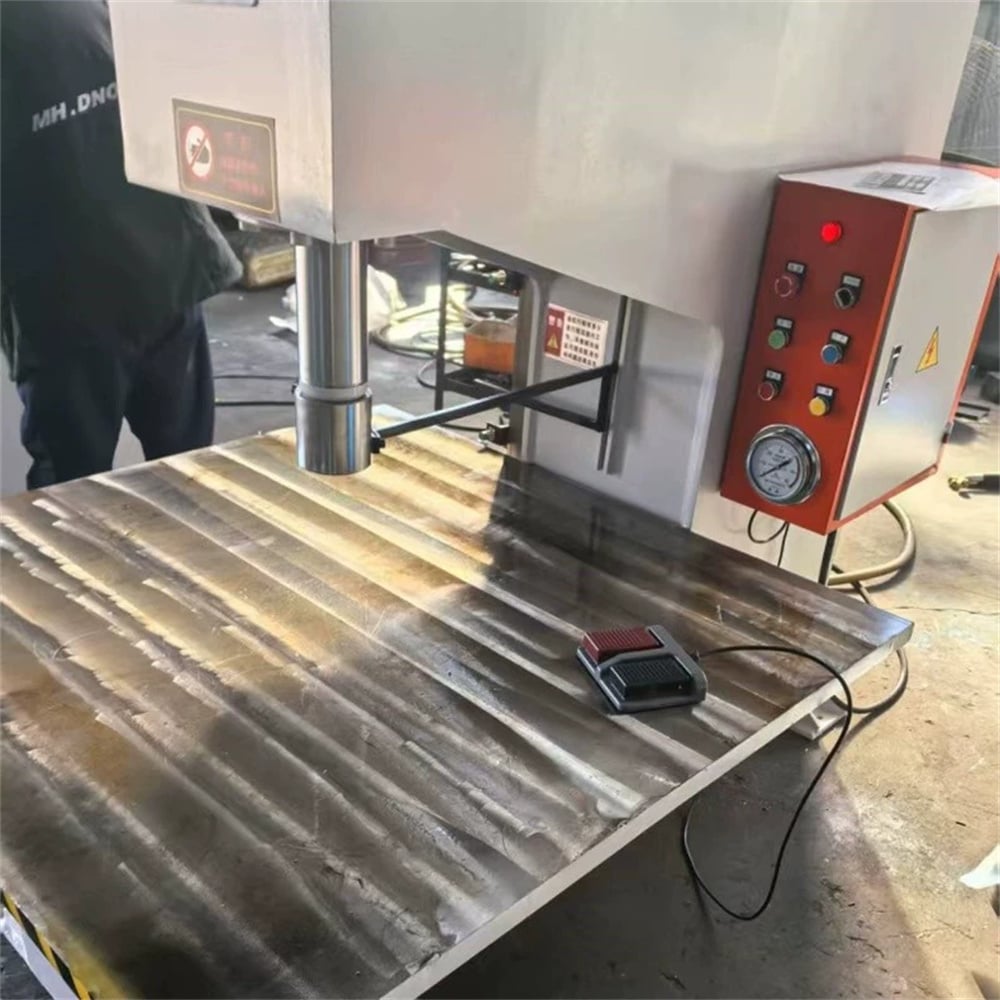
Welded Frame Hydraulic Press Overview
The welded frame hydraulic press is the workhorse of modern manufacturing. These machines are constructed by joining heavy steel plates through advanced welding processes, such as CO2 shielded arc welding or submerged arc welding. The goal is to create a single, unified body that acts as a monolithic structure. Because there are no mechanical joints or fasteners holding the primary frame together, the risk of components shifting or loosening over time is virtually non-existent. This inherent unity is the primary reason why many operators associate welded frames with superior “static” stability.
One of the critical steps in manufacturing a high-quality welded frame is the stress-relief process. After welding, the entire frame is typically placed in a large annealing furnace. This heat treatment eliminates the internal stresses created during the cooling of the weld beads. Without this step, a welded frame might warp or crack over years of heavy use. HARSLE utilizes state-of-the-art vibration stress relief and thermal annealing to ensure that our welded frames remain dimensionally stable for decades. Once the stress is relieved, the frame is moved to a large-scale CNC boring and milling machine to ensure that all mounting surfaces are perfectly square and parallel.
The advantages of the welded design extend to its vibration-damping characteristics. Because the frame is a continuous piece of steel, it can absorb and dissipate the shock loads generated during blanking or high-speed punching more effectively than a multi-piece frame. This leads to quieter operation and a longer lifespan for the hydraulic components and seals, which are sensitive to excessive machine vibration. However, the downside is that once a welded press is built, its dimensions are fixed. If you need to move the machine to a different facility with narrow doors or low ceilings, the monolithic nature of the frame can become a significant logistical challenge.
Furthermore, welded frames are generally more cost-effective for presses in the 50-ton to 1000-ton range. The manufacturing process is streamlined, and the lack of expensive high-tension tie-rods reduces the overall material cost. For industries like automotive component manufacturing, appliance housing production, and general metal bending, the welded H-frame or C-frame provides the perfect balance of rigidity, footprint, and price.
Bolted Frame (Tie-Rod) Hydraulic Press Overview
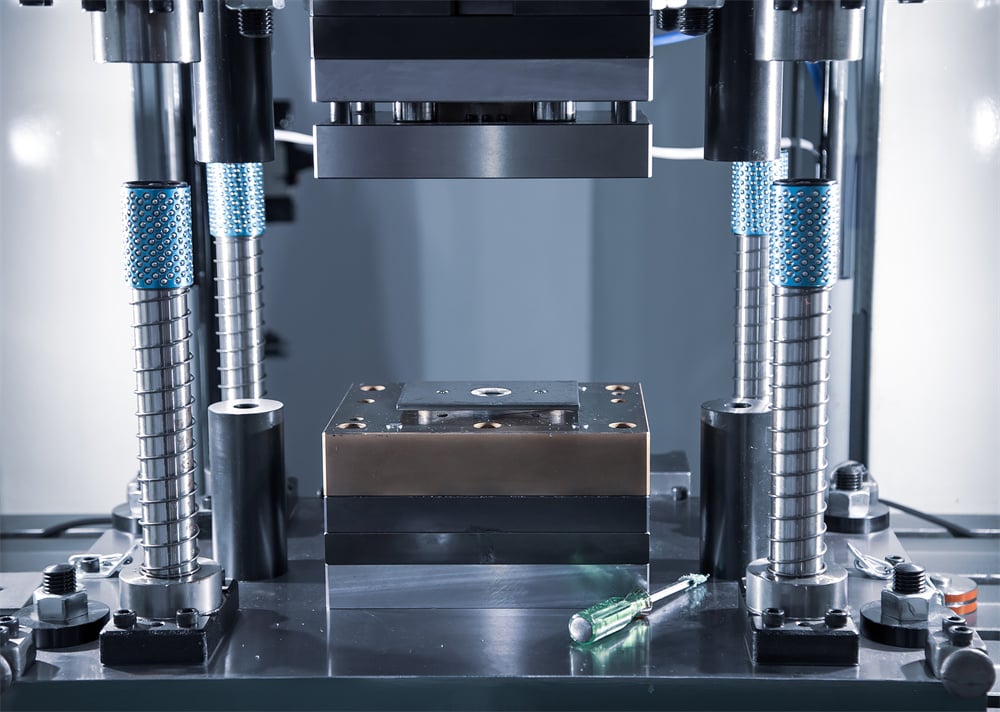
The bolted frame hydraulic press, often called a tie-rod frame, is a marvel of mechanical engineering designed for flexibility and extreme power. Unlike the welded design, a bolted frame consists of several major components: the upper crown (head), the side columns (uprights), and the lower bed (base). These components are held together by four massive steel tie-rods that pass through the corners of the structure. Large nuts are then tightened onto the ends of these rods to compress the entire assembly into a single unit.
The secret to the stability of a bolted frame lies in the “pre-tensioning” of the tie-rods. During assembly, the tie-rods are often heated or stretched using hydraulic tensioners before the nuts are tightened. As the rods cool or the tensioners are released, they shrink, exerting a massive compressive force on the columns. This pre-load ensures that the frame components stay in contact even when the press is operating at full capacity. If the pre-load is calculated correctly, the bolted frame can exhibit rigidity that rivals or even exceeds that of a welded frame in specific high-tonnage applications.
One of the primary reasons manufacturers choose a bolted frame is for logistics. For presses exceeding 1500 or 2000 tons, the physical size of a welded frame would be impossible to transport via road or rail. A bolted frame can be shipped in sections and assembled on-site at the customer’s factory. This modularity also makes the machine easier to repair. If a specific component, such as the bed, becomes damaged after years of service, it can theoretically be replaced without scrapping the entire machine. In a welded press, a major structural failure often means the end of the machine’s life.
However, bolted frames require more rigorous maintenance. Over time, the constant cycling of the press and the resulting vibrations can cause the tie-rod nuts to lose their precise tension. If the frame becomes “loose,” the parallelism of the slide will suffer, leading to catastrophic tool failure. Therefore, factories using bolted presses must implement regular inspections of the tie-rod tension. While they offer incredible versatility for massive industrial projects, they demand a higher level of technical oversight to maintain their stability.
Specification Comparison Table
To better understand the technical differences, the following table compares the typical characteristics of welded vs. bolted frame designs across several key performance indicators.
| Feature | Welded Frame (Monoblock) | Bolted Frame (Tie-Rod) |
|---|---|---|
| Primary Construction | Steel plate welding with stress relief | Sectional crown, bed, and columns |
| Typical Tonnage Range | 50T – 1200T | 1000T – 10,000T+ |
| Rigidity/Deflection | Excellent (Fixed structure) | High (Dependent on tie-rod tension) |
| Vibration Damping | Superior (Continuous material) | Moderate (Joints can dissipate energy) |
| Maintenance Needs | Low (Check welds periodically) | High (Regular tie-rod tension checks) |
| Transportability | Difficult for large sizes | Excellent (Modular shipping) |
| Initial Cost | Lower (Simpler manufacturing) | Higher (Precision machining of joints) |
| Customization | Limited once welded | High (Modular components) |
Best-fit Applications for Each Design
Welded Frame Applications
Welded frame hydraulic presses are the preferred choice for high-speed, high-precision environments where the machine’s footprint needs to be minimized. In the automotive industry, these presses are frequently used for stamping small to medium-sized brackets, interior panels, and engine components. The rigidity of the welded H-frame ensures that the dies remain perfectly aligned even during rapid cycling, which is essential for maintaining tight tolerances in mass production.
Furthermore, welded frames are ideal for deep drawing operations. Because the frame is a single unit, it handles the sustained pressure of a deep draw without the “breathing” effect that can sometimes occur in poorly maintained bolted frames. They are also widely used in the electronics industry for housing fabrication and in the appliance industry for making refrigerator panels and washing machine drums. If your production requires a machine that you can “set and forget” with minimal structural maintenance, the welded frame is the winner.
Bolted Frame Applications
Bolted frame presses shine in heavy industrial sectors where the sheer force required exceeds the practical limits of a welded structure. In aerospace manufacturing, bolted presses are used to form large fuselage sections and wing components. These parts require massive beds and high tonnages that only a modular tie-rod design can provide. The ability to assemble these giants inside a facility that might not have the overhead clearance for a pre-welded unit is a game-changer.
Another key area is forging and heavy plate forming. In these applications, the machine is subjected to extreme shock loads. The bolted design, with its pre-tensioned tie-rods, acts like a giant spring that can absorb these massive energy releases more gracefully than a rigid weldment. If a weld were to fail under such extreme shock, it could be catastrophic; in a bolted press, the energy is distributed through the rods. Additionally, for research and development facilities that may need to modify their press configuration in the future, the bolted frame offers a level of flexibility that a welded frame simply cannot match.
Cost and Maintenance Comparison
When evaluating the total cost of ownership (TCO), the welded frame usually has a lower entry point. The manufacturing process—cutting steel, welding, annealing, and machining—is a well-established industrial workflow that HARSLE has optimized for efficiency. Maintenance for a welded frame is relatively straightforward: it involves routine checks of the hydraulic oil, seal replacements, and occasional ultrasonic testing of the weld joints in high-stress areas. For most small to medium shops, the welded frame represents the most economical path to reliable production.
Bolted frames, however, involve a higher initial investment. The cost of manufacturing high-tensile tie-rods, precision-machining the mating surfaces of the crown and bed, and the labor-intensive assembly process adds up. Furthermore, the maintenance schedule for a bolted press is more demanding. If the tie-rods are not checked and re-tensioned according to the manufacturer’s specifications, the frame can lose its squareness. This leads to uneven wear on the slide guides (gibbing) and can eventually damage the main hydraulic cylinders.
However, one must consider the “repairability” factor. If a welded frame develops a major structural crack in the main pillar, the repair is complex, requiring specialized on-site welding and potentially another round of stress relief, which is often impossible. In contrast, a bolted frame allows for the replacement of individual columns or rods. For a company planning to run a machine for 30 or 40 years, the modularity of the bolted design might actually result in a lower TCO despite the higher upfront and maintenance costs.
Recommendation: Which Should You Choose?
The decision between a Welded Frame Hydraulic Press Vs Bolted Frame Hydraulic Press ultimately comes down to three factors: Tonnage, Precision Requirements, and Logistics.
- Choose a Welded Frame if: Your required tonnage is under 1200 tons, you prioritize high-speed precision, you want a lower initial purchase price, and you have the facility access to move a single-piece machine. It is the best choice for 90% of standard metal forming, bending, and stamping tasks.
- Choose a Bolted Frame if: You require a press over 1500 tons, you are forming exceptionally large parts (like aerospace or ship components), you need to install the machine in a restricted space where it must be assembled on-site, or you want the ability to replace major structural components in the future.
At HARSLE, we recommend that buyers look closely at their 5-year production plan. If you anticipate moving your factory or significantly increasing the size of your workpieces, the modularity of a bolted frame might be worth the extra investment. However, for the vast majority of stable, high-volume production environments, the welded frame offers the best “stability-to-cost” ratio in the industry.
Frequently Asked Questions (FAQ)
1. Does a welded frame lose stability over time?
If the frame was properly stress-relieved during manufacturing, it should not lose stability. However, if the press is consistently overloaded beyond its rated capacity, micro-cracks can form in the welds, which will eventually compromise the structure. Regular inspections are key.
2. Can a bolted frame be as precise as a welded one?
Yes, but it requires more maintenance. A properly pre-tensioned bolted frame can achieve excellent parallelism. The challenge is that the tension must be monitored. If the nuts loosen even slightly, the precision will drop immediately.
3. Why are most small presses welded?
Efficiency and cost. For smaller tonnages, the benefits of a bolted frame (like modularity) don’t outweigh the higher manufacturing costs. Welding provides a very rigid, compact, and affordable solution for smaller machines.
4. How often should tie-rods be checked on a bolted press?
Most manufacturers recommend a visual inspection every month and a full tension check every 6 to 12 months, depending on the shift intensity and the type of work (e.g., heavy shock loads require more frequent checks).
5. Is it possible to convert a welded press to a bolted one?
No. The engineering philosophies are fundamentally different. A welded press is designed as a single unit, while a bolted press is designed as a series of interlocking components. You must choose the correct frame type at the time of purchase.
6. Which frame type is better for vibration damping?
Generally, the welded frame is better for damping high-frequency vibrations because there are no gaps or joints for the energy to travel through. However, for massive, low-frequency shock loads, the “give” in a bolted tie-rod system can sometimes be advantageous for the machine’s longevity.