
How Laser Cutting Machines Enhance Prototype and Low-Volume Production


Introduction to Agile Manufacturing with Laser Technology
In the modern industrial landscape, the ability to transition quickly from a conceptual design to a physical prototype is a significant competitive advantage. Traditional manufacturing methods, while efficient for mass production, often struggle with the high costs and long lead times associated with low-volume runs. This is where Laser Cutting Machines Enhance Prototype Low-Volume Production. By eliminating the need for expensive hard tooling and offering unparalleled flexibility, fiber laser cutting technology has become the backbone of agile manufacturing.
HARSLE, a leader in metal fabrication machinery, understands that today’s engineers and designers require precision and speed. Whether you are developing a new automotive component or a specialized medical instrument, the laser cutting process allows for rapid iterations. This article explores the technical nuances, application scenarios, and strategic benefits of utilizing laser cutting machines for small-scale production and prototyping.
Application Scenarios for Prototype and Low-Volume Production
The versatility of laser cutting makes it suitable for a wide array of industries. In the automotive sector, for instance, manufacturers often need to produce a handful of brackets, heat shields, or structural reinforcements for crash testing or aerodynamic evaluation. Using traditional stamping dies for these few parts would be financially ruinous. Laser cutting allows these parts to be produced directly from a CAD file in minutes.
In the aerospace industry, where components are often complex and materials are expensive, the precision of a fiber laser is indispensable. Low-volume production of specialized engine baffles or interior cabin hardware requires a process that minimizes material waste and ensures structural integrity. Laser cutting provides the clean edges and tight tolerances necessary for flight-critical hardware without the mechanical stress induced by traditional shearing.
Medical device manufacturing also benefits significantly. Prototyping surgical tools or diagnostic equipment enclosures requires high levels of hygiene and precision. Laser cutting machines can handle stainless steel and titanium with ease, producing burr-free edges that require minimal post-processing. This speed allows medical startups to move through clinical trial phases much faster than previously possible.
Architectural modeling and custom signage are other areas where low-volume production is the norm. Architects often require intricate metal screens or structural models that are unique to a single project. The ability to program a laser cutter to follow complex geometric patterns allows for creative freedom that was once limited by the capabilities of manual fabrication tools.
Material and Process Requirements
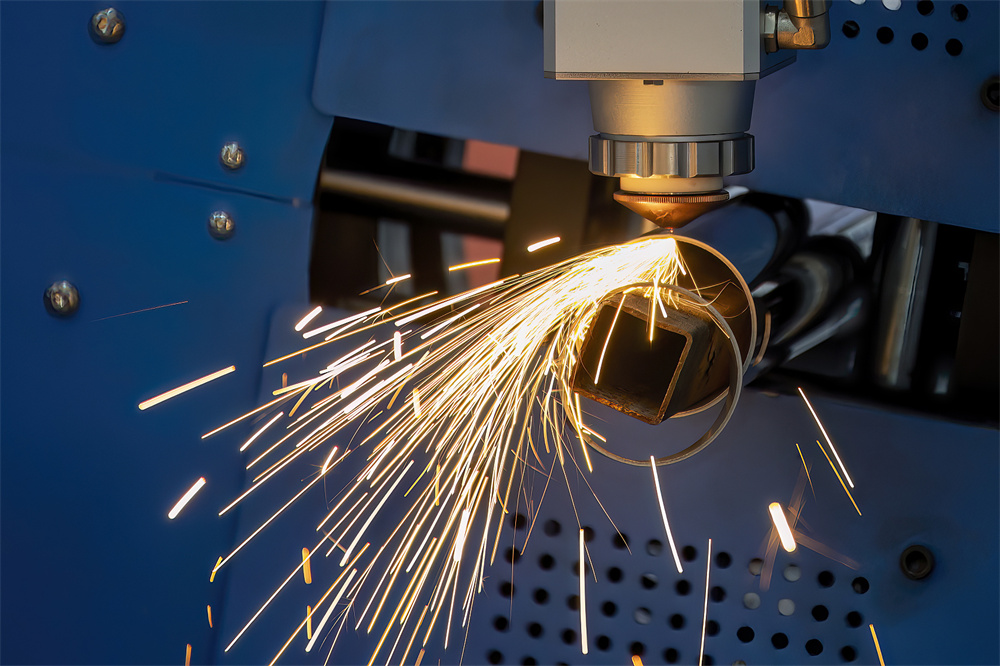
When considering how Laser Cutting Machines Enhance Prototype Low-Volume Production, understanding material compatibility is crucial. Fiber lasers are exceptionally efficient at cutting a variety of metals, including carbon steel, stainless steel, aluminum, brass, and copper. Each material presents unique challenges that the machine must be configured to handle.
For carbon steel, oxygen is typically used as the assist gas to facilitate an exothermic reaction, which increases cutting speed. However, for prototyping where edge quality is paramount, nitrogen may be used to prevent oxidation, resulting in a clean, paint-ready surface. Stainless steel and aluminum are almost always cut with nitrogen to maintain the material’s corrosion resistance and provide a bright, smooth finish.
The thickness of the material also dictates the process requirements. Prototyping often involves thin-gauge sheets (0.5mm to 3mm) where high-speed cutting and minimal heat-affected zones (HAZ) are required. However, low-volume production might also involve heavy plates for industrial machinery bases. A high-power fiber laser (e.g., 6kW to 12kW) can transition between these tasks seamlessly by adjusting the focal point and gas pressure settings within the CNC controller.
Tolerance requirements in prototyping are often stricter than in mass production because the prototype serves as the master template for future manufacturing. Modern laser cutters can achieve tolerances within ±0.05mm. This level of accuracy ensures that when multiple parts are assembled, they fit perfectly, allowing engineers to validate the design’s mechanical integrity without doubting the fabrication quality.
Recommended Machine Configuration for Prototyping
For shops focusing on prototypes and low-volume orders, the machine configuration must prioritize flexibility and ease of setup. HARSLE recommends a fiber laser cutting machine equipped with a high-quality laser source, such as Raycus or IPG, ranging from 3kW to 6kW for general-purpose work.
- Laser Source: A 3kW fiber laser is often the “sweet spot” for prototyping, offering enough power to cut up to 20mm carbon steel while maintaining excellent beam quality for thin materials.
- Cutting Head: An autofocus cutting head (like Raytools) is essential. It allows the machine to automatically adjust the focus for different material thicknesses, reducing setup time between different prototype jobs.
- Control System: A user-friendly CNC system like CypCut is highly recommended. It supports direct import of DXF/AI files and features built-in nesting software, which is vital for maximizing material usage on small batches.
- Bed Design: A dual-platform exchange table is beneficial even for low-volume work, as it allows the operator to unload finished parts and load new sheets while the machine is still cutting, maximizing uptime.
- Cooling and Filtration: A robust industrial chiller and a high-efficiency dust extraction system ensure the machine operates consistently during long experimental cuts and maintains a clean working environment.
Workflow: From CAD to Finished Prototype
The workflow for laser cutting in a prototyping environment is significantly streamlined compared to traditional methods. It begins with the digital design. Engineers create 3D models in software like SolidWorks or AutoCAD, which are then exported as 2D vector files (usually .DXF or .DWG).
Once the file is imported into the laser’s CAM software, the nesting process begins. For low-volume production, nesting is used not just for efficiency but to group different parts made from the same material on a single sheet. This “kit cutting” approach ensures that all components for a single prototype assembly are produced simultaneously.
The operator then selects the appropriate cutting parameters from a pre-installed library. These parameters include laser power, cutting speed, gas pressure, and nozzle height. For a new material or a highly specialized design, the operator might perform a “test cut” on a small scrap piece to fine-tune the settings. This iterative capability is a core reason why Laser Cutting Machines Enhance Prototype Low-Volume Production.
After the cutting process is complete, the parts are removed from the slats. Because fiber lasers produce such high-quality edges, post-processing like grinding or deburring is often unnecessary. The parts can move immediately to the next stage, whether it be bending on a HARSLE press brake, welding, or final assembly.

Productivity Benefits of Laser Cutting
The primary benefit of laser cutting in this context is the elimination of tooling costs. In traditional stamping, a single die can cost thousands of dollars and take weeks to manufacture. If the prototype design changes, the die becomes obsolete. With a laser cutter, a design change only requires a few clicks in the software. This “zero-tooling” environment drastically reduces the financial risk of product development.
Speed is another critical factor. A fiber laser can cut complex shapes at speeds exceeding 30 meters per minute. For low-volume production, this means that a batch of 50 parts can be finished in the time it would take to simply set up a traditional milling machine or punch press. This rapid turnaround allows companies to respond to market demands or engineering changes in real-time.
Material utilization is also greatly improved. Advanced nesting algorithms can fit parts into the smallest possible area, reducing scrap. In prototyping, where expensive alloys are often used, the ability to save even 10% of the material can result in significant cost savings over the course of a year. Furthermore, the non-contact nature of laser cutting means there is no tool wear, ensuring that the first part is identical to the hundredth part.
Case Example: Custom Drone Frame Development
Consider a startup company developing a new heavy-lift industrial drone. The frame requires lightweight yet incredibly strong carbon steel and aluminum components with intricate cutouts for sensors and wiring. During the R&D phase, the engineers needed to test three different frame geometries to determine which offered the best vibration dampening.
Using a HARSLE fiber laser cutting machine, the team was able to cut all three versions of the frame in a single afternoon. They used a 3kW source with nitrogen assist to ensure the aluminum edges were clean and ready for anodizing. After testing, they realized the motor mounts needed to be reinforced. They updated the CAD file, and within 20 minutes, the new reinforced parts were cut and ready for assembly.
If they had used traditional machining, each iteration would have taken days of scheduling with a machine shop and significant setup fees. By bringing the laser cutting in-house, the company reduced its development cycle from three months to three weeks, allowing them to secure a patent and enter the market ahead of their competitors.
Frequently Asked Questions (FAQ)
1. What is the maximum thickness a 3kW fiber laser can cut for prototypes?
A 3kW fiber laser can typically cut up to 20mm in carbon steel and 10mm in stainless steel. For prototyping, it is most efficient and precise in the 1mm to 8mm range, providing excellent edge quality and speed.
2. How difficult is it to switch between different materials?
Switching is very simple. With an autofocus cutting head and a modern CNC controller like CypCut, the operator simply selects the new material profile from the software. The machine automatically adjusts the focus and gas settings. The only manual step is usually changing the nozzle if switching between very thin and very thick materials.
3. Is laser cutting cost-effective for a single part?
Yes, absolutely. Since there is no physical tool to create, the cost of cutting a single part is primarily the cost of the material and a few minutes of machine time. This makes it the most cost-effective method for one-off prototypes.
4. Does laser cutting affect the properties of the metal?
Laser cutting does create a small heat-affected zone (HAZ) along the cut edge. However, because fiber lasers cut so quickly, the HAZ is much smaller than that produced by plasma or oxy-fuel cutting. For most prototype applications, the HAZ is negligible and does not affect the structural integrity of the part.
5. What maintenance is required for a laser cutter in a low-volume shop?
Maintenance involves regular cleaning of the protective lenses, checking the water level and temperature in the chiller, and ensuring the rails and racks are lubricated. Because fiber lasers do not have the complex internal mirrors of CO2 lasers, they are much easier to maintain in a small shop environment.
Conclusion: Investing in the Future of Fabrication
The evidence is clear: Laser Cutting Machines Enhance Prototype Low-Volume Production by providing a level of flexibility, precision, and speed that traditional methods cannot match. For businesses looking to innovate and stay ahead of the curve, a fiber laser is not just a tool; it is a strategic asset that enables rapid growth and experimentation.
HARSLE is committed to providing high-quality, reliable laser cutting solutions tailored to the needs of modern manufacturers. Our machines are designed to handle the rigors of production while remaining accessible for the fast-paced world of prototyping. If you are ready to elevate your production capabilities, contact HARSLE today to find the perfect machine for your specific needs.
Ready to Optimize Your Production?
Explore HARSLE’s full range of fiber laser cutting machines and see how we can help you reduce lead times and increase precision. Contact our technical team for a customized quote and a demonstration of our latest technology.












