
How to Troubleshoot Inconsistent Laser Cutting Machine Output Quality


Introduction to Laser Cutting Consistency
In the high-stakes world of industrial metal fabrication, consistency is the hallmark of quality. When a laser cutting machine begins to produce inconsistent results—varying edge roughness, incomplete cuts, or excessive dross—it doesn’t just affect a single part; it threatens the entire production timeline and the manufacturer’s reputation. To troubleshoot inconsistent laser cutting machine output quality, one must adopt a systematic approach that examines the intersection of optics, mechanics, gas dynamics, and software parameters.
HARSLE understands that downtime is the enemy of profitability. Whether you are operating a high-power fiber laser or a precision CO2 system, the physics of the cutting process remains constant. Inconsistency often stems from subtle shifts in the machine’s environment or wear and tear on consumable components. By identifying the root cause of these fluctuations, operators can restore the machine to its peak performance, ensuring that every cut meets the tight tolerances required by modern engineering standards.

This guide is designed to provide a deep dive into the technical variables that influence cut quality. We will explore why a machine might perform perfectly in the morning but fail by the afternoon, and how to implement a maintenance regimen that prevents these issues from recurring. From the purity of the assist gas to the thermal stability of the cutting head, every detail matters when striving for perfection in metal fabrication.
Key Considerations for Output Consistency
Before diving into the mechanical components, it is essential to consider the external factors that influence output. The first consideration is material consistency. Not all steel is created equal; variations in carbon content, surface oxidation, and even the mill’s cooling process can affect how the laser interacts with the metal. If you notice inconsistency, check if the issue persists across different batches of material. Often, what appears to be a machine fault is actually a result of poor-quality raw materials or surface contaminants like oil and rust.
The second major consideration is the environmental stability of the workshop. Laser cutting machines are sensitive to temperature fluctuations. High ambient temperatures can affect the efficiency of the chiller, leading to slight variations in the laser source’s wavelength or power stability. Furthermore, dust and airborne particulates can settle on the protective windows or mirrors, causing beam scattering. Ensuring a clean, temperature-controlled environment is the first step in maintaining a stable cutting process.
Thirdly, the role of the operator cannot be overlooked. Inconsistent output is frequently traced back to manual overrides of optimized cutting parameters. While it may be tempting to increase speed to meet a deadline, doing so without adjusting power or gas pressure can lead to poor edge quality. Standardizing operating procedures and ensuring that all operators are trained on the specific nuances of HARSLE machinery is vital for long-term consistency.
Technical Details: The Science of the Cut
The Optical Path and Beam Integrity
The heart of any laser cutting machine is its optical path. In fiber lasers, this involves the fiber cable, the collimator, and the focusing lens. Any deviation in the alignment of these components will result in an asymmetrical beam profile. To troubleshoot inconsistent laser cutting machine output quality, start by inspecting the protective window (cover glass). Even a microscopic speck of dust can absorb laser energy, creating a localized hot spot that distorts the beam—a phenomenon known as thermal lensing. This causes the focal point to shift during the cut, leading to a clean start but a dross-heavy finish.
Focus position is perhaps the most critical parameter. For thin materials, the focus is usually on or slightly above the surface, while for thick materials, it is buried deep within the plate. If the machine’s Z-axis calibration is off, or if the capacitive height sensor is not functioning correctly, the nozzle-to-workpiece distance will vary. This variation changes the power density at the point of impact, resulting in inconsistent kerf widths and edge roughness.
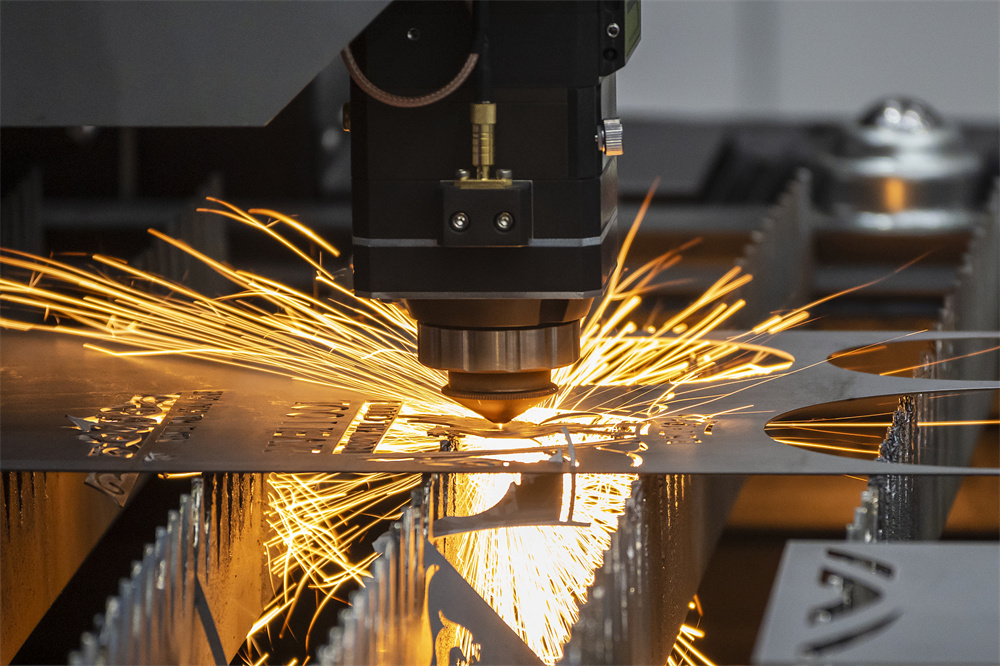
Assist Gas Dynamics
The assist gas (Oxygen, Nitrogen, or Compressed Air) performs two roles: it expels molten material from the kerf and, in the case of oxygen, adds exothermic energy to the process. Inconsistency often arises from fluctuations in gas pressure or purity. For instance, if the nitrogen purity drops even by 0.1%, the resulting oxidation can cause a yellowing of the edge and increased dross. Operators should check the gas delivery system for leaks or bottlenecks that might cause pressure drops during high-flow operations.
Nozzle condition and centering are equally important. A damaged nozzle or one that is not perfectly centered with the laser beam will cause the gas flow to be turbulent. This turbulence prevents the clean ejection of melt, leading to “bearding” or dross on one side of the cut while the other side remains clean. Regularly checking the nozzle centering using the “tape test” is a fundamental troubleshooting step.
Mechanical Precision and Motion Control
The mechanical integrity of the gantry and drive system dictates the machine’s ability to follow the programmed path accurately. Inconsistent quality in corners or small circles often points to mechanical backlash or vibration. Check the tension of the belts, the lubrication of the rack and pinion, and the tightness of the linear guides. If the machine vibrates at certain frequencies, it can cause a “wavy” pattern on the cut edge, which is a clear sign of resonance issues in the motion control system.
| Symptom | Potential Cause | Recommended Action |
|---|---|---|
| Heavy Dross at Bottom | Focus too high or speed too fast | Lower focus or decrease cutting speed |
| Rough Edge Surface | Gas pressure too low or nozzle damaged | Increase gas pressure; replace nozzle |
| Incomplete Cutting | Laser power decay or dirty lens | Check laser source; clean/replace optics |
| Inconsistent Kerf Width | Thermal lensing or Z-axis instability | Check cooling system; calibrate height sensor |
Troubleshooting Step-by-Step
Step 1: Visual Inspection of Consumables
Start with the easiest fixes. Remove the nozzle and inspect it for any signs of contact with the workpiece or internal erosion. Even a slight deformation of the nozzle orifice can ruin the gas flow laminarity. Next, check the protective window. Use a high-intensity light to look for pits, burns, or dust. If the window is dirty, clean it using approved optical grade wipes and solvent, or replace it if it shows signs of permanent damage.
Step 2: Verify Beam Centering and Focus
Perform a centering test using thermal paper or clear tape. Fire a short pulse at low power to see if the beam hole is perfectly centered in the nozzle. If it is off-center, adjust the X and Y alignment screws on the cutting head. Once centered, verify the focus. Many modern HARSLE machines feature auto-focus heads; ensure the software calibration matches the physical focal point by performing a focus find test on a scrap piece of material.
Step 3: Monitor Gas Flow and Pressure
While the machine is cutting, monitor the pressure gauge at the regulator and the software readout. If there is a significant discrepancy or if the pressure fluctuates, the issue may lie in the gas supply lines or the proportional valve. Ensure that the gas hoses are of the correct diameter for the required flow rate, especially when cutting thick stainless steel with high-pressure nitrogen.
Step 4: Analyze the Cooling System
The chiller is the unsung hero of laser consistency. Check the water temperature and flow rate. If the water is too warm, the laser source and the cutting head will expand slightly, shifting the optical alignment. Ensure the chiller filters are clean and the coolant level is topped up with the correct ratio of deionized water and additive. A fluctuating chiller temperature is a common cause of “drifting” cut quality over the course of a shift.
Selection Advice for High-Precision Equipment
When looking to upgrade or purchase a new machine to avoid these common pitfalls, certain features are non-negotiable. First, prioritize machines with a robust, heat-treated frame. A machine bed that warps over time will never produce consistent results, regardless of the laser source’s quality. HARSLE utilizes high-strength steel frames that undergo stress-relief annealing to ensure long-term structural stability.
Second, consider the quality of the motion control components. Look for world-class servo motors (such as Yaskawa or Panasonic) and high-precision gear reducers. These components ensure that the machine can handle high accelerations without losing position or inducing vibrations. A machine with a high-end CNC controller will also offer better algorithms for cornering and power modulation, which are essential for maintaining quality on complex geometries.
Third, evaluate the cutting head technology. An intelligent cutting head with integrated sensors for temperature, pressure, and contamination can provide real-time feedback to the operator. This allows the machine to automatically compensate for minor variations, significantly reducing the need for manual troubleshooting. Investing in a machine with a reputable fiber laser source (like Raycus or IPG) also ensures that the beam quality remains stable over thousands of hours of operation.
Frequently Asked Questions (FAQ)
Why does my laser cut well in one direction but poorly in another?
This is almost always a sign of nozzle misalignment or a damaged nozzle. If the laser beam is not perfectly centered, the gas flow will be uneven, causing the melt to be blown out effectively in one direction but trapped in the other. It can also indicate a problem with the beam’s circularity or a mechanical issue in one of the axes.
How often should I calibrate the height sensor?
The capacitive height sensor should be calibrated daily or whenever you change the nozzle. Changes in nozzle size or shape affect the capacitance measurement, which can lead to an incorrect nozzle-to-plate distance. Most HARSLE machines have a one-touch calibration routine that takes only a few seconds.
Can the type of assist gas affect the lifespan of my optics?
While the gas itself doesn’t damage the optics, the quality of the gas delivery system does. If your compressed air system doesn’t have adequate filtration and drying, oil and moisture can reach the cutting head, quickly contaminating the protective window and potentially damaging the focusing lens.
What is the most common cause of sudden power loss?
Sudden power loss is usually attributed to a contaminated optical component (like the protective window) or a failure in the laser source’s delivery fiber. However, before assuming the worst, check the simplest cause: a loose connection in the control cable or an incorrect setting in the software’s power-frequency table.
Conclusion
To troubleshoot inconsistent laser cutting machine output quality, one must look beyond the surface and understand the synergy between the machine’s various systems. Consistency is not an accident; it is the result of meticulous maintenance, high-quality components, and a deep understanding of the cutting process. By following the steps outlined in this guide—from checking optics and gas dynamics to ensuring mechanical precision—operators can minimize waste and maximize productivity.
HARSLE remains committed to providing fabricators with the tools and knowledge they need to succeed. Our machines are engineered for reliability, but even the best equipment requires a proactive approach to maintenance. By mastering these troubleshooting techniques, you ensure that your HARSLE laser cutting machine remains a cornerstone of your production line, delivering precision-cut parts day in and day out. Remember, in the world of metal fabrication, the difference between a good part and a scrap part often comes down to the smallest of adjustments.












