Comprehensive Guide: How to Calculate Bending Force for a Press Brake Machine


Technical Overview of Press Brake Bending Force
In the world of precision metal fabrication, understanding the physics behind material deformation is paramount. The bending force, often referred to as tonnage, is the amount of pressure required by a press brake to bend a specific piece of sheet metal. Accurate calculation is not merely a matter of efficiency; it is a critical safety requirement and a prerequisite for maintaining the structural integrity of your machinery. When you calculate bending force a press brake machine requires, you are essentially determining the limits of your equipment and the behavior of the material under stress.
HARSLE, as a leader in industrial machinery, emphasizes that incorrect tonnage settings can lead to catastrophic tool failure, permanent deformation of the press brake bed (deflection), or poor part quality characterized by inconsistent angles. The bending process involves overcoming the material’s yield strength to achieve permanent plastic deformation. This process is influenced by the material’s thickness, its tensile strength, the length of the bend, and the width of the V-die opening used during the operation.
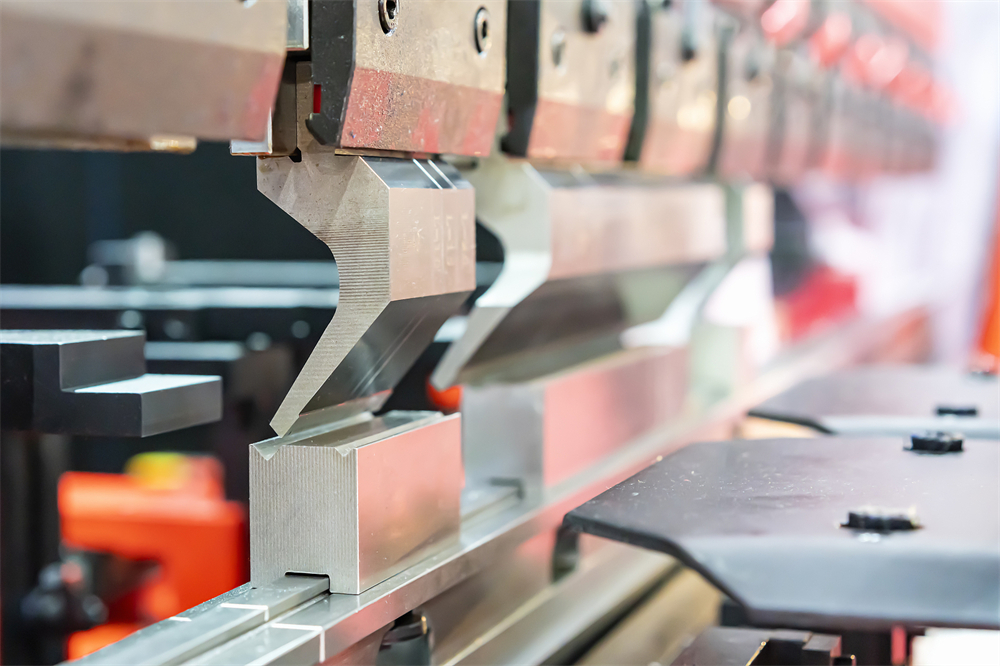
There are two primary methods of bending: air bending and bottoming (or coining). Air bending is the most common method in modern CNC fabrication because it requires significantly less force. In air bending, the material only touches the two edges of the V-die and the tip of the punch. Conversely, bottoming requires the punch to press the material fully into the die, necessitating three to five times more force. This guide focuses primarily on air bending calculations, as they are the standard for most industrial applications using HARSLE equipment.
Furthermore, the mechanical advantage provided by the V-die is a crucial factor. A wider V-die reduces the force required but increases the minimum flange length and the internal bend radius. Balancing these factors is the hallmark of a skilled engineer. By mastering the calculation of bending force, operators can ensure that their press brake operates within its optimal performance envelope, extending the lifespan of both the machine and the tooling.
Core Parameters Influencing Bending Force
To accurately calculate bending force a press brake machine needs, one must first identify and measure four critical parameters. These variables form the foundation of the standard tonnage formula and must be verified before any fabrication begins.
1. Material Thickness (S)
Material thickness is perhaps the most sensitive variable in the equation. In the standard formula, thickness is squared, meaning that even a small increase in gauge can lead to a significant jump in required tonnage. For instance, doubling the thickness of a plate doesn’t just double the force; it quadruples it. Engineers must use precise calipers to measure the actual thickness of the sheet, as nominal gauge sizes can vary between suppliers.
2. Tensile Strength (Rm)
Tensile strength represents the maximum stress that a material can withstand while being stretched or pulled before breaking. Different materials have different resistance levels. Standard mild steel typically has a tensile strength of approximately 450 N/mm², while stainless steel (such as 304 or 316) can range from 600 to 700 N/mm². Aluminum, being softer, requires much less force. When calculating force, a material factor (K) is often applied to account for these variations.
3. Bending Length (L)
The length of the bend refers to the total width of the sheet metal being processed along the die. Tonnage is usually expressed in tons per meter or tons per foot. Therefore, a 3-meter bend will require three times the force of a 1-meter bend of the same material and thickness. It is vital to ensure the press brake’s total tonnage capacity exceeds the calculated force for the entire length of the workpiece.
4. V-Die Opening (V)
The V-opening is the width of the bottom die. The industry standard for air bending is to use a V-opening that is 8 times the material thickness (V=8S) for materials up to 6mm thick. For thicker plates (8mm to 12mm), a V-opening of 10S or 12S is often used. A wider V-opening reduces the required bending force because it increases the leverage (moment arm) during the bend, but it also results in a larger internal radius.
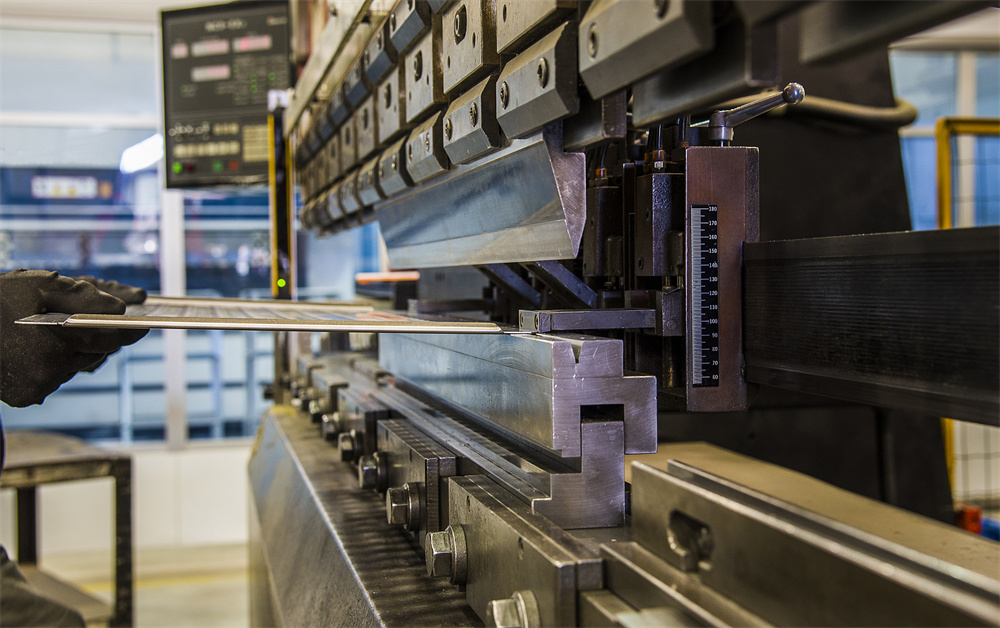
The Standard Calculation Method
The most widely accepted formula to calculate bending force a press brake machine requires for air bending mild steel is as follows:
P = (650 * S² * L) / V
Where:
P = Bending Force (expressed in Kilo-Newtons, kN. To convert to Tons, divide by 9.8 or roughly 10).
S = Material Thickness (mm).
L = Bending Length (m).
V = V-die Opening (mm).
650 = A constant for mild steel with a tensile strength of 450 N/mm².
Step-by-Step Calculation Example
Let’s assume we need to bend a 4mm thick mild steel plate that is 2.5 meters long. Following the 8x rule, we choose a V-die opening of 32mm (4mm * 8).
- Square the thickness: 4 * 4 = 16.
- Multiply by the constant: 16 * 650 = 10,400.
- Multiply by the length: 10,400 * 2.5 = 26,000.
- Divide by the V-opening: 26,000 / 32 = 812.5 kN.
- Convert to tons: 812.5 / 9.8 ≈ 83 Tons.
If the material were stainless steel, we would need to adjust the constant. Since stainless steel is roughly 50% stronger than mild steel, we would multiply the result by 1.5, resulting in approximately 124.5 tons. This adjustment is crucial to prevent underestimating the load on the hydraulic system.
The Role of the Material Factor (K)
While the standard formula uses 650 as a baseline for mild steel, engineers often use a simplified version: P = K * S² * L / V. In this context, K is a variable coefficient. For aluminum, K might be as low as 0.3 to 0.5 times the steel value. For high-tensile strength alloys like Hardox or specialized armored plating, the K factor can be significantly higher. Always consult the material data sheet provided by the metal supplier to determine the exact tensile strength before finalizing your tonnage calculations.
Bending Force Parameter Table (Mild Steel)
The following table provides a quick reference for the required tonnage per meter (T/m) when bending mild steel (Rm = 450 N/mm²) using standard V-die openings.
| Thickness (mm) | V-Opening (mm) | Internal Radius (mm) | Min. Flange (mm) | Force (Tons/Meter) |
|---|---|---|---|---|
| 1.0 | 8 | 1.3 | 5.5 | 7 |
| 1.5 | 12 | 2.0 | 8.5 | 11 |
| 2.0 | 16 | 2.6 | 11.0 | 15 |
| 2.5 | 20 | 3.3 | 14.0 | 18 |
| 3.0 | 24 | 4.0 | 16.5 | 22 |
| 4.0 | 32 | 5.3 | 22.0 | 30 |
| 5.0 | 40 | 6.7 | 28.0 | 38 |
| 6.0 | 48 | 8.0 | 33.0 | 45 |
| 8.0 | 64 | 10.7 | 45.0 | 60 |
| 10.0 | 80 | 13.3 | 55.0 | 75 |
Note: The values above are estimates for air bending. If you are performing bottoming, multiply these values by 3 to 5. Always ensure your machine has a safety margin of at least 20% above the calculated tonnage to account for material variations and hydraulic fluctuations.
Common Engineering Mistakes in Tonnage Calculation
Even with a formula, errors can occur. Avoiding these common pitfalls will protect your HARSLE press brake and ensure high-quality output.
Ignoring Grain Direction
Metal has a grain direction resulting from the rolling process at the mill. Bending transverse to the grain (across the grain) requires more force and is less likely to crack. Bending parallel to the grain requires slightly less force but increases the risk of material fracture. If your calculation is right at the limit of the machine’s capacity, the grain direction could be the factor that causes an overload or a part failure.
Using the Wrong V-Opening
Attempting to bend thick material in a narrow V-die is a frequent mistake. While a narrow V-die allows for a smaller flange, it exponentially increases the pressure required. This can lead to “point loading,” where the concentrated force damages the die rail or the ram. Conversely, using a V-die that is too wide for thin material will result in inaccurate angles and a lack of control over the bend radius.
Neglecting Tooling Limits
Every punch and die has a maximum load rating (expressed in tons per meter). It is possible to calculate bending force a press brake machine can handle, only to realize that the tooling itself cannot withstand that pressure. For example, a narrow gooseneck punch is much weaker than a standard straight punch. Always check the stamped load limit on your tooling before executing a high-tonnage bend.
Calculating for Nominal Rather than Maximum Thickness
Sheet metal thickness tolerances can vary. A “10 gauge” sheet might be slightly thicker than the standard. If your calculation is based on the nominal thickness but the actual material is at the upper limit of the tolerance, you may exceed the machine’s capacity. Always calculate based on the maximum possible thickness of the batch to stay on the safe side.
Selection Checklist for Press Brake Tonnage
When purchasing a new press brake or planning a complex job, use this checklist to ensure your equipment matches your requirements:
- Identify Maximum Material Thickness: What is the thickest material you will realistically bend? Calculate tonnage for this thickness using the smallest V-die you intend to use.
- Determine Maximum Length: Tonnage is cumulative. A 4-meter machine bending 4-meter plate requires significantly more total force than a 2-meter machine.
- Account for Material Type: If you plan to work with stainless steel or high-strength alloys, ensure your machine capacity is at least 50-100% higher than what is required for mild steel.
- Evaluate Tooling Compatibility: Ensure your die holders and punches are rated for the calculated tonnage.
- Consider Future Growth: It is often more cost-effective to purchase a machine with 20% more capacity than you currently need than to replace a machine later because it cannot handle a new contract.
- Check CNC Features: Modern HARSLE CNC press brakes include built-in tonnage calculators that automatically adjust hydraulic pressure based on the entered material parameters, providing an extra layer of safety.
Frequently Asked Questions (FAQ)
What happens if I exceed the press brake tonnage?
Exceeding the rated tonnage can cause several types of damage. The most common is “ram upset” or “bed deflection,” where the machine components permanently deform, meaning the machine will no longer produce straight bends. In extreme cases, hydraulic seals can fail, or the tooling can shatter, posing a significant safety risk to the operator.
How does air bending differ from bottoming in terms of force?
Air bending requires the least amount of force because the material is not pressed into the bottom of the die. Bottoming requires the material to be fully seated, which requires 3-5 times more force. Coining, which actually thins the material at the bend point to eliminate springback, requires 5-10 times the force of air bending. Most modern calculations are based on air bending.
Can I bend a short piece of thick metal on a high-tonnage machine?
Yes, but you must be careful of “concentrated loading.” If you apply 100 tons of force over a 100mm area, the pressure is immense and can indent the bed or the ram. This is known as point loading. Always try to distribute the load or use specialized heavy-duty tooling for short, thick bends.
Why does stainless steel require more bending force?
Stainless steel has a higher yield strength and work-hardens more rapidly than mild steel. This means it resists deformation more strongly, requiring approximately 50% to 60% more pressure to achieve the same bend angle as mild steel of the same thickness.
Does the punch radius affect the bending force?
In air bending, the punch radius has a minimal effect on the required force, provided it is smaller than the natural internal radius created by the V-die. However, if the punch radius is significantly larger, it can change the physics of the bend and slightly increase the required force as more material is being displaced.
How do I calculate force for aluminum?
For most common aluminum alloys (like 5052 or 6061), you can calculate the force for mild steel and then multiply by 0.4 to 0.6. Aluminum is much more ductile and has a lower tensile strength, making it significantly easier to bend, though it is more prone to surface marking.