How CNC Press Brakes Optimize Complex Bending Applications: A Comprehensive Guide


Introduction to Modern Metal Fabrication
In the rapidly evolving landscape of industrial manufacturing, the demand for high-precision, intricate metal components has never been greater. Traditional manual bending methods, while foundational, often struggle to meet the tight tolerances and complex geometries required by modern aerospace, automotive, and electronics industries. This is where the integration of Computer Numerical Control (CNC) technology into press brakes has revolutionized the shop floor. Understanding how CNC press brakes optimize complex bending applications is essential for any fabrication business looking to improve efficiency, reduce waste, and maintain a competitive edge.
A CNC press brake is not merely a machine that applies force; it is a sophisticated system that synchronizes mechanical power with digital precision. By automating the positioning of the backgauge and the movement of the ram, these machines allow for the creation of multi-bend parts in a single setup. This capability significantly reduces the margin for human error and accelerates production timelines. As we delve deeper into this guide, we will explore the technical nuances and strategic advantages that make CNC press brakes the cornerstone of modern metalworking.
HARSLE has been at the forefront of this technological shift, providing robust and intelligent solutions designed to tackle the most challenging bending tasks. Whether it is handling high-strength alloys or executing intricate sequence bends, the modern CNC press brake is designed to handle variability with ease. This article provides an in-depth look at the mechanisms, software, and operational strategies that enable these machines to excel in complex environments.
Key Considerations for Complex Bending
Precision and Repeatability
The primary challenge in complex bending is maintaining consistency across multiple bends on a single workpiece. When a part requires five, ten, or even twenty different bends at varying angles, a deviation of even half a degree in the first bend can lead to a completely unusable part by the final stage. CNC press brakes optimize complex bending applications by utilizing high-resolution encoders and closed-loop hydraulic systems. These systems constantly monitor the position of the ram (Y1 and Y2 axes) to ensure that the punch enters the die at the exact depth required for the programmed angle.
Repeatability is equally critical. In high-volume production, the thousandth part must be identical to the first. CNC systems store specific programs, including material thickness, tensile strength, and springback calculations. This digital memory ensures that once a complex part is perfected, it can be reproduced indefinitely with minimal setup time. This level of consistency is virtually impossible to achieve with manual or NC-controlled machines, where operator fatigue and manual adjustments introduce variability.
Material Variability and Springback
Not all metals are created equal. Even within the same batch of sheet metal, there can be slight variations in thickness and grain direction. These factors significantly influence ‘springback’—the tendency of the metal to partially return to its original shape after the bending force is removed. Advanced CNC press brakes are equipped with sophisticated software that can calculate springback based on material databases or real-time angle measurement systems. By over-bending the material by a precisely calculated amount, the machine ensures the final angle is perfect.
Operator Skill and Safety
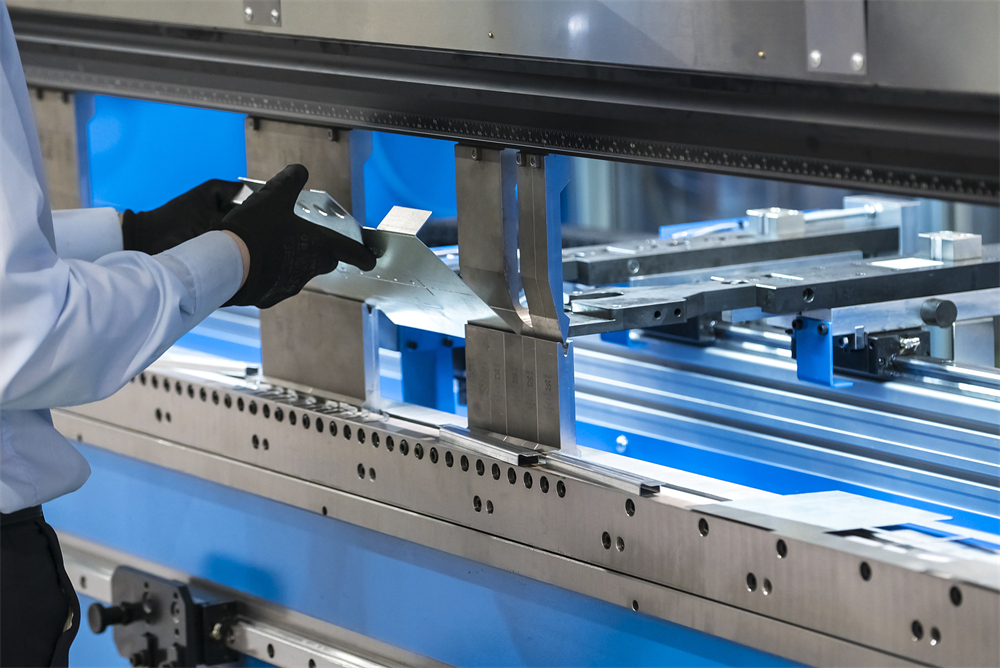
Complex bending often involves awkward part handling and intricate sequences that can be dangerous for inexperienced operators. CNC press brakes mitigate these risks through intuitive graphical interfaces and safety features like laser guards. The controller often displays a 3D simulation of the bending process, guiding the operator on how to orient the part for each step. This reduces the cognitive load on the operator and minimizes the risk of ‘wrong-way’ bends, which are common in complex multi-stage projects.
Technical Details: The Mechanics of Complexity
Multi-Axis Control Systems
The true power of a CNC press brake lies in its axes. While a basic machine might only control the ram (Y) and a simple backgauge (X), a machine optimized for complex bending will often feature 4, 6, or even 8 axes. These include:
- Y1/Y2 Axes: Independent control of the left and right cylinders to ensure the ram remains perfectly level or can be tilted for tapered bends.
- X-Axis: Controls the forward and backward movement of the backgauge, determining the flange length.
- R-Axis: Controls the vertical movement of the backgauge fingers, essential for parts with flanges of different heights.
- Z1/Z2 Axes: Controls the lateral movement of the backgauge fingers, allowing them to be positioned precisely for narrow or wide workpieces.
- V-Axis (Crowning): Compensates for the natural deflection of the machine bed under high pressure, ensuring a consistent angle across the entire length of the bend.
The Role of CNC Crowning
When a press brake applies hundreds of tons of pressure, the center of the bed and the ram naturally deflect or ‘bow.’ Without compensation, this results in a ‘canoe effect,’ where the bend angle is correct at the ends but obtuse in the middle. For complex, long parts, this is unacceptable. CNC press brakes optimize complex bending applications through automatic crowning systems. The controller calculates the required compensation based on the material length, thickness, and tonnage, and then adjusts a series of wedges or hydraulic cylinders in the bed to counteract the deflection in real-time.
Advanced Software and 3D Simulation
Modern controllers, such as those from Delem, ESA, or Cybelec, are essentially powerful computers. They allow engineers to import CAD files (like .DXF or .STEP) directly into the machine. The software then automatically determines the optimal bend sequence, selects the appropriate tooling, and checks for potential collisions between the part and the machine frame. This ‘offline programming’ capability means the machine can continue producing parts while the next job is being prepared, maximizing uptime and ensuring that even the most complex geometries are feasible before the first piece of metal is even touched.
Selection Advice: Choosing the Right Machine
Selecting a CNC press brake for complex applications requires a thorough analysis of your production needs. It is not just about the maximum tonnage; it is about the versatility of the system. Here is a breakdown of what to look for:
| Feature | Importance for Complex Bending | Recommended Specification |
|---|---|---|
| Number of Axes | High – Allows for intricate part positioning. | 6+ Axes (Y1, Y2, X, R, Z1, Z2) |
| Controller Type | Critical – Determines ease of programming and simulation. | Touchscreen with 3D Graphics (e.g., Delem DA-66T) |
| Crowning System | Essential – Ensures accuracy over long lengths. | Motorized/CNC Automatic Crowning |
| Throat Depth | Medium – Allows for deeper bends and larger side flanges. | 400mm or greater |
| Angle Sensing | Optional but Helpful – Real-time correction for material variance. | Laser or Mechanical Angle Sensors |
When evaluating a machine, consider the ‘Open Height’ and ‘Stroke.’ For complex box bending or parts with deep returns, you need a machine with a large open height to allow for the removal of the finished part. Additionally, the speed of the backgauge is a factor; high-speed servo-driven backgauges can significantly reduce cycle times for parts requiring multiple hits.
Another vital aspect is the tooling system. Complex bending often requires specialized punches and dies, such as gooseneck punches for deep channels or multi-V dies for varying thicknesses. A CNC press brake with a quick-change tooling system (like Wila or Promecam) allows for rapid transitions between different complex jobs, further optimizing the production flow.
Deep Dive: Specific Complex Bending Techniques
Bumping (Large Radius Bending)
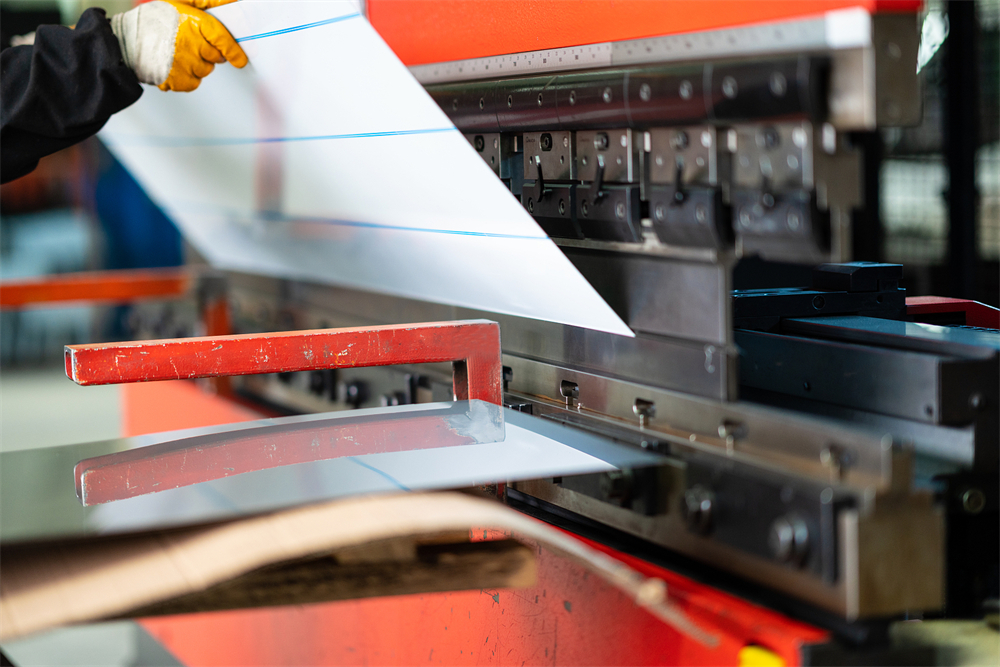
Creating a large, smooth radius on a press brake is a classic complex application. Instead of using a custom-made radius tool, a CNC press brake uses a process called ‘bumping.’ The machine performs a series of small, incremental bends close together. The CNC controller calculates the exact distance between each hit and the precise depth required to achieve the desired overall radius. This allows a standard V-die to create a wide variety of radii, providing immense flexibility for custom fabrication.
Hemming and Offset Bending
Hemming involves folding a piece of metal back on itself to create a safe, rounded edge or to add structural rigidity. Offset bending creates two bends in opposite directions with a small web between them (a ‘Z’ shape). Both require precise control of the ram and specialized tooling. CNC machines can automate the transition from a standard bend to a flattening (hemming) operation in a single program, eliminating the need for secondary machines or manual handling.
Box Bending with Deep Returns
Fabricating a five-sided box requires a specific sequence to avoid colliding with the previously bent sides. CNC software excels here by simulating the ‘fold-up’ process. It can identify if a standard punch will hit the side of the box and suggest a ‘window’ punch or a gooseneck punch instead. By optimizing the sequence, the CNC press brake ensures that even deep boxes with narrow profiles can be manufactured efficiently.
Maintenance and Longevity of CNC Systems
To ensure that CNC press brakes continue to optimize complex bending applications over the long term, a rigorous maintenance schedule is required. Because these machines rely on high-precision electronics and hydraulics, cleanliness is paramount. Hydraulic oil must be filtered and changed regularly to prevent contamination of the proportional valves, which are responsible for the Y1/Y2 accuracy.
Calibration is another critical factor. Over time, mechanical wear can lead to slight misalignments. Annual or semi-annual calibration of the backgauge axes and the ram parallelism ensures that the digital readings on the controller accurately reflect the physical reality of the machine. Furthermore, the tooling should be inspected for wear; a worn die will produce inconsistent angles regardless of how advanced the CNC system is.
Frequently Asked Questions (FAQ)
1. What is the difference between an NC and a CNC press brake?
An NC (Numerical Control) press brake typically controls only the depth of the ram and a simple backgauge position. The operator must manually enter coordinates for each step. A CNC (Computer Numerical Control) press brake features a full computer interface, often with graphical simulation, and controls multiple axes (X, R, Z, etc.) simultaneously. CNC machines are far superior for complex, multi-bend parts.
2. Can a CNC press brake handle different material thicknesses in one program?
Yes. One of the main ways CNC press brakes optimize complex bending applications is by allowing the operator to program different material thicknesses for different steps, or by using sensors to detect the actual thickness and adjust the ram depth automatically for each bend.
3. How does the CNC controller calculate springback?
The controller uses a combination of pre-loaded material databases (containing Young’s Modulus and tensile strength data) and mathematical formulas. Some high-end machines also use real-time angle measurement systems that bend the part, measure the result, and then perform a ‘re-hit’ to correct for any springback detected.
4. Is offline programming necessary for complex bending?
While not strictly necessary, it is highly recommended. Offline programming allows you to identify potential collisions and optimize the bend sequence without stopping the machine’s production. This significantly increases the ROI of the machine.
5. What are the most common axes on a CNC press brake?
The most common are Y1/Y2 (ram movement), X (backgauge depth), R (backgauge height), Z1/Z2 (backgauge lateral movement), and the V-axis (crowning compensation).
Conclusion: The Future of Precision Bending
In conclusion, the question of how CNC press brakes optimize complex bending applications is answered through the seamless integration of multi-axis hardware, intelligent software, and precision hydraulic control. These machines have transformed metal fabrication from a craft reliant on trial-and-error into a high-tech, predictable science. By reducing setup times, eliminating scrap, and allowing for the creation of geometries that were previously thought impossible, CNC press brakes provide a clear path to increased profitability and industrial capability.
As we look to the future, the integration of Artificial Intelligence (AI) and the Internet of Things (IoT) will further enhance these machines. Imagine a press brake that can predict its own maintenance needs or automatically adjust its program based on real-time data from the steel mill. For now, investing in a high-quality CNC press brake from a trusted manufacturer like HARSLE is the best way to ensure your shop is equipped to handle the complexities of modern manufacturing. Whether you are a small job shop or a large-scale industrial facility, the precision and versatility of a CNC system are indispensable tools for success in the 21st century.