
Troubleshooting Press Brake Die Selection Problems for Common Sheet Metal Jobs


Introduction to Press Brake Die Selection Challenges
In the world of precision metal fabrication, the press brake is a cornerstone of production. However, even the most advanced HARSLE press brake is only as effective as the tooling installed within it. Troubleshooting press brake die selection problems for common sheet metal jobs is a critical skill for operators and shop managers alike. Selecting the wrong die doesn’t just lead to inaccurate bends; it can cause material waste, damage expensive tooling, and even pose safety risks to the operator. The complexity of modern sheet metal work—ranging from thin-gauge aluminum to heavy-duty structural steel—requires a deep understanding of how die geometry interacts with material properties.
Many fabrication shops face recurring issues such as inconsistent bend angles, unsightly marking on the workpiece, or unexpected tonnage spikes. Often, these problems are not faults of the machine itself but are rooted in improper die selection. By mastering the art of troubleshooting press brake die selection problems for common sheet metal jobs, businesses can significantly improve their throughput and reduce the cost per part. This guide provides a comprehensive deep dive into the technicalities of die selection, common pitfalls, and practical solutions to ensure every bend is a perfect bend.
Key Considerations for Die Selection
Understanding the Material Properties
The first step in troubleshooting press brake die selection problems for common sheet metal jobs is a thorough analysis of the material. Different metals react uniquely under pressure. For instance, stainless steel has a much higher yield strength than mild steel, requiring more tonnage and often a wider V-opening to prevent tool breakage. Aluminum, on the other hand, is prone to cracking if the punch radius is too sharp or the die opening is too narrow. When selecting a die, you must account for the material’s tensile strength, thickness, and grain direction. Bending against the grain can lead to cracking, which might mistakenly be attributed to the die when it is actually a material orientation issue.
Furthermore, the thickness of the material is the primary driver for determining the V-opening width. A common industry standard is the “8x rule,” where the V-opening should be eight times the thickness of the material. However, this rule is not universal. For thinner materials (under 3mm), a 6x opening might be more appropriate for tighter radii, while for heavy plates (over 12mm), a 10x or 12x opening is often necessary to manage the extreme tonnage required. Failing to adjust the V-opening based on material thickness is one of the most frequent errors in die selection.
The Role of the V-Opening Width
The width of the V-die opening directly influences the internal bend radius and the tonnage required to complete the bend. A narrower V-opening results in a smaller internal radius but significantly increases the pressure exerted on both the tool and the machine. Conversely, a wider V-opening reduces the required tonnage but increases the internal bend radius. Troubleshooting press brake die selection problems for common sheet metal jobs often involves finding the “sweet spot” where the radius meets the design specifications without exceeding the machine’s capacity.
If the V-opening is too small for the material thickness, the material may “bottom out” prematurely or cause the die to split. If the V-opening is too large, the material may not be properly supported, leading to inaccurate angles and a “floppy” bend. Operators must use tonnage charts provided by HARSLE to ensure that the chosen die can handle the calculated load. Overloading a die is a common cause of permanent deformation in the tooling, which then leads to systemic inaccuracies in all future jobs.
Technical Details: Air Bending vs. Bottoming
The Mechanics of Air Bending
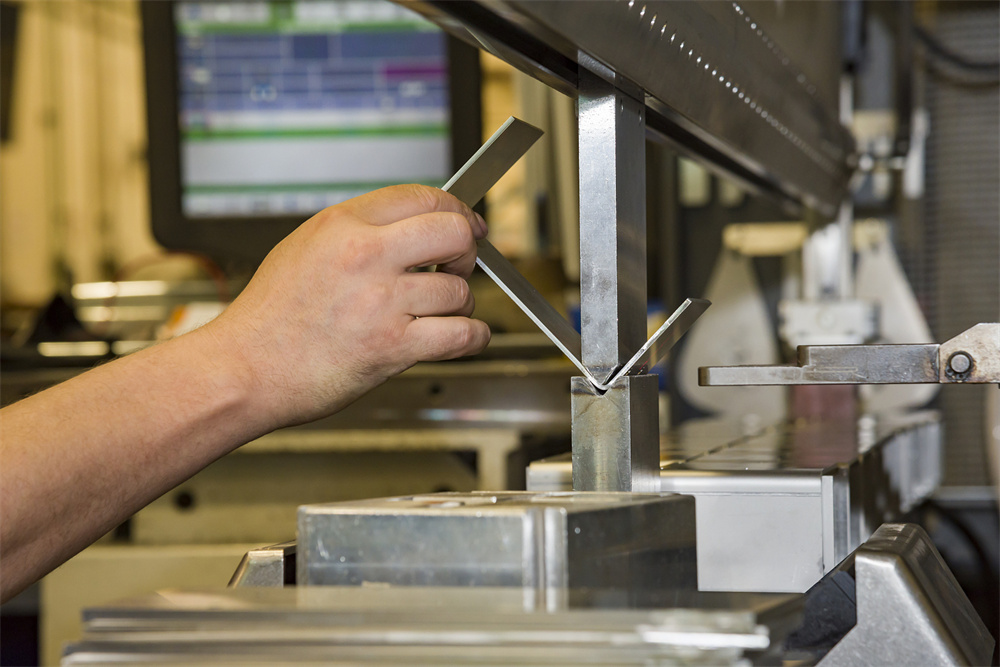
Air bending is the most common method used in modern CNC press brakes. In this process, the material only touches the two edges of the V-die and the tip of the punch. The angle of the bend is determined by how deep the punch descends into the die. This method is highly versatile because one set of tools can produce a wide range of angles. However, troubleshooting press brake die selection problems for common sheet metal jobs in air bending requires a precise understanding of springback. Springback occurs when the metal tries to return to its original shape after the pressure is released.
To compensate for springback, the die angle must be sharper than the desired final angle. For example, an 88-degree die is often used to achieve a 90-degree bend in mild steel. If the operator selects a 90-degree die for air bending, they may find it impossible to achieve a true 90-degree angle because the material will always spring back a few degrees. This is a classic selection error that can be easily solved by choosing a die with a smaller included angle.
Bottoming and Coining Considerations
Bottoming involves pressing the material against the bottom of the V-die. This method provides higher accuracy and less springback but requires significantly more tonnage—usually 3 to 5 times more than air bending. Coining is an even more extreme version where the material is actually thinned at the bend point to eliminate springback entirely. Troubleshooting press brake die selection problems for common sheet metal jobs involving bottoming requires ensuring that the die and punch are perfectly matched in terms of angle.
If you are bottoming with a 90-degree punch in an 88-degree die, you will likely damage the tools or the machine. The geometry must be identical. Because of the high forces involved, bottoming is generally reserved for thinner materials and high-precision parts. Most HARSLE machines are optimized for air bending, so operators should be cautious when switching to bottoming techniques without verifying the tool’s load ratings.
Troubleshooting Specific Die Selection Problems
Problem 1: Inconsistent Bend Angles
Inconsistent angles across the length of a part are a frequent headache. While this can sometimes be a machine crowning issue, it is often related to die wear or improper die seating. If the die is not perfectly centered under the punch, the pressure will be uneven. Additionally, if the die has been used for many years, the shoulders of the V-opening may have worn down unevenly. Troubleshooting press brake die selection problems for common sheet metal jobs in this scenario involves inspecting the die for physical wear and using a feeler gauge to ensure the die is seated correctly in the holder.
Another factor is the material’s thickness variation. Commercial-grade sheet metal can have thickness tolerances of +/- 10%. If the die selection is too tight, these small variations are magnified. Switching to a slightly wider V-opening can often provide more “forgiveness” for material thickness variations, leading to more consistent results across a production run.
Problem 2: Surface Marking and Galling
For aesthetic parts or materials like polished stainless steel and aluminum, surface marking is a major problem. This is often caused by the friction between the material and the sharp shoulders of the V-die. Troubleshooting press brake die selection problems for common sheet metal jobs involving marking usually leads to two solutions: using dies with larger shoulder radii or employing protective measures. A larger shoulder radius allows the material to roll into the die more smoothly, reducing friction.
If a larger radius isn’t an option, operators can use “no-mar” die film or urethane inserts. These act as a buffer between the metal and the hard steel of the die. In some cases, specialized rotating-wing dies (like the Markless series) can be used, where the die shoulders rotate with the material, virtually eliminating all sliding friction and subsequent marking.
Problem 3: Tonnage Overload and Tool Damage
Perhaps the most dangerous issue is tonnage overload. This happens when the operator attempts to bend thick or high-strength material in a V-opening that is too narrow. The concentrated force can exceed the yield strength of the die steel, causing it to crack or explode. Troubleshooting press brake die selection problems for common sheet metal jobs regarding tonnage requires the strict use of tonnage calculators. Before every job, the operator should calculate the required force based on the material type, thickness, bend length, and V-opening.
If the calculated tonnage is close to the die’s limit, the operator must select a wider V-opening. It is always better to have a slightly larger internal radius than a broken die or a damaged HARSLE press brake ram. Remember that the tonnage required increases exponentially as the V-opening decreases. Doubling the V-opening width can reduce the required tonnage by approximately 50%.
Selection Advice for Common Jobs
Choosing Dies for Stainless Steel
Stainless steel is notorious for its high springback and toughness. When troubleshooting press brake die selection problems for common sheet metal jobs involving stainless, always opt for dies with an 85-degree or 88-degree angle to allow for significant over-bending. Because stainless steel is harder than mild steel, it will wear out standard dies faster. It is recommended to use induction-hardened tooling to ensure longevity. Furthermore, because stainless is often used for decorative purposes, consider using a V-opening that is 10x the material thickness to reduce the pressure and the likelihood of marking.
Choosing Dies for Aluminum
Aluminum is softer but more prone to cracking at the bend line. The key to successful aluminum bending is the punch radius, but the die selection is equally important. A wider V-opening helps distribute the pressure, reducing the strain on the outer fibers of the bend. If you encounter cracking, the first troubleshooting step should be to increase the V-opening width. This increases the internal bend radius, which is the most effective way to prevent fracture in aluminum alloys like 6061-T6.
Die Maintenance Checklist
To avoid troubleshooting press brake die selection problems for common sheet metal jobs in the middle of a production run, implement a rigorous maintenance schedule. Tooling should be cleaned after every shift to remove “slugs” or metal flakes that can become embedded in the die surface. These flakes can cause marking on future parts. Additionally, inspect the dies for any signs of “mushrooming” or hairline cracks. A die that shows signs of structural failure should be decommissioned immediately. Proper storage is also vital; dies should be kept in a dry environment and oiled lightly to prevent rust, which can alter the friction characteristics of the tool.
Technical Comparison Table: V-Opening Selection
| Material Thickness (mm) | Recommended V-Opening (mm) | Internal Radius (Approx) | Tonnage Factor (Mild Steel) |
|---|---|---|---|
| 0.5 – 1.0 | 6 – 8 | 1.0 – 1.3 | Low |
| 1.2 – 2.5 | 12 – 16 | 2.0 – 2.6 | Medium |
| 3.0 – 5.0 | 24 – 32 | 4.0 – 5.3 | High |
| 6.0 – 10.0 | 50 – 80 | 8.0 – 13.0 | Very High |
FAQ: Troubleshooting Press Brake Die Selection
How do I know if my V-opening is too small?
If you notice that the tonnage required is significantly higher than what the chart suggests, or if the material is showing deep gouges on the outside of the bend, your V-opening is likely too small. Another sign is the “splitting” of the die or the punch struggling to reach the required depth without the machine straining.
Can I use the same die for different materials?
Technically yes, but you must adjust your calculations. A die that works for 2mm mild steel will require much more force for 2mm stainless steel. Always check the tonnage limits of the die before switching materials. Also, be aware that bending stainless steel in a die previously used for mild steel can cause carbon contamination, leading to rust on the stainless part.
What is the difference between a 90-degree and an 88-degree die?
A 90-degree die is typically used for bottoming, where the material is forced to take the exact shape of the tool. An 88-degree die is used for air bending to allow for springback. If you are air bending to a 90-degree final angle, the 88-degree die is almost always the better choice.
How does die height affect the job?
Die height (or the overall height of the tool set) affects the open height of the press brake. If you use a die that is too short, the ram may not be able to reach it, or you may have clearance issues with the backgauge. Always ensure your tool height is compatible with your HARSLE machine’s stroke and throat depth.
Conclusion
Troubleshooting press brake die selection problems for common sheet metal jobs is an ongoing process of education and observation. By understanding the relationship between material thickness, V-opening width, and tonnage, operators can avoid the most common pitfalls of metal fabrication. Whether you are working with a high-speed HARSLE CNC press brake or a manual hydraulic model, the principles of physics remain the same. Investing time in proper die selection and maintenance not only protects your equipment but also ensures that your shop delivers the highest quality parts to your customers. Remember, the right tool for the job is not just about the shape of the bend; it’s about the safety, efficiency, and precision of the entire fabrication process.


