CNC Press Brake Vs Conventional Press Brake: A Practical Buying Guide


Comparison Summary: Navigating the Choice Between CNC and Conventional Press Brakes
In the modern metal fabrication landscape, selecting the right equipment is a pivotal decision that impacts production efficiency, part accuracy, and long-term profitability. The debate of CNC Press Brake Vs Conventional Press Brake: A Practical Buying guide often centers on the balance between technological sophistication and cost-effective simplicity. While both machines serve the fundamental purpose of bending sheet metal, the mechanisms by which they achieve this—and the level of human intervention required—differ significantly.
A conventional press brake, often referred to as a manual or NC (Numerical Control) press brake, typically relies on a torsion bar to synchronize the movement of the cylinders. It requires a skilled operator to manually set the backgauge and stroke depth for every different bend angle. In contrast, a CNC (Computer Numerical Control) press brake utilizes advanced software and independent hydraulic valves (Y1 and Y2 axes) to control the ram’s position with micron-level precision. This automation allows for complex, multi-bend sequences to be performed in a single setup, drastically reducing the margin for human error.
For a business owner or workshop manager, the choice isn’t just about the machine’s price tag; it is about the “Total Cost of Ownership” and the specific demands of their client base. High-volume production with complex geometries demands the speed of CNC, while simple, repetitive tasks might be more economically handled by a robust conventional machine. This guide will delve into the technical nuances, operational costs, and application scenarios to help you make an informed investment for your facility.
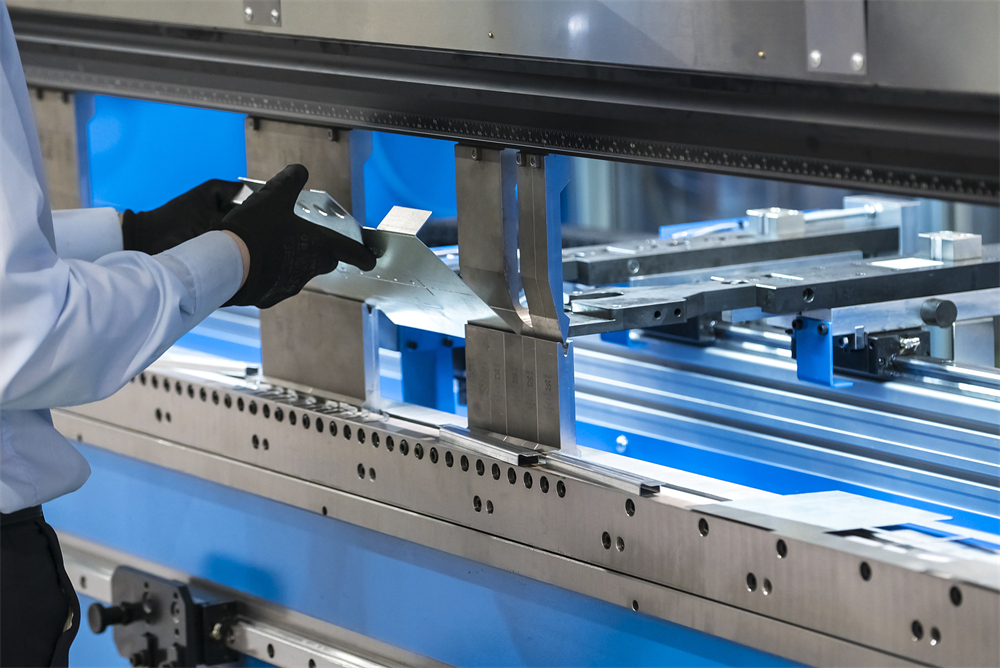
CNC Press Brake Overview: Precision and Automation
The CNC press brake represents the pinnacle of modern bending technology. At its core, the machine is governed by a sophisticated controller—such as those from Delem, Cybelec, or ESA—which acts as the brain of the operation. These controllers allow operators to input 2D or 3D drawings directly, which the software then translates into precise bending sequences. The most significant advantage of a CNC system is its ability to control multiple axes simultaneously, including the ram (Y1, Y2), the backgauge (X, R, Z1, Z2), and even the crowning system (V-axis).
One of the standout features of a CNC press brake is the electro-hydraulic proportional valve system. Unlike conventional machines that use a mechanical torsion bar for synchronization, CNC machines use linear encoders to monitor the position of the ram in real-time. If one side of the ram deviates by even a fraction of a millimeter, the controller adjusts the hydraulic pressure instantly to correct it. This ensures that the bend angle remains consistent across the entire length of the workpiece, even if the material thickness varies slightly.
Furthermore, CNC machines excel in “setup reduction.” In a traditional shop, changing from one part design to another might take 30 minutes of manual adjustments. With a CNC press brake, the operator simply loads a new program, and the backgauge automatically moves to the correct position. This makes CNC technology indispensable for “High-Mix, Low-Volume” production environments where flexibility is key. Additionally, modern CNC controllers include collision detection and bend sequence optimization, which prevents costly mistakes and tool damage.
HARSLE CNC press brakes often come equipped with automatic crowning systems. When bending long sheets, the center of the machine tends to deflect slightly under pressure, leading to a “canoe effect” where the angle in the middle is wider than at the ends. The CNC controller calculates this deflection and adjusts a series of wedges or hydraulic cylinders in the lower table to compensate, ensuring a perfectly straight bend every time. This level of automation removes the guesswork and the need for manual shimming, which is a common bottleneck in conventional bending.
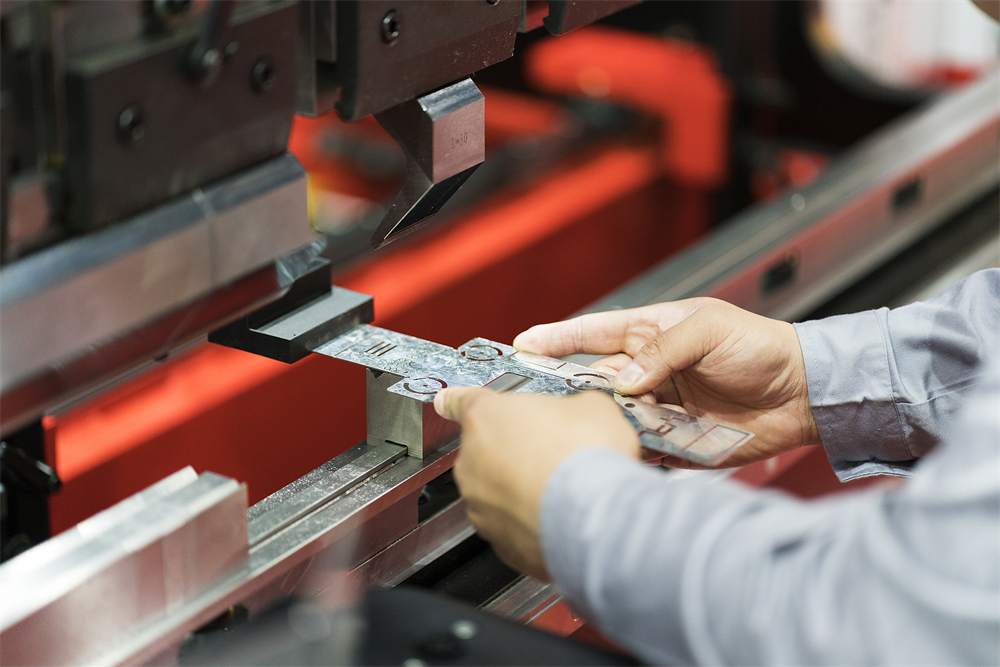
Conventional Press Brake Overview: Simplicity and Durability
The conventional press brake, often utilizing a torsion bar design, has been the workhorse of the metalworking industry for decades. Its primary appeal lies in its mechanical simplicity and lower initial investment cost. In these machines, a heavy-duty steel bar connects the two sides of the ram, ensuring they move up and down together. While this mechanical link is robust, it lacks the independent adjustability found in CNC models. However, for many fabrication shops, this simplicity is an asset rather than a drawback.
Operating a conventional press brake is a tactile experience that relies heavily on the operator’s skill. The backgauge is often adjusted via a simple NC controller (like the E21 or E300) that moves the gauge to a specific dimension, but the operator must still manually set the depth of the stroke to achieve the desired angle. This process often involves a “trial and error” phase with scrap material to fine-tune the settings. For simple 90-degree bends on consistent material, a skilled operator can be remarkably efficient on a conventional machine.
Maintenance on conventional machines is generally more straightforward and less expensive. Because they lack the complex electronics, linear encoders, and proportional valves of CNC models, many repairs can be handled by in-house maintenance teams without the need for specialized software technicians. This makes them ideal for regions where technical support for high-end electronics might be limited, or for shops where the machine will be used for basic tasks that don’t justify the overhead of a CNC system.
Despite the rise of automation, the conventional press brake remains a staple for heavy-duty applications, such as bending thick plates for structural steel or simple brackets. If your production line consists of the same part being produced thousands of times with minimal variation, the high-speed programming capabilities of a CNC machine might be redundant. In such cases, the conventional press brake offers a faster Return on Investment (ROI) due to its lower purchase price and lower maintenance requirements.
Specification Comparison Table
To better understand the CNC Press Brake Vs Conventional Press Brake: A Practical Buying decision, let’s look at the technical specifications side-by-side. This table highlights the fundamental differences in performance and capability.
| Feature | CNC Press Brake | Conventional (NC/Torsion Bar) |
|---|---|---|
| Synchronization | Electro-hydraulic (Y1, Y2 independent) | Mechanical Torsion Bar |
| Accuracy | High (±0.01mm) | Moderate (±0.05mm to 0.1mm) |
| Backgauge Control | Multi-axis (X, R, Z1, Z2, etc.) | Single or Dual axis (X, R manual) |
| Setup Time | Very Fast (Software-driven) | Slow (Manual adjustment/Trial) |
| Crowning System | Automatic/CNC Controlled | Manual or None |
| Operator Skill | Requires software knowledge | Requires high manual bending skill |
| Price Point | Higher Initial Investment | Lower Initial Investment |
Best-fit Applications: Choosing Based on Production Needs
The decision to buy a CNC or conventional press brake should be driven by your specific product portfolio. CNC press brakes are the undisputed kings of complexity. If your shop produces parts for the aerospace, medical, or high-end electronics industries, the precision of a CNC machine is non-negotiable. These industries often require multiple bends at different angles and lengths on a single piece of metal. A CNC machine can handle these “staged” bends in one continuous operation, ensuring that the cumulative tolerance remains within strict limits.
On the other hand, conventional press brakes are perfectly suited for the construction and heavy machinery sectors. For example, if you are manufacturing simple C-channels, Z-profiles, or large base plates where the tolerance requirements are more relaxed (e.g., +/- 0.5 degrees), a conventional machine will get the job done at a fraction of the cost. They are also excellent for “dedicated” production lines where the machine is set up once and runs the same part for weeks at a time.
Another factor to consider is the material type. When working with high-strength steels or exotic alloys, material “springback” becomes a major issue. CNC press brakes have built-in databases and sensors that can calculate and compensate for springback automatically. In a conventional machine, the operator must manually over-bend the part based on experience, which can lead to significant scrap rates when working with expensive materials.
Finally, consider the volume of your orders. If you are a job shop that takes on dozens of different small orders every day, the programming speed of a CNC machine will allow you to finish more jobs in a shift. If you are a manufacturer with a steady, unchanging product line, the conventional machine’s slower setup time becomes less of a disadvantage, making it a more cost-effective choice for long-term, stable production.
Cost and Maintenance Comparison: Short-term vs. Long-term
When analyzing CNC Press Brake Vs Conventional Press Brake: A Practical Buying guide, the financial aspect is often the deciding factor. A CNC press brake can cost 2 to 3 times more than a conventional machine of the same tonnage and length. However, the initial purchase price is only one part of the equation. You must also consider labor costs. A CNC machine reduces the need for highly paid, veteran operators because the software handles the complex calculations. This allows shops to utilize less experienced staff for machine operation while the “programming” is done in the office.
Maintenance costs also follow a different trajectory. Conventional machines are mechanically driven and require regular lubrication of the torsion bar, adjustment of the limit switches, and monitoring of the hydraulic seals. These are generally low-cost tasks. CNC machines, however, require a clean environment for their electronic components. The linear scales must be kept free of dust, and the software may require periodic updates. While the hydraulic components are similar, the proportional valves in a CNC machine are more sensitive to oil contamination, necessitating more frequent filter changes and high-quality hydraulic oil.
Energy efficiency is another area where CNC machines often win. Many modern CNC press brakes from HARSLE utilize hybrid drive systems or variable-speed pumps. These systems only run the motor when the machine is actually bending, whereas older conventional machines might have the motor running constantly. Over several years of operation, the energy savings from a CNC machine can significantly offset its higher purchase price.
Lastly, consider the resale value. As the industry moves toward Industry 4.0 and smart manufacturing, the demand for used CNC equipment remains high. A well-maintained CNC press brake retains its value better than a conventional machine, which may be seen as obsolete by larger buyers in a few years. This “residual value” should be factored into your long-term financial planning.
Recommendation: Which One Should You Buy?
To make the final decision, we recommend a simple three-step evaluation process based on your current business status and future goals:
- Step 1: Analyze Your Part Complexity. If more than 30% of your parts require three or more bends, or if you work with tolerances tighter than 0.5mm, you should invest in a CNC press brake. The reduction in scrap and the increase in accuracy will pay for the machine quickly.
- Step 2: Evaluate Your Labor Pool. Are you struggling to find experienced manual press brake operators? If so, the CNC machine’s user-friendly interface and automated features will allow you to maintain production levels with a less specialized workforce.
- Step 3: Consider Your Growth Strategy. If you plan to scale your business and take on more diverse contracts, the CNC press brake provides the flexibility needed to adapt. However, if you are starting a small shop with a limited budget and a focus on simple, heavy-duty fabrication, a conventional press brake is a reliable and low-risk entry point.
At HARSLE, we provide both high-performance CNC models and robust conventional machines. We often suggest that growing shops consider a “hybrid” approach—using a CNC machine for their most complex, high-value work and keeping a conventional machine for simple, high-volume tasks. This balances the high precision of CNC with the low operating costs of conventional technology.
Frequently Asked Questions (FAQ)
1. Can I upgrade a conventional press brake to CNC later?
While it is technically possible to add a simple NC controller to a manual machine, fully converting a torsion-bar machine to a true Y1/Y2 CNC system is rarely cost-effective. The hydraulic and mechanical architectures are fundamentally different. It is usually better to trade in the old machine for a dedicated CNC model.
2. Is a CNC press brake harder to learn?
Actually, for a new generation of workers, CNC machines are often easier to learn. The graphical interfaces resemble modern tablets or computers, and the software handles the trigonometry of bending. Learning the “feel” of a manual machine takes years of practice, whereas CNC programming can be learned in a few days of training.
3. How much more accurate is a CNC press brake?
A CNC press brake typically offers a ram repeatability of ±0.01mm, whereas a conventional machine might vary by ±0.05mm or more. While this sounds small, it makes a massive difference in the final fit-up of parts, especially if they are being welded or assembled into larger structures.
4. Does a CNC press brake require a special foundation?
Regardless of the type, any press brake over 100 tons should have a proper reinforced concrete foundation to prevent the frame from twisting. However, CNC machines are more sensitive to vibrations, so ensuring a stable, level floor is even more critical for maintaining their high precision.
5. What is the lifespan of a HARSLE press brake?
With proper maintenance, both CNC and conventional press brakes can last 15 to 20 years or more. The mechanical frame is built for longevity; the main difference is that the electronics on a CNC machine may need an upgrade or replacement after 10-12 years to stay compatible with modern software.