
Torsion Bar Press Brake vs Synchronized Press Brake: What’s the Difference?


Introduction to Press Brake Technology
In the world of metal fabrication, the press brake stands as a cornerstone of production. Whether you are manufacturing simple brackets or complex aerospace components, the ability to bend sheet metal with precision is paramount. However, when browsing the market for new machinery, specifically from industry leaders like HARSLE, buyers often encounter a critical choice: the Torsion Bar Press Brake versus the Synchronized (Electro-Hydraulic) Press Brake. Understanding the Torsion Bar Press Brake Vs Synchronized Press Brake: ’s Difference? is essential for making an informed investment that aligns with your production goals, budget, and accuracy requirements.
Historically, the torsion bar design was the industry standard, providing a reliable and cost-effective way to achieve uniform bends. As technology evolved, the demand for higher precision, automation, and the ability to handle complex geometries led to the development of the electro-hydraulic synchronized press brake. While both machines utilize hydraulic power to drive a ram against a die, the method by which they ensure the ram remains level—and the resulting accuracy of the bend—differs significantly. This article provides a deep dive into these two technologies, comparing their mechanical structures, control systems, and operational efficiencies.
Choosing the wrong machine can lead to increased scrap rates, slower production cycles, and higher long-term maintenance costs. Conversely, selecting the right machine ensures a competitive edge in a crowded market. By the end of this guide, you will have a clear understanding of which technology suits your specific fabrication needs, whether you are a small job shop or a high-volume industrial manufacturer.
Understanding the Torsion Bar Press Brake
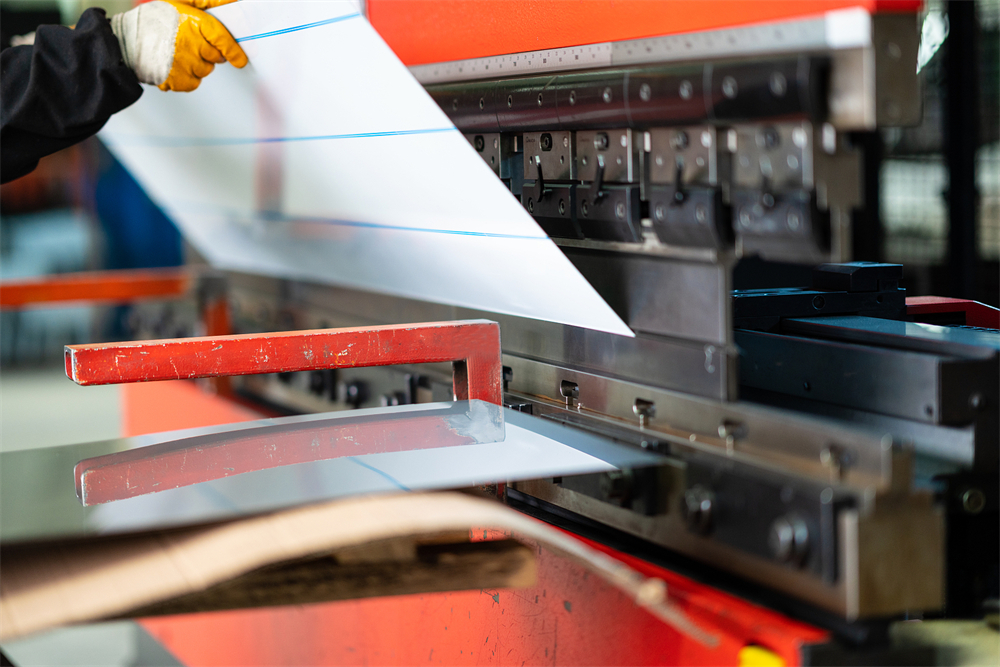
The Torsion Bar Press Brake, often referred to as a conventional or mechanical-synchronization press brake, relies on a heavy-duty steel bar (the torsion bar) to link the two hydraulic cylinders. This mechanical link ensures that both ends of the ram move downward simultaneously. It is a robust, time-tested design that has served the metalworking industry for decades. The simplicity of this system is its greatest strength, offering a straightforward approach to metal bending without the need for complex electronic feedback loops.
In a torsion bar setup, the synchronization is purely mechanical. When the hydraulic fluid enters the cylinders, the torsion bar resists any uneven movement, forcing the ram to stay relatively level. However, because it is a mechanical connection, it is subject to physical limitations. For instance, the bar itself can experience slight twisting under extreme loads, and the mechanical joints can wear over time. Most torsion bar machines utilize a simple CNC or NC controller, such as the E21 or E300, which manages the backgauge (X-axis) and the stroke depth (Y-axis) but does not offer independent control over the individual cylinders.
One of the defining characteristics of the torsion bar press brake is its reliance on mechanical stops within the cylinders to determine the bend angle. To change the angle, the operator must adjust these stops, which can be a manual or semi-automated process. While this is effective for repetitive, high-volume work where the setup doesn’t change frequently, it lacks the flexibility required for rapid prototyping or small-batch production where multiple different angles are needed in a single sequence.
Understanding the Synchronized Press Brake
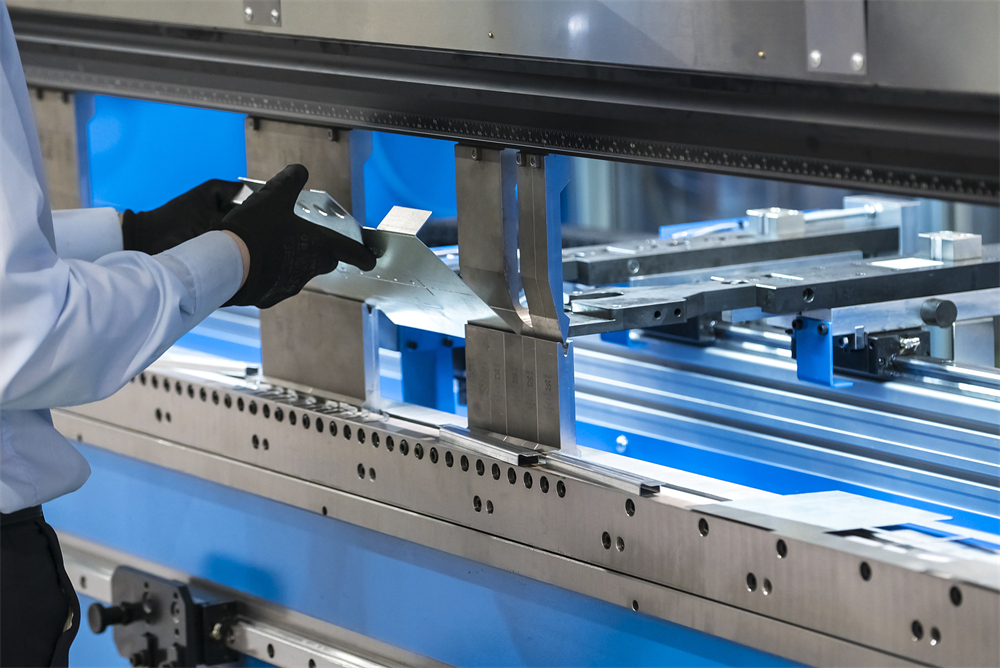
The Synchronized Press Brake, or Electro-Hydraulic Synchronized Press Brake, represents the pinnacle of modern bending technology. Unlike its torsion bar counterpart, it does not use a mechanical link to keep the ram level. Instead, it employs a sophisticated system of proportional valves and linear encoders. Each cylinder is controlled independently by the CNC system, which monitors the position of the ram in real-time with micron-level accuracy. This is often referred to as Y1 and Y2 axis control.
The linear encoders, mounted on ‘C’ frames or the main side frames, track the exact position of each end of the ram. If the CNC controller detects even a fraction of a millimeter of deviation between the two sides, it instantly adjusts the flow of hydraulic oil through the proportional valves to correct the position. This happens hundreds of times per second, ensuring that the ram remains perfectly parallel to the bed, even when the workpiece is placed off-center. This capability is known as “eccentric loading” support, and it is a major advantage for complex fabrication tasks.
Furthermore, synchronized press brakes are almost always equipped with advanced CNC controllers, such as the Delem DA-53T, DA-66T, or ESA systems. These controllers offer graphical interfaces, 3D visualization, and automatic calculation of bend sequences, spring-back compensation, and crowning requirements. The integration of electronics and hydraulics allows for much higher approach, pressing, and return speeds, significantly boosting overall productivity compared to older mechanical designs.
Technical Specification Comparison Table
To better understand the Torsion Bar Press Brake Vs Synchronized Press Brake: ’s Difference?, let’s look at the technical specifications side-by-side. This table highlights the fundamental differences in performance and control.
| Feature | Torsion Bar Press Brake | Synchronized Press Brake |
|---|---|---|
| Synchronization Method | Mechanical Torsion Bar | Electro-Hydraulic (Proportional Valves) |
| Cylinder Control | Linked (Single Y-axis) | Independent (Y1, Y2 axes) |
| Positioning Accuracy | ± 0.1 mm | ± 0.01 mm |
| Eccentric Loading | Poor (Can damage the bar) | Excellent (Automatic compensation) |
| Bending Speed | Standard | High-speed (Variable) |
| Controller Type | Simple NC/CNC (e.g., E21) | Advanced Graphical CNC (e.g., DA-58T) |
| Crowning System | Manual (Optional) | Automatic Hydraulic/Mechanical |
| Setup Time | Moderate to Long | Very Short (Automated) |
Key Differences: Precision, Speed, and Versatility
When discussing the Torsion Bar Press Brake Vs Synchronized Press Brake: ’s Difference?, precision is usually the first topic of conversation. Because the synchronized machine uses linear encoders and proportional valves, it can achieve a level of repeatability that is simply impossible for a torsion bar machine. In a torsion bar system, the mechanical stops and the bar’s own deflection limit the accuracy to about 0.1mm. In contrast, a synchronized machine can maintain tolerances within 0.01mm. For industries like electronics or medical device manufacturing, this difference is the margin between a perfect part and a scrap piece.
Speed is another critical factor. Synchronized press brakes are designed for high-efficiency environments. They feature faster rapid-down speeds and faster return speeds. Because the CNC system manages the entire cycle, the transition between the approach speed and the pressing speed is seamless. Additionally, the backgauge on synchronized machines is typically more advanced, moving faster and offering more axes of movement (X, R, Z1, Z2, etc.), which reduces the time spent positioning the sheet metal between bends.
Versatility and the ability to handle eccentric (off-center) loads are where the synchronized machine truly shines. If you attempt to bend a small, thick piece of metal at one end of a torsion bar press brake, the uneven force can twist the torsion bar and cause permanent damage to the machine’s alignment. A synchronized press brake senses this uneven resistance and automatically adjusts the hydraulic pressure to each cylinder to keep the ram level. This allows operators to perform multiple setups across the length of the bed, increasing throughput for complex parts.
Best-fit Applications for Each Machine
Despite the technological superiority of the synchronized press brake, the torsion bar model remains a popular choice for many businesses. The key is matching the machine to the application. Torsion bar press brakes are ideal for shops that primarily produce simple parts with consistent thicknesses and large tolerances. If your work involves bending long, straight profiles for roofing, HVAC ducting, or basic structural components, a torsion bar machine offers a high return on investment due to its lower initial cost and durability.
On the other hand, the synchronized press brake is the go-to solution for precision engineering. It is best suited for shops that handle a wide variety of materials (stainless steel, aluminum, mild steel) and thicknesses. If your production involves complex multi-bend sequences, high-precision enclosures, or parts that require consistent angles across the entire length of a long bend, the synchronized machine is necessary. Its ability to integrate with CAD/CAM software also makes it the better choice for Industry 4.0 environments where digital workflows are standard.
Furthermore, for businesses looking to reduce their reliance on highly skilled operators, the synchronized press brake is advantageous. The advanced CNC controllers guide the operator through the process with visual aids, reducing the likelihood of errors. In contrast, getting the best results from a torsion bar machine often requires an experienced operator who understands the “feel” of the machine and can manually compensate for material variations.
Cost and Maintenance Comparison
The initial purchase price is perhaps the most significant difference between these two types of machinery. A torsion bar press brake is considerably more affordable, often costing 30% to 50% less than a synchronized model of the same tonnage and length. For a startup or a small workshop with limited capital, this lower entry point is highly attractive. Maintenance on these machines is also relatively simple; because there are fewer electronic components and no complex proportional valves, a standard industrial mechanic can often handle most repairs.
Synchronized press brakes require a higher initial investment, but they offer lower operational costs in high-volume environments. The increased speed and reduced setup time mean that the cost per part is lower. However, maintenance is more specialized. The hydraulic system must be kept extremely clean to prevent damage to the proportional valves, and the electronic sensors and CNC software may require periodic calibration or updates from specialized technicians. HARSLE provides comprehensive support for these systems, but owners must be prepared for the technical nature of the equipment.
Energy efficiency is another cost consideration. Many modern synchronized press brakes are equipped with servo-main motors or “hybrid” systems. These systems only run the hydraulic pump when the machine is actually bending, whereas older torsion bar designs often have the pump running constantly. Over several years of operation, the energy savings from a synchronized machine can significantly offset its higher purchase price.
Final Recommendation: Which One Should You Buy?
Deciding between a Torsion Bar Press Brake Vs Synchronized Press Brake: ’s Difference? ultimately comes down to your specific business model. If your primary goal is to minimize capital expenditure and you are producing parts where a tenth of a millimeter doesn’t matter, the Torsion Bar Press Brake is a reliable workhorse that will serve you well for years. It is easy to operate, easy to fix, and gets the job done for standard fabrication tasks.
However, if you are looking to future-proof your business, increase your production capacity, and take on high-precision contracts, the Synchronized Press Brake is the clear winner. The precision, speed, and ease of use provided by modern CNC systems and electro-hydraulic synchronization offer a level of flexibility that mechanical systems cannot match. In the long run, the reduction in scrap and the ability to perform complex bends in a single setup will provide a much higher value to your workshop.
At HARSLE, we recommend evaluating your current workload and your growth projections for the next five years. If you expect to move into more complex assemblies or work with expensive materials where errors are costly, investing in a synchronized machine now will save you from needing to upgrade sooner than expected. Our team is always available to help you analyze your parts and recommend the specific model that fits your technical and budgetary requirements.
Frequently Asked Questions (FAQ)
1. Can a torsion bar press brake be upgraded to a synchronized one?
Generally, no. The fundamental mechanical structure of the two machines is different. A torsion bar machine lacks the mounting points for linear encoders and the hydraulic manifold required for proportional valves. It is almost always more cost-effective to purchase a new synchronized machine than to attempt a conversion.
2. Is the synchronized press brake harder to learn?
Actually, the opposite is often true. While the technology is more complex, the CNC interface on a synchronized machine is much more user-friendly. Modern controllers like Delem or ESA use touchscreens and 3D graphics to guide the operator, making it easier for a novice to produce accurate parts compared to the manual adjustments required on a torsion bar machine.
3. How does crowning affect the difference between these machines?
Crowning compensates for the deflection of the machine’s bed and ram under pressure. While both machines can have crowning systems, synchronized press brakes often feature “Automatic Hydraulic Crowning” controlled by the CNC. This ensures a perfectly straight bend across the entire length of the workpiece automatically, whereas torsion bar machines often rely on manual wedge adjustments.
4. Which machine is better for thick plate bending?
Both can handle thick plates, but the synchronized press brake is safer and more accurate for heavy-duty work. The ability to handle eccentric loads means that if a thick plate isn’t perfectly centered, the synchronized machine won’t suffer mechanical damage, whereas a torsion bar machine might.
5. Does HARSLE provide training for both types of machines?
Yes, HARSLE provides comprehensive training and technical support for our entire range of press brakes. Whether you choose the simplicity of a torsion bar model or the advanced features of a synchronized machine, our engineers will ensure your team is proficient in operation and maintenance.


