Hydraulic Press Motor Running but No Movement: Troubleshooting Steps


Introduction to Hydraulic Press Operational Failures
In the high-stakes environment of metal fabrication, equipment uptime is the lifeblood of productivity. Among the various challenges faced by floor managers and maintenance technicians, few scenarios are as perplexing as when a Hydraulic Press Motor Running But No Movement: Troubleshooting Steps becomes the primary focus of the day. You hear the steady hum of the electric motor, indicating that power is reaching the unit, yet the ram remains stubbornly stationary. This disconnect between mechanical input and hydraulic output can halt production lines, delay shipments, and cause significant financial strain.
Understanding why a hydraulic press fails to move despite a running motor requires a systematic approach to the machine’s anatomy. A hydraulic press is a complex synergy of electrical controls, mechanical linkages, and fluid power dynamics. When the motor spins but the cylinder doesn’t extend or retract, the issue typically lies within the transmission of energy—either the fluid isn’t being moved, it’s being diverted, or the control signals are preventing the valves from opening. At HARSLE, we recognize that rapid diagnostics are essential for maintaining the efficiency of your metalworking operations.
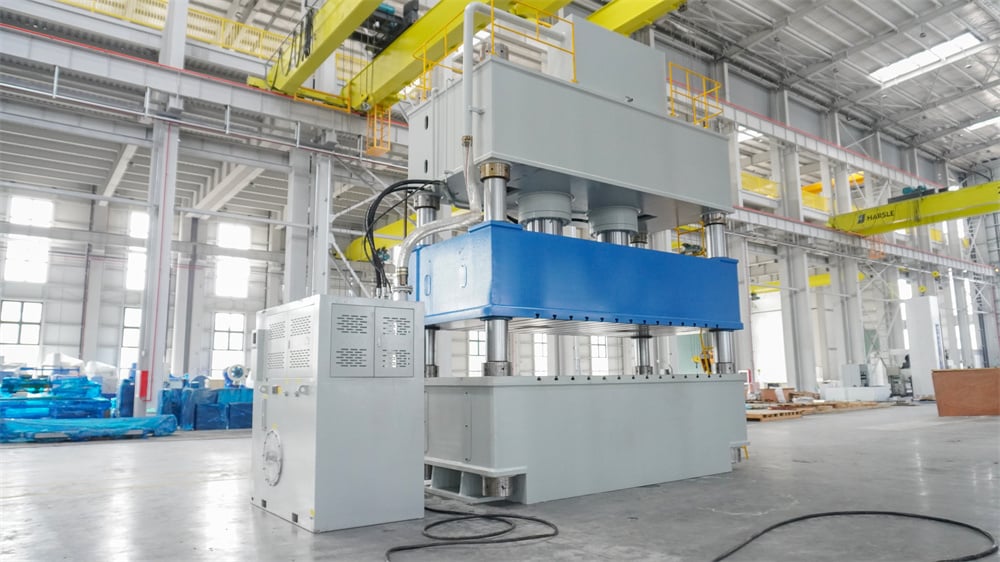
This comprehensive guide is designed to walk you through the technical nuances of diagnosing this specific failure. We will explore everything from simple fluid level checks to complex valve manifold inspections. By the end of this article, you will have a professional-grade framework for identifying the root cause of a non-responsive hydraulic ram, ensuring your HARSLE machinery—or any industrial press—returns to service with minimal downtime. Whether you are dealing with a 100-ton C-frame press or a massive 2000-ton four-column hydraulic powerhouse, the fundamental troubleshooting principles remain the same.
Key Considerations Before Troubleshooting
Before diving into the mechanical and hydraulic components, safety must be the absolute priority. Hydraulic systems operate under immense pressure, often exceeding 3,000 PSI. A pinhole leak can cause fluid injection injuries, which are medical emergencies. Always ensure that the press is in a ‘zero energy state’ before performing physical inspections. This involves implementing Lockout/Tagout (LOTO) procedures on the main power supply and ensuring that any accumulated pressure in the accumulators or cylinders is safely bled off according to the manufacturer’s specifications.
Another key consideration is the environment in which the machine operates. Temperature fluctuations can significantly affect hydraulic oil viscosity. If the workshop is exceptionally cold, the oil may be too thick for the pump to prime effectively, leading to a motor that runs while the pump cavitates. Conversely, extreme heat can degrade the oil, leading to internal leakage within the valves. Understanding the context of the failure—whether it happened suddenly during operation or after a long period of inactivity—provides vital clues for the diagnostic process.
Documentation is your best friend during troubleshooting. Always have the hydraulic schematic and the electrical ladder logic diagram for your specific HARSLE model ready. These documents act as a map, showing you how the fluid should flow and which solenoids must be energized for movement to occur. Without these, you are essentially guessing, which can lead to the unnecessary replacement of expensive components like pumps or cylinders when the actual fault might be a simple five-dollar relay or a clogged suction strainer.
Technical Details: Diagnosing the Root Cause
1. Hydraulic Fluid and Suction Issues
The most common reason a motor runs without movement is that the pump is not actually moving any oil. This often starts at the reservoir. If the oil level is too low, the suction pipe may be drawing in air instead of fluid. This is known as aeration. Check the sight glass on the side of the hydraulic tank; if the oil is below the minimum line, the pump cannot create the necessary vacuum to pull fluid into the system. Furthermore, check for foaming in the oil, which indicates air is entering the system through a leak in the suction line or a worn shaft seal on the pump.
The suction strainer, located inside the tank at the beginning of the intake line, can also become clogged with debris or sludge over time. If the strainer is blocked, the pump will starve for oil, creating a distinct high-pitched whining sound (cavitation). Cavitation is extremely destructive to hydraulic pumps, as the collapsing air bubbles erode the internal metal surfaces. If you suspect a clogged strainer, it must be cleaned or replaced immediately to prevent permanent pump failure.
2. Pump and Coupling Failures
If the oil level is sufficient and the suction line is clear, the next point of failure is the mechanical connection between the motor and the pump. Most hydraulic presses use a flexible coupling to join the motor shaft to the pump shaft. Over time, the rubber insert (often called a ‘spider’) can shear or the set screws can loosen. In this scenario, the motor spins freely, but the pump shaft remains stationary. You can often diagnose this by removing the coupling guard and visually inspecting the connection while the motor is briefly jogged.
Internal pump failure is another possibility, though usually preceded by noise or a gradual loss of speed. If the internal vanes, gears, or pistons have shattered, the pump will no longer generate flow. A quick way to test pump output is to install a pressure gauge at the pump’s discharge port. If the motor is running and the gauge reads zero even when a command is given, the pump or its drive mechanism is likely at fault. Ensure you also check the rotation of the motor; if the wiring was recently changed, the motor might be spinning backward, which prevents most hydraulic pumps from moving fluid.
3. Valve Malfunctions and Pressure Bypass
If the pump is producing flow, the fluid must be directed to the cylinder to create movement. This is handled by the directional control valve (DCV). If the solenoid coil on the DCV has burnt out, the valve spool will not shift, and the oil will simply cycle back to the tank through the relief valve. You can test this by manually depressing the override pin on the end of the solenoid. If the press moves when the pin is pushed manually, the problem is electrical (coil, wiring, or PLC signal). If it still doesn’t move, the spool inside the valve may be jammed by a piece of contamination.
The system relief valve is another critical component. Its job is to protect the system by opening when pressure exceeds a set limit. If the relief valve is stuck in the open position due to a broken spring or a piece of dirt holding the poppet off its seat, all the oil flow from the pump will bypass the rest of the circuit and go straight back to the reservoir. In this case, the motor runs, the pump works, but no pressure can build up to move the ram. Touching the relief valve or its return line can provide a clue; if it feels excessively hot, it means oil is constantly blowing across the relief seat at high velocity.
4. Electrical and Control System Logic
Modern HARSLE hydraulic presses rely on sophisticated PLC (Programmable Logic Controller) systems to manage safety and operation. If a safety interlock is not met—such as a light curtain being tripped, an emergency stop button being depressed, or a door limit switch not being engaged—the PLC will prevent the directional valves from shifting. Often, the motor is allowed to run (to maintain lubrication or cooling), but the ‘cycle start’ command is inhibited.
Check the diagnostic screen on the HMI (Human Machine Interface). Look for any active alarms or ‘not ready’ indicators. It is also common for limit switches that detect the ‘home’ or ‘up’ position of the ram to fail. If the PLC thinks the ram is already at its end-of-travel, it will not send the signal to move further in that direction. Inspecting the physical condition of these switches and ensuring they are being tripped correctly by the ram’s movement is a vital troubleshooting step.
Selection Advice: Choosing a Reliable Hydraulic Press
When purchasing a hydraulic press, the ease of troubleshooting and the quality of components should be top priorities. A machine that is difficult to diagnose will cost far more in the long run than a slightly more expensive, well-engineered model. Here are key factors to consider when selecting your next machine from HARSLE:
- Component Brand Recognition: Ensure the press uses world-class hydraulic components from brands like Rexroth, Vickers, or Yuken. These parts are not only more reliable but also have readily available datasheets and replacement parts globally.
- Manifold Design: Look for presses with integrated hydraulic manifolds rather than excessive piping. Manifolds reduce the number of potential leak points and make it much easier to identify which valve controls which function.
- Diagnostic Features: Modern presses should come equipped with pressure gauges at key points (pump outlet, cylinder cap end, rod end) and an HMI that provides real-time feedback on I/O (Input/Output) status. This allows your team to see if a signal is being sent to a valve without needing a multimeter.
- Accessibility: A well-designed press allows easy access to the reservoir, suction strainers, and motor-pump coupling. If a technician has to spend four hours removing panels just to check an oil filter, maintenance will likely be neglected.
- Filtration Systems: High-quality presses include multi-stage filtration, including return-line filters and sometimes kidney-loop systems, to keep the oil clean. Clean oil is the single most important factor in preventing valve jams and pump wear.
By investing in a HARSLE hydraulic press, you are choosing a machine designed with the end-user in mind. Our engineering team focuses on creating robust hydraulic circuits that are easy to maintain and troubleshoot, ensuring that when a problem does arise, it can be resolved quickly and safely.
Frequently Asked Questions (FAQ)
Why is my hydraulic press motor humming but the ram isn’t moving?
A humming motor usually indicates it is energized but may be under heavy load or unable to turn the pump. This could be due to a seized pump, a phase loss in the electrical supply (running on two phases), or a mechanical jam in the press itself. If the motor is spinning but the ram is stationary, refer to the coupling and fluid level checks mentioned above.
Can low hydraulic oil cause the press to stop moving?
Yes, absolutely. If the oil level drops below the suction intake, the pump will draw in air. This prevents the system from building pressure. Always check the oil level as your first step when movement stops.
How do I know if my hydraulic pump is bad?
Signs of a failing pump include excessive noise (whining or grinding), increased cycle times (slow movement), and the inability to reach maximum operating pressure. If the pump is running but producing no flow or pressure at all, and the coupling is intact, the internal components have likely failed.
What does it mean when the solenoid valve is ‘stuck’?
A solenoid valve can be stuck either electrically or mechanically. Electrically, the coil may be burnt out and cannot create the magnetic field needed to move the spool. Mechanically, a small piece of metal or dirt can wedge itself between the spool and the valve body, preventing it from shifting even if the coil is working.
How often should I change the hydraulic oil and filters?
For most industrial applications, hydraulic oil should be tested every 2,000 hours and changed if it shows signs of oxidation or contamination. Filters should typically be replaced every 500 to 1,000 hours, or whenever the ‘filter clogged’ indicator on the machine is activated.
Conclusion: Maintaining Peak Performance
A Hydraulic Press Motor Running But No Movement: Troubleshooting Steps scenario is a challenge that every maintenance department will eventually face. However, by following a structured diagnostic path—starting with the simplest possibilities like oil levels and safety interlocks before moving to complex valve and pump diagnostics—you can significantly reduce the time your machine spends offline. Most issues are rooted in basic maintenance oversights, such as contaminated fluid or worn-out seals, highlighting the importance of a rigorous preventive maintenance program.
At HARSLE, we are committed to providing not just high-performance metal fabrication machinery, but also the knowledge and support needed to keep that machinery running at peak efficiency. Our hydraulic presses are engineered for durability, featuring high-quality components and intuitive designs that simplify the troubleshooting process. By understanding the technical details of your hydraulic system and choosing the right equipment for your applications, you can ensure long-term reliability and a superior return on investment.
Remember, when in doubt, consult your HARSLE manual or contact our technical support team. Attempting to repair complex hydraulic manifolds without proper training can lead to further damage or safety risks. Stay proactive, keep your hydraulic fluid clean, and your HARSLE press will continue to be the backbone of your production floor for years to come.