
Why Press Brakes Are Essential for Metal Furniture Production: A Comprehensive Guide


Introduction to Metal Furniture Fabrication
The global furniture industry has witnessed a significant shift over the last decade, moving from traditional wood-based designs to sleek, durable, and modern metal alternatives. Whether it is high-end office workstations, industrial-style shelving, or minimalist home decor, metal has become the material of choice for designers and manufacturers alike. At the heart of this manufacturing revolution lies a critical piece of machinery: the press brake. Understanding why press brakes are essential metal furniture production tools is key for any fabricator looking to achieve high-quality results, minimize waste, and maintain a competitive edge in a demanding market.
Metal furniture requires a unique combination of structural integrity and aesthetic appeal. Unlike structural steel used in construction, furniture components often feature visible joints, complex angles, and thin-gauge materials that are sensitive to surface damage. A press brake provides the necessary force and precision to transform flat sheets of steel, aluminum, or stainless steel into functional three-dimensional components. From the simple 90-degree bend of a cabinet door to the intricate ergonomic curves of a designer chair, the press brake is the primary engine of creation.
HARSLE has long been at the forefront of providing high-performance bending solutions tailored for the furniture industry. By integrating advanced CNC (Computer Numerical Control) technology with robust hydraulic systems, these machines allow manufacturers to push the boundaries of design. In this guide, we will delve deep into the technical and operational reasons why press brakes are the backbone of modern metal furniture production, exploring everything from precision requirements to the selection of the right equipment for your facility.

Key Considerations in Metal Furniture Manufacturing
1. Precision and Dimensional Accuracy
In the world of furniture, precision is not just a luxury; it is a requirement. When manufacturing a metal desk, for instance, the legs must be perfectly symmetrical, and the frame must be square to ensure the tabletop fits correctly. Even a deviation of half a degree in a bend can lead to a wobbly product or a failed assembly. Press brakes are essential metal furniture production assets because they offer repeatable accuracy. Modern CNC systems can control the ram position within microns, ensuring that the first piece in a production run is identical to the thousandth.
2. Material Versatility and Surface Protection
Furniture is made from a variety of metals, each with its own characteristics. Cold-rolled steel is common for office furniture due to its smooth finish, while stainless steel is preferred for medical or outdoor applications. Aluminum is often used for lightweight, high-end residential pieces. A high-quality press brake allows operators to adjust pressure and speed settings to accommodate these different materials without causing cracking or excessive springback. Furthermore, specialized tooling and urethane pads can be used with press brakes to prevent marking on polished surfaces, which is vital for furniture where the metal is the final visible finish.
3. Complexity of Design
Modern furniture design often involves complex geometries that cannot be achieved through simple welding or casting. Designers frequently utilize “origami-style” folding techniques where a single sheet of metal is bent multiple times to create a rigid structure. This reduces the need for welding, which in turn reduces labor costs and eliminates the need for extensive grinding and polishing of weld seams. Press brakes with multi-axis backgauges (X, R, Z1, Z2) allow for the rapid positioning of complex parts, making these intricate designs commercially viable.
4. Production Efficiency and Scalability
For a furniture manufacturer to be profitable, they must be able to scale production. Manual bending methods are slow and prone to human error. CNC press brakes allow for the storage of programs, meaning an operator can switch from bending chair frames to cabinet panels in a matter of minutes. This flexibility is crucial for “Just-In-Time” (JIT) manufacturing, where companies produce smaller batches of various designs rather than massive stockpiles of a single item. The speed of a hydraulic press brake significantly reduces the cycle time per part, directly impacting the bottom line.
Technical Details of Press Brakes in the Furniture Industry
The Role of CNC Synchronization
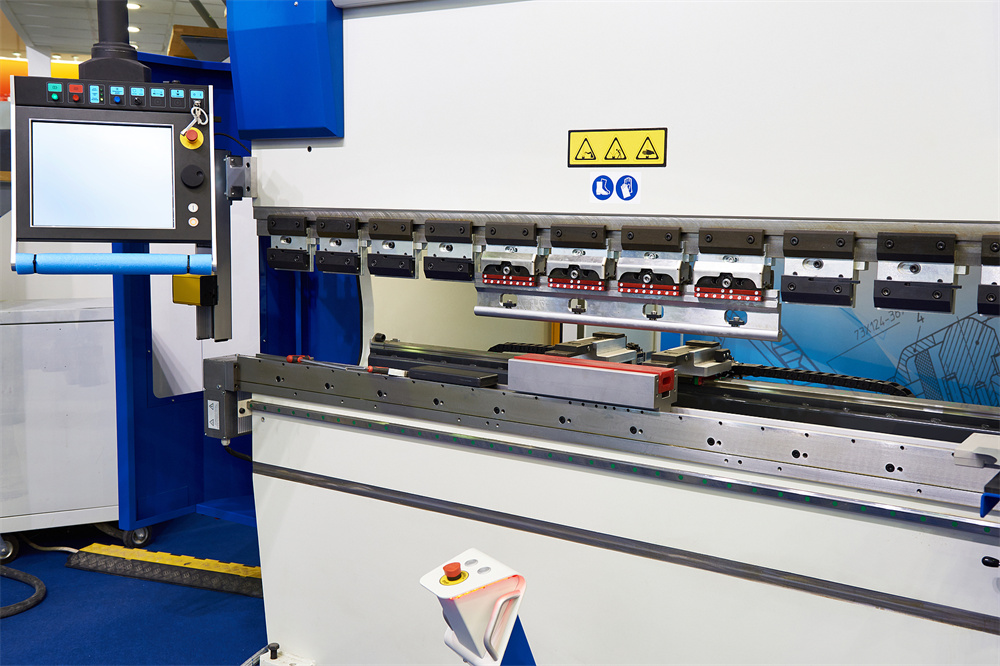
In furniture production, the “Synchronized” aspect of a CNC hydraulic press brake is vital. This technology uses electronic sensors (linear encoders) to monitor the position of the cylinders at both ends of the ram. If one side deviates even slightly, the CNC controller adjusts the hydraulic valves instantaneously to balance the force. This ensures that the bend angle is consistent across the entire length of a long workpiece, such as a 2-meter-long wardrobe panel. Without this synchronization, the metal would exhibit “boeing” or uneven angles, making assembly impossible.
Crowning Systems for Long Bends
When a press brake applies force to a metal sheet, the machine’s bed and ram naturally deflect slightly under the pressure. This can result in a “canoe effect,” where the bend angle is correct at the ends but obtuse in the middle. To counteract this, HARSLE press brakes utilize crowning systems. Mechanical crowning involves a series of wedges in the lower table that can be adjusted to create a slight curve, neutralizing the deflection. For furniture makers working with long, thin panels, a CNC-controlled crowning system is essential for maintaining a perfectly straight bend line.
Tooling Selection for Furniture Components
The choice of punch and die (tooling) is what determines the final shape of the furniture part. For example:
- Gooseneck Punches: These are essential for creating deep “U” shapes or channels, common in drawer slides and frame supports, as they provide clearance for previously bent flanges.
- Acute Angle Dies: Used for creating bends sharper than 90 degrees, often seen in decorative trim or specialized shelving brackets.
- Multi-V Dies: Allow the operator to quickly switch between different material thicknesses without changing the entire tool setup, increasing uptime.
Backgauge Precision and Multi-Axis Control
The backgauge is the component that the operator rests the metal sheet against to ensure the bend is in the right place. In furniture production, parts often have multiple bends in different directions. A 4-axis or 6-axis backgauge can move independently in various directions, allowing the machine to handle asymmetrical parts or parts that require tapered bends. This level of automation reduces the reliance on manual measurements and significantly speeds up the fabrication process.
Selection Advice: Choosing the Right Press Brake
Calculating Tonnage Requirements
One of the most common mistakes in selecting a press brake for furniture is overestimating or underestimating the required tonnage. Since most furniture is made from relatively thin gauge material (0.8mm to 3.0mm), a high-tonnage machine (e.g., 300 tons) is often unnecessary and can be less precise for delicate work. A 40-ton to 100-ton machine is usually the “sweet spot” for furniture manufacturers. To calculate the required force, use the standard formula: P = (1.42 * UTS * s^2 * L) / w, where P is force, UTS is ultimate tensile strength, s is thickness, L is length, and w is the V-opening width.
Controller Software and Ease of Use
For furniture shops that frequently update their designs, the CNC controller’s software is a major factor. Systems like Delem or Cybelec offer 2D and 3D graphical interfaces that allow operators to visualize the bending sequence before they even touch a piece of metal. This feature includes collision detection, which prevents the workpiece from hitting the machine frame or tooling during complex folds. Choosing a machine with an intuitive interface reduces the training time for new employees and minimizes scrap during the prototyping phase.
Safety Features and Compliance
Safety is paramount in any industrial setting. Modern press brakes should be equipped with laser protection systems (such as DSP or Lazersafe) that monitor the area around the top tool. If an obstruction (like an operator’s finger) is detected, the machine stops instantly. For furniture production, where operators are often handling small parts close to the tooling, these safety systems are non-negotiable for maintaining a safe and productive workplace.
Maintenance and Longevity
Investing in a press brake is a long-term commitment. When selecting a machine, consider the ease of maintenance. Look for components from reputable global brands (e.g., Bosch-Rexroth hydraulics, Schneider electrics) to ensure that replacement parts are easily accessible. Regular maintenance, such as oil changes, filter replacements, and checking the parallelism of the ram, will ensure that the machine remains an essential part of your metal furniture production line for decades.
Frequently Asked Questions (FAQ)
Why is a CNC press brake better than a manual one for furniture?
CNC press brakes offer automated control over the bend angle, depth, and backgauge position. This eliminates the trial-and-error associated with manual machines, ensuring that every furniture component is identical. This is critical for mass production and for parts that must fit together perfectly during assembly.
Can I bend stainless steel furniture without scratching it?
Yes. By using specialized “no-mark” tooling, urethane film, or nylon inserts in the dies, you can bend polished stainless steel or aluminum without leaving tool marks. This is a standard practice in high-end furniture manufacturing where aesthetics are a priority.
What is the ideal tonnage for office furniture production?
Most office furniture, such as filing cabinets and desk frames, uses 18 to 22-gauge steel. A press brake with 40 to 80 tons of pressure is typically sufficient for these materials, providing a balance of speed, precision, and energy efficiency.
How does a press brake help in reducing welding costs?
By using a press brake to create complex shapes from a single sheet of metal, you reduce the number of individual pieces that need to be joined. Fewer joints mean less welding, less heat distortion, and less time spent on post-weld finishing like grinding and painting.
Is it difficult to program a press brake for new furniture designs?
With modern 3D CNC controllers, programming is very straightforward. Many systems allow you to import CAD files directly, and the software automatically calculates the bend sequence and backgauge positions, making it easy to transition from design to production.
Conclusion: The Future of Metal Furniture with HARSLE
In conclusion, it is clear why press brakes are essential metal furniture production tools. They provide the precision, versatility, and efficiency required to meet the high standards of today’s consumers. As furniture designs become more daring and materials more varied, the role of the press brake will only grow in importance. By investing in high-quality CNC machinery, manufacturers can ensure they are capable of producing durable, beautiful, and cost-effective metal furniture.
HARSLE remains committed to supporting the furniture industry with innovative bending solutions. Our range of CNC synchronized press brakes is designed to handle the specific challenges of furniture fabrication, from thin-gauge precision to complex multi-bend sequences. By choosing the right equipment and focusing on technical excellence, your facility can lead the way in the evolving world of metal furniture manufacturing. Whether you are a small boutique workshop or a large-scale industrial producer, the right press brake is the foundation upon which your success is built.












