Comprehensive Guide to Hydraulic Press Applications in Appliance Manufacturing and Assembly


Introduction to Hydraulic Press Applications in Appliance Manufacturing and Assembly
The global appliance industry, often referred to as the ‘white goods’ sector, relies heavily on precision, speed, and repeatability. From the sleek stainless steel doors of a modern refrigerator to the robust internal drums of a high-capacity washing machine, the structural integrity and aesthetic appeal of these products are largely determined by the machinery used in their fabrication. Among the most critical pieces of equipment in this sector is the hydraulic press. Hydraulic press applications in appliance manufacturing and assembly have evolved from simple stamping tasks to complex, multi-stage forming processes that integrate advanced automation and servo-technology.
As consumer demand for energy-efficient, durable, and aesthetically pleasing appliances grows, manufacturers must adopt forming solutions that can handle thinner, high-strength materials without compromising on quality. The hydraulic press offers a unique combination of high tonnage, controllable stroke, and uniform pressure distribution, making it indispensable for the deep drawing, punching, and assembly of appliance components. This article explores the intricate details of how these machines are utilized, the technical requirements of the materials involved, and the productivity benefits that modern hydraulic systems bring to the factory floor.
Application Scenarios in the Appliance Industry
Hydraulic presses are utilized across a wide spectrum of appliance production lines. One of the most prominent scenarios is the manufacturing of refrigerator panels. These panels require large-surface-area forming with precise corner radii and minimal surface defects. A hydraulic press provides the steady, controlled pressure necessary to ensure that the metal flows evenly into the die, preventing thinning or tearing of the material. This is particularly important for high-end appliances where a brushed stainless steel finish must remain pristine throughout the forming process.
Another critical application is the production of washing machine tubs and drums. These components often involve deep drawing, where a flat sheet of metal is transformed into a deep, cylindrical shape. The ability of a hydraulic press to maintain constant pressure throughout the entire stroke allows for deeper draws than are typically possible with mechanical presses. Furthermore, the assembly of these components—such as pressing bearings into housings or joining the inner and outer drums—requires the precision force control that only hydraulic systems can provide.
Beyond large panels and drums, hydraulic presses are used for smaller, intricate parts such as microwave oven cavities, dishwasher liners, and air conditioner housings. In these scenarios, multi-station or progressive die setups are often employed. The hydraulic press’s versatility allows it to handle various die sets, enabling manufacturers to switch between different product models with minimal downtime. This flexibility is essential in an industry characterized by frequent design updates and seasonal demand fluctuations.
Material and Process Requirements
The materials used in appliance manufacturing are diverse, ranging from cold-rolled steel and galvanized steel to various grades of stainless steel and aluminum alloys. Each material presents unique challenges. For instance, stainless steel (commonly 304 or 430 grade) is favored for its corrosion resistance and aesthetic appeal but is prone to work hardening. This requires a hydraulic press that can deliver high force at a controlled speed to manage the material’s flow characteristics effectively.
Process requirements in this industry are exceptionally stringent. Surface quality is paramount; any scratches, ripples, or ‘orange peel’ effects on a visible panel can lead to a rejected part. To achieve this, hydraulic presses must be equipped with sophisticated blank holder systems. These systems apply a specific amount of pressure to the edges of the metal sheet, controlling how it is drawn into the die. Modern hydraulic presses allow for independent control of the blank holder force at different points around the die, which is crucial for forming asymmetrical parts like sink basins or complex oven doors.
Furthermore, dimensional accuracy is non-negotiable. Appliance components must fit together perfectly during the assembly phase to ensure structural rigidity and noise reduction. This necessitates a press with high frame stiffness and minimal deflection under load. The hydraulic system must also feature high-resolution linear encoders to monitor the position of the ram to within microns, ensuring that every part produced is identical to the last.
Recommended Machine Configuration
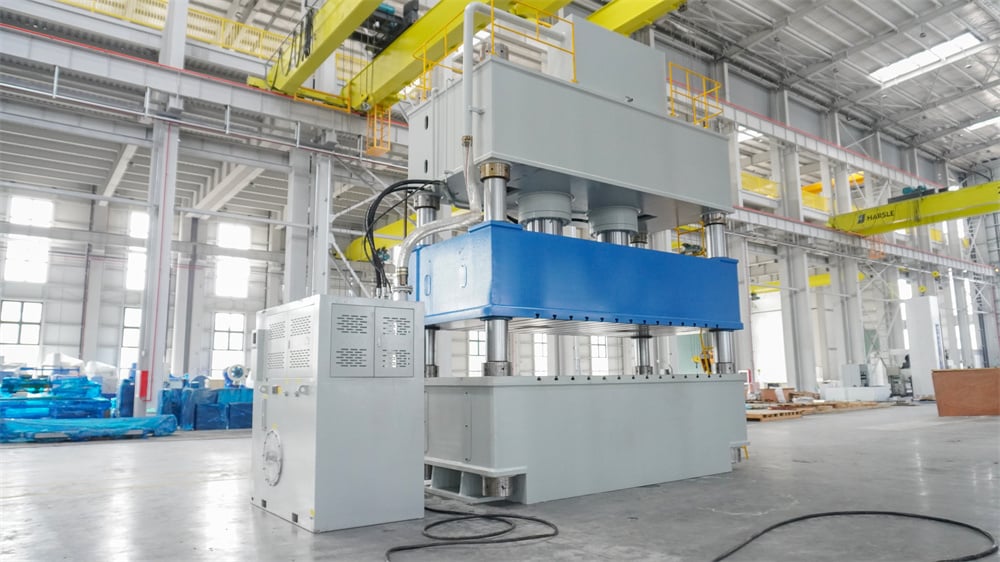
For appliance manufacturing, the configuration of the hydraulic press is tailored to the specific part being produced. For large panels, an H-frame (or four-column) hydraulic press is typically recommended. The H-frame design offers superior rigidity and can accommodate large bed sizes, which are necessary for refrigerator doors or side panels. These machines are often configured with tonnages ranging from 500 to 2000 tons, depending on the material thickness and the complexity of the draw.
Servo-Hydraulic Systems
One of the most significant advancements in machine configuration is the integration of servo-motor driven pumps. Unlike traditional hydraulic systems that run the motor at a constant speed, servo-hydraulic systems only consume energy when the press is in motion. This not only reduces energy consumption by up to 50% but also allows for much finer control over the pressing speed and pressure profile. For delicate forming operations in appliance assembly, this level of control is vital to prevent material fracture.
Multi-Cushion and Ejection Systems
To facilitate deep drawing, the press should be equipped with a hydraulic die cushion located in the bed. This cushion provides the necessary resistance to the blank holder. Advanced configurations include multi-point cushions where the pressure can be adjusted dynamically during the stroke. Additionally, high-speed ejection systems are required to quickly remove the finished part from the die, minimizing cycle times and maximizing throughput.
Workflow in Appliance Manufacturing and Assembly
The workflow involving hydraulic press applications in appliance manufacturing assembly is a highly synchronized process. It begins with material preparation, where coils of steel are unrolled, straightened, and cut into blanks. These blanks are then lubricated to reduce friction during the forming process. In a modern facility, robotic arms or automated sheet feeders place the blank into the hydraulic press.
Once the blank is positioned, the press cycle begins. The ram descends rapidly (fast approach), then slows down as it contacts the material (pressing speed). The hydraulic system applies the programmed force, drawing the metal into the die cavity. After a brief dwell time at the bottom of the stroke to set the shape, the ram retracts. The die cushion or an upper ejector then pushes the part out of the die, and a robot removes it for the next stage of production.
The assembly workflow is equally critical. For example, in the production of a washing machine, a hydraulic press might be used to press-fit the central shaft into the drum. This requires a ‘press-to-distance’ or ‘press-to-force’ logic, where the machine stops exactly when a certain depth or resistance is reached. This ensures a secure fit without damaging the sensitive bearings or the drum itself. The entire workflow is monitored by a central PLC (Programmable Logic Controller), which records data for every cycle, providing full traceability for quality assurance.
Productivity Benefits of Modern Hydraulic Presses
The adoption of advanced hydraulic press technology offers several key productivity benefits for appliance manufacturers:
- Reduced Cycle Times: Modern hydraulic systems feature high-speed valves and optimized oil circuits that allow for faster approach and retraction speeds, significantly shortening the overall cycle time per part.
- Energy Efficiency: As mentioned, servo-hydraulic technology drastically reduces electricity usage, which is a major operational cost in large-scale manufacturing.
- Lower Scrap Rates: The precision and repeatability of hydraulic presses mean fewer defective parts. The ability to fine-tune the pressure profile ensures that even complex parts are formed correctly the first time.
- Versatility: A single hydraulic press can be used for a variety of tasks—from deep drawing to punching and assembly—simply by changing the die and the software program. This reduces the need for multiple specialized machines.
- Enhanced Safety: Modern presses are equipped with light curtains, dual-hand controls, and emergency monitoring systems that protect operators while maintaining high production speeds.
Case Example: Refrigerator Door Production
Consider a leading appliance manufacturer that needed to upgrade its refrigerator door production line. The previous mechanical press line struggled with high scrap rates when forming new, thinner-gauge stainless steel panels. The manufacturer transitioned to a HARSLE 1000-ton H-frame hydraulic press equipped with a servo-drive system and a multi-point hydraulic cushion.
The results were immediate. The scrap rate dropped from 4% to less than 0.5% because the hydraulic press could maintain a consistent blank holder force that adjusted for slight variations in material thickness. Furthermore, the energy consumption of the pressing station decreased by 40%. The manufacturer was also able to integrate a robotic loading and unloading system, which increased the output from 120 units per hour to 180 units per hour. This case highlights how hydraulic press applications in appliance manufacturing assembly can directly impact the bottom line through improved quality and efficiency.
Frequently Asked Questions (FAQ)
1. Why is a hydraulic press preferred over a mechanical press for appliance parts?
Hydraulic presses are preferred for appliance parts, especially those requiring deep drawing (like tubs or sinks), because they provide full rated tonnage throughout the entire stroke. Mechanical presses only reach their full force at the bottom of the stroke. Additionally, hydraulic presses offer better control over pressing speed and pressure, which is essential for maintaining surface quality on visible panels.
2. What tonnage is typically required for appliance manufacturing?
Tonnage requirements vary widely. Small internal components might only require 50 to 100 tons, while large exterior panels for refrigerators or washing machines typically require between 500 and 2000 tons. The specific tonnage depends on the material type, thickness, and the total surface area being formed.
3. How does servo-technology improve hydraulic press performance?
Servo-technology replaces traditional induction motors with servo motors that control the hydraulic pumps. This allows for precise control of the ram’s movement, reduces noise, generates less heat (extending oil life), and significantly lowers energy consumption by only running the motor when the press is active.
4. Can hydraulic presses be integrated into fully automated lines?
Yes, modern hydraulic presses are designed with integration in mind. They feature advanced PLC systems that can communicate with industrial robots, conveyors, and factory-wide ERP systems. This allows for fully automated ‘lights-out’ manufacturing processes.
5. What maintenance is required for these machines?
Regular maintenance includes monitoring oil levels and quality, checking for leaks in hydraulic lines, inspecting seals, and ensuring the lubrication system for the gibs (guides) is functioning correctly. Modern presses often have self-diagnostic features that alert operators to maintenance needs before they cause downtime.
Conclusion and Call to Action
The role of hydraulic press applications in appliance manufacturing and assembly cannot be overstated. These machines provide the power, precision, and flexibility required to meet the rigorous standards of the modern white goods market. By investing in high-quality hydraulic equipment, manufacturers can ensure superior product quality, reduce operational costs, and maintain a competitive edge in a fast-paced industry.
At HARSLE, we specialize in providing state-of-the-art hydraulic press solutions tailored to the unique needs of the appliance industry. Whether you are looking for a high-tonnage deep drawing press or a precision assembly station, our team of experts is ready to help you optimize your production line. Contact HARSLE today to learn more about our innovative metal fabrication machinery and how we can support your manufacturing goals.