Press Brake Die Clearance Explained: Achieving Clean and Consistent Bends


Technical Overview of Press Brake Die Clearance
In the world of precision metal fabrication, the term ‘die clearance’—often referred to in the context of the V-opening width—is the cornerstone of successful bending operations. Press brake die clearance explained: achieving clean and consistent bends requires a deep understanding of how the punch, the material, and the die interact under immense pressure. At its core, die clearance determines the internal bend radius, the required tonnage, and the overall aesthetic quality of the finished part. When a press brake operator selects a die, they are not just choosing a tool; they are defining the geometric constraints that will govern the metal’s behavior during its plastic deformation phase.
The physics of bending involves stretching the outer fibers of the material while compressing the inner fibers. The space between the shoulders of the V-die (the V-opening) dictates where the material is supported and where it is allowed to flow. If the clearance is too narrow, the material is forced into a tight space, significantly increasing the friction and the force required to achieve the bend. Conversely, if the clearance is too wide, the material lacks sufficient support, leading to inconsistent angles and a larger-than-desired internal radius. For HARSLE machines, which are engineered for high precision, matching the correct die clearance to the material thickness is the first step in maximizing the machine’s potential.
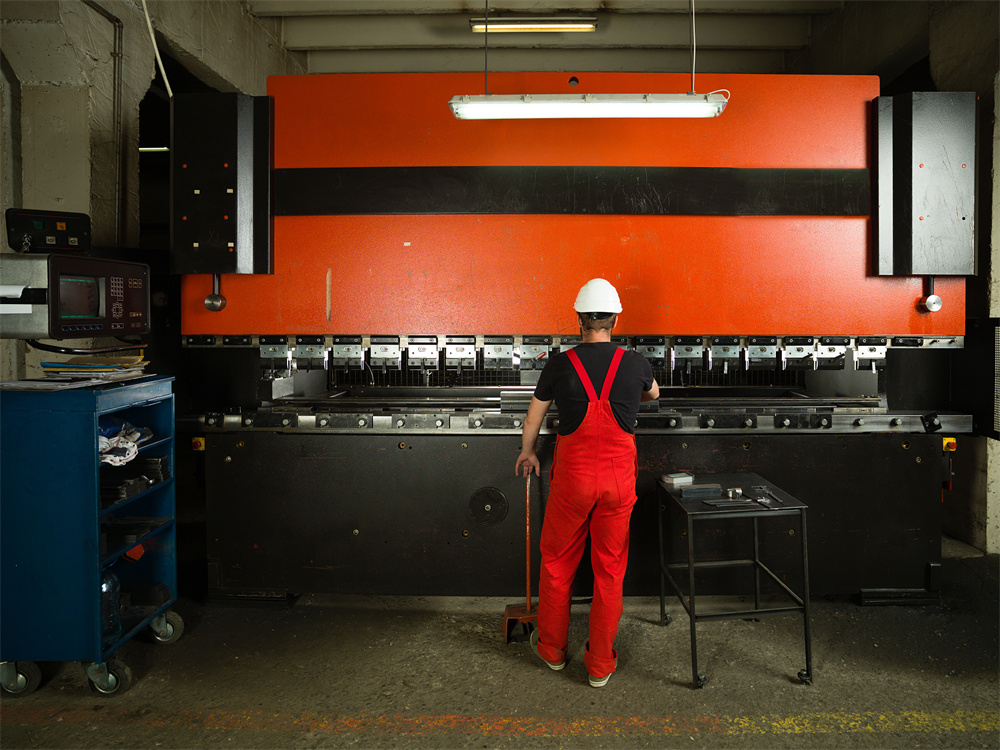
Furthermore, die clearance is intrinsically linked to the method of bending: air bending, bottoming, or coining. In air bending, which is the most common method used in modern CNC hydraulic press brakes, the material only touches the two edges of the die and the tip of the punch. Here, the die clearance (V-opening) is the primary factor in determining the resulting bend radius. Because the material does not bottom out in the die, the ‘clearance’ effectively acts as a floating variable that operators must calculate with precision to ensure the CNC controller can accurately predict the stroke depth.
Understanding the relationship between the V-opening and the material thickness (T) is vital. The industry standard often cites the ‘8x rule,’ where the V-opening should be eight times the thickness of the material. However, this is a generalized starting point. Depending on the material’s tensile strength and the desired flange length, this ratio may shift between 6x and 12x. Mastering these nuances is what separates a standard fabrication shop from a high-precision engineering facility.
Core Parameters Influencing Die Selection
To achieve clean and consistent bends, several core parameters must be evaluated simultaneously. The first and most obvious is Material Thickness (T). As the thickness increases, the resistance to bending grows exponentially. This necessitates a larger V-opening to distribute the load and prevent the material from cracking or the machine from overloading. For thin materials (under 3mm), a smaller V-opening is required to maintain control over the bend angle and prevent the ‘flopping’ effect where the material bows uncontrollably.
The second parameter is Material Tensile Strength. Not all metals are created equal. Stainless steel, for instance, has a much higher yield strength than cold-rolled steel or aluminum. When bending stainless steel, the die clearance must often be increased (using a 10x or 12x thickness rule) to accommodate the higher tonnage requirements and the significant springback characteristic of the material. If an operator uses a standard 8x V-opening for high-tensile materials, they risk damaging the die shoulders or causing premature wear on the punch tip.
Internal Bend Radius (Ri) is the third critical parameter. In air bending, the internal radius is approximately 15% to 17% of the V-opening width for cold-rolled steel. If a specific radius is required by the engineering drawing, the operator must work backward from that radius to select the appropriate die clearance. Choosing a die that is too large will result in a ‘soft’ bend with a large radius, while a die that is too small will create a ‘sharp’ bend that may weaken the material’s structural integrity at the bend line.
Finally, the Minimum Flange Length must be considered. Every V-opening has a minimum flange requirement; if the part’s flange is shorter than half the V-opening plus a small margin, the material will slip into the die rather than bending over the shoulders. This leads to inaccurate bends and potential safety hazards. Therefore, die clearance selection is a balancing act between the thickness of the metal, the strength of the alloy, the required radius, and the physical dimensions of the part being produced.
Calculation Method for Optimal Die Clearance
Calculating the correct die clearance is a blend of mathematical formulas and empirical experience. The most widely accepted formula for general-purpose mild steel is V = T × 8. For example, if you are bending 2mm thick mild steel, the ideal V-opening would be 16mm. However, for a more professional approach, engineers often use a range based on the material thickness categories:
- Thin Materials (0.5mm to 2.5mm): Use V = 6T to 8T. A 6T ratio provides a tighter radius and more precision for small electronic enclosures or decorative parts.
- Medium Materials (3mm to 8mm): Use V = 8T to 10T. This is the ‘sweet spot’ for most industrial applications, balancing tonnage and accuracy.
- Thick Materials (10mm and above): Use V = 10T to 12T. Larger openings are essential here to reduce the massive tonnage required and to prevent the material from fracturing.
When working with different materials, a multiplier is often applied to the tonnage calculation, but the V-opening itself may also need adjustment. For Aluminum, which is softer and more prone to cracking if bent too sharply, a larger V-opening (10T to 12T) is often preferred to ensure a larger radius. For Stainless Steel, the 10T rule is standard to manage the high pressure and springback. Springback is the tendency of the metal to return to its original shape after the pressure is released; a wider die clearance often requires a deeper punch stroke to over-bend the material, compensating for this effect.
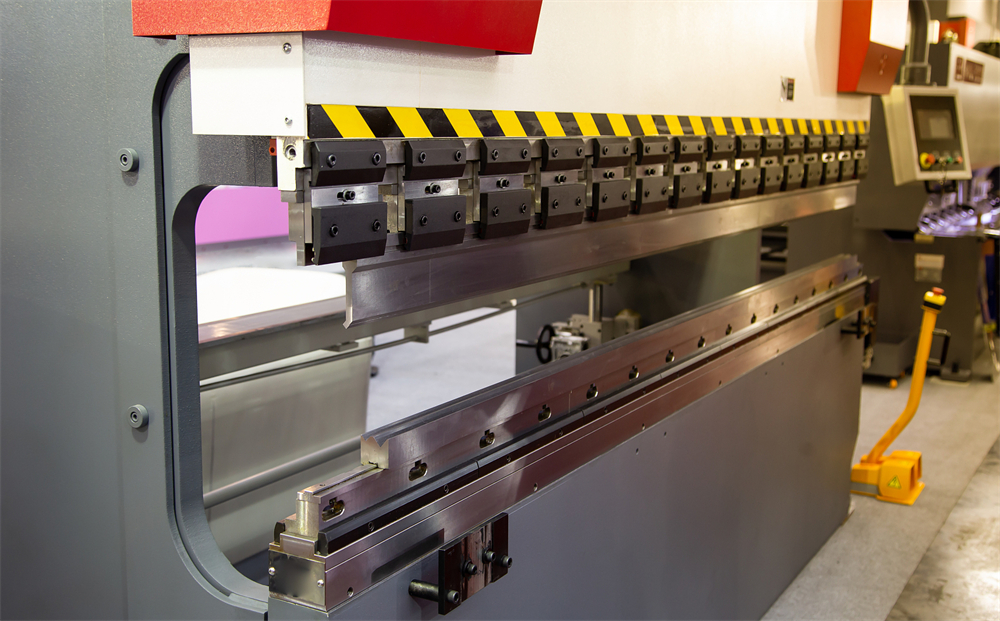
Another advanced calculation involves determining the Tonnage (F). The formula is generally: F = (1.42 × Tensile Strength × T² × Length) / V. This formula highlights why die clearance (V) is so important: because V is in the denominator, doubling the V-opening width effectively halves the required tonnage. This is a critical realization for operators working near the maximum capacity of their press brake. By increasing the die clearance slightly, they can safely bend thicker or harder materials without straining the hydraulic system of the HARSLE press brake.
Parameter Table for Press Brake Die Selection
The following table provides a quick reference guide for selecting the appropriate V-opening based on material thickness for standard mild steel (Tensile Strength approx. 450 MPa). Note that for stainless steel, you should generally move up one V-opening size.
| Material Thickness (mm) | Recommended V-Opening (mm) | Internal Radius (Approx. mm) | Min. Flange Length (mm) | Tonnage per Meter (Approx.) |
|---|---|---|---|---|
| 0.5 – 1.0 | 6 – 8 | 1.0 – 1.3 | 4.5 – 6.0 | 6 – 10 |
| 1.2 – 1.5 | 10 – 12 | 1.6 – 2.0 | 7.5 – 9.0 | 11 – 15 |
| 2.0 | 16 | 2.6 | 11.5 | 17 |
| 3.0 | 24 | 4.0 | 17.0 | 25 |
| 4.0 | 32 | 5.3 | 23.0 | 33 |
| 5.0 | 40 | 6.7 | 28.0 | 42 |
| 6.0 | 50 | 8.5 | 35.0 | 50 |
| 8.0 | 63 | 10.5 | 45.0 | 75 |
| 10.0 | 80 | 13.5 | 56.0 | 100 |
| 12.0 | 100 | 17.0 | 70.0 | 120 |
This table serves as a foundational guide. In practice, the specific tooling available in your shop will dictate the final choice. If the exact recommended V-opening is not available, it is generally safer to choose the next larger size rather than a smaller one, provided the minimum flange length of the part allows for it. Using a larger die reduces the risk of ‘orange peel’ (surface texture degradation) and keeps the machine’s hydraulic pressure within safe operating limits.
Common Engineering Mistakes in Die Clearance
One of the most frequent mistakes in metal fabrication is underestimating the impact of V-opening on tonnage. Operators often try to use a small V-opening to achieve a tight radius on thick material. This results in a massive spike in tonnage, which can not only deform the part but also cause permanent damage to the press brake’s ram or the die itself. In extreme cases, the die can literally explode under the pressure, posing a significant safety risk. Always check the tonnage chart provided by HARSLE before attempting a bend with a narrow die.
Another common error is ignoring the material’s grain direction. Metal is rolled in a specific direction during manufacturing, creating a ‘grain.’ Bending parallel to the grain is much more likely to result in cracking, especially if the die clearance is too tight. When the clearance is optimized, the stress is distributed more evenly, but if the operator fails to account for grain direction and uses a small V-opening, the part is almost guaranteed to fail quality inspection due to micro-fractures on the outer radius.
Inconsistent Die Wear is a subtle but damaging issue. Over time, the shoulders of the V-die become worn and rounded. This effectively changes the die clearance during the bend, as the material ‘sinks’ deeper into the worn shoulders. This leads to inconsistent bend angles across the length of the part. Many engineers fail to include die inspection in their maintenance routines, leading to a slow drift in part quality that is difficult to diagnose. Regularly measuring the V-opening and checking for shoulder symmetry is essential for maintaining ‘clean and consistent’ results.
Finally, there is the mistake of incorrectly calculating the bend deduction. Because the die clearance determines the internal radius, it also determines the bend deduction (the amount of material ‘lost’ or ‘gained’ in the bend). If an engineer uses a standard bend deduction in their CAD software but the operator chooses a different die clearance on the shop floor, the final dimensions of the part will be incorrect. Communication between the design office and the shop floor regarding die selection is paramount for precision engineering.
Selection Checklist for Press Brake Operators
Before beginning any bending operation, operators should follow this checklist to ensure the die clearance is optimized for the task at hand:
- Verify Material Specs: Confirm the thickness and tensile strength of the sheet metal. Is it mild steel, stainless, or aluminum?
- Check the Drawing: Identify the required internal bend radius and the minimum flange length.
- Calculate the V-Opening: Use the 8x rule as a baseline, adjusting for material type (e.g., 10x for stainless).
- Tonnage Verification: Ensure the calculated tonnage for the chosen V-opening does not exceed the machine’s or the tool’s rated capacity.
- Tooling Inspection: Check the die for wear, cracks, or debris. Ensure the punch tip radius is compatible with the V-opening (the punch tip should generally be smaller than the resulting internal radius).
- CNC Programming: Enter the correct die width and radius into the CNC controller so the backgauge and stroke depth are calculated accurately.
- Test Bend: Perform a scrap piece test bend to verify the angle and radius before proceeding with the production run.
- Safety Check: Ensure all guards are in place and the material is properly supported to prevent ‘whip-up’ during the bend.
Frequently Asked Questions (FAQ)
1. Why is the 8x rule so common for die clearance?
The 8x rule (V=8T) is considered the industry standard because it provides the best balance between manageable tonnage and a ‘natural’ bend radius for mild steel. It minimizes the risk of material cracking while ensuring the press brake operates within a high-efficiency range. It is the most versatile ratio for general fabrication.
2. Can I use a smaller V-opening to get a sharper bend?
While a smaller V-opening will result in a tighter internal radius, it comes at the cost of significantly higher tonnage. If you must achieve a very sharp bend, it is often better to use a ‘bottoming’ or ‘coining’ technique with specialized tooling, rather than simply forcing the material into a narrow air-bending die. However, be aware that sharp bends can create stress risers in the material.
3. How does die clearance affect springback?
Generally, a wider die clearance results in a larger bend radius, which in turn can increase the amount of springback. This is because a larger radius involves more elastic deformation relative to plastic deformation. Modern CNC press brakes compensate for this by over-bending the part by a few degrees, but the operator must ensure the die is wide enough to allow for this extra travel.
4. What happens if the V-opening is too large?
If the V-opening is too large (e.g., 12T or 15T for thin material), the bend will lack precision. The internal radius will be very large and potentially inconsistent, and the material may not sit securely against the backgauges, leading to skewed or ‘dog-legged’ bends. Additionally, the minimum flange length increases, making it impossible to bend small details.
5. Does the die clearance need to change for coated materials?
Yes. For materials like galvanized steel or pre-painted aluminum, a slightly larger V-opening or the use of protective ‘bending film’ is recommended. This reduces the friction and pressure on the shoulders of the die, preventing the coating from galling, scratching, or peeling off during the bending process.
6. How often should I replace my dies?
Dies should be replaced when the shoulders show visible signs of deformation or when the bend angles become inconsistent across the length of the machine. In high-production environments, precision-ground and hardened tooling is recommended as it maintains its ‘clearance’ dimensions much longer than standard flame-hardened dies.