How to Select the Right Press Brake for Small-Batch and High-Volume Production


Technical Overview of Modern Press Brake Systems
In the contemporary landscape of metal fabrication, the ability to adapt to varying production demands is a critical competitive advantage. Whether a facility is focused on the rapid prototyping of small batches or the relentless output of high-volume components, the choice of a press brake dictates the efficiency, precision, and profitability of the entire operation. To select the right press brake for small-batch and high-volume production, one must first understand the fundamental mechanics and the technological evolution of these machines.
Modern press brakes have transitioned from simple mechanical linkages to sophisticated CNC-controlled hydraulic and electric systems. For small-batch production, the primary challenge is the ‘setup-to-run’ ratio. When a machine spends more time being configured than actually bending metal, the cost per part skyrockets. Conversely, high-volume production focuses on ‘cycle-time optimization’ and ‘repeatability.’ In this scenario, even a fraction of a second saved per stroke can result in thousands of dollars in annual savings. HARSLE, as a leader in the industry, integrates advanced control systems that bridge the gap between these two disparate production philosophies.
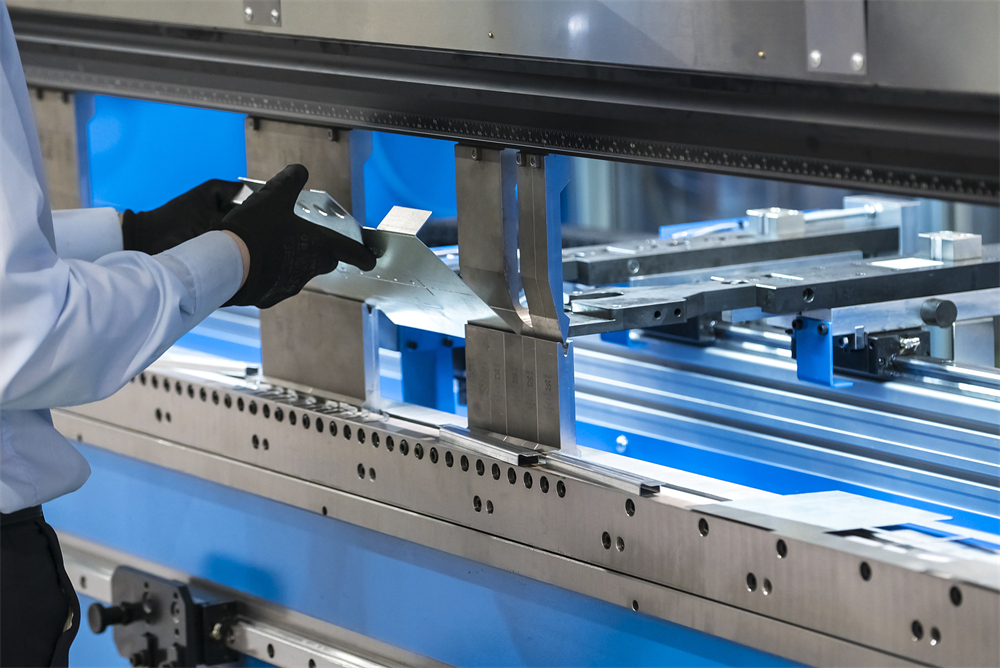
The physics of bending involves overcoming the material’s yield strength to achieve permanent deformation. This requires precise control over the ram’s position (Y-axis) and the backgauge’s position (X, R, Z axes). For small batches, the flexibility of the CNC system to handle complex geometries with minimal manual intervention is paramount. For high-volume runs, the thermal stability of the hydraulic system and the speed of the servo-electric drives become the deciding factors. Understanding these technical nuances is the first step in making an informed investment.
Core Parameters for Machine Selection
Tonnage and Bending Length
Tonnage is the most fundamental parameter. It represents the maximum pressure the press brake can exert. Selecting the right tonnage involves calculating the thickest material and the longest bend you anticipate. However, it is a common mistake to simply buy the highest tonnage available. Excessive tonnage on thin materials can lead to machine wear and tool damage if not managed by a sophisticated CNC system. For high-volume production, choosing a machine that operates comfortably at 60-80% of its rated capacity ensures longevity and reduces maintenance downtime.
The Backgauge System (X, R, Z1, Z2 Axes)
The backgauge is the heart of the machine’s versatility. In small-batch production, parts often have multiple bends of varying lengths and angles. A 4-axis or 6-axis backgauge allows the operator to position the sheet accurately for complex shapes without manual repositioning. For high-volume production, the speed of the backgauge movement is critical. High-speed servo motors in the backgauge system reduce the ‘air time’ between bends, significantly increasing parts-per-hour metrics.
Crowning Systems (Deflection Compensation)
When a press brake applies pressure, the bed and the ram naturally deflect or ‘bow.’ Without compensation, this results in a ‘canoe effect’ where the angle in the middle of the bend is different from the ends. For high-volume production, an automatic CNC crowning system is non-negotiable to ensure every part is identical. In small-batch production, where materials and thicknesses change frequently, a crowning system that can be adjusted on-the-fly via the controller saves hours of shim-based manual adjustments.
Control Systems and Software
The interface between the human and the machine defines the production speed. Modern CNC controllers like those from Delem, Cybelec, or ESA offer 3D visualization and offline programming. For small batches, offline programming allows the next job to be prepared while the current one is running. For high-volume production, the controller’s ability to integrate with robotic arms and automated loading systems is a key consideration for future-proofing the workshop.
Calculation Method for Bending Force
To accurately select a press brake for small-batch and high-volume production, you must master the bending force calculation. The standard formula for air bending is: F = (650 * S^2 * L) / V.
- F: Bending Force (expressed in Kilonewtons or Tons).
- S: Material Thickness (mm).
- L: Bending Length (m).
- V: V-die Opening (mm). Usually, V is 8 to 10 times the thickness (S).
For example, if you are bending 3mm thick mild steel over a length of 2 meters using a 24mm V-die, the calculation would be: (650 * 3^2 * 2) / 24 = 487.5 kN, which is approximately 50 tons. However, when selecting a machine, you must account for material variations. Stainless steel, for instance, requires about 50% more pressure than mild steel due to its higher tensile strength. For high-volume production, adding a 20% safety margin to your calculated tonnage prevents the hydraulic system from running at its absolute limit, which preserves seal life and oil quality.
Parameter Comparison Table
The following table illustrates the differences in machine requirements based on the production scale. Use this as a reference when evaluating HARSLE models or other industrial equipment.
| Feature | Small-Batch Production | High-Volume Production | Technical Justification |
|---|---|---|---|
| Drive System | Hydraulic or Hybrid | Servo-Electric or High-Speed Hybrid | Electric systems offer faster cycle times and higher energy efficiency for continuous runs. |
| Backgauge Axes | 4-6 Axes (X, R, Z1, Z2, X5, X6) | 2-4 High-Speed Axes | Small batches need geometric flexibility; high volume needs speed and reliability. |
| Tooling Change | Quick-Change / Hydraulic Clamping | Fixed Specialized Tooling or ATC | ATC (Automatic Tool Changers) are ideal for high-mix, but fixed setups work for long runs. |
| Crowning | Manual or CNC Hydraulic | CNC Motorized (High Precision) | Motorized crowning provides faster, more repeatable compensation for long-term accuracy. |
| Software | Offline 3D Programming | ERP Integration & Robotic Interface | Small batches benefit from fast programming; high volume benefits from data integration. |
| Tonnage Margin | 10-15% Over Max Requirement | 20-30% Over Max Requirement | Higher margins in high volume reduce mechanical fatigue and heat buildup. |
Common Engineering Mistakes in Selection
One of the most frequent errors when companies select a press brake for small-batch and high-volume production is underestimating the importance of the ‘throat depth.’ The throat depth determines how large a flange can be bent. In small-batch environments where part designs change weekly, a shallow throat can suddenly render the machine useless for a new contract. Always opt for a deeper throat than you currently need to ensure long-term versatility.
Another mistake is ignoring the ‘approach’ and ‘return’ speeds of the ram. In high-volume production, the actual bending time is often only 20% of the total cycle. The rest is spent moving the ram to the part and back up. A machine with a slow approach speed will bottleneck your entire production line. High-performance HARSLE machines utilize high-speed valves and servo-hydraulics to minimize these non-productive intervals.
Finally, many engineers overlook the cooling system. In high-volume production, the hydraulic oil can reach high temperatures, leading to a drop in viscosity and a loss of precision. For 24/7 operations, an industrial oil cooler is not an option—it is a necessity. Conversely, for small batches, an oversized cooling system might be an unnecessary expense, but the machine should still have thermal sensors to protect the components.
Selection Checklist for Procurement
When you are ready to finalize your purchase, use this checklist to ensure the machine meets both small-batch and high-volume requirements:
- Material Compatibility: Does the tonnage account for the highest tensile strength material you use (e.g., Hardox or Stainless 316)?
- Stroke Length: Is the stroke long enough to accommodate deep box bending and the use of tall tools?
- Controller Capability: Does the CNC support the file formats exported by your CAD/CAM software (DXF, STEP)?
- Safety Systems: For high-volume work, are laser guards (like DSP or LazerSafe) integrated to allow high-speed closing without compromising operator safety?
- Maintenance Support: Does the manufacturer provide remote diagnostics? This is vital for high-volume lines where every hour of downtime is a major loss.
- Energy Efficiency: For high-volume production, consider a hybrid system that only runs the motor when the ram is moving, potentially saving up to 60% in energy costs.
- Tooling Compatibility: Does the machine use standard European or American style tooling, or will you be locked into a proprietary system?
Frequently Asked Questions (FAQ)
1. Can one press brake really handle both small-batch and high-volume production?
Yes, but it requires a high-specification CNC machine. The key is the control system and the clamping mechanism. Hydraulic tool clamping allows for fast changes (small-batch), while high-speed servo-hydraulics ensure the cycle times needed for high-volume runs.
2. Why is servo-electric becoming more popular for high-volume work?
Servo-electric press brakes eliminate the hydraulic oil, which means no thermal expansion issues and no oil changes. They are incredibly fast and precise, making them the gold standard for high-volume, small-part production where speed is the primary KPI.
3. How does offline programming help small-batch production?
Offline programming allows an engineer to create the bending sequence, select tools, and simulate the bend on a computer. This means the operator just loads the program and the tools, reducing the setup time from 30 minutes to 5 minutes.
4. What is the impact of ‘Springback’ on machine selection?
Springback is when the metal tries to return to its original shape after bending. High-volume production requires a machine with an ‘angle measurement system’ (like a laser angle tracker) that adjusts the bend in real-time to compensate for material variations, ensuring every part is identical.
5. Is a 2-axis backgauge enough for general fabrication?
For simple high-volume parts, a 2-axis (X, R) backgauge is often sufficient. However, for small-batch work where you might encounter tapered parts or complex offsets, a 4-axis or 6-axis backgauge is essential to avoid complex manual jigging.
6. How often should I calibrate my press brake?
For high-volume production, a quick daily check and a professional calibration every six months are recommended. For small-batch work, calibration should be checked whenever you switch to a high-precision job to ensure the Y-axis repeatability is within tolerance.
Conclusion
Selecting the right press brake for small-batch and high-volume production is a balancing act between flexibility and raw speed. By focusing on advanced CNC controls, robust backgauge systems, and accurate tonnage calculations, fabricators can invest in a machine that serves their current needs while providing the scalability for future growth. HARSLE continues to innovate in this space, providing the technical reliability required for the most demanding industrial environments. Whether you are bending a single prototype or ten thousand brackets, the right machine is the foundation of your success.