Hydraulic Press Applications In Aerospace Component Manufacturing: A Comprehensive Guide


Introduction to Hydraulic Press Applications In Aerospace Component Manufacturing
The aerospace industry represents the pinnacle of engineering precision, where every component must meet exacting standards for strength, weight, and durability. Central to the production of these critical parts is the hydraulic press. Hydraulic press applications in aerospace component manufacturing have evolved from simple forming tasks to highly sophisticated processes involving exotic alloys and complex geometries. As aircraft designs push the boundaries of performance, the machinery used to create them must offer unparalleled control and reliability.
In this comprehensive guide, we explore how hydraulic presses facilitate the creation of everything from fuselage panels to engine components. We will delve into the specific material requirements, the advanced workflows involved, and the technological configurations that make HARSLE hydraulic presses a preferred choice for aerospace manufacturers worldwide. Understanding these applications is essential for any facility looking to upgrade its production capabilities or enter the high-stakes world of aerospace fabrication.
Application Scenarios in Aerospace Manufacturing
Hydraulic press applications in aerospace component manufacturing are diverse, spanning across various sections of an aircraft. One of the most prominent scenarios is the production of structural airframe components. These include wing spars, ribs, and bulkheads that require immense force to shape high-strength aluminum and titanium alloys. Unlike mechanical presses, hydraulic presses provide constant pressure throughout the entire stroke, which is vital for maintaining the structural integrity of large-scale airframe parts.
Another critical application is found in the manufacturing of engine components. Jet engines operate under extreme temperatures and pressures, necessitating parts made from nickel-based superalloys like Inconel. Hydraulic presses are used for isothermal forging and deep drawing of combustion liners, turbine housings, and exhaust nozzles. The ability to control the speed and pressure of the ram allows for the slow, steady deformation required to prevent cracking in these sensitive materials.
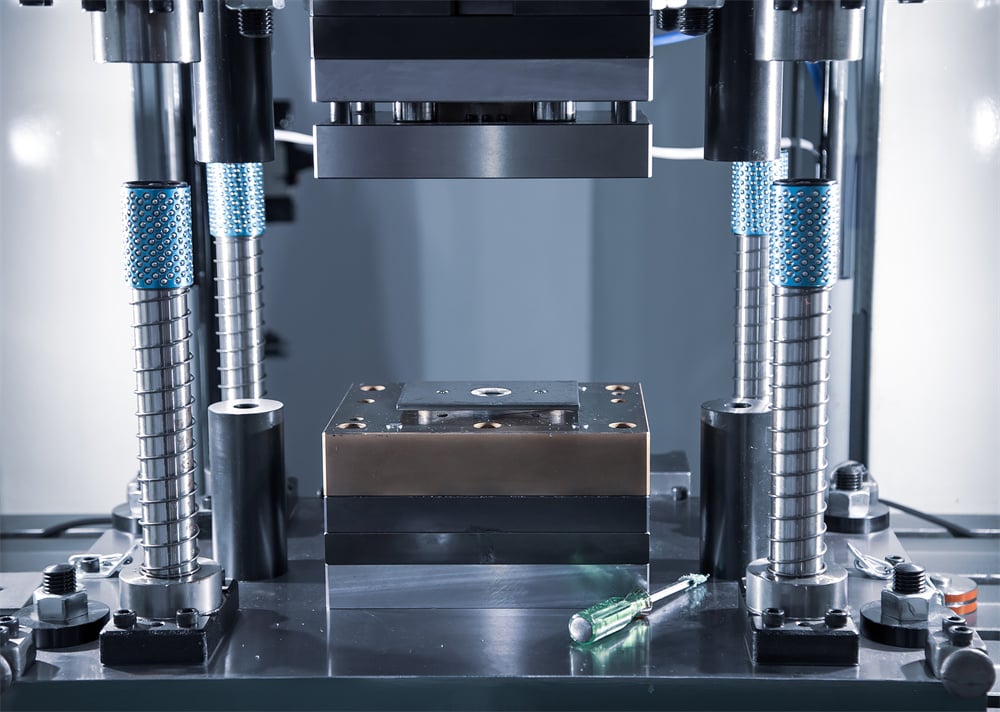
Beyond structural and engine parts, hydraulic presses are instrumental in creating interior components and secondary structures. This includes seat frames, galley components, and cargo handling equipment. While these parts may not face the same stresses as a wing spar, they still require high repeatability and precision to ensure a perfect fit within the aircraft’s tight tolerances. Furthermore, the rise of composite materials in aerospace has led to the use of hydraulic presses for compression molding of carbon fiber reinforced polymers (CFRP).
Finally, specialized applications such as superplastic forming (SPF) and diffusion bonding (DB) rely heavily on hydraulic press technology. These processes involve heating the material to a state where it becomes highly ductile, then using gas pressure and hydraulic force to mold it into complex, near-net-shape components. This reduces the need for subsequent machining and assembly, significantly lowering the overall weight of the aircraft.
Material and Process Requirements
The materials used in aerospace are selected for their high strength-to-weight ratios and resistance to environmental degradation. However, these same properties make them notoriously difficult to form. Titanium alloys, for instance, have high spring-back rates and require precise thermal management during the pressing process. Hydraulic press applications in aerospace component manufacturing must account for these material characteristics through advanced control systems and integrated heating elements.
Aluminum alloys, particularly the 2000 and 7000 series, are staples in the industry. These materials often require solution heat treatment followed by forming in a “soft” state before aging. The hydraulic press must be capable of rapid cycles to process these parts before the material naturally hardens. Additionally, the use of stainless steel and high-strength steels in landing gear components requires presses with massive tonnage capacities, often exceeding 5,000 to 10,000 tons, to achieve the necessary deformation without compromising the metal’s grain structure.
Key Aerospace Materials and Their Forming Challenges
| Material | Common Components | Forming Challenge |
|---|---|---|
| Titanium (Ti-6Al-4V) | Engine blades, fasteners, structural frames | High spring-back, requires hot forming |
| Inconel 718 | Turbine housings, exhaust ducts | Extreme hardness, requires slow deformation speeds |
| Aluminum 7075 | Wing skins, fuselage frames | Susceptibility to cracking if not formed at correct temp |
| Carbon Fiber Composites | Control surfaces, interior panels | Requires precise temperature and pressure dwell times |
Process requirements in aerospace also demand high levels of cleanliness and precision. Hydraulic systems must be designed to prevent oil leaks that could contaminate sensitive aerospace alloys. Furthermore, the integration of CNC (Computer Numerical Control) is mandatory. CNC systems allow for the programming of complex pressure profiles, where the force applied changes dynamically throughout the stroke to accommodate the thinning or thickening of the material as it flows into the die.
Recommended Machine Configuration
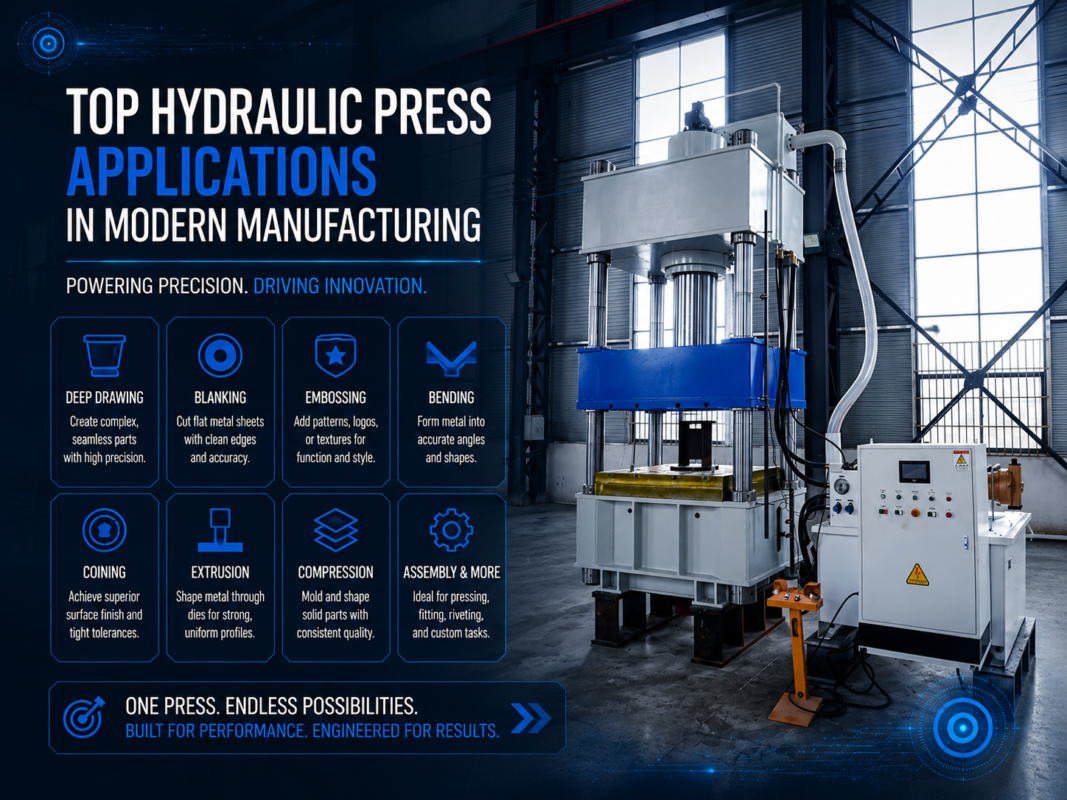
When selecting a machine for hydraulic press applications in aerospace component manufacturing, the configuration must prioritize rigidity and control. An H-frame (or four-column) design is typically recommended over a C-frame for high-precision work. The H-frame provides a balanced distribution of force, minimizing frame deflection under heavy loads. This ensures that the upper and lower dies remain perfectly aligned, which is critical for maintaining the tight tolerances required in aerospace parts.
Servo-hydraulic systems are becoming the industry standard for aerospace applications. Unlike traditional hydraulic systems that run a pump at a constant speed, servo-driven pumps only operate when movement or pressure is required. This results in significant energy savings, reduced heat generation in the hydraulic oil, and, most importantly, much finer control over the ram’s position and velocity. A servo-hydraulic press can achieve positioning accuracy within microns, a necessity for complex deep drawing and coining operations.
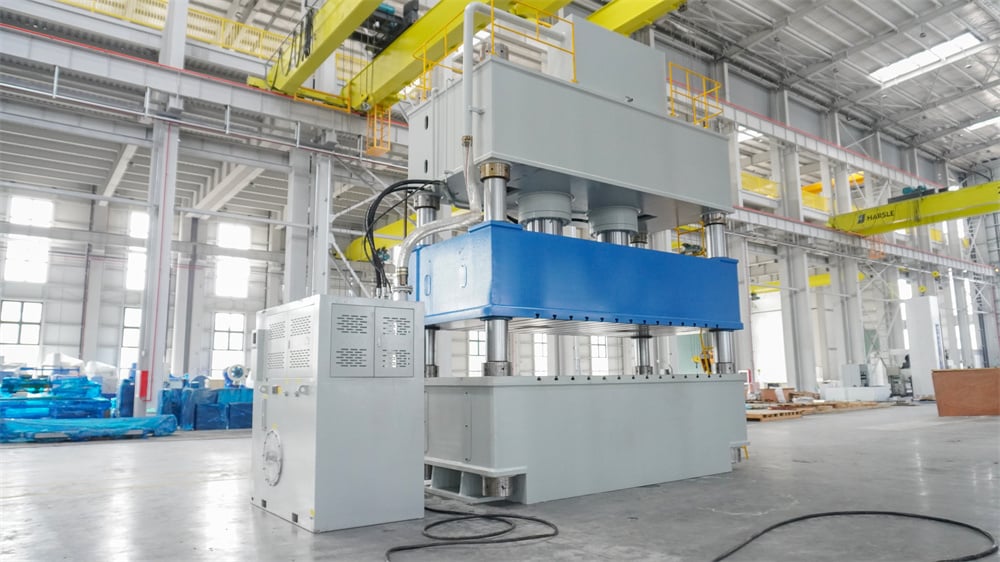
For hot forming and SPF applications, the press must be equipped with heated platens and an integrated thermal control system. These platens can reach temperatures up to 1000°C, requiring specialized insulation to protect the hydraulic cylinders and the machine frame. Additionally, multi-zone heating allows for precise temperature gradients across the die surface, ensuring uniform material flow in complex parts. Vacuum systems may also be integrated for diffusion bonding processes to prevent oxidation of the metal surfaces.
Safety and data logging are also paramount. Aerospace manufacturers are often required to provide a “birth certificate” for every part produced, documenting the exact pressure, temperature, and duration of the forming cycle. Therefore, the recommended machine configuration includes a robust data acquisition system that integrates with the factory’s ERP (Enterprise Resource Planning) software. This ensures full traceability and compliance with AS9100 quality standards.
Workflow in Aerospace Component Pressing
The workflow for hydraulic press applications in aerospace component manufacturing is a multi-stage process that begins long before the metal touches the die. It starts with advanced simulation software. Engineers use Finite Element Analysis (FEA) to simulate the forming process, identifying potential areas of thinning, wrinkling, or excessive stress. This allows for the optimization of the die design and the development of the ideal pressure profile for the hydraulic press.
Once the simulation is complete, the material is prepared. For many aerospace alloys, this involves precision cutting (often via waterjet or laser) and surface cleaning to remove any oxides or contaminants. If the process involves hot forming, the blank or the die (or both) is preheated to the required temperature. The blank is then carefully positioned within the press, often using automated robotic arms to ensure consistency and safety.
- Material Preparation: Cutting, cleaning, and pre-heating of the alloy blank.
- Die Setup: Installation and alignment of precision-machined aerospace dies.
- Press Cycle: Execution of the programmed CNC profile, including multi-stage pressure application and dwell times.
- Cooling/Unloading: Controlled cooling of the part to prevent warping, followed by removal from the press.
- Post-Processing: Trimming of excess material, heat treatment, and surface finishing.
- Inspection: Non-destructive testing (NDT) such as X-ray or ultrasonic inspection to ensure internal integrity.
The actual pressing cycle in aerospace is often slower than in automotive or general manufacturing. This “slow-form” approach is necessary to allow the metal’s grain structure to adapt to the new shape without inducing internal micro-cracks. After the cycle is complete, the part may undergo secondary operations like chemical milling or shot peening to improve its fatigue resistance. Every step is meticulously documented to maintain the rigorous safety standards of the aviation industry.
Productivity Benefits of Advanced Hydraulic Presses
Implementing advanced hydraulic press applications in aerospace component manufacturing offers several key productivity benefits. First and foremost is the reduction in material waste. Aerospace alloys are incredibly expensive; a single sheet of titanium can cost thousands of dollars. Precision hydraulic forming allows for “near-net-shape” production, meaning the final part is very close to its finished dimensions, significantly reducing the amount of material that must be machined away as scrap.
Another benefit is the consolidation of parts. Traditional aerospace manufacturing often involved riveting together dozens of small components. With high-tonnage hydraulic presses, manufacturers can form large, complex structural sections as a single piece. This not only reduces the weight of the aircraft by eliminating fasteners but also reduces assembly time and the number of potential failure points in the structure. This “monolithic” design approach is a major driver in modern aircraft efficiency.
Furthermore, the repeatability offered by CNC-controlled hydraulic presses ensures that every part produced is identical to the last. In an industry where a fraction of a millimeter can be the difference between a perfect fit and a rejected part, this consistency is invaluable. It reduces the rate of reworks and scrap, directly impacting the manufacturer’s bottom line. The integration of IoT (Internet of Things) sensors also allows for predictive maintenance, minimizing unplanned downtime and ensuring the press is always ready for production.
Case Example: Forming a Titanium Engine Nacelle
To illustrate the power of hydraulic press applications in aerospace component manufacturing, let’s look at the production of a titanium engine nacelle skin. The nacelle is the aerodynamic housing for the jet engine, and its skin must be incredibly strong yet lightweight. In this case, a HARSLE 1500-ton H-frame hydraulic press was utilized, equipped with a specialized hot-forming package.
The process began with a Ti-6Al-4V blank. Because titanium is difficult to form at room temperature, the press platens were heated to 700°C. The CNC system was programmed with a specific velocity profile: a fast approach to save time, followed by a very slow pressing speed (0.1 mm/s) as the material began to deform into the complex curvature of the nacelle. A dwell time of 300 seconds at peak pressure allowed the material to “set,” significantly reducing spring-back issues.
The result was a perfectly formed component that met all aerodynamic and structural requirements. By using a hydraulic press instead of traditional stretch forming, the manufacturer reduced material usage by 15% and cut the production cycle time by 20%. The integrated data logging system provided a complete record of the temperature and pressure throughout the cycle, satisfying the stringent quality audits of the aerospace prime contractor.
Frequently Asked Questions (FAQ)
What is the typical tonnage required for aerospace hydraulic presses?
Tonnage varies widely depending on the application. Small interior components might only require 100 to 500 tons, while large structural airframe parts or heavy forgings can require anywhere from 2,000 to over 15,000 tons. The key is not just the total force, but the ability to control that force precisely across the entire stroke.
Why is a hydraulic press preferred over a mechanical press for aerospace?
Hydraulic presses offer several advantages for aerospace: constant pressure throughout the stroke, adjustable stroke length, and the ability to dwell at a specific pressure. Mechanical presses have a fixed stroke and deliver peak force only at the bottom of the cycle, which is unsuitable for the deep drawing and slow-forming processes required for aerospace alloys.
Can hydraulic presses handle composite materials?
Yes, hydraulic presses are excellent for compression molding of composites. They provide the steady pressure and precise temperature control needed to cure resins and bond carbon fiber layers. Many modern aerospace presses are designed to be “hybrid,” capable of handling both metal forming and composite molding.
How does HARSLE ensure the precision of its aerospace presses?
HARSLE utilizes high-precision linear encoders, Bosch Rexroth or Parker hydraulic components, and Siemens CNC systems. Our frames are stress-relieved and machined to exacting tolerances to ensure minimal deflection. We also offer custom-designed servo-hydraulic systems for the highest level of control and energy efficiency.
Conclusion and Call to Action
Hydraulic press applications in aerospace component manufacturing are at the heart of modern aviation’s progress. From reducing aircraft weight to enabling the use of advanced superalloys, these machines are indispensable tools for the aerospace engineer. As the industry moves toward more sustainable and efficient aircraft, the demand for high-precision, high-control hydraulic forming will only continue to grow.
At HARSLE, we specialize in providing cutting-edge hydraulic solutions tailored to the unique needs of the aerospace sector. Whether you require a high-tonnage forging press or a specialized hot-forming system, our team of experts is ready to help you achieve your production goals with reliability and precision. Contact HARSLE today to discuss your aerospace manufacturing challenges and discover how our advanced hydraulic presses can elevate your production capabilities.