
Press Brake Forming: Process, Methods, Key Settings and Design Rules

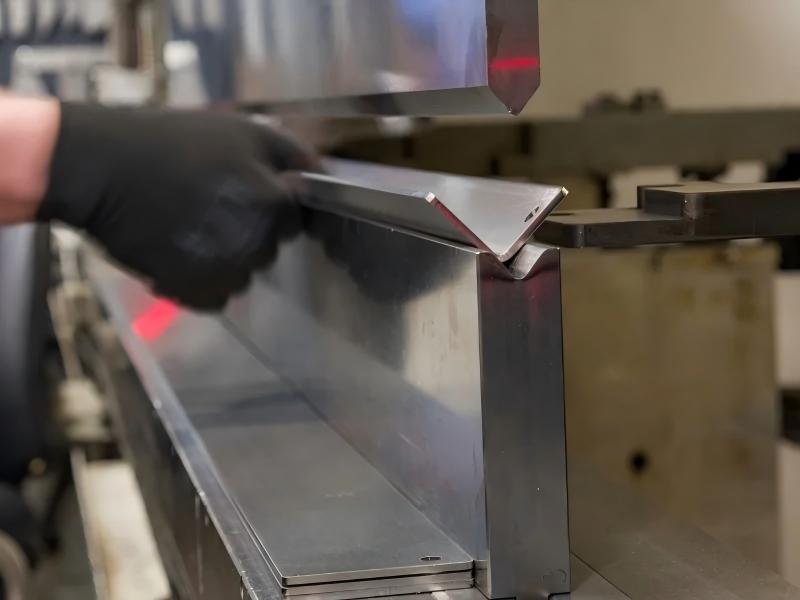
Short answer: press brake forming bends sheet metal or plate along a straight line by pressing it between a punch and a die. Most work today uses air bending, where the punch depth sets the angle. Bottoming and coining are used for special cases. Good results depend on four choices: the V-die opening (about 8 × thickness), enough tonnage, correct springback compensation and a sensible bend sequence. This guide explains the process, the methods and the design rules for parts that form well.
How Press Brake Forming Works
- The operator or robot places the sheet against the backgauge, which sets the flange length.
- The ram moves down quickly, then slows to bending speed when the punch touches the sheet.
- The punch pushes the sheet into the die to the programmed depth (air bending) or until it contacts the die walls (bottoming).
- The ram returns; the sheet springs back slightly, and the CNC has already compensated for this by overbending.
- The next bend is made in the programmed sequence.
Press Brake Forming Methods
| Method | Force (relative) | Typical use |
|---|---|---|
| Air bending | 1× | Most jobs; one die makes many angles |
| Bottoming | ≈ 3–5× | Thin sheet with tight angle tolerance |
| Coining | ≈ 5–10× | Very thin sheet, sharp radii, no springback |
| Radius (bump) bending | Varies | Large radii with many small bends |
| Hemming | High at flattening | Folded safety edges |
| Offset / joggle forming | Medium | Z-shapes in one stroke |
Compare the three main methods in detail in air bending vs bottoming vs coining.
Key Settings and Numbers
| Setting | Rule of thumb | Details |
|---|---|---|
| V-die opening | ≈ 8 × thickness (6–12 × T) | V-die opening chart |
| Inside radius (air bending) | ≈ 15–17% of V (mild steel) | Larger for stainless |
| Tonnage (mild steel) | ≈ 65 × T² ÷ V tons per meter | Tonnage calculator |
| Minimum flange | ≈ 0.7 × V | Shorter flanges fall into the die |
| Springback | 0.5–2° mild steel, 2–4° stainless | Springback chart |
| Flat blank length | Outside dimensions − bend deduction | K-factor chart |
Design Rules for Press Brake Forming
- Keep flanges long enough: at least about 0.7 × V for the die you will use.
- Keep holes away from bends: at least 2 × thickness plus the inside radius, or the holes will distort.
- Use relief cuts where a bend meets an edge or another bend, to avoid tearing.
- Use a consistent inside radius across the part to reduce tool changes.
- Bend across the rolling direction where possible, especially on high-strength steel and aluminum, to avoid cracking.
- Check tool collisions on box shapes: return flanges may need gooseneck punches or a specific sequence.
Bend Sequence Basics
- Bend the short and inside flanges first, outer and long flanges last.
- Keep the part stable against the backgauge for every bend.
- Avoid sequences where a formed flange hits the punch, ram or frame. CNC controllers with 2D/3D simulation check this automatically.
- Group bends that use the same tool to reduce tool changes.
Common Forming Problems
| Problem | Typical cause | See |
|---|---|---|
| Wrong angle | Springback, material variation, depth | Angle troubleshooting |
| Angle varies along the bend | Crowning, tool wear | Crowning problems |
| Cracks on the outside of the bend | Radius too small, bend parallel to grain, hard material | Use a wider V or radius tool |
| Marks on the sheet | Die shoulders, dirty tools | Urethane or roller dies, protective film |
Select a bending method from radius, flange geometry and load
Use the material and tooling specifications to confirm achievable inside radius, minimum flange and allowable force. Record the method and inspect the first approved part before production.
Frequently Asked Questions
What is press brake forming?
The process of bending sheet metal or plate along a straight line between a punch and a die on a press brake, typically to make angles, channels, boxes and profiles.
What is the most common press brake forming method?
Air bending: it needs the least force, and one die produces many angles under CNC depth control.
How thick can a press brake form?
That depends on tonnage and length. Typical 100–200 ton machines bend mild steel up to about 6–10 mm over 3 m; heavy press brakes form 20 mm and thicker.
Form Your Parts with KAVDO
KAVDO builds CNC electro-hydraulic, electric and torsion-bar press brakes. New to the machine? Start with what is a press brake. Send your drawing through the contact page for a forming feasibility check.
