How to Troubleshoot a Hydraulic Press That Moves Too Slowly: A Comprehensive Guide

Introduction to Hydraulic Press Speed Issues
In the world of metal fabrication, time is quite literally money. When a hydraulic press begins to operate slower than its rated cycle time, the impact is felt immediately across the entire production line. A slow-moving press creates a bottleneck, reduces the number of parts produced per shift, and can even affect the quality of the finished product due to temperature changes in the workpiece or inconsistent pressure application. Understanding how to troubleshoot a hydraulic press that moves too slowly is a critical skill for maintenance teams and shop floor managers alike.
HARSLE has spent decades perfecting the art of hydraulic machinery, and we understand that a drop in speed is often a symptom of an underlying systemic issue rather than a single component failure. Whether you are using a four-column press, a C-frame press, or a specialized deep drawing machine, the principles of fluid power remain the same. Speed in a hydraulic system is a direct function of flow rate. If the ram is moving slowly, it means the required volume of oil is not reaching the cylinder at the necessary rate, or it is escaping before it can do its work.
This guide is designed to walk you through the technical nuances of hydraulic speed loss. We will explore everything from pump efficiency and valve settings to the physical properties of the hydraulic fluid itself. By following a systematic troubleshooting approach, you can minimize downtime and return your equipment to its peak performance levels. Let’s dive into the key considerations and technical details required to diagnose and fix a sluggish hydraulic press.
Key Considerations Before Troubleshooting
Before you begin turning wrenches or adjusting relief valves, it is vital to establish a baseline and ensure safety. Troubleshooting a hydraulic press involves working with high-pressure systems and heavy mechanical components. Safety should always be the primary concern. Ensure that the press is properly locked out and tagged out (LOTO) when performing mechanical inspections, and always wear appropriate personal protective equipment (PPE).
The first consideration is to define “slow.” Is the press slow during the rapid advance phase, the pressing phase, or the return stroke? Identifying exactly when the slowdown occurs can narrow down the list of potential culprits significantly. For instance, a slow rapid advance often points toward a pre-fill valve or a high-flow pump circuit issue, while a slow pressing stroke might indicate a main pump wear problem or a leak in the high-pressure seals.
Another key consideration is the history of the machine. Did the speed drop suddenly, or has it been a gradual decline over several months? A sudden drop often suggests a mechanical failure, such as a broken spring in a valve or a blown seal. A gradual decline is more indicative of wear and tear, such as a pump losing volumetric efficiency or the gradual buildup of contaminants in the filters. Keeping a detailed maintenance log is invaluable during this phase of the investigation.
Finally, consider the environment. Hydraulic systems are sensitive to temperature. If the shop floor is exceptionally cold or if the machine’s cooling system is failing, the viscosity of the oil will change. Thick, cold oil moves slowly and can cause cavitation, while overly hot, thin oil can bypass seals and valves more easily, leading to a loss of effective flow. Always check the operating temperature of the reservoir before diving into more complex mechanical diagnostics.
Technical Details: Root Causes of Slow Movement
1. Pump Efficiency and Volumetric Loss
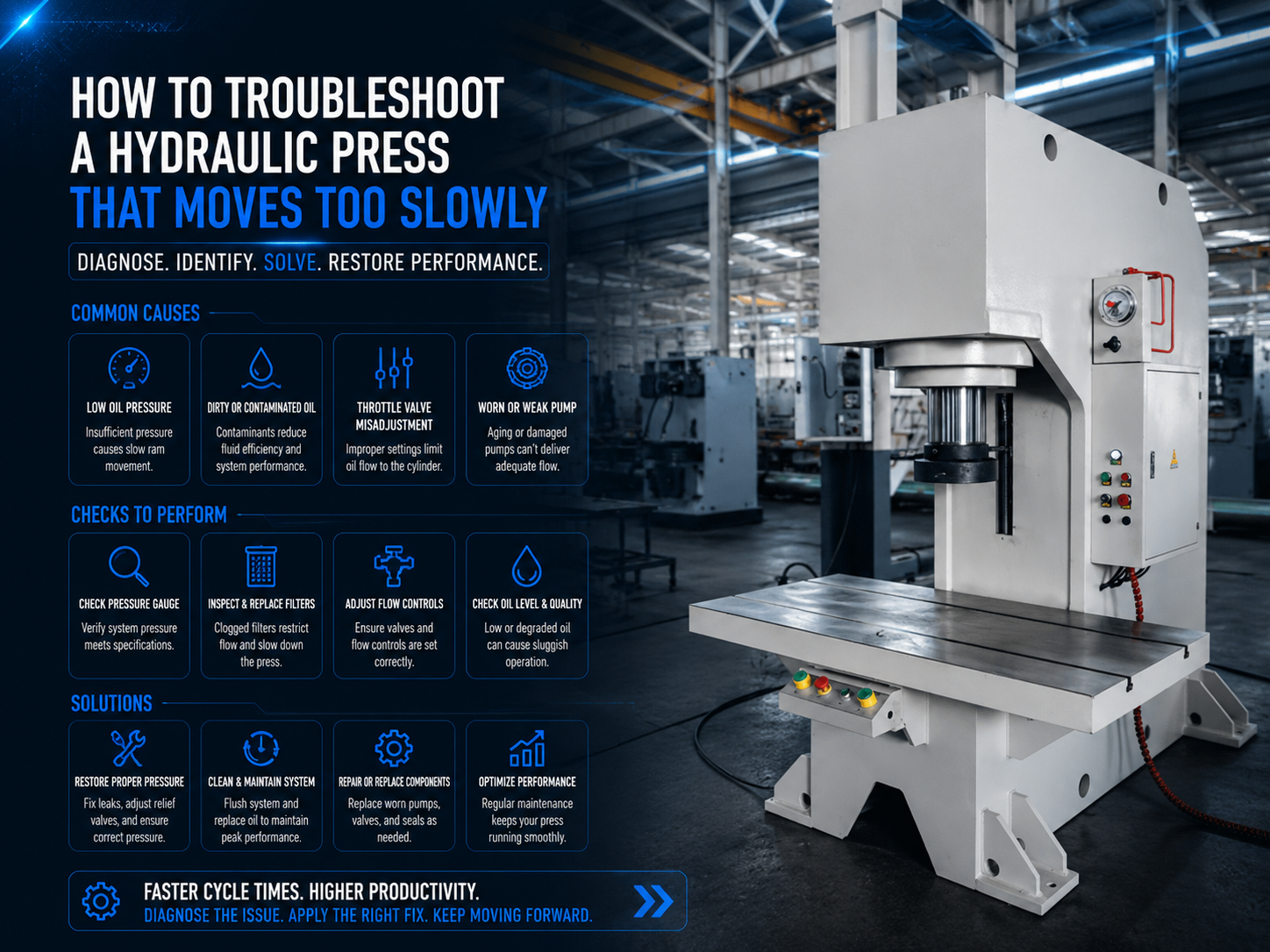
The hydraulic pump is the heart of the press. Its job is to convert mechanical energy into fluid flow. When a pump wears out, it suffers from internal leakage, also known as volumetric loss. As the internal clearances between gears, vanes, or pistons increase, a portion of the oil that should be sent to the cylinder instead slips back to the suction side of the pump. This results in a lower flow rate (GPM or LPM) and, consequently, a slower ram speed.
To troubleshoot this, you should perform a pump flow test. By measuring the flow at low pressure and then again at high pressure, you can calculate the efficiency. If the flow drops significantly as the pressure increases, the pump is likely worn and needs rebuilding or replacement. Additionally, listen for unusual noises. A high-pitched whining or growling often indicates cavitation or aeration, both of which reduce flow and can destroy a pump in short order.
2. Relief Valve and Control Valve Issues
Valves act as the traffic controllers of the hydraulic system. If a relief valve is set too low or is leaking, it will allow oil to bypass the cylinder and return to the tank prematurely. This is a common reason why a press might move at normal speed under no load but slow down significantly as soon as it encounters resistance. The oil takes the path of least resistance, which, in this case, is through the faulty relief valve.
Directional control valves can also cause issues if the spool is not shifting fully. If the spool is partially blocked by debris or if the solenoid is weak, the orifice through which the oil must pass remains restricted. This restriction creates a pressure drop and limits the volume of oil reaching the cylinder. Inspecting the solenoids for proper voltage and ensuring the spools move freely is a critical step in the troubleshooting process.
3. Fluid Contamination and Viscosity
The condition of the hydraulic fluid is often overlooked. Hydraulic oil must maintain a specific viscosity to function correctly. If the oil is too thick (high viscosity), it creates excessive friction and resistance within the pipes and valves, slowing down the flow. If the oil is too thin (low viscosity), it leaks past seals and internal components more easily. Contamination—such as dirt, metal shavings, or water—can also clog filters and suction strainers, starving the pump of oil and causing a massive drop in speed.
Regular oil analysis is recommended to monitor the health of your fluid. If you find that your press is moving slowly, check the suction strainer inside the reservoir. A clogged strainer is a frequent and easily fixable cause of slow movement. Furthermore, ensure that the oil type matches the manufacturer’s specifications for your specific climate and workload.
4. Cylinder Seal Leakage
Internal leakage within the hydraulic cylinder is a “silent killer” of speed. If the piston seals are worn or damaged, high-pressure oil can bypass the piston and move to the low-pressure side of the cylinder. Since the oil is staying within the cylinder, you won’t see an external leak, but the ram will move much slower because the effective pressure and flow are being neutralized. This is often accompanied by the cylinder drifting downward when the machine is stopped in mid-stroke.
5. Mechanical Friction and Alignment
Sometimes the problem isn’t hydraulic at all. A hydraulic press relies on precise mechanical alignment. If the gibs (the guides that keep the ram straight) are too tight or lack lubrication, they create immense mechanical friction. The hydraulic system must then work harder to overcome this friction, which can result in slower movement and excessive heat generation. Check the lubrication system and ensure that the ways are clean and properly greased.
Selection Advice: Choosing the Right Press for Speed
When purchasing a new hydraulic press, it is important to select a machine that is engineered for your specific speed requirements. Not all presses are created equal, and a machine designed for heavy, slow forging will not perform well in a high-speed stamping application. Here are some tips for selecting the right equipment to avoid future speed frustrations:
- Analyze Cycle Time Requirements: Before buying, calculate your required parts per minute. Ensure the press has a “Rapid Advance” and “Rapid Return” feature, which uses a separate high-flow circuit to move the ram quickly when not under load.
- Check Pump Capacity: Look for machines equipped with high-quality variable displacement pumps. These pumps can adjust their flow based on demand, providing high speed when needed and high pressure at lower speeds for the actual forming process.
- Evaluate the Cooling System: If you plan on running the press continuously, ensure it has a robust oil cooling system (air or water-cooled). Overheated oil is a leading cause of speed loss in industrial environments.
- Consider Proportional Hydraulics: For applications requiring precise speed control throughout the stroke, proportional valves offer the best performance. They allow the PLC to ramp speed up and down smoothly, preventing hydraulic shock and maintaining consistent cycle times.
- Brand Reputation: Choose a manufacturer like HARSLE that uses world-class components (such as Rexroth valves or Siemens motors). High-quality components have tighter tolerances and are less prone to the internal leakage that causes slowdowns.
| Component | Potential Problem | Diagnostic Action |
|---|---|---|
| Hydraulic Pump | Internal wear/Volumetric loss | Perform flow test at varying pressures. |
| Relief Valve | Set too low or stuck open | Check pressure gauge during pressing cycle. |
| Suction Filter | Clogged with debris | Inspect and clean/replace filter element. |
| Cylinder Seals | Bypassing (Internal leak) | Check for ram drift or heat buildup in cylinder. |
| Hydraulic Oil | Incorrect viscosity or overheating | Check oil temperature and verify oil grade. |
Frequently Asked Questions (FAQ)
Why does my hydraulic press slow down only after it has been running for an hour?
This is almost always related to oil temperature. As the machine runs, the oil heats up and its viscosity drops (it becomes thinner). If your pump or seals are slightly worn, the thinner oil will leak past them more easily, reducing the effective flow rate. Check your cooling system and ensure the oil is not exceeding 50-60°C (122-140°F).
Can a faulty motor cause a hydraulic press to move slowly?
Yes. If the electric motor driving the pump is not reaching its rated RPM or is struggling under load due to electrical issues (like a dropped phase), the pump will not be able to deliver its full rated flow. Check the motor’s amp draw and RPM during the pressing cycle.
How often should I change the hydraulic filters?
In a standard industrial environment, filters should be changed every 1,000 to 2,000 operating hours, or at least once a year. However, if you notice a drop in speed, the filters should be the first thing you check, regardless of the schedule.
What is cavitation, and how does it affect speed?
Cavitation occurs when the pump cannot get enough oil, causing vacuum bubbles to form. When these bubbles collapse, they cause micro-explosions that damage the pump internals. This reduces the pump’s ability to move oil, leading to a significant and noisy drop in speed.
Is it possible to increase the speed of an old hydraulic press?
Sometimes. You can potentially increase speed by installing a larger pump or a high-speed manifold, but this must be done carefully. The rest of the system (pipes, valves, and motor) must be able to handle the increased flow and power requirements. Consult with a HARSLE technician before making such modifications.
Conclusion
Learning how to troubleshoot a hydraulic press that moves too slowly is an essential part of maintaining a productive metal fabrication shop. By understanding that speed is a product of flow, and that flow can be compromised by pump wear, valve issues, fluid degradation, or mechanical friction, you can approach the problem logically and efficiently. Start with the simplest solutions—checking oil levels, temperatures, and filters—before moving on to more complex component testing.
At HARSLE, we pride ourselves on building robust, high-speed hydraulic machinery designed to withstand the rigors of modern manufacturing. However, even the best machines require regular maintenance and occasional troubleshooting. By staying proactive and following the steps outlined in this guide, you can ensure your hydraulic press remains a fast, reliable, and profitable asset for your business. If you encounter a speed issue that you cannot resolve, our technical support team is always available to provide expert guidance and genuine replacement parts to get you back up to speed.