How Sheet Thickness and Material Properties Affect Press Brake Bending: A Comprehensive Technical Guide


Technical Overview: The Physics of Metal Deformation
In the world of precision metal fabrication, understanding how sheet thickness and material properties affect press brake bending is the difference between a perfect component and a pile of scrap metal. Press brake bending is not merely a mechanical action of pushing a punch into a die; it is a complex interaction of metallurgical properties, mechanical forces, and geometric constraints. When a press brake applies force to a metal sheet, the material undergoes elastic deformation followed by plastic deformation. The success of this process depends heavily on the inherent characteristics of the metal being worked.
The primary mechanism at play is the displacement of the material’s neutral axis. During a bend, the inner surface of the metal is compressed, while the outer surface is stretched. Between these two zones lies the neutral axis, which theoretically experiences no change in length. However, as sheet thickness increases or material ductility changes, the position of this neutral axis shifts, directly impacting the final dimensions of the part. This phenomenon is why fabricators must calculate ‘bend allowance’ and ‘bend deduction’ with extreme precision.
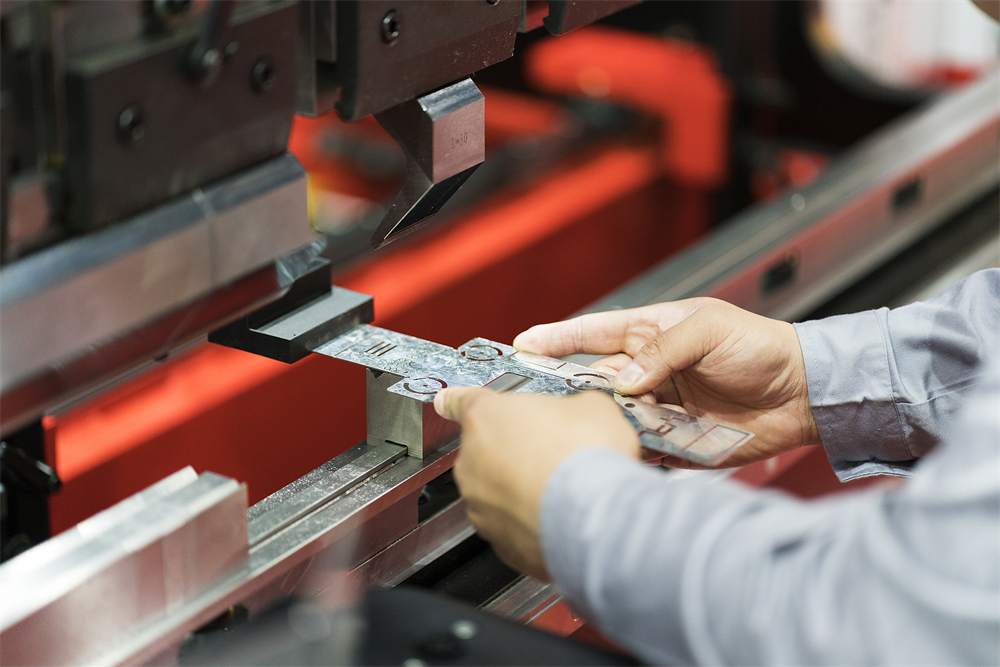
Furthermore, the method of bending—whether air bending, bottoming, or coining—interacts differently with material properties. Air bending, the most common method in modern CNC fabrication, relies on a three-point contact system where the material’s yield strength and thickness determine the final angle. Because the material does not fully touch the die walls, the ‘springback’ effect is more pronounced, making the material’s elastic modulus a critical factor in machine programming. HARSLE machines utilize advanced sensors to compensate for these variables, but the operator must still understand the underlying physics to optimize production.
Core Parameters: Sheet Thickness and Material Strength
When discussing how sheet thickness and material properties affect press brake bending, we must first look at the relationship between thickness ($t$) and the required bending force ($P$). In physics, the force required to bend a sheet is proportional to the square of its thickness. This means that if you double the thickness of a plate, you do not simply double the required tonnage; you quadruple it. This exponential relationship is a fundamental law that governs press brake selection and tooling longevity.
Material properties, specifically yield strength and tensile strength, act as multipliers in this equation. Yield strength is the point at which a material ceases to return to its original shape and begins to deform permanently. A high-strength material like stainless steel (e.g., Grade 304 or 316) has a much higher yield point than soft aluminum or mild steel. Consequently, bending stainless steel requires significantly more pressure even if the thickness is identical to a mild steel counterpart. This increased pressure puts higher stress on the press brake’s hydraulic system and the tooling itself.
Ductility and elongation are also vital. Ductility refers to a material’s ability to undergo plastic deformation before fracturing. Materials with low ductility are prone to ‘cracking’ on the outer radius of the bend, especially when using a small punch radius. For instance, certain aerospace-grade aluminum alloys or high-carbon steels may require a larger internal bend radius to prevent structural failure. Understanding the minimum bend radius for specific thicknesses and materials is essential for maintaining the structural integrity of the finished product.
Calculation Method: Determining Tonnage and Springback
To accurately predict how sheet thickness and material properties affect press brake bending, engineers use the standard tonnage formula. The basic formula for air bending is: P = (k * S * L * t²) / V. In this equation, P represents the force in tons, S is the tensile strength of the material, L is the length of the bend, t is the sheet thickness, and V is the V-die opening width. The constant k usually ranges from 1.3 to 1.5 depending on the friction and die geometry.
The V-die opening ($V$) is a critical variable that is often determined by the sheet thickness. The industry standard ‘Rule of 8’ suggests that the V-opening should be approximately 8 times the material thickness for mild steel. However, for thicker materials (over 6mm) or high-strength alloys, this ratio might increase to 10x or 12x to reduce the required tonnage and prevent tool breakage. Choosing a V-opening that is too small for a given thickness will cause the tonnage to skyrocket, potentially damaging the machine’s ram or the die itself.
Springback calculation is another essential step. Springback occurs because every metal has an elastic region; when the punch is released, the material ‘springs back’ toward its original shape. The amount of springback is influenced by the ratio of the bend radius to the material thickness ($R/t$) and the material’s yield strength. High-strength materials with a high elastic modulus exhibit more springback. For example, while mild steel might spring back 1 to 2 degrees, stainless steel can spring back as much as 3 to 5 degrees. Modern HARSLE CNC press brakes incorporate springback compensation tables and laser angle measurement systems to adjust the punch depth automatically in real-time.
Parameter Table: Material Comparison for Bending
The following table provides a general reference for how different materials and thicknesses interact during the bending process. Note that these values are based on standard air bending practices.
| Material Type | Thickness (mm) | Recommended V-Opening (mm) | Tensile Strength (N/mm²) | Approx. Tonnage per Meter | Springback Estimate |
|---|---|---|---|---|---|
| Mild Steel (A36) | 2.0 | 16 | 450 | 15-18 | 1.5° |
| Mild Steel (A36) | 6.0 | 48 | 450 | 45-50 | 2.0° |
| Stainless Steel (304) | 2.0 | 16 | 600 | 22-25 | 3.5° |
| Stainless Steel (304) | 5.0 | 40 | 600 | 55-60 | 4.0° |
| Aluminum (5052-H32) | 2.0 | 12 | 210 | 8-10 | 0.5° |
| Aluminum (6061-T6) | 4.0 | 32 | 310 | 18-22 | 2.0° |
As seen in the table, the material type significantly alters the tonnage requirements. Stainless steel requires roughly 50% more force than mild steel for the same thickness, while aluminum requires significantly less. However, aluminum’s lower ductility in certain tempers (like T6) means it is more susceptible to cracking if the V-opening is too narrow or the punch radius is too sharp.
Common Engineering Mistakes in Press Brake Bending
One of the most frequent mistakes in metal fabrication is ignoring the grain direction of the sheet metal. During the rolling process at the mill, the metal’s grains are elongated in the direction of rolling. Bending ‘with the grain’ (parallel to the rolling direction) is easier but increases the risk of cracking and reduces the maximum bend angle. Bending ‘across the grain’ (perpendicular) provides more strength and a cleaner bend but requires slightly more force. Failing to account for grain orientation can lead to inconsistent results across a production run.
Another common error is the improper selection of V-die width. Operators often try to use a single V-die for multiple thicknesses to save setup time. However, using a V-die that is too narrow for a thick plate causes ‘sharp bending,’ where the punch forces the material to exceed its physical limits, leading to visible deformation or ‘creasing’ on the outer radius. Conversely, using a V-die that is too wide for thin material results in poor angle accuracy and inconsistent flange lengths because the material is not properly supported during the stroke.
Neglecting the ‘K-factor’ in CAD/CAM programming is a third major pitfall. The K-factor is the ratio of the neutral axis position to the material thickness. Since different materials and thicknesses shift the neutral axis differently, using a generic K-factor (like 0.44 for everything) will result in parts that are either too long or too short after bending. For high-precision industries like aerospace or medical equipment, the K-factor must be empirically tested for every specific material batch and thickness combination used on the shop floor.
Selection Checklist: Choosing the Right Press Brake and Tooling
To ensure your facility is equipped to handle the variables of sheet thickness and material properties, use the following checklist when selecting HARSLE equipment or planning a project:
- Tonnage Capacity: Does the machine have at least 20% more tonnage than your maximum calculated requirement? Always allow a safety margin to prevent hydraulic strain.
- Bending Length: Ensure the bed length can accommodate your longest parts without excessive deflection. Consider HARSLE’s mechanical or hydraulic crowning systems for long bends.
- Tooling Hardness: For high-strength materials like stainless steel or Hardox, are you using induction-hardened tooling? Standard tooling will wear down rapidly under high-pressure applications.
- CNC Controller Features: Does the controller support multi-axis backgauging and automatic bend sequence calculation? Advanced controllers can store material libraries with specific springback data.
- Angle Measurement Systems: For materials with inconsistent properties (like recycled steel), consider an integrated laser angle tracking system to ensure every bend is accurate regardless of material variance.
- Throat Depth: Ensure the machine’s throat depth is sufficient for the flange lengths required by your thickest materials.
Frequently Asked Questions (FAQ)
1. Why does my stainless steel part have a different angle than my mild steel part using the same settings?
This is due to the difference in yield strength and elastic modulus. Stainless steel has higher springback than mild steel. Even if the thickness is the same, the stainless steel will ‘relax’ more once the punch is lifted. You must program a deeper ‘over-bend’ for stainless steel to achieve the desired final angle.
2. Can I bend a sheet that is thicker than the machine’s rated capacity if I use a very wide V-die?
While a wider V-die reduces the required tonnage, you must never exceed the machine’s rated capacity. Furthermore, the ‘concentrated load’ on the punch and the center of the bed can still cause permanent deformation (ram upset) even if the total tonnage seems within limits. Always consult the HARSLE load chart for your specific model.
3. How does temperature affect the bending of thick plates?
Material properties change with temperature. Cold materials are more brittle and require more force, while warm materials are more ductile. In very cold environments, thick plates may need to be pre-heated slightly to prevent cracking, or the machine’s hydraulic oil may need a warm-up cycle to ensure consistent pressure delivery.
4. What is the ‘minimum flange’ I can bend for a specific thickness?
The minimum flange length is directly related to the V-die opening. Generally, the flange must be long enough to span across the V-die opening and sit securely on both shoulders. If the flange is too short, it will slip into the die, resulting in a failed bend and potential tool damage. A common rule is that the minimum flange should be roughly 1.5 to 2 times the material thickness plus the bend radius.
5. How do I know if my material is ‘cracking’ during the bend?
Cracking usually appears on the outside of the bend radius. It looks like small fissures or ‘orange peeling.’ This happens when the outer fibers of the metal are stretched beyond their ultimate tensile strength. To fix this, increase the punch radius or use a wider V-die to create a larger, more gradual bend radius.
Conclusion
Understanding how sheet thickness and material properties affect press brake bending is the cornerstone of modern metalworking. By mastering the relationship between tonnage, V-die selection, and material behavior, fabricators can produce higher quality parts with less waste. HARSLE continues to lead the industry by providing high-performance press brakes equipped with the technology needed to handle these complex variables. Whether you are working with thin aluminum or heavy-duty structural steel, the principles of physics remain the same: respect the material, calculate the forces, and choose the right equipment for the job.