Press Brake Price Comparison Guide: Manual, Hydraulic, and CNC Models


Introduction to Press Brake Investment
In the competitive landscape of metal fabrication, selecting the right press brake is one of the most significant capital investments a workshop will make. Whether you are a small startup or a large-scale industrial manufacturer, understanding the nuances of the Press Brake Price Comparison : Manual, Hydraulic, CNC Models is essential for balancing upfront costs with long-term productivity. HARSLE, a leader in metalworking machinery, recognizes that price is often the primary filter for buyers, but it should never be the only one. The cost of a machine is a reflection of its technology, precision, and capacity to generate revenue.
The market for press brakes has evolved significantly over the last decade. What used to be a simple choice between a manual folder and a basic hydraulic press has transformed into a complex matrix of options involving multi-axis CNC controls, hybrid drive systems, and automated tool changers. This guide aims to demystify the pricing structures of various models, helping you identify where your money is best spent to achieve the highest return on investment (ROI).
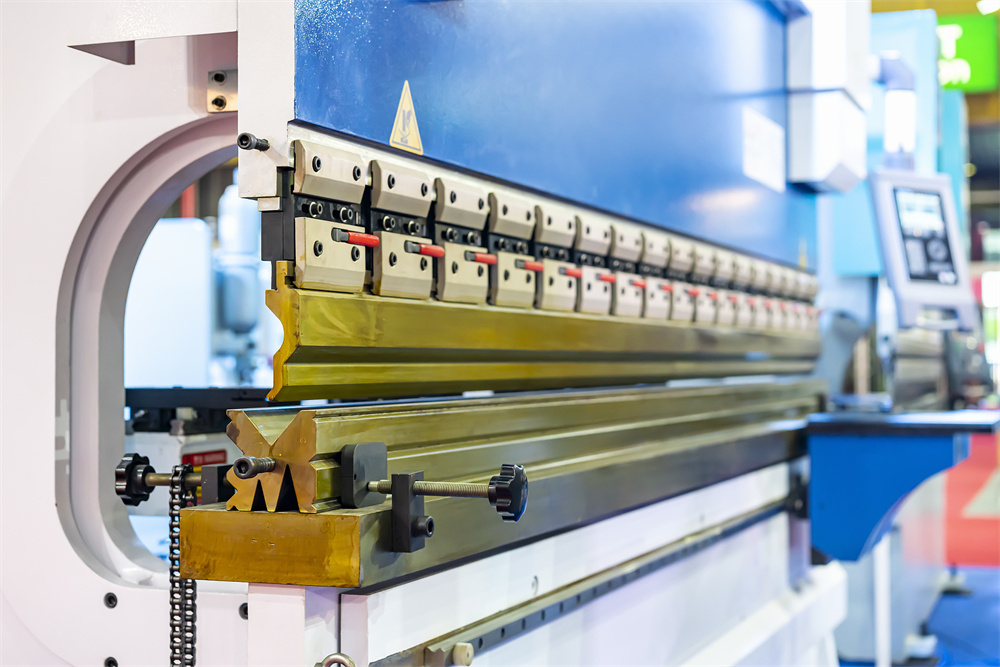
Price Range Overview: From Entry-Level to High-End
When conducting a Press Brake Price Comparison : Manual, Hydraulic, CNC Models, it is helpful to categorize machines into three distinct price brackets based on their operational technology. These prices are estimates for new machinery and can vary based on regional taxes, shipping, and specific brand reputations.
Manual and Mechanical Press Brakes ($2,000 – $12,000)
Manual press brakes, often referred to as hand brakes or leaf brakes, are the most affordable entry point. These machines rely entirely on physical labor or simple mechanical linkages. They are typically limited to thin-gauge materials (usually 16 gauge or thinner) and shorter lengths. While the initial cost is low, the labor cost per part is high because of the slow setup and manual effort required. These are best suited for HVAC shops, prototype labs, or hobbyist environments where high-volume production is not a priority.
Hydraulic (NC) Press Brakes ($15,000 – $45,000)
Hydraulic press brakes with basic NC (Numerical Control) represent the mid-range market. These machines use hydraulic cylinders to provide the force needed for bending thicker materials. An NC controller typically manages the backgauge (X-axis) and the stroke depth (Y-axis), but lacks the sophisticated synchronization found in full CNC models. A standard 100-ton hydraulic press brake from a reputable manufacturer like HARSLE usually falls within the $20,000 to $35,000 range, depending on the throat depth and bending length.
CNC Synchronized Press Brakes ($45,000 – $250,000+)
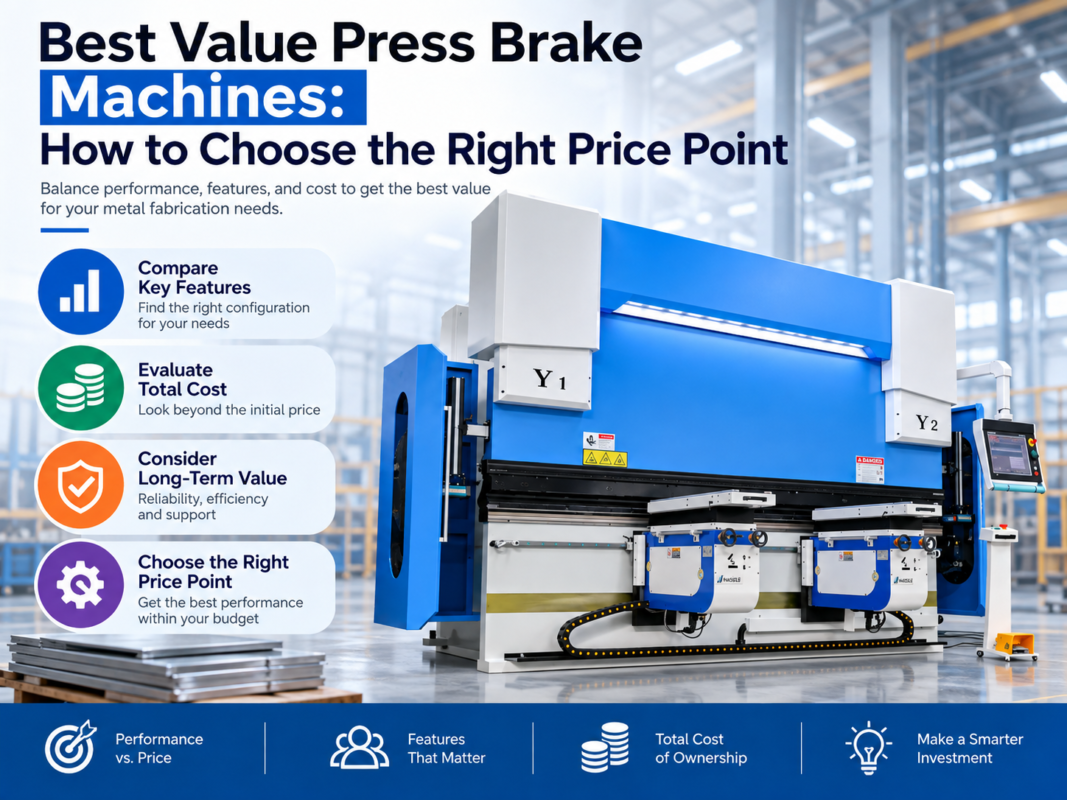
CNC (Computer Numerical Control) models are the gold standard for modern fabrication. These machines feature synchronized hydraulic cylinders (Y1 and Y2) that are monitored by linear encoders to ensure perfect parallelism. Prices for CNC models start around $45,000 for basic 3-axis or 4-axis configurations and can exceed $250,000 for large-tonnage machines (400T+) or those equipped with 8+ axes, robotic integration, and high-end controllers like Delem or Cybelec.
Main Cost Drivers in Press Brake Pricing
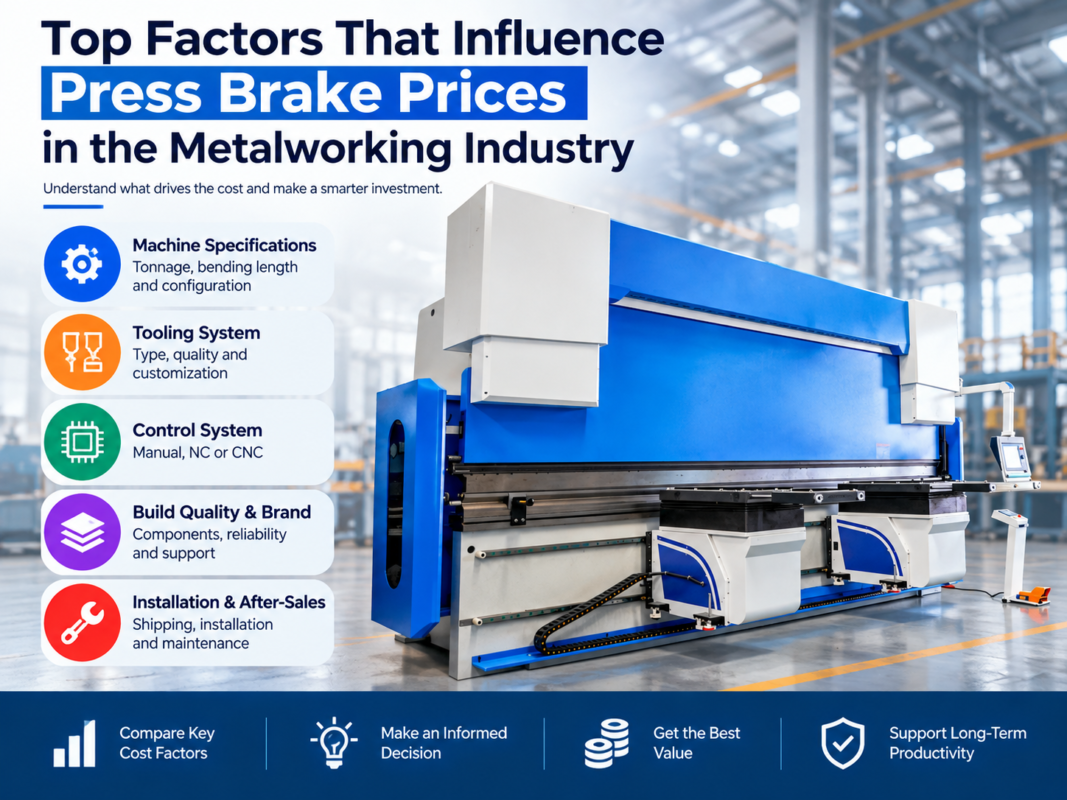
Understanding why one machine costs $30,000 while another seemingly identical one costs $60,000 requires looking under the hood. Several key factors drive the final price tag of a press brake.
- Tonnage and Bending Length: The most obvious cost drivers. A 300-ton machine requires a much heavier frame, larger cylinders, and more robust hydraulics than a 40-ton machine. Similarly, a 6-meter bending length requires a massive bed and ram, which significantly increases material and shipping costs.
- Frame Construction: High-quality press brakes use stress-relieved, heavy-duty steel frames. The thickness of the side plates and the quality of the welding determine the machine’s deflection under load. Cheaper machines often use lighter frames that may flex, leading to inaccurate bends over time.
- Hydraulic Components: Premium brands like Bosch-Rexroth or Hoerbiger are more expensive but offer superior reliability and smoother valve transitions. These components ensure that the ram moves precisely to the commanded position every time.
- Linear Encoders: In CNC models, the accuracy of the Y1 and Y2 axes depends on linear encoders. High-resolution encoders (often from brands like Heidenhain or Givi) add to the cost but allow for sub-micron positioning accuracy.
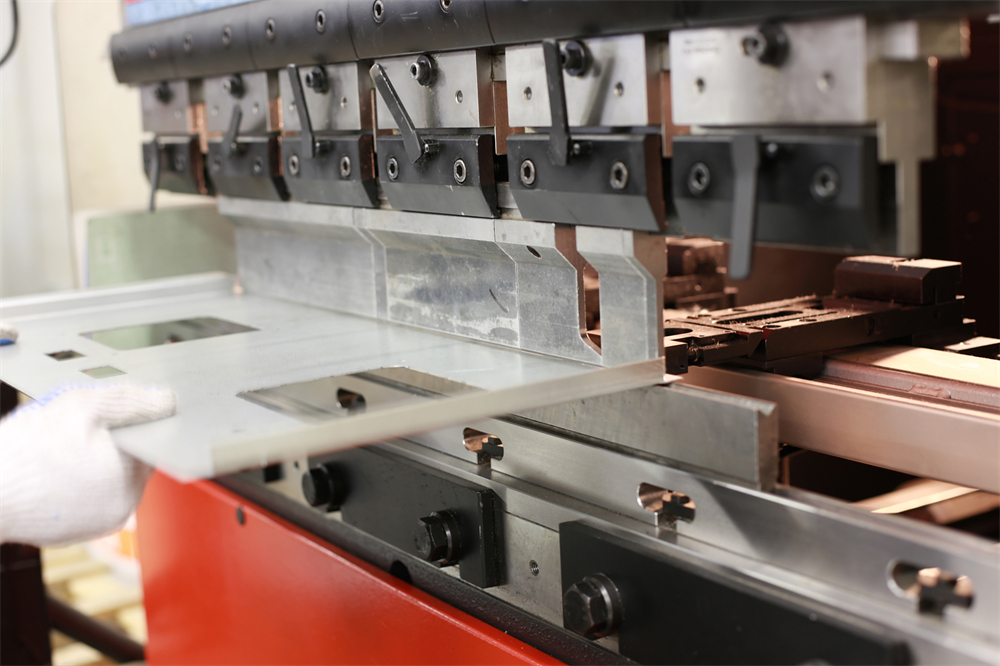
Configuration Impact: Customizing Your Machine
The base price of a press brake is rarely the final price. The configuration you choose can add 20% to 50% to the initial quote. When performing a Press Brake Price Comparison : Manual, Hydraulic, CNC Models, consider these optional but often necessary upgrades:
The Controller (The Brain)
The controller is one of the most expensive individual components. A basic E21 NC controller is inexpensive but limited to simple 2D programming. Upgrading to a Delem DA-53T or DA-66T adds thousands of dollars but provides a touch-screen interface, 3D visualization, and automatic bend sequencing. High-end controllers can also calculate the developed length of a part, reducing material waste during prototyping.
Backgauge Complexity
A standard backgauge usually moves in the X-axis (forward/backward). However, complex parts may require R-axis (up/down), Z1/Z2 axes (left/right), or even X-prime axes for tapered bends. Each additional axis requires its own motor, drive, and mechanical assembly, increasing the price by $3,000 to $7,000 per axis.
Crowning Systems
When a press brake bends a long piece of metal, the center of the bed and ram tend to deflect. A crowning system compensates for this. Manual crowning (using a hand crank) is the budget-friendly option. Motorized CNC crowning, which is controlled by the machine’s computer, ensures consistent angles across the entire length of the part automatically. This is a must-have for any machine over 2.5 meters in length if high precision is required.
Hidden Costs: Beyond the Sticker Price
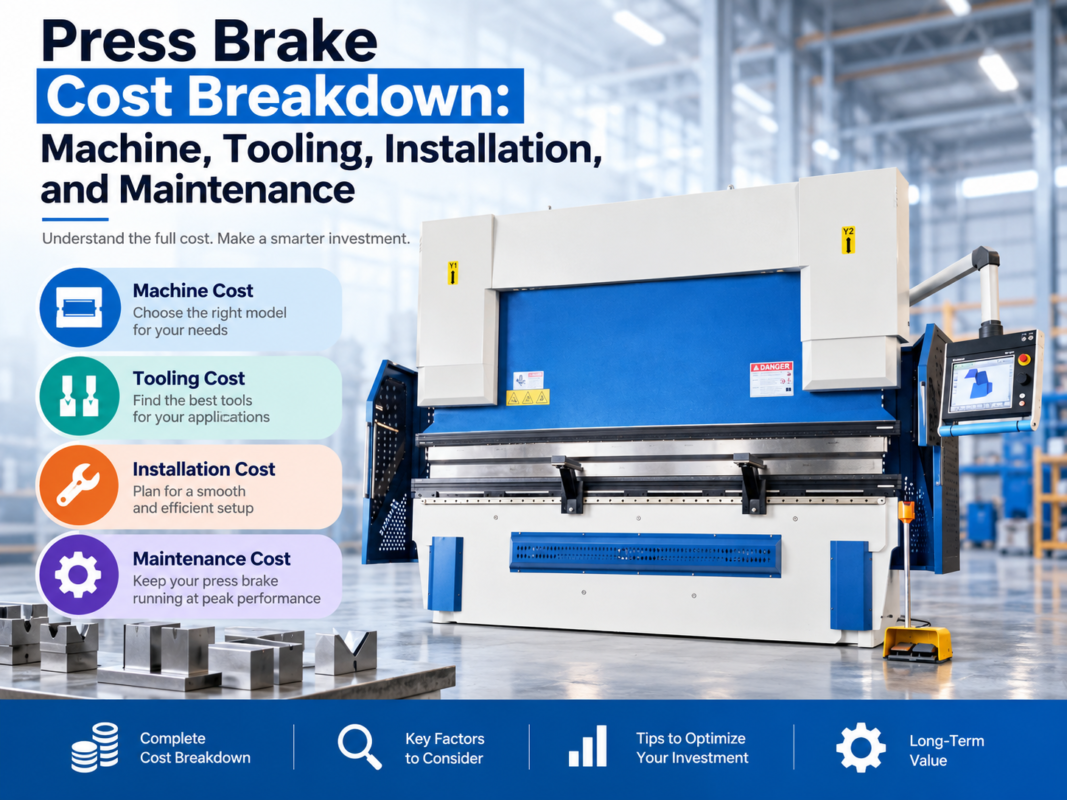
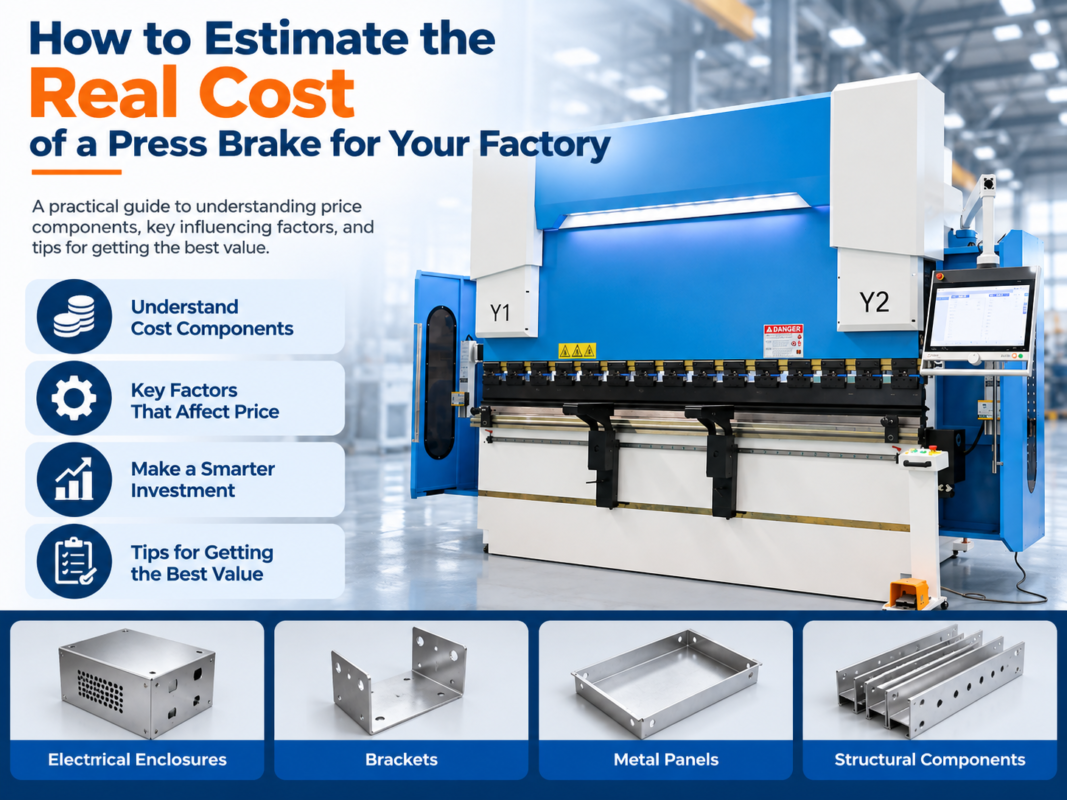
Many first-time buyers fail to account for the “soft costs” associated with a press brake purchase. To get an accurate Press Brake Price Comparison : Manual, Hydraulic, CNC Models, you must include the following in your budget:
- Freight and Rigging: Press brakes are incredibly heavy. Shipping a 10-ton machine across the country can cost several thousand dollars. Furthermore, you will likely need to hire a professional rigging company with a heavy-duty forklift or crane to move the machine into your facility.
- Foundation Requirements: Large tonnage machines (typically 200T and above) may require a reinforced concrete pit or a specific floor thickness to prevent the machine from sinking or shifting.
- Tooling: Most press brakes do not come with a full set of tooling. A comprehensive set of punches and dies can easily cost $5,000 to $15,000. Specialized tooling for offset bends or large radii will cost even more.
- Installation and Training: While some manufacturers include this, others charge daily rates for a technician to fly to your site, level the machine, and train your operators. Proper training is vital for maximizing the machine’s potential and ensuring safety.
- Maintenance and Consumables: Hydraulic oil (often hundreds of liters), filter replacements, and electricity costs should be factored into the operational budget.
ROI Calculation: Why More Expensive is Sometimes Cheaper
The cheapest machine on paper is often the most expensive in the long run. Let’s compare a manual/NC hydraulic press brake with a high-end CNC model for a mid-sized shop.
Scenario A: NC Hydraulic Press Brake ($25,000)
Setup time for a complex 4-bend part: 15 minutes. Scrap rate: 5%. Operator skill required: High. Because the operator must manually adjust the backgauge or perform multiple test bends, the throughput is limited. Over five years, the labor costs and material waste can exceed the initial savings.
Scenario B: CNC Synchronized Press Brake ($55,000)
Setup time for the same part: 2 minutes (using saved programs). Scrap rate: 0.5%. Operator skill required: Moderate. The CNC machine handles the calculations and positioning, allowing a less experienced operator to produce perfect parts. The $30,000 price difference is often recovered within 18-24 months through increased production speed and reduced waste.
Buying Advice: Choosing the Right Model for Your Shop
HARSLE recommends a systematic approach to choosing your next press brake. Don’t just look at the Press Brake Price Comparison : Manual, Hydraulic, CNC Models; look at your production goals.
- Analyze Your Workload: If you bend the same simple bracket 1,000 times a day, a basic NC machine might be sufficient. If you do custom work with different shapes every hour, a CNC model is non-negotiable.
- Check Material Specs: Always buy a machine with 20% more tonnage than your thickest material requires. Running a machine at its maximum capacity constantly will lead to premature wear.
- Evaluate Local Support: A cheap machine from an unknown brand becomes a paperweight if you can’t get spare parts or technical support. Choose a manufacturer like HARSLE that has a proven track record and available components.
- Consider Future Growth: It is better to buy a 4-axis machine now than to realize in a year that you need the R-axis for more complex parts. Retrofitting axes is significantly more expensive than buying them integrated.
Frequently Asked Questions (FAQ)
What is the average lifespan of a hydraulic press brake?
With proper maintenance, a high-quality hydraulic press brake from HARSLE can last 20 to 30 years. The mechanical frame is nearly indestructible; however, the electronics and hydraulic seals may need upgrading or replacement every 10-15 years.
Can I upgrade a manual press brake to CNC?
While technically possible with aftermarket kits, it is rarely cost-effective. The mechanical structure of a manual machine is not designed for the speed and precision of CNC components. It is almost always better to sell the manual machine and invest in a purpose-built CNC model.
Is a used press brake a good deal?
Used machines can offer savings, but they come with risks. You must inspect the bed for “crowning” (permanent deformation), check the hydraulic pumps for leaks, and ensure the controller software is still supported. Often, the cost of refurbishing a used machine brings the total close to the price of a new, warrantied HARSLE machine.
How much does press brake tooling cost?
Standard tooling usually costs between $100 and $300 per foot. Precision-ground, hardened tooling for CNC machines is more expensive but lasts much longer and provides better accuracy. Expect to spend at least 10% of the machine’s value on an initial tooling package.
What is the difference between NC and CNC?
NC (Numerical Control) usually controls one or two axes with simple numerical input. CNC (Computer Numerical Control) uses a computer to synchronize all machine movements, offering graphical interfaces, 3D modeling, and complex automation capabilities.