Hydraulic Shearing Machine Won’t Start: Step-by-Step Troubleshooting Guide

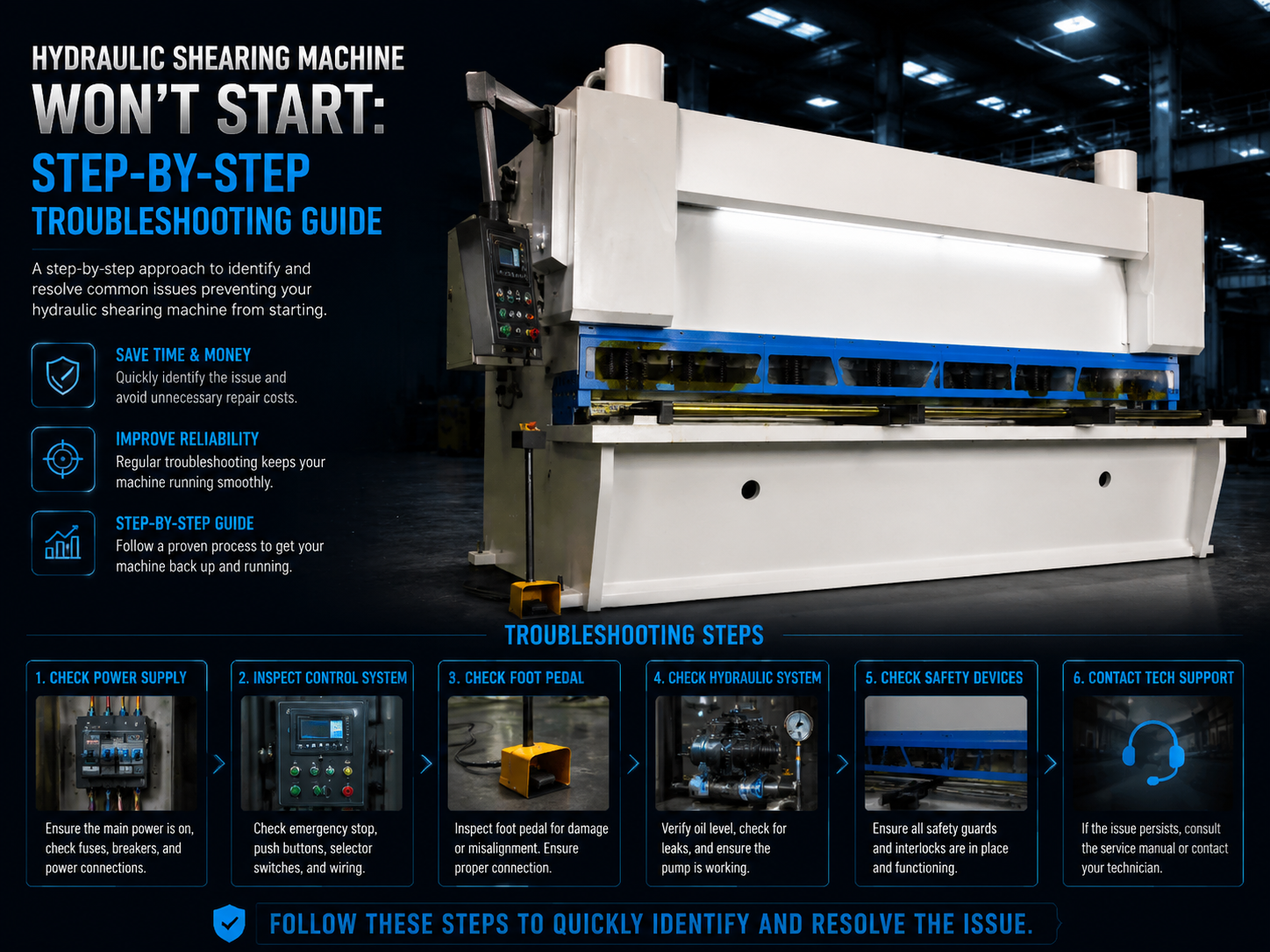
Introduction to Hydraulic Shearing Machine Troubleshooting
In the high-stakes world of metal fabrication, the hydraulic shearing machine is a cornerstone of production. Whether you are cutting mild steel, stainless steel, or aluminum, a sudden failure where the Hydraulic Shearing Machine Won’t Start: Step-By-Step Troubleshooting becomes necessary can halt an entire production line, leading to missed deadlines and increased operational costs. Understanding why these robust machines fail to initiate is the first step toward maintaining a high-efficiency workshop. HARSLE, a leader in metalworking machinery, recognizes that even the most durable equipment requires systematic maintenance and occasional diagnostic intervention.
When a hydraulic shearing machine refuses to start, the issue usually stems from one of three primary systems: electrical, hydraulic, or safety interlocks. Modern machines are equipped with complex PLC (Programmable Logic Controller) systems and sensitive hydraulic valves that ensure precision but also require specific conditions to be met before the motor or the shearing beam will engage. This guide is designed to walk operators and maintenance technicians through a logical progression of checks, from the simplest external factors to more complex internal component failures.
Before diving into the technical depths, it is essential to distinguish between a machine that has no power at all and a machine where the motor runs but the shearing beam does not move. This distinction significantly narrows down the potential culprits. In this comprehensive guide, we will cover every possible scenario, ensuring that your Hydraulic Shearing Machine Won’t Start: Step-By-Step Troubleshooting process is as efficient as possible, minimizing downtime and restoring your fabrication capabilities.

Key Considerations Before Troubleshooting
Safety is the absolute priority when dealing with industrial machinery. Before any inspection begins, ensure that the machine is properly isolated. This involves following Lockout-Tagout (LOTO) procedures to prevent accidental startup while hands or tools are near moving parts or electrical terminals. Hydraulic systems also retain residual pressure even when the power is off; therefore, technicians must be cautious when loosening fittings or checking valves.
Another key consideration is the environment in which the machine operates. Extreme temperatures can affect the viscosity of hydraulic oil, while high humidity or dust levels can lead to premature failure of electrical contactors and sensors. If your Hydraulic Shearing Machine Won’t Start: Step-By-Step Troubleshooting efforts are occurring in a particularly harsh environment, these external factors should be your first point of investigation. Often, a simple cleaning of the electrical cabinet or a change of hydraulic fluid can resolve intermittent starting issues.
Documentation is your best friend during troubleshooting. Always have the machine’s wiring diagrams, hydraulic schematics, and the operator’s manual provided by HARSLE or your specific manufacturer. These documents provide the “baseline” for how the machine should behave. Without them, you are essentially flying blind. Check for any error codes displayed on the CNC or NC controller, as these are direct communications from the machine’s brain regarding what it perceives to be wrong.
Finally, consider the age and service history of the machine. A new machine failing to start might point toward an installation error or a loose connection from shipping, whereas an older machine might be suffering from component wear, such as a burnt-out motor winding or a leaking internal seal in the hydraulic cylinder. Keeping a detailed maintenance log helps identify patterns that can lead to faster diagnosis during a breakdown.
Technical Details: Electrical System Diagnostics
1. Power Supply and Main Circuit Breaker
The most common reason a Hydraulic Shearing Machine Won’t Start: Step-By-Step Troubleshooting process begins is a simple lack of power. Start at the source: check the main factory power supply. Is the circuit breaker tripped? If so, do not simply reset it; investigate why it tripped. It could be a short circuit in the motor or a surge in the factory grid. Use a multimeter to verify that all three phases of the 380V/415V (or local standard) power are reaching the machine’s main isolator switch.
2. Emergency Stop Buttons and Safety Interlocks
It sounds elementary, but a significant percentage of service calls are resolved by simply resetting an Emergency Stop (E-Stop) button. Check every E-Stop on the machine, including those on the main console, the foot pedal, and any remote stations. Furthermore, modern shearing machines have safety gates or light curtains. If a rear safety gate is open or a light curtain is obstructed, the PLC will prevent the hydraulic pump from engaging or the beam from moving. Ensure all guards are closed and sensors are aligned.
3. Control Transformer and Fuses
Inside the electrical cabinet, the control transformer steps down the high voltage to 24V DC or 110V AC for the control circuit. If the transformer fails or a secondary fuse blows, the machine’s buttons and screen may light up, but the command to start the motor will never reach the contactor. Inspect all glass or ceramic fuses for signs of burning. If a fuse is blown, replace it with one of the exact same rating; using a higher-rated fuse can lead to catastrophic damage to the PLC or solenoid valves.
4. Motor Contactor and Thermal Overload Relay
The motor contactor is the heavy-duty switch that sends power to the main hydraulic pump motor. If the contactor coil is burnt out, the motor won’t start. Additionally, check the thermal overload relay attached to the contactor. If the motor has been running too hot or drawing too much current, the relay will trip to protect the motor. Press the reset button on the relay. If it trips again immediately, you likely have a mechanical jam in the pump or a phase loss in the electrical supply.
Technical Details: Hydraulic System Diagnostics
1. Oil Level and Quality
Hydraulic shearing machines rely on a specific volume of oil to create pressure. If the oil level in the reservoir is too low, the pump may suck in air (cavitation), or a low-level float switch may trigger a safety shutdown. Check the sight glass on the side of the tank. Furthermore, if the oil is milky (water contamination) or dark and smelling burnt (oxidation), it may have lost its lubricating properties, causing valves to stick in the closed position, preventing the machine from starting its cycle.
2. Hydraulic Pump and Coupling
If the motor is running but there is no pressure, the issue is likely the hydraulic pump or the coupling connecting the motor to the pump. Over time, the flexible spider coupling can wear out and shear off, meaning the motor spins freely without turning the pump. If the pump itself has failed internally, it will not be able to generate the necessary bar pressure to move the heavy shearing beam. Listen for unusual whining or grinding noises, which indicate pump cavitation or mechanical failure.
3. Solenoid Valves and Directional Control
The flow of hydraulic oil is directed by solenoid valves. When you press the foot pedal, an electrical signal is sent to a solenoid coil, which moves a spool inside the valve. If the coil is burnt out or the spool is jammed by a tiny piece of metal debris, the oil won’t flow to the cylinders. You can often manually override these valves using a small pin to see if the machine moves; if it does, the problem is electrical (the coil or the signal). If it doesn’t, the problem is mechanical (the valve spool or the cylinder).
4. Pressure Relief Valve Settings
The pressure relief valve is the safety gate for the hydraulic system. If it is set too low or if the internal spring has broken, all the oil pumped by the motor will bypass the cylinders and go straight back to the tank. This results in a machine that sounds like it is running perfectly but refuses to move the blade. Check the pressure gauge while attempting a cut; if the needle doesn’t climb to the required operating pressure, the relief valve may need adjustment or replacement.
Selection Advice: Choosing a Reliable Shearing Machine
When investing in a new shearing machine, the goal is to minimize the frequency of Hydraulic Shearing Machine Won’t Start: Step-By-Step Troubleshooting scenarios. This starts with selecting a machine built with high-quality, globally recognized components. For instance, HARSLE machines often utilize Siemens motors, Schneider electrics, and Bosch Rexroth hydraulic systems. These components are not only more reliable but also easier to find replacements for in the local market, reducing potential downtime.
Consider the frame construction. A rigid, mono-block welded frame reduces vibration, which is a leading cause of loose electrical connections and hydraulic leaks over time. Furthermore, look for machines with advanced CNC controllers like the Delem or Cybelec series. These controllers offer sophisticated self-diagnostics, often telling the operator exactly why the machine won’t start (e.g., “Rear Guard Open” or “Motor Overload”) through on-screen prompts, which simplifies the troubleshooting process immensely.
After-sales support is another critical factor. A manufacturer that provides detailed technical manuals, video tutorials, and a responsive service team can save you thousands of dollars in lost production. When selecting a machine, ask about the availability of spare parts and the manufacturer’s warranty terms. A machine is only as good as the support behind it when things go wrong.
| Feature | Benefit for Reliability | Recommended Brand/Type |
|---|---|---|
| Main Motor | Ensures consistent power and longevity | Siemens / ABB |
| Hydraulic Valves | Precise control and leak resistance | Bosch Rexroth / Omega |
| Electrical Components | Reduces risk of control circuit failure | Schneider / Eaton |
| CNC Controller | Advanced diagnostics and ease of use | Delem / ESA / Cybelec |
Frequently Asked Questions (FAQ)
Q1: Why does my shearing machine motor hum but not start?
A humming motor usually indicates a “single-phasing” condition, where one of the three power phases is missing. This could be due to a blown fuse or a bad contactor. It can also be caused by a mechanical jam in the hydraulic pump that is preventing the motor from turning. Turn off the power immediately to prevent the motor from burning out.
Q2: The machine starts, but the blade moves very slowly. What’s wrong?
Slow movement is typically a hydraulic volume issue. Check for a clogged suction filter in the oil tank, which starves the pump of oil. Alternatively, the pump may be worn out and unable to provide the full flow rate, or there may be an internal leak in the hydraulic cylinders (bypassing seals).
Q3: How often should I change the hydraulic oil?
For most industrial shearing machines, the hydraulic oil should be changed every 2,000 to 4,000 operating hours, or at least once a year. Regular oil analysis can help determine the exact timing, but keeping the oil clean is the best way to prevent valve and pump failures.
Q4: Can a faulty backgauge prevent the machine from starting?
Yes. Many CNC shearing machines have safety parameters linked to the backgauge. If the backgauge hits a limit switch or if the controller loses the backgauge position (encoder error), it may disable the cutting cycle to prevent damage to the machine or the workpiece.
Q5: What is the first thing I should check if the machine suddenly stops?
Always check the Emergency Stop buttons first. In a busy shop, it is common for someone to accidentally bump an E-Stop. After that, check the control panel for any error messages or tripped circuit breakers in the main electrical cabinet.
Conclusion: Maintaining Peak Performance
Mastering the Hydraulic Shearing Machine Won’t Start: Step-By-Step Troubleshooting process is an essential skill for any metal fabrication professional. By understanding the interplay between electrical signals, hydraulic pressure, and mechanical movement, you can transform a stressful breakdown into a manageable maintenance task. Most issues are rooted in simple causes—a loose wire, a dirty filter, or a triggered safety sensor—and can be resolved quickly with a systematic approach.
However, the best way to handle a machine that won’t start is to prevent the failure from happening in the first place. Regular preventative maintenance, including tightening electrical terminals, checking oil quality, and lubricating moving parts, will significantly extend the life of your equipment. Choosing high-quality machinery from reputable manufacturers like HARSLE ensures that you start with a foundation of reliability and precision.
In conclusion, while a non-starting machine is a challenge, it is also an opportunity to inspect and improve your operational standards. Keep your manuals handy, follow safety protocols strictly, and don’t hesitate to reach out to professional technicians when a problem exceeds your internal expertise. With the right knowledge and a proactive mindset, your hydraulic shearing machine will remain a productive and profitable asset for years to come.