
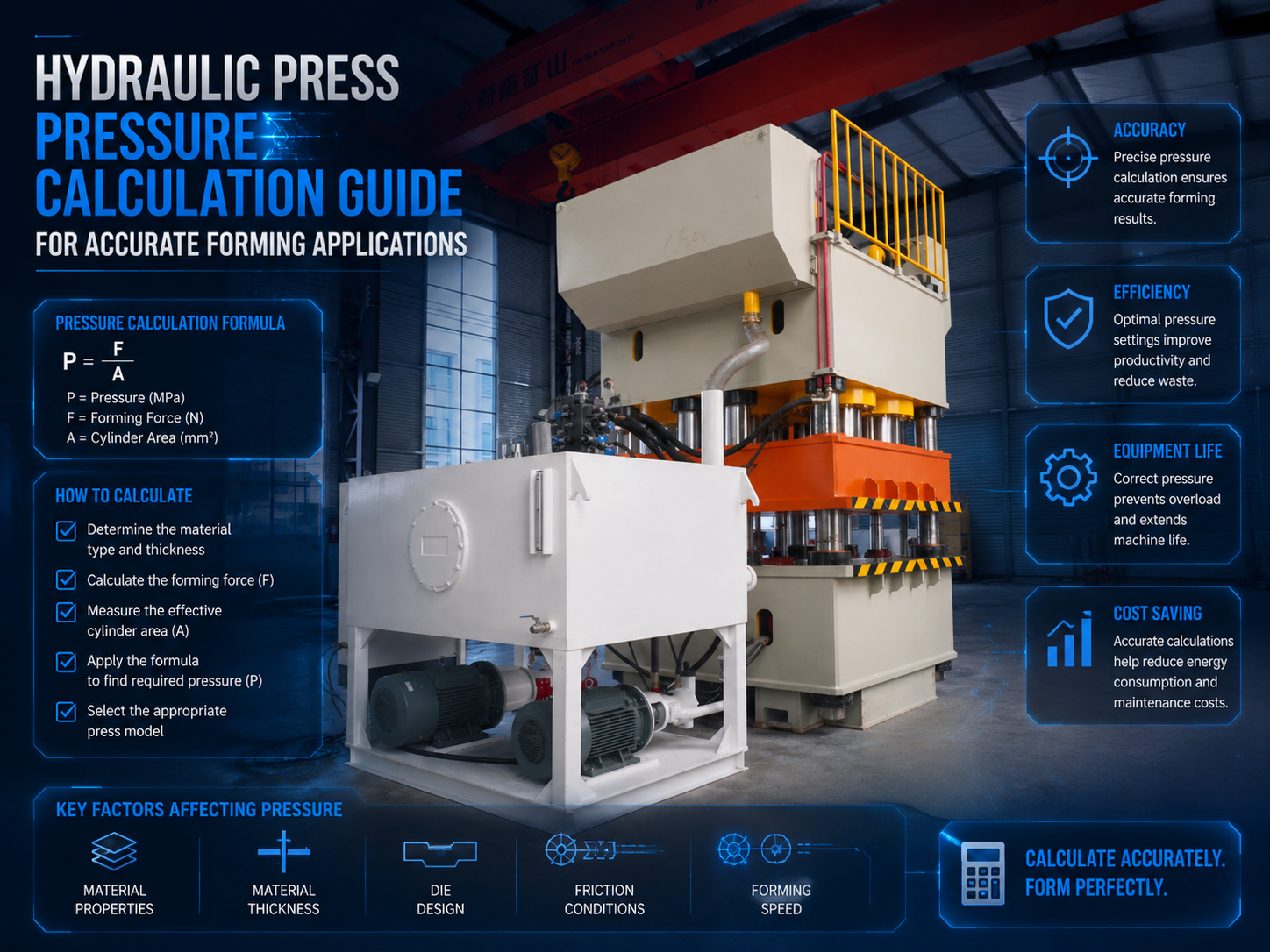
Hydraulic Press Pressure Calculation Guide for Accurate Forming Applications

Technical Overview of Hydraulic Press Pressure Dynamics
In the realm of modern metal fabrication, the ability to achieve precision is dictated by the mastery of force application. A hydraulic press operates on the fundamental principle of Pascal’s Law, which states that pressure applied to a confined fluid is transmitted undiminished in every direction throughout the fluid. For industrial applications, this means that a relatively small amount of force applied to a small piston can generate a massive amount of force at a larger piston. This capability makes the hydraulic press an indispensable tool for tasks ranging from simple blanking to complex deep drawing and forging.
Understanding the Hydraulic Press Pressure Calculation Accurate Forming Applications is not merely a theoretical exercise; it is a practical necessity for ensuring the longevity of the machinery and the quality of the finished product. When a machine is under-pressured, the material may not flow correctly into the die, leading to defects such as wrinkling or incomplete forming. Conversely, over-pressuring a system can lead to catastrophic tool failure, excessive wear on hydraulic seals, and unnecessary energy consumption. HARSLE, as a leader in metal fabrication technology, emphasizes the importance of these calculations to help operators maximize the efficiency of their equipment.
The physics behind the hydraulic press involves a delicate balance between fluid dynamics and mechanical engineering. The hydraulic oil serves as the medium for energy transfer, and its properties—such as viscosity and compressibility—play a role in how pressure is built and maintained. In high-precision forming, even minor fluctuations in pressure can result in dimensional inaccuracies. Therefore, a robust understanding of how to calculate and control this pressure is the first step toward achieving manufacturing excellence.
Core Parameters Influencing Pressure Calculation
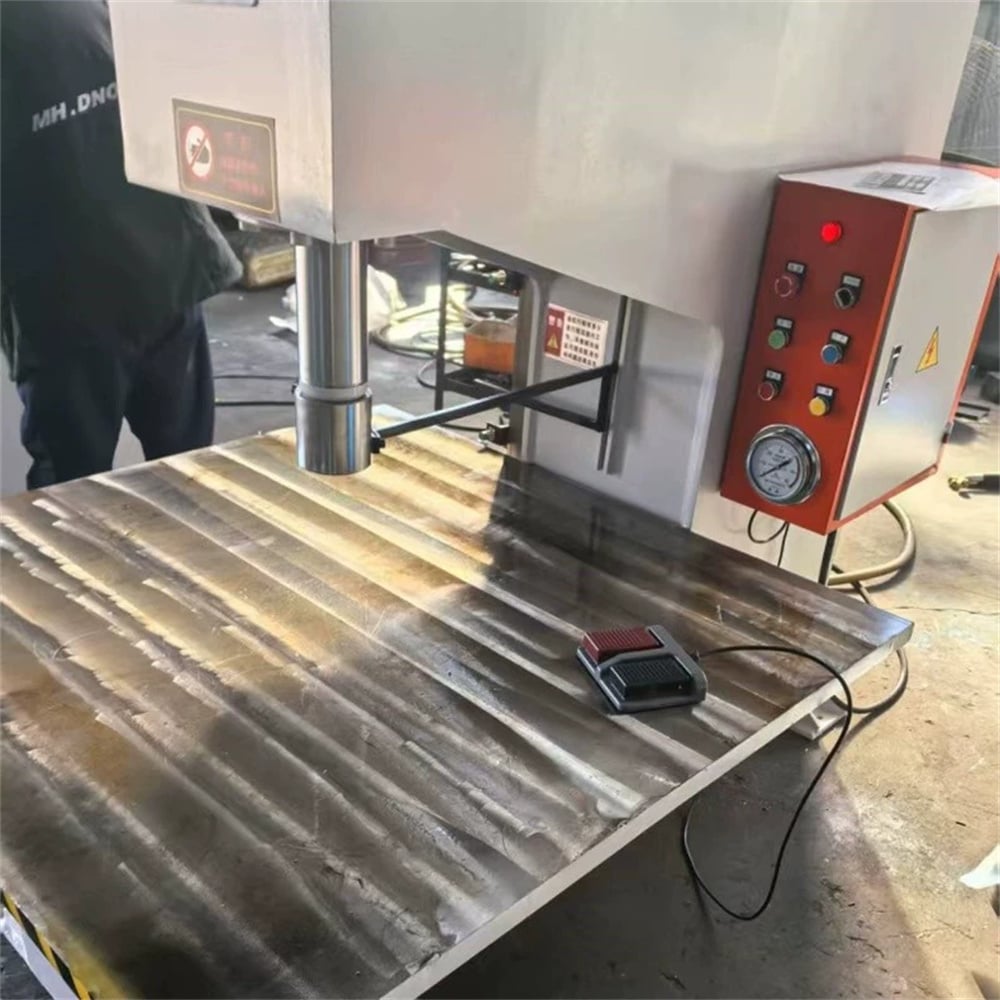
To perform an accurate pressure calculation, one must first identify the core parameters that define the hydraulic system’s performance. The most critical variable is the effective area of the hydraulic cylinder. This is the surface area of the piston that the pressurized oil acts upon. In a standard single-acting cylinder, this is simply the area of the piston head. However, in double-acting cylinders, the effective area for the return stroke is reduced by the area of the piston rod, a detail often overlooked by novice engineers.
Another vital parameter is the material property of the workpiece. Different metals exhibit varying levels of resistance to deformation, known as yield strength and ultimate tensile strength. For instance, forming a 5mm stainless steel plate requires significantly more pressure than forming a 5mm aluminum sheet. The geometry of the part—specifically the perimeter of the cut or the surface area of the bend—also dictates the total force required. Without accounting for these material-specific variables, any pressure calculation remains incomplete.
System pressure, usually measured in bars or PSI (pounds per square inch), is the controlled variable that the operator adjusts. This pressure is generated by the hydraulic pump and regulated by relief valves. The relationship between this system pressure and the resulting tonnage (force) is the cornerstone of press operation. Additionally, factors such as friction within the cylinder seals, the weight of the upper bolster (ram), and the resistance of die cushions must be factored into the equation to ensure that the actual force delivered to the workpiece matches the theoretical calculation.
The Calculation Method: Step-by-Step Guide
The fundamental formula for calculating the force (F) generated by a hydraulic press is F = P × A, where P is the pressure and A is the effective area. To apply this to Hydraulic Press Pressure Calculation Accurate Forming Applications, we must break it down into actionable steps. First, determine the required force based on the material and the process. For a blanking operation, the force is calculated as: Force = Perimeter × Thickness × Shear Strength. Once the required force is known, you can determine the necessary system pressure.
Step 1: Calculate the Effective Area (A). If you know the diameter (D) of the cylinder bore, the area is calculated using the formula A = π × (D/2)². For example, a cylinder with a 200mm bore has an area of approximately 31,416 square millimeters. It is essential to convert these units into meters or inches depending on whether you are using Metric or Imperial systems to maintain consistency.
Step 2: Determine the Required Tonnage. Tonnage is the standard unit of measure for press capacity. One metric ton is approximately 10,000 Newtons. If your material calculation suggests you need 100 tons of force, you must ensure your hydraulic system can generate this without exceeding its maximum rated pressure. This involves rearranging the formula to P = F / A. If your 100-ton requirement (approx. 1,000,000 N) is applied to the 31,416 mm² area, the required pressure would be roughly 31.8 MPa (318 bar).
Step 3: Factor in Safety and Friction. In real-world engineering, theoretical values are rarely sufficient. It is standard practice to add a safety factor of 15% to 20% to account for mechanical friction, oil temperature variations, and material inconsistencies. Therefore, if your calculation calls for 318 bar, setting the machine to 370 bar ensures that the press consistently completes the forming cycle even under less-than-ideal conditions. This buffer prevents the ram from stalling mid-stroke, which can damage both the part and the tooling.
Parameter Table for Common Forming Applications
The following table provides a reference for the estimated tonnage required per millimeter of thickness for various materials during standard bending and punching operations. Note that these are general guidelines and should be verified against specific material data sheets.
| Material Type | Yield Strength (MPa) | Punching Force (kN/mm²) | Bending Force (Tons/m at 2mm) | Recommended Safety Factor |
|---|---|---|---|---|
| Aluminum (1100-O) | 35 – 50 | 0.07 – 0.10 | 5 – 8 | 1.15 |
| Mild Steel (A36) | 250 – 300 | 0.35 – 0.45 | 15 – 20 | 1.20 |
| Stainless Steel (304) | 500 – 600 | 0.60 – 0.75 | 25 – 35 | 1.25 |
| High-Strength Steel | 700+ | 0.85+ | 40+ | 1.30 |
When using this table for Hydraulic Press Pressure Calculation Accurate Forming Applications, remember that the width of the die opening (V-opening) significantly impacts the bending force. A narrower V-opening increases the required pressure exponentially. Always consult the HARSLE technical manual for specific machine tonnage charts that account for these geometric variables.
Common Engineering Mistakes in Pressure Calculation
One of the most frequent errors in hydraulic press operation is the failure to account for “Springback.” When pressure is released, the metal tends to return slightly to its original shape. If the initial pressure calculation does not account for the need to over-bend or “bottom out” the tool, the final part will not meet dimensional tolerances. Engineers often calculate the force needed to reach the yield point but forget the additional force required for plastic deformation and setting the final shape.
Another common mistake is neglecting the “Pressure Drop” across the hydraulic circuit. As oil travels through valves, manifolds, and hoses, friction causes a loss of pressure. If the pressure gauge is located at the pump rather than the cylinder inlet, the actual force exerted by the ram may be 5-10% lower than indicated. This is particularly critical in long-stroke applications or systems with complex manifold blocks. HARSLE machines are designed to minimize these losses, but operators must still be aware of the discrepancy.
Furthermore, many operators ignore the effect of oil temperature on pressure accuracy. As hydraulic oil heats up during a long production shift, its viscosity decreases. This can lead to increased internal leakage within the pump and valves, resulting in a subtle but significant drop in effective pressure. For accurate forming applications, it is vital to use a press equipped with an oil cooling system or to recalibrate the pressure settings once the machine has reached its steady-state operating temperature.
Selection Checklist for the Right Hydraulic Press
Choosing the correct machine involves more than just looking at the maximum tonnage. To ensure your Hydraulic Press Pressure Calculation Accurate Forming Applications are successful, follow this selection checklist:
- Maximum Tonnage: Does the press offer at least 20% more capacity than your highest calculated requirement?
- Stroke Length and Daylight: Is there enough vertical space to accommodate your tallest dies and the necessary stroke for part removal?
- Speed Control: Does the press allow for variable approach, pressing, and return speeds? Precision forming often requires a slow “pressing speed” to allow material flow.
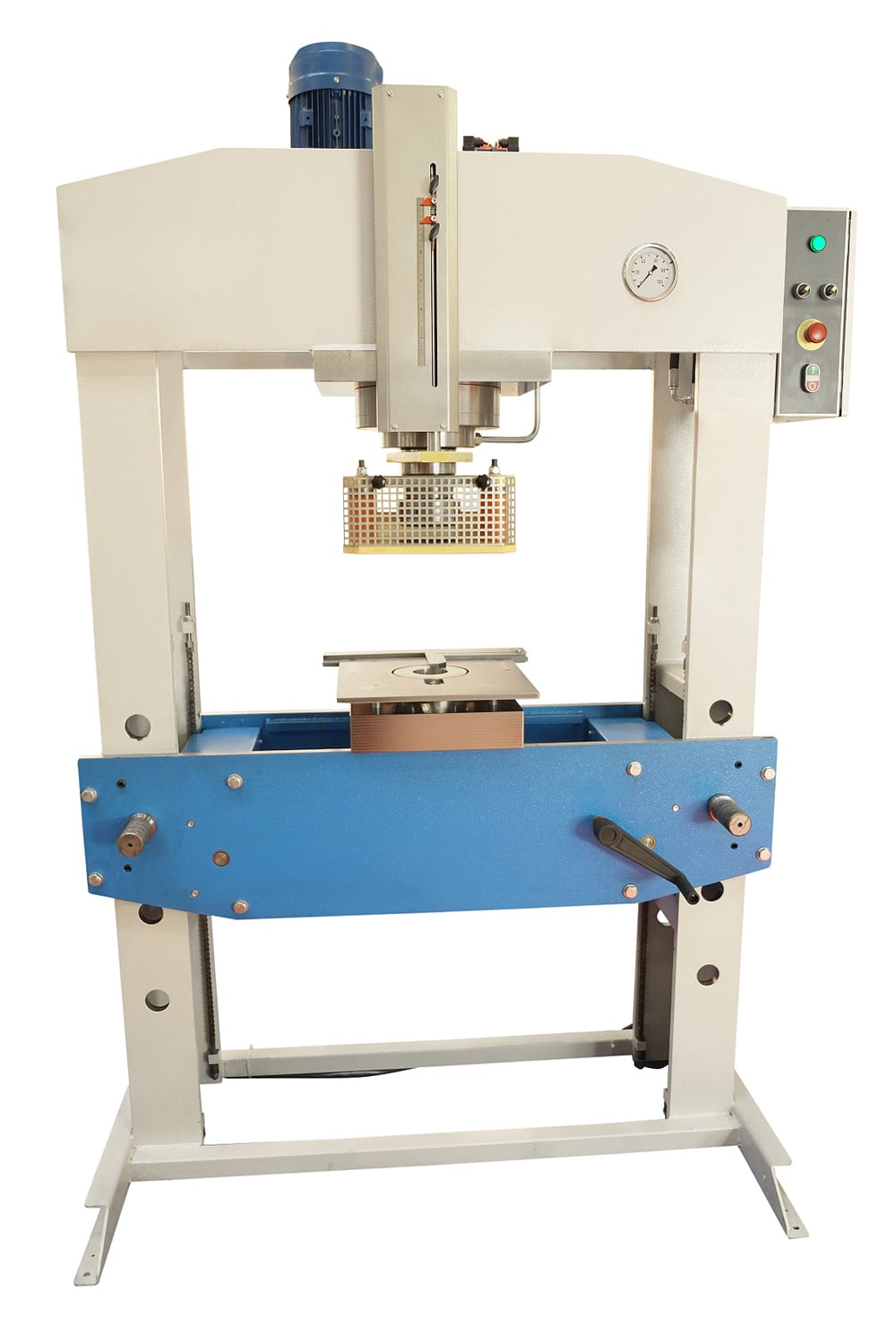
- Frame Rigidity: For high-pressure applications, a C-frame might deflect. Consider an H-frame or Four-Column press for better structural integrity and parallelism.
- Control System: Does the machine feature a CNC interface that can store pressure profiles for different jobs? This reduces setup time and human error.
- Safety Features: Ensure the press includes light curtains, dual-hand palm buttons, and emergency stop circuits that comply with local safety standards.
Advanced Considerations: Deep Drawing and Complex Geometries
In deep drawing applications, the calculation becomes more complex because the pressure must be distributed between the main ram and the blank holder (die cushion). The blank holder pressure is critical; if it is too low, the material will wrinkle; if it is too high, the material will tear. The ratio of blank holder force to punch force typically ranges from 30% to 50%. Calculating this requires a deep understanding of the material’s “Draw Ratio” and its strain-hardening exponent.
Modern HARSLE hydraulic presses often utilize proportional valve technology to manage these complex pressure requirements. This allows the machine to change the pressure dynamically during a single stroke. For example, you might need high pressure at the start of a draw to overcome initial resistance, followed by a lower, sustained pressure as the material flows into the cavity. Mastering these advanced calculations is what separates high-end industrial manufacturing from basic metalworking.
Frequently Asked Questions (FAQ)
1. How do I convert PSI to Tonnage for my hydraulic press?
To convert PSI to Tons, you must know the area of the cylinder in square inches. Multiply the PSI by the Area (sq in) to get the total pounds of force, then divide by 2,000 to get US Tons. For example: 3,000 PSI × 10 sq in = 30,000 lbs / 2,000 = 15 Tons.
2. Why does my press lose pressure during a long hold cycle?
Pressure loss during a hold cycle is usually caused by internal leakage in the directional control valve or a worn piston seal. It can also be caused by a faulty check valve. If the pressure drops slowly, it is likely a seal issue; if it drops rapidly, it is likely a valve or bypass issue.
3. Can I use a 100-ton press for a job that calculates to 95 tons?
While technically possible, it is not recommended. Operating a press at 95% of its maximum capacity for extended periods leads to excessive heat generation and stress on the frame. It is better to use a 125-ton or 150-ton press to ensure a safety margin and longer machine life.
4. How often should I calibrate the pressure gauge on my HARSLE press?
For accurate forming applications, we recommend calibrating the pressure gauge every 6 to 12 months, or whenever you notice inconsistencies in part quality. Using a master gauge for periodic checks is a good practice in ISO-certified facilities.
5. Does the type of hydraulic oil affect the pressure calculation?
The type of oil does not change the theoretical pressure calculation (F=PA), but it does affect the efficiency. Higher viscosity oil may cause more friction and slower response times, while low viscosity oil might increase internal leakage at high pressures. Always use the oil grade recommended in your HARSLE manual.
6. What is the difference between ‘Nominal Pressure’ and ‘Working Pressure’?
Nominal pressure is the maximum pressure the machine is designed to handle (the rating on the nameplate). Working pressure is the actual pressure set by the operator for a specific task. For safety and longevity, the working pressure should always be lower than the nominal pressure.