How to Diagnose Uneven Cutting on a Shearing Machine: A Technical Guide


Introduction to Shearing Precision in Metal Fabrication
In the world of metal fabrication, the shearing machine is the workhorse that sets the foundation for every subsequent process. Whether you are preparing plates for welding, bending on a press brake, or laser cutting intricate patterns, the quality of the initial shear determines the accuracy of the final product. However, one of the most common and frustrating issues operators face is uneven cutting. When a shearing machine fails to produce a straight, clean, and square edge, it leads to material waste, increased labor costs, and potential damage to downstream equipment.
To diagnose uneven cutting on a shearing machine, one must look beyond the surface. It is rarely a single-factor problem; rather, it is often a combination of mechanical wear, improper settings, and material variables. A professional diagnosis requires a systematic approach, moving from the most obvious external adjustments to the internal hydraulic and structural components. At HARSLE, we understand that downtime is costly, which is why we have developed this comprehensive guide to help you identify and rectify cutting inaccuracies before they impact your bottom line.
Uneven cutting can manifest in several ways: a ‘bow’ in the middle of the plate, a ‘twist’ along the length of the cut, or a ‘burr’ that is heavier on one side than the other. Each of these symptoms points toward a specific mechanical or operational failure. By understanding the physics of the shearing process—where the metal is first compressed, then sheared, and finally fractured—operators can better visualize where the process is breaking down. This guide will walk you through the essential diagnostic steps to restore your machine to peak performance.
Key Considerations Before Starting Your Diagnosis
Before diving into the technical adjustments, it is crucial to consider the context of the problem. Is the uneven cutting a new development, or has it gradually worsened over time? If the issue appeared suddenly after a specific job, it might indicate a mechanical shift or a broken component. If it has been a slow decline, it likely points toward blade wear or gradual misalignment. Understanding the history of the machine’s performance is the first step in an effective diagnosis.
Material properties play a significant role in how a shearing machine behaves. Not all metals are created equal; stainless steel, for instance, requires much higher shearing forces and tighter tolerances than mild steel or aluminum. If you are switching between materials without adjusting the machine settings, you are almost guaranteed to experience uneven cuts. Always verify that the material’s tensile strength and thickness fall within the machine’s rated capacity. Overloading a shear can cause the frame to deflect, leading to permanent inaccuracies.
Another key consideration is the environment in which the machine operates. Temperature fluctuations in a workshop can affect the viscosity of hydraulic oil, which in turn affects the speed and pressure of the shearing stroke. Furthermore, the foundation upon which the machine sits must be perfectly level. A shearing machine that is not properly leveled will experience uneven stress on its frame, causing the blade beam to travel along an inconsistent path. Before blaming the blades or the hydraulics, always check the level of the machine bed.
Finally, operator skill and consistency cannot be overlooked. Are the sheets being fed squarely against the back gauge? Is the back gauge itself calibrated correctly? Sometimes, what appears to be a machine error is actually a procedural error. Ensuring that the material is properly supported and that the hold-downs are engaging correctly is essential before proceeding to more complex technical diagnostics.
Technical Details: Step-by-Step Diagnostic Process
1. Evaluating Blade Gap (Clearance)
The blade gap, or the distance between the upper and lower blades, is perhaps the most critical factor in achieving a clean cut. If the gap is too wide, the metal will bend between the blades rather than shearing, resulting in a large burr and a rounded edge. If the gap is too narrow, the blades may rub against each other, causing excessive wear and requiring significantly more force to complete the cut. To diagnose uneven cutting on a shearing machine, you must first verify the gap across the entire length of the blade.
Use a feeler gauge to check the clearance at multiple points—usually at both ends and in the center. For most mild steel applications, the gap should be approximately 8% to 10% of the material thickness. If the gap is inconsistent (e.g., tighter at the ends than in the middle), it suggests that the blade beam is bowing or that the blades themselves are not seated correctly in their holders. Modern CNC shearing machines often feature automatic blade gap adjustment, but even these systems require periodic manual verification to ensure the sensors and actuators are calibrated.
2. Inspecting Blade Sharpness and Condition
A dull blade does not cut; it tears. Inspect the cutting edges of both the upper and lower blades for signs of rounding, chipping, or “pick-up” (where small bits of the workpiece material weld themselves to the blade). Even a slight dulling of the edge can cause the material to shift during the cut, leading to an uneven edge. Most shearing blades have four usable edges; if one edge is worn, the blade can be flipped or rotated to a fresh edge.
When inspecting the blades, look for uneven wear patterns. If the wear is concentrated in the center, it indicates that the machine is frequently used for narrow strips, which can cause the blades to develop a “sway.” If the blades are chipped, it may be a sign that the material being cut is too hard or that the blade gap was set too tight for a previous job. Sharp blades are essential for reducing the load on the hydraulic system and ensuring a clean fracture zone in the metal.
3. Checking the Hydraulic System and Synchronization
In hydraulic shearing machines, the movement of the upper blade beam is controlled by two or more hydraulic cylinders. If these cylinders are not perfectly synchronized, the beam will descend at a slight angle, causing one side of the cut to be deeper or faster than the other. This lack of synchronization is a primary cause of uneven cutting. Diagnosis involves checking for air trapped in the hydraulic lines, leaking seals, or a malfunctioning proportional valve.
Monitor the pressure gauges during a test cut. If the pressure fluctuates wildly or if one cylinder reaches peak pressure significantly before the other, there is a hydraulic imbalance. Additionally, check the nitrogen return cylinders (common in swing beam shears). If the nitrogen pressure is low, the beam may not return to its starting position correctly, or it may chatter during the downward stroke, leading to a jagged or uneven edge profile.
4. Verifying Hold-down Cylinder Performance
The purpose of the hold-down cylinders is to secure the metal plate firmly against the table before the shearing action begins. If the hold-downs are weak, leaking, or unevenly spaced, the material can pivot or slide during the cut. This movement results in a cut that is not square to the reference edge. To diagnose this, observe the material during the shearing cycle. If you see the plate move even a fraction of a millimeter after the hold-downs engage, you have found your problem.
Check the hydraulic pressure specifically for the hold-down circuit. Often, this is a separate sub-system from the main shearing cylinders. Ensure that the rubber or plastic pads on the feet of the hold-downs are intact; if they are worn down to the metal, they may not provide enough friction to hold the plate securely, especially if the plate has a light coating of oil.
5. Back Gauge Alignment and Parallelism
If the cut is straight but the dimensions are incorrect (e.g., the piece is wider at one end than the other), the issue lies with the back gauge. The back gauge must be perfectly parallel to the bottom blade. Over time, the lead screws or the drive belt of the back gauge can wear or slip, causing one side of the gauge to lag behind the other. This results in a tapered cut.
To diagnose back gauge issues, move the gauge to a set distance (e.g., 500mm) and measure the distance from the blade to the gauge bar at both ends using a precision rule or a calibration block. If there is a discrepancy, the back gauge must be mechanically adjusted or the CNC offset must be updated. Also, check for “play” or backlash in the back gauge movement; if the gauge can be wiggled by hand, the bearings or nuts likely need replacement.
Selection Advice: Choosing the Right Shearing Machine
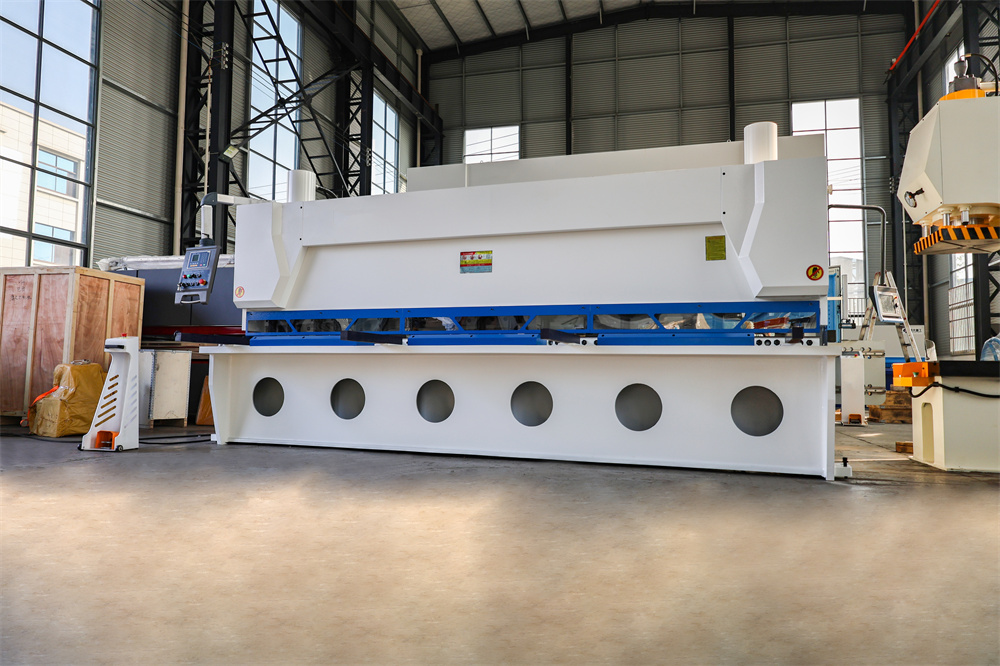
When purchasing a shearing machine, understanding the difference between a Swing Beam Shear and a Guillotine Shear is vital for long-term accuracy. A swing beam shear (like the HARSLE QC12Y series) uses a pivoting motion. It is generally more robust and easier to maintain but can have slight limitations in terms of adjusting the rake angle. A hydraulic guillotine shear (like the HARSLE QC11Y series), on the other hand, moves the blade in a straight vertical line. This allows for adjustable rake angles, which is critical for minimizing “twist” and “bow” in thin or narrow strips.
If your workshop handles a wide variety of material thicknesses, look for a machine with an easy-to-use blade gap adjustment system. Manual hand-wheel adjustments are fine for occasional changes, but for high-production environments, a motorized or CNC-controlled gap adjustment is a worthwhile investment. This ensures that the operator actually makes the adjustment, rather than “making do” with a sub-optimal setting that leads to uneven cuts and blade wear.
Consider the control system as well. A basic E21S controller provides simple back gauge positioning, but moving up to a DAC-360T or similar CNC system allows the machine to automatically calculate the rake angle, blade gap, and stroke length based on the material type and thickness entered by the operator. This automation removes much of the human error associated with uneven cutting. Finally, always choose a manufacturer like HARSLE that provides a rigid, heat-treated frame, as frame deflection is a hidden cause of cutting inaccuracies that cannot be fixed with simple adjustments.
Frequently Asked Questions (FAQ)
Why does my metal plate twist after being sheared?
Twisting is usually caused by a rake angle that is too high for the thickness of the material. The rake angle is the slope of the upper blade. While a higher angle reduces the required shearing force, it increases the tendency for the material to twist. Reducing the rake angle (on guillotine shears) or ensuring the blade gap is tight enough can help minimize this issue.
How often should I sharpen my shearing blades?
There is no fixed timeframe, as it depends on the material being cut. However, a good rule of thumb is to inspect the blades every 500 working hours. If you notice an increase in burr height or if the machine sounds like it is struggling, it is time to rotate or sharpen the blades. Cutting stainless steel will dull blades much faster than mild steel.
Can air in the hydraulic system cause uneven cutting?
Yes, absolutely. Air is compressible, whereas hydraulic oil is not. If air is trapped in one of the cylinders, that cylinder will lag behind the other, causing the blade beam to descend unevenly. This can lead to a slanted cut or even damage the machine’s guides. Bleeding the hydraulic system is a standard maintenance task to resolve this.
What is the ‘bow’ effect in shearing?
The ‘bow’ effect occurs when the sheared strip curves upward or downward. This is often caused by excessive shearing force or improper blade gap. It is particularly common when cutting very narrow strips. Using a machine with a lower rake angle or a rear support system can help prevent the material from bowing under its own weight and the force of the cut.
Is it normal for the machine to make a loud ‘bang’ during the cut?
While shearing is naturally noisy, an excessively loud bang can indicate that the blade gap is too wide, causing the material to fracture prematurely and violently. It can also indicate that the nitrogen return cylinders are bottoming out or that the hydraulic pressure is set too high for the material thickness.
Conclusion: Maintaining Precision with HARSLE
Diagnosing uneven cutting on a shearing machine is a process of elimination that requires attention to detail and a deep understanding of the machine’s mechanics. By systematically checking the blade gap, blade sharpness, hydraulic synchronization, and back gauge alignment, you can identify the root cause of most inaccuracies. Regular maintenance is not just about preventing breakdowns; it is about ensuring that every cut you make is as precise as the first one the machine performed.
At HARSLE, we are committed to providing high-quality metal fabrication machinery that stands the test of time. Our shearing machines are engineered with rigid frames and precision components to minimize deflection and maximize accuracy. However, even the best machine requires a skilled operator and a consistent maintenance schedule. We hope this guide serves as a valuable resource for your workshop, helping you maintain the high standards of quality that your customers expect. For more information on our range of shearing machines or for technical support, feel free to contact the HARSLE team today.