
Why Press Brake Bends Are Not Symmetrical and How to Correct Them: A Comprehensive Guide


Introduction to Bending Symmetry in Metal Fabrication
In the world of precision metal fabrication, achieving a perfect bend is both an art and a science. However, one of the most common and frustrating challenges operators face is when press brake bends are not symmetrical. Asymmetry in bending can lead to significant downstream issues, including poor fitment during assembly, structural weaknesses in the final product, and increased scrap rates that eat into profit margins. Understanding why these discrepancies occur and knowing how to correct them is essential for any high-quality fabrication shop.
Symmetry in a bend typically refers to the uniformity of the angle and the flange length across the entire width of the workpiece. When a bend is asymmetrical, one side of the metal may be over-bent while the other is under-bent, or the bend line may not be perfectly parallel to the edge of the sheet. This problem is rarely the result of a single factor; rather, it is often a combination of machine mechanical issues, material inconsistencies, and setup errors. At HARSLE, we emphasize that precision starts with understanding the mechanics of your equipment.
This comprehensive guide will delve into the root causes of asymmetrical bends, ranging from hydraulic synchronization errors to the subtle influence of material grain direction. We will provide actionable steps to diagnose these issues and technical solutions to ensure your press brake delivers consistent, symmetrical results every time. Whether you are using a manual NC machine or a high-end multi-axis CNC press brake, the principles of symmetry remain the same.
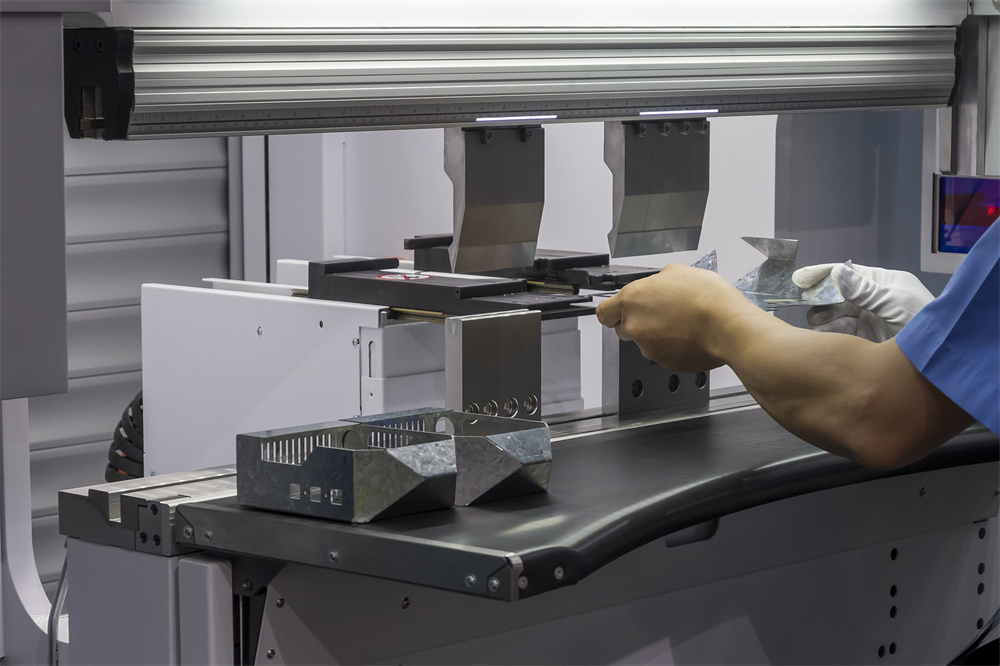
Key Considerations for Bending Symmetry
Before diving into the complex mechanical adjustments, it is vital to consider the fundamental factors that influence how metal reacts under pressure. Symmetry is not just about the machine; it is about the interaction between the machine, the tools, and the material.
Material Properties and Grain Direction
One of the most overlooked reasons why press brake bends are not symmetrical is the material itself. Sheet metal is not a perfectly isotropic substance. During the rolling process at the mill, the metal develops a “grain” or directional orientation of its internal structure. Bending parallel to the grain requires less force but is more prone to cracking and inconsistent springback. Bending perpendicular to the grain requires more force but offers more stability.
If a large workpiece is cut such that the grain direction varies across its length, the resistance to bending will not be uniform. This results in one end of the bend reaching the desired angle while the other end lags behind. To correct this, operators must ensure that blanks are nested and cut with consistent grain orientation relative to the bend line. Additionally, variations in material thickness—even within the same sheet—can cause the press brake to apply uneven pressure, leading to asymmetry.
Tooling Condition and Alignment
The punch and die are the primary contact points with the metal. If the tooling is worn, chipped, or improperly seated, symmetry is impossible to maintain. Over time, the center of a long die may experience more wear than the ends, especially if the machine is frequently used for short parts in the center of the bed. This localized wear creates a “hollow” spot that prevents the material from being pressed consistently.
Alignment is equally critical. The punch must be perfectly centered within the V-die. If the punch is slightly offset to the left or right, the material will be drawn into the die unevenly, resulting in a flange that is longer on one side than the other. Regular inspection of the tool holders and the use of precision-ground tooling can mitigate these issues. When press brake bends are not symmetrical, the first physical check should always be the centering of the tools.
Machine Deflection and The “Canoe” Effect
Every press brake, regardless of its build quality, undergoes some degree of deflection under load. The side frames of the machine tend to spread apart, and the bed and ram tend to bow away from each other in the center. This is often called the “canoe effect.” If this deflection is not compensated for, the center of the workpiece will be under-bent compared to the ends near the side frames. While this usually results in a “bowed” bend rather than a simple asymmetrical one, if the machine’s side frames are not equally rigid or if the load is offset, the resulting bend will be noticeably asymmetrical.
Technical Details: The Mechanics of Asymmetry
To truly understand how to correct them, we must look at the internal systems of the press brake. Modern machines rely on sophisticated hydraulics and electronics to maintain balance.
Hydraulic Synchronization (Y1 and Y2 Axes)
In a standard CNC press brake, the movement of the ram is controlled by two independent hydraulic cylinders, referred to as the Y1 and Y2 axes. For a bend to be symmetrical, these two cylinders must move in perfect synchronization, reaching their target depth at exactly the same time. If the Y1 cylinder is slightly out of sync with Y2, the ram will tilt. Even a deviation of a few microns can result in a noticeable angular difference across the length of the part.
Correction involves calibrating the linear encoders that track the position of each cylinder. If the encoders are dirty or loose, they may provide inaccurate feedback to the CNC controller. Furthermore, air trapped in the hydraulic lines or a failing proportional valve can cause one side to lag. Regular maintenance of the hydraulic fluid and bleeding the system are essential technical steps to ensure Y1/Y2 symmetry.
The Role of Crowning Systems
As mentioned, machine deflection is inevitable. To counter this, manufacturers use “crowning” systems. Crowning applies an upward force to the center of the bed to match the downward deflection of the ram. There are two main types: hydraulic and mechanical.
- Hydraulic Crowning: Uses cylinders built into the lower bed to push upward. The CNC calculates the required pressure based on the material thickness and length.
- Mechanical Crowning: Uses a series of wedges or a wave-shaped bar that can be adjusted to create a curve in the bed.
If the crowning system is not calibrated correctly, or if the operator does not input the correct material data into the CNC, the bend will not be uniform. If you find that press brake bends are not symmetrical specifically in the middle versus the ends, the crowning settings are the most likely culprit.
Backgauge Precision and Calibration
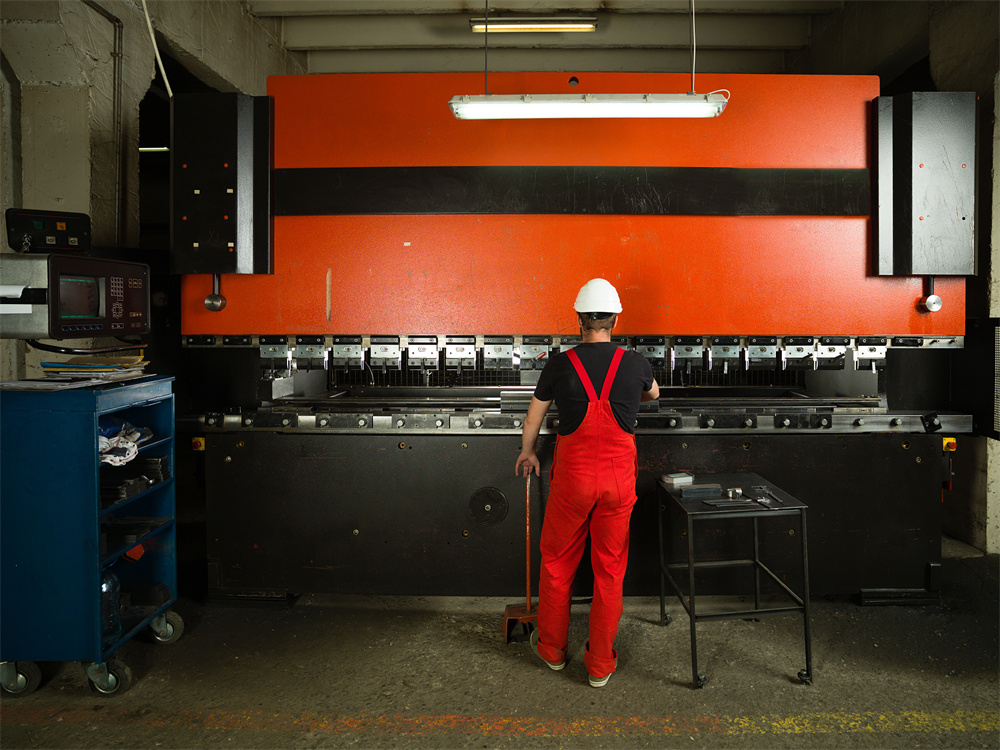
Sometimes the bend angle is correct, but the flange lengths are different, making the part look asymmetrical. This is usually a backgauge issue. The backgauge fingers must be perfectly parallel to the center of the V-die. If the backgauge bar is skewed, the sheet will be fed into the machine at an angle. Modern CNC backgauges (X, R, Z1, Z2, etc.) allow for high precision, but they can be knocked out of alignment by heavy impacts or loose mounting bolts. Periodic “homing” and physical measurement of the backgauge position relative to the die are necessary to maintain symmetry.
Selection Advice: Choosing the Right Press Brake for Precision
If you are consistently struggling with the fact that your press brake bends are not symmetrical, it might be time to evaluate whether your current machinery is suited for your production requirements. When selecting a new press brake, consider the following features that enhance symmetry:
| Feature | Benefit for Symmetry | Recommended For |
|---|---|---|
| Dual Linear Encoders | Provides real-time feedback for Y1/Y2 synchronization within 0.01mm. | High-precision aerospace and medical parts. |
| Automatic CNC Crowning | Dynamically adjusts for deflection based on real-time pressure sensors. | Long workpieces (over 2 meters). |
| Precision Ground Tooling | Ensures the punch and die are perfectly straight and centered. | All professional fabrication. |
| Multi-Axis Backgauge | Allows for complex parts to be positioned accurately every time. | Complex geometries and high-volume production. |
| Angle Measurement Systems | Lasers measure the angle during the bend and adjust the ram in real-time. | Eliminating material variation issues. |
For shops handling varied materials, a machine with a high-end controller like a Delem or Cybelec is advisable. These controllers have advanced algorithms to calculate springback and deflection, significantly reducing the trial-and-error phase. HARSLE’s Genius series, for instance, integrates these technologies to ensure that even novice operators can achieve symmetrical results.
Maintenance Checklist to Correct Asymmetry
If you are currently facing issues, follow this step-by-step checklist to correct them:
- Check Tooling Alignment: Use a centering tool to ensure the punch is perfectly aligned with the die center.
- Inspect for Wear: Use a straightedge to check for “daylight” under the punch or in the die. Replace worn sections.
- Verify Leveling: Ensure the machine itself is level on the shop floor. An unlevel machine can cause the frame to twist slightly.
- Calibrate Encoders: Clean the linear scales and ensure the reader heads are secure. Perform a zero-point calibration.
- Test Material: Bend a test strip from the same batch of metal to see if the issue persists across different grain directions.
- Monitor Hydraulic Temperature: Overheated oil can change viscosity, leading to inconsistent valve response. Ensure the cooling system is functional.
FAQ: Frequently Asked Questions
Why is my bend angle different at each end of the machine?
This is usually caused by a lack of synchronization between the Y1 and Y2 cylinders. It can also be caused by uneven material thickness or the machine not being level. Check your linear encoders and ensure the ram is not tilted.
How does crowning affect symmetry?
Crowning compensates for the natural bowing of the machine under pressure. Without it, the center of a long bend will be wider (less bent) than the ends. If the crowning is over-adjusted, the center will be over-bent. Proper calibration ensures a uniform angle across the entire length.
Can worn tooling cause asymmetrical bends?
Yes. If the die is worn more on one side or in the center, the material will not be supported evenly. This leads to variations in the bend radius and angle. Always rotate or replace tooling that shows signs of localized wear.
What is the best way to compensate for material springback?
The best way is to use a CNC press brake with an integrated angle tracking system (like a laser). Otherwise, you must perform test bends and program the “over-bend” into the controller based on the specific material batch.
Does the backgauge affect the bend angle?
Indirectly, yes. If the backgauge is not parallel to the die, the part will be bent at an angle (skewed). While the internal angle might be correct, the flange dimensions will be asymmetrical, making the part unusable.
Conclusion
Understanding why press brake bends are not symmetrical is the first step toward achieving manufacturing excellence. As we have explored, the causes range from simple tooling misalignment to complex hydraulic synchronization issues and material science variables. By implementing a rigorous maintenance schedule, utilizing advanced CNC features like automatic crowning, and paying close attention to material grain, fabricators can virtually eliminate asymmetry.
At HARSLE, we are committed to providing the industry with the tools and knowledge necessary to master metal forming. Precision is not just a goal; it is a requirement in today’s competitive market. By following the technical advice and selection criteria outlined in this guide, you can ensure that every bend your shop produces is a testament to quality and accuracy. If your current equipment is holding you back, consider upgrading to a system designed with symmetry and precision at its core.


