Hydraulic Press Brake Filtration: Optimizing Machine Longevity


In the world of high-precision sheet metal fabrication, the hydraulic press brake remains the workhorse of the factory floor. While much attention is paid to advanced CNC controllers and high-tonnage capacity, the lifeblood of these machines—the hydraulic fluid—often goes overlooked. Hydraulic press brake filtration is not merely a maintenance task; it is a critical engineering requirement that directly impacts bending accuracy, valve responsiveness, and the overall lifespan of the machine. Contamination is the leading cause of hydraulic system failure, often resulting from microscopic particles that are invisible to the naked eye but catastrophic to high-pressure components.
A modern press brake operates under intense pressures, often exceeding 300 bar, with proportional valves that have clearances as tight as 1 to 5 microns. When hydraulic oil becomes contaminated with metal shavings, silica, or elastomer particles, it leads to a cascade of mechanical degradation. Maintaining fluid cleanliness through robust filtration ensures that the backgauge system remains accurate and the bending angle stays consistent across thousands of cycles. For factory owners and maintenance managers, understanding the nuances of fluid power cleanliness is the difference between a machine that lasts twenty years and one that requires a mid-life overhaul of its expensive manifold blocks.
Understanding the Basics of Hydraulic Press Brake Filtration

Hydraulic Press Brake filtration is the process of removing solid contaminants from the hydraulic fluid to prevent damage to the system’s sensitive components. In a press brake, the hydraulic circuit includes pumps, cylinders, and sophisticated servo-valves that regulate flow and pressure. These components rely on a thin film of oil for lubrication and sealing. If that film is breached by hard particles, the result is abrasive wear.
Cleanliness in hydraulic systems is governed by the international standard ISO 4406. This code classifies the number of particles per milliliter of fluid at three specific sizes: 4 microns, 6 microns, and 14 microns. For example, an ISO code of 18/16/13 indicates a specific range of particle counts at each level. In high-performance press brakes using proportional valves, achieving an ISO 16/14/11 or better is often required by the manufacturer to maintain warranty and performance standards. Filtration systems are designed to reach these targets by intercepting particles during different stages of the hydraulic cycle.
Why This Topic Matters in Sheet Metal Fabrication
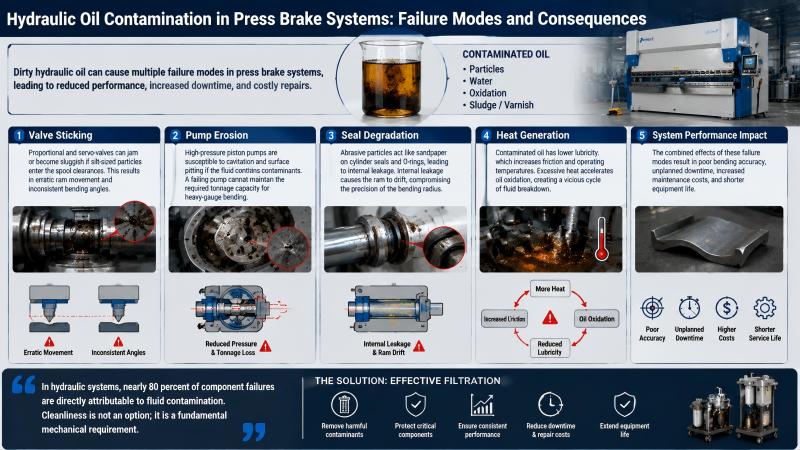
The significance of hydraulic Press Brake filtration in sheet metal fabrication cannot be overstated, particularly when dealing with tight tolerances and varied sheet thickness. When hydraulic oil is dirty, several failure modes emerge:
- Valve Sticking: Proportional and servo-valves can jam or become sluggish if silt-sized particles enter the spool clearances. This results in erratic ram movement and inconsistent bending angles.
- Pump Erosion: High-pressure piston pumps are susceptible to cavitation and surface pitting if the fluid contains contaminants. A failing pump cannot maintain the required tonnage capacity for heavy-gauge bending.
- Seal Degradation: Abrasive particles act like sandpaper on cylinder seals and O-rings, leading to internal leakage. Internal leakage causes the ram to drift, compromising the precision of the bending radius.
- Heat Generation: Contaminated oil has lower lubricity, which increases friction and operating temperatures. Excessive heat accelerates oil oxidation, creating a vicious cycle of fluid breakdown.
“In hydraulic systems, nearly 80 percent of component failures are directly attributable to fluid contamination. Cleanliness is not an option; it is a fundamental mechanical requirement.”
Key Factors to Consider in Hydraulic Press Brake Filtration Systems
When evaluating a press brake’s filtration system, engineers must look beyond simple filter replacement. Several technical factors determine the effectiveness of the system:
Micron Rating
The micron rating indicates the size of particles the filter can trap. However, one must distinguish between ‘nominal’ and ‘absolute’ ratings. An absolute rating implies the filter will stop 99.9 percent of particles of a certain size, which is necessary for protecting sensitive CNC hydraulic manifolds.
The Beta Ratio (Efficiency)
The Beta Ratio is the industry standard for measuring filter efficiency. It compares the number of particles upstream of the filter to the number downstream. A higher Beta ratio signifies a more efficient filter. For press brakes, a Beta ratio of 200 or 1000 is typically preferred for critical pressure-line filters.
Pressure Drop (Delta P)
Every filter creates a restriction in flow, measured as a pressure drop. As the filter clogs with debris, the pressure drop increases. If the Delta P becomes too high, a bypass valve may open, allowing unfiltered oil to circulate to prevent the filter element from collapsing—a dangerous state for the machine.
Technical Explanation and Cleanliness Calculations
To quantify filtration efficiency, engineers use the Beta Ratio formula. Understanding this formula allows maintenance teams to select the correct replacement elements for their specific machine requirements.
The Beta Ratio (βx) is calculated as follows:
βx = Nu / Nd
Where:
Nu = Number of particles per unit volume larger than x microns in the upstream fluid.
Nd = Number of particles per unit volume larger than x microns in the downstream fluid.
To convert the Beta Ratio into a percentage efficiency (E), the following formula is used:
E = ((βx – 1) / βx) * 100
For example, if a filter has a Beta 10 = 200 rating, it means that for every 200 particles of 10 microns entering the filter, only 1 passes through. This equates to an efficiency of 99.5 percent. In a press brake with high-speed hydraulics, maintaining high Beta ratios at low micron levels is essential for protecting the cylinder bores and the material tensile strength sensor feedback loops.
Comparison of Filtration Methods
Not all filters are placed in the same location. A robust hydraulic system uses a combination of filtration types to ensure comprehensive protection.
| Filter Type | Location | Primary Purpose | Pros/Cons |
|---|---|---|---|
| Suction Strainer | Inside the Reservoir | Protects the pump from large debris. | Low cost; Can cause pump cavitation if clogged. |
| Pressure Line Filter | After the Pump | Protects sensitive valves and actuators. | Highest protection; Must withstand full system pressure. |
| Return Line Filter | Before the Reservoir | Captures wear particles before they enter the tank. | Easy to service; Does not protect valves directly from pump debris. |
| Off-line (Kidney Loop) | Separate Circuit | Continuous cleaning and moisture removal. | Excellent for deep cleaning; Requires additional motor/pump. |
Step-by-Step Guide to Maintaining Fluid Cleanliness

Maintenance of the filtration system should be proactive rather than reactive. Follow these steps to ensure optimal hydraulic health:
- Monitor Visual Indicators: Most industrial press brakes have differential pressure gauges on the filter housings. Check these while the oil is at operating temperature. If the needle is in the red zone, change the element immediately.
- Establish a Sampling Schedule: Perform oil analysis every 2,000 operating hours. Send samples to a lab to check for the ISO 4406 cleanliness code and the presence of water or chemical breakdown.
- Use Proper Filling Techniques: Never pour oil directly from a barrel into the reservoir. New oil is often dirtier than what is required for a press brake. Always use a filter cart (kidney loop) to pump new oil into the machine.
- Replace Breather Caps: The reservoir ‘breathes’ air as the cylinders move. Ensure the air breather has a 3-micron or better rating and includes desiccant to remove moisture.
- Standardize Elements: Use high-quality synthetic media filters rather than cellulose (paper) filters. Synthetic media has more uniform pore sizes and better dirt-holding capacity.
Common Mistakes to Avoid
In our experience consulting on sheet metal machinery, we see several recurring mistakes that lead to costly hydraulic failures:
- Ignoring the Bypass: Many operators ignore the filter indicator, thinking the machine is still running fine. In reality, the filter is likely in ‘bypass mode,’ meaning unfiltered oil is destroying the proportional valves.
- Changing Oil Instead of Filtering: Oil doesn’t usually ‘wear out’ in a press brake; it gets dirty. Often, installing a high-quality off-line filtration system is more cost-effective than a full oil change of 400 liters.
- Using Incorrect Micron Ratings: Substituting a 25-micron filter where a 10-micron filter is specified will quickly lead to valve lag and lost precision in the bending angle.
- Neglecting the Air Breather: A dirty environment in a fabrication shop means lots of airborne dust. If the air breather is inadequate, the reservoir becomes a sink for shop floor contaminants.
“The most expensive filter you will ever buy is the one that was too cheap to protect your servo-valves.”
Industry Applications
The requirement for ultra-clean hydraulics varies by application. In the **Aerospace Industry**, where aluminum and titanium parts require extreme precision and repeatable bending radii, press brakes are often equipped with redundant pressure-line filtration and continuous laser-particle counters. In **Automotive Manufacturing**, high-speed production lines utilize kidney-loop systems to ensure the machines can run 24/7 without valve failure. Even in **General Job Shops**, maintaining filtration is the key to handling various material tensile strengths without having to recalibrate the CNC backgauge system due to hydraulic drift.
Conclusion
Keeping it clean is not just a slogan; it is a technical imperative for any hydraulic press brake operation. By understanding the ISO 4406 standards, implementing a multi-stage filtration strategy, and adhering to a strict maintenance schedule, fabrication facilities can significantly reduce downtime and repair costs. A well-maintained filtration system ensures that the hydraulic fluid remains a reliable medium for power transmission, allowing the machine to deliver the precision and force required for modern sheet metal fabrication. For long-term success, invest in high Beta-ratio filters and never underestimate the damage that microscopic particles can do to your bottom line.
FAQ
How often should I change the hydraulic filters on my press brake?
Generally, filters should be changed every 1,000 to 2,000 hours of operation, or whenever the differential pressure indicator signals a clog. However, an annual change is recommended regardless of hours to prevent media degradation.
What is the difference between nominal and absolute micron ratings?
A nominal rating is an arbitrary commercial description indicating the filter can stop some percentage of particles of that size. An absolute rating (usually Beta 75 or higher) means the filter has been tested to stop 99.9% of particles at that specific micron size.
Can I use generic filters for my hydraulic press brake?
It is discouraged. Generic filters often lack the structural integrity to handle high-pressure spikes or may have lower Beta ratios, which fails to protect sensitive proportional valves used in CNC machines.
Why does my new oil need to be filtered?
New oil from a drum typically has an ISO cleanliness level around 21/19/16, which is far too dirty for a modern press brake requiring 16/14/11. Always pump oil through a 5-micron or 10-micron filter cart when filling the reservoir.
What are the symptoms of air contamination in a hydraulic system?
Air contamination, or aeration, usually causes the pump to make a loud whining noise, causes ‘spongy’ or erratic ram movement, and can lead to fluid foaming and overheating.