Press Brake Technical Guide: How to Choose the Right Bending Machine for Your Fabrication Shop


Technical Overview: The Evolution of Modern Bending Technology
In the competitive landscape of modern metal fabrication, the press brake stands as the cornerstone of production. Whether you are a small job shop or a large-scale industrial manufacturer, the ability to accurately and efficiently bend sheet metal determines your throughput and profitability. This Press Brake Technical Guide: How to Choose the Right Bending Machine for Your Fabrication Shop aims to demystify the complexities of these machines, helping you make an informed investment that aligns with your production goals.
Historically, press brakes were purely mechanical, relying on massive flywheels to generate the force needed for bending. While powerful, these machines lacked precision and were notoriously difficult to set up. The industry then transitioned to hydraulic systems, which offered better control and safety. Today, we see a further evolution into electro-hydraulic synchronized CNC press brakes and even fully electric models. These modern machines utilize advanced software and high-precision sensors to ensure that every bend is consistent, regardless of material variations.
Choosing the right machine involves more than just looking at the price tag. It requires a deep understanding of your material types, the complexity of your parts, and the level of automation your workflow demands. HARSLE has been at the forefront of this technological shift, providing machines that integrate high-speed hydraulics with intuitive CNC interfaces. Understanding the fundamental mechanics—such as how the Y1 and Y2 cylinders communicate to maintain parallelism—is the first step in mastering the Press Brake Technical : Choose Bending Machine Fabrication Shop process.
The Shift from NC to CNC
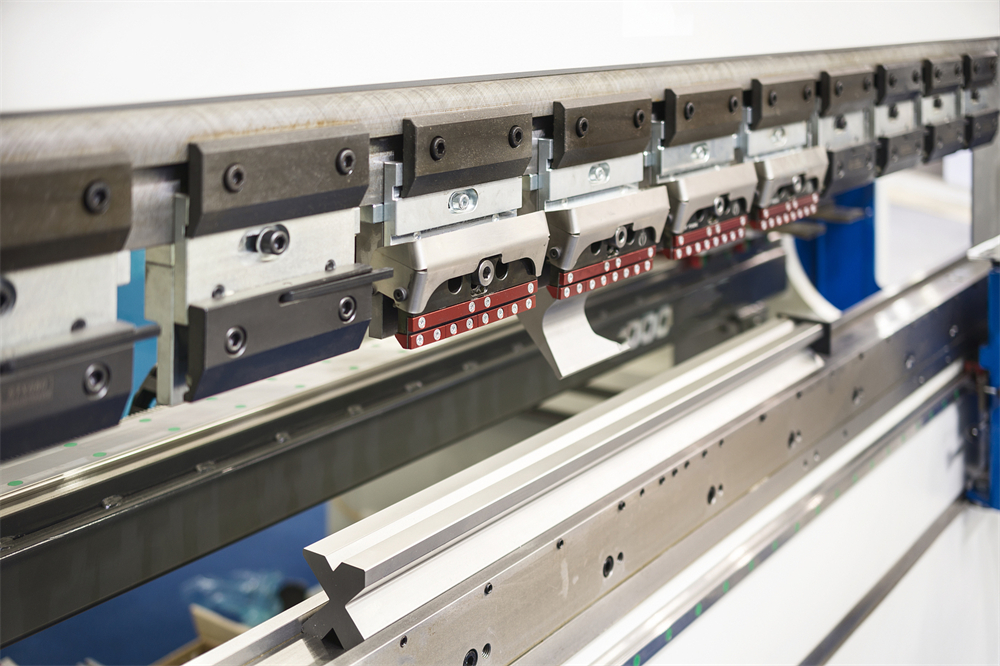
One of the most critical decisions a shop owner faces is choosing between NC (Numerical Control) and CNC (Computer Numerical Control). NC machines are generally simpler, often using a torsion bar to synchronize the cylinders. They are excellent for repetitive, simple bends where high-speed adjustments aren’t necessary. However, for complex parts with multiple bends and varying angles, a CNC press brake is indispensable. CNC systems allow for automatic calculation of the bend sequence, backgauge positioning, and even crowning compensation, significantly reducing setup time and scrap rates.
Core Parameters: Understanding the Machine’s DNA
When evaluating a press brake, several core parameters define its capability. These are the non-negotiable specifications that will dictate what your shop can and cannot produce. Ignoring these technical details often leads to purchasing a machine that is either underpowered for heavy plates or too slow for high-volume thin-gauge work.
1. Tonnage (Bending Force)
Tonnage is the measure of the maximum pressure the press brake can exert. It is the most critical factor in machine selection. If you choose a machine with insufficient tonnage, you risk damaging the frame or the hydraulic system when attempting to bend thick materials. Conversely, an oversized machine for thin materials can be inefficient and may lack the sensitivity required for delicate work. Tonnage requirements are influenced by material thickness, material type (e.g., stainless steel requires significantly more force than aluminum), and the width of the V-die opening.
2. Bending Length
The bending length refers to the maximum width of the sheet metal the machine can process. While it might seem straightforward to buy a machine that matches your longest part, you must also consider the distance between the side housings. If you need to pass a long part through the machine for a secondary operation, the “distance between uprights” becomes a vital sub-parameter. HARSLE machines are designed with generous throat depths and upright distances to provide maximum flexibility for complex geometries.
3. Throat Depth and Stroke
Throat depth determines how far a flange can extend into the machine before hitting the frame. For deep box bending or complex profiles, a larger throat depth is essential. The stroke, on the other hand, is the total distance the upper beam can move. A longer stroke is beneficial when using tall tools or when bending parts that require significant clearance for removal. Combined with the “open height” (the distance between the ram and the table when fully retracted), these parameters define the physical envelope of your bending possibilities.
4. Backgauge Axes (X, R, Z1, Z2)
The backgauge is the heart of precision in a press brake. A basic 2-axis backgauge (X and R) allows for depth and height adjustment. However, for complex parts with tapered flanges or multiple steps, a 4-axis (X, R, Z1, Z2) or even a 6-axis backgauge is required. The Z-axes allow the fingers to move independently left and right, which is crucial for supporting wide parts or performing offset bends. High-speed backgauges driven by servo motors are standard in HARSLE’s CNC line, ensuring rapid positioning and high repeatability.
Calculation Method: Determining Your Tonnage Requirements
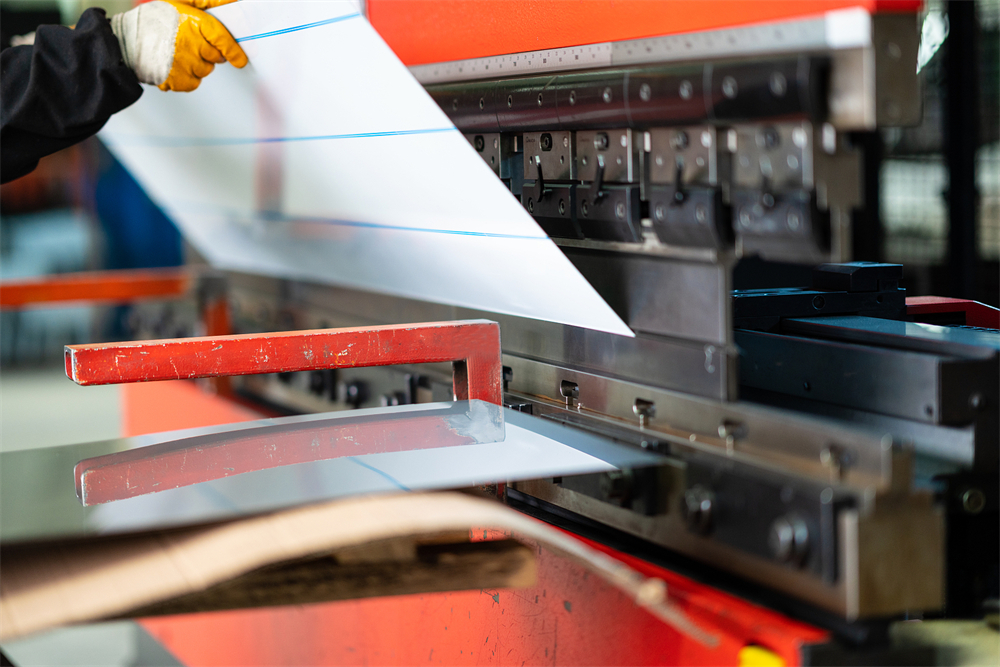
To accurately Choose Bending Machine Fabrication Shop, you must be able to calculate the required bending force. The standard formula for air bending mild steel (with a tensile strength of approximately 450 MPa) is:
P = (650 x S² x L) / V
- P: Bending force in Kilonewtons (kN). To convert to Tons, divide by 9.8.
- S: Material thickness in millimeters (mm).
- L: Bending length in meters (m).
- V: V-die opening width in millimeters (mm). Usually, V is 8 to 10 times the material thickness (S).
For example, if you are bending 4mm thick mild steel over a length of 2.5 meters using a 32mm V-die opening, the calculation would be: P = (650 x 16 x 2.5) / 32 = 812.5 kN. This equates to approximately 83 tons. However, it is always recommended to add a 20% safety margin to account for material variations and tool friction, leading to a recommendation of a 100-ton machine.
The Impact of Material Type
It is vital to remember that the constant (650) in the formula changes based on the material’s tensile strength. Stainless steel, for instance, often requires 50% more pressure than mild steel. Aluminum, depending on the alloy, may require significantly less. If your shop works with a variety of materials, always calculate based on the toughest material you plan to process.
Parameter Table: Common Press Brake Specifications
The following table provides a quick reference for common press brake capacities found in professional fabrication shops. These figures are representative of HARSLE’s standard CNC series.
| Model Capacity (Tons) | Bending Length (mm) | Distance Between Uprights (mm) | Throat Depth (mm) | Ram Stroke (mm) | Approach Speed (mm/s) |
|---|---|---|---|---|---|
| 63T | 2500 | 2000 | 250 | 150 | 100 |
| 100T | 3200 | 2600 | 320 | 200 | 120 |
| 160T | 3200 | 2600 | 400 | 200 | 120 |
| 200T | 4000 | 3200 | 400 | 250 | 100 |
| 300T | 4000 | 3200 | 400 | 250 | 80 |
Common Engineering Mistakes in Press Brake Selection
Even experienced engineers can make mistakes when selecting a press brake. Avoiding these common pitfalls will save your shop time, money, and frustration.
1. Ignoring Deflection and Crowning
When a press brake applies force, both the upper beam and the lower table deflect (bend) slightly. This causes the bend angle to be wider in the center of the machine than at the ends. Many shops fail to invest in a crowning system (either hydraulic or mechanical) to compensate for this. Without crowning, you will spend hours shimming dies to get a straight bend, which is a massive waste of labor.
2. Underestimating the Importance of Tooling
A press brake is only as good as the tooling it uses. Many buyers focus entirely on the machine and try to save money on cheap, low-quality dies. Precision-ground, hardened tooling is essential for maintaining accuracy and longevity. Furthermore, ensure the machine’s clamping system (e.g., Amada-style or European-style) is compatible with the tooling you intend to use or already own.
3. Overlooking Maintenance Access
Industrial machines require maintenance. Choosing a machine that is cramped or has poorly placed hydraulic components can make routine tasks like oil changes or filter replacements a nightmare. HARSLE designs machines with accessibility in mind, ensuring that your maintenance team can keep the machine running at peak performance with minimal downtime.
4. Miscalculating the “Real” Tonnage
As mentioned in the calculation section, many shops calculate the theoretical tonnage but forget the safety margin. Additionally, if you plan to do “bottoming” or “coining” instead of air bending, the tonnage requirements can be 3 to 5 times higher. Ensure your machine choice reflects your actual bending method.
Selection Checklist: How to Choose the Right Bending Machine
Before finalizing your purchase, go through this checklist to ensure the machine meets all your operational needs. This is the ultimate summary of the Press Brake Technical Guide: How to Choose the Right Bending Machine for Your Fabrication Shop.
- Material Analysis: What is the maximum thickness and tensile strength of the materials you will bend?
- Maximum Length: What is the longest part you will produce, and does it fit between the uprights?
- Accuracy Requirements: Do you need +/- 0.5 degrees or +/- 0.1 degrees? This determines if you need a high-end CNC system with laser angle measurement.
- Production Volume: Will the machine run one shift or three? High-volume shops should look for high-speed hydraulics and rapid backgauge movement.
- Complexity of Parts: How many bends per part? More complex parts require more backgauge axes and advanced CNC software (like Delem DA66T or DA69T).
- Crowning System: Is a crowning system included to prevent the “canoe effect” on long bends?
- Safety Features: Does the machine include light curtains or laser guards (like DSP or Lazersafe) to protect operators?
- Future Proofing: Is the CNC controller capable of importing 3D files (STEP/IGES) for offline programming?
Frequently Asked Questions (FAQ)
Q1: What is the difference between Air Bending and Bottoming?
Air bending is the most common method where the material only touches the tool at three points (the punch tip and the two edges of the V-die). The angle is determined by how deep the punch descends. Bottoming involves pressing the material fully into the die. Air bending requires less tonnage and is more versatile, while bottoming provides higher accuracy but requires specific tooling for every angle and much higher force.
Q2: How often should I change the hydraulic oil?
For most industrial press brakes, the hydraulic oil should be changed every 2,000 to 4,000 hours of operation, or at least once a year. Regular oil analysis can help determine the exact timing. Keeping the oil clean is the single most important factor in extending the life of the hydraulic valves and pumps.
Q3: Can I bend small parts on a large press brake?
Yes, but it is not always efficient. Large machines have slower cycle times and may lack the fine control needed for very small, delicate parts. Additionally, bending small parts in the center of a large machine can lead to localized wear on the bed and ram if not managed correctly.
Q4: Why is the CNC controller so important?
The controller is the brain of the machine. A good CNC controller (like those from Delem, Cybelec, or ESA) calculates the developed length of the part, determines the bend sequence, and automatically adjusts the backgauge and crowning. This reduces the skill level required for the operator and virtually eliminates setup errors.
Q5: What is the benefit of a Servo-Hydraulic system?
Servo-hydraulic systems (often called “Hybrid” systems) use a servo motor to drive the hydraulic pump. This means the pump only runs when the machine is actually moving. This results in significant energy savings (up to 60%), less heat generation in the oil, and much quieter operation compared to traditional constant-run pumps.
By following this Press Brake Technical Guide, you are well-equipped to navigate the market and select a machine that will serve your fabrication shop for years to come. Remember that the best machine is not just the one with the highest specs, but the one that fits perfectly into your specific production workflow. HARSLE remains committed to providing the technical support and high-quality machinery needed to help your business thrive in the world of precision metal fabrication.