How a Hydraulic Shearing Machine Solved Thickness Cutting Challenges in Heavy Fabrication


Introduction to Heavy Fabrication Cutting Challenges
In the world of heavy industrial manufacturing, the ability to process thick metal plates with precision and speed is the cornerstone of productivity. For decades, fabricators struggled with the limitations of mechanical shears and thermal cutting methods when dealing with high-tensile materials and significant thicknesses. The primary issue was not just the force required, but the quality of the finished edge and the structural integrity of the material after the cut. This is where the evolution of the hydraulic shearing machine changed the landscape of the industry. In this article, we explore how a hydraulic shearing machine solved thickness cutting challenges in heavy fabrication, providing a reliable, cost-effective, and high-precision alternative to traditional methods.
Heavy fabrication often involves materials such as carbon steel, stainless steel, and high-strength alloys ranging from 12mm to over 40mm in thickness. Traditional mechanical shears often lacked the adjustable parameters needed to handle such a wide range of thicknesses without causing significant material distortion or tool wear. Furthermore, thermal cutting processes like plasma or oxy-fuel, while capable of cutting thick plates, introduce a Heat Affected Zone (HAZ) that can compromise the metallurgical properties of the edge, necessitating secondary grinding or machining processes. The introduction of advanced hydraulic systems allowed for controlled, high-tonnage pressure that could be fine-tuned to the specific requirements of the material being processed.
HARSLE has been at the forefront of this technological shift, developing hydraulic shearing machines that integrate robust mechanical engineering with sophisticated CNC controls. By focusing on the physics of the shearing process—specifically the relationship between rake angle, blade gap, and material resistance—modern hydraulic shears have eliminated the bottlenecks that once plagued heavy-duty workshops. Today, these machines are not just cutting tools; they are precision instruments capable of delivering repeatable accuracy within fractions of a millimeter, even when dealing with the most demanding industrial applications.

Key Considerations for Cutting Thick Materials
When addressing the challenges of heavy-duty shearing, several critical factors must be considered to ensure both machine longevity and part quality. The first and perhaps most vital consideration is the Rake Angle. In a shearing machine, the rake angle is the slope of the upper blade relative to the lower blade. For thin materials, a low rake angle is preferred to minimize twist and bow. However, for thick plates, a higher rake angle is necessary to reduce the shearing force required. A hydraulic shearing machine solved thickness cutting challenges in heavy fabrication by allowing operators to adjust this angle dynamically, ensuring the machine can handle maximum capacity without overloading the hydraulic circuit.
Another essential factor is the Blade Gap Adjustment. The clearance between the upper and lower blades must be precisely calibrated based on the material thickness and tensile strength. If the gap is too narrow for a thick plate, the friction increases exponentially, leading to rapid blade dulling and potential damage to the machine frame. Conversely, if the gap is too wide, the material will “fold” or develop a large burr rather than shearing cleanly. Modern hydraulic shears often feature motorized or CNC-controlled blade gap adjustment, which allows for instantaneous changes based on the programmed material profile, ensuring a clean, square edge every time.
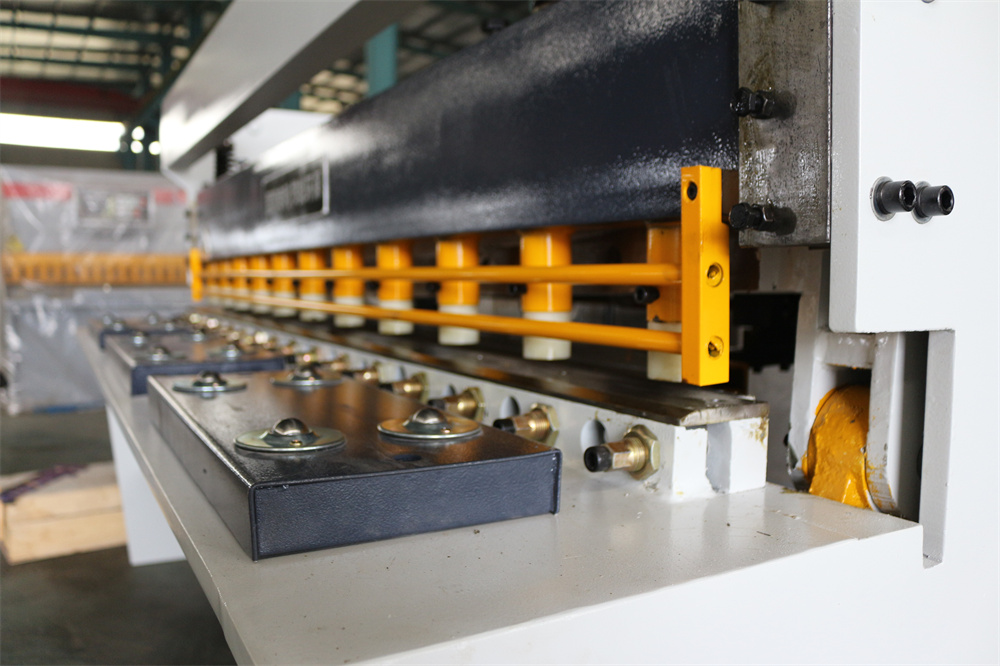
Material handling and stability also play a significant role in heavy fabrication. Thick plates are incredibly heavy and difficult to maneuver. A high-quality hydraulic shearing machine incorporates heavy-duty hold-down cylinders. These cylinders apply immense pressure to the plate before the shearing action begins, preventing the material from sliding or tipping during the cut. Without sufficient hold-down force, the lateral pressure of the shear would cause the plate to shift, resulting in inaccurate dimensions and potential safety hazards for the operator. Furthermore, the use of ball transfers on the worktable allows for easier positioning of heavy sheets, reducing operator fatigue and improving throughput.
Finally, the structural rigidity of the machine itself cannot be overlooked. Heavy-duty shearing generates massive internal stresses. A machine designed for thick plate cutting must feature a heavy, stress-relieved steel frame. HARSLE utilizes advanced FEA (Finite Element Analysis) to ensure that the frames of their hydraulic shears can withstand the repetitive shocks of high-tonnage shearing without deforming over time. This structural integrity is what allows a hydraulic shearing machine to maintain its precision over decades of service in a demanding industrial environment.
Technical Details of Modern Hydraulic Shears
The technical superiority of a hydraulic shearing machine lies in its integrated systems. Unlike mechanical shears that rely on a flywheel and clutch, hydraulic shears use a system of pumps, valves, and cylinders to deliver consistent force throughout the entire stroke. This allows the operator to stop, start, or reverse the stroke at any point, providing a level of control and safety that is impossible with mechanical alternatives. The hydraulic system is typically powered by high-quality components from brands like Bosch Rexroth or Hoerbiger, ensuring reliability and smooth operation.
One of the primary technical distinctions in the industry is between the Swing Beam Shear (QC12Y) and the Guillotine Shear (QC11Y). While swing beam shears are excellent for light to medium-duty work due to their simplicity and lower maintenance, the hydraulic guillotine shear is the preferred choice for heavy fabrication. The guillotine design allows for a variable rake angle and a perfectly vertical cutting path. This vertical movement ensures that the blade remains parallel to the material, which is crucial for maintaining edge squareness on plates exceeding 16mm in thickness. By adjusting the rake angle, the guillotine shear can effectively “slice” through thick material with less force, protecting the machine’s structural components.
The blades themselves are a marvel of metallurgy. For heavy-duty applications, blades are typically made from high-carbon, high-chrome alloys such as Cr12MoV or 6CrW2Si. These materials are heat-treated to achieve a balance between hardness (to maintain a sharp edge) and toughness (to resist chipping under high impact). In a hydraulic shearing machine, the blades often feature multiple cutting edges—four on the bottom and two or four on the top—allowing them to be rotated when one edge becomes dull, thereby doubling or quadrupling the lifespan of the tool before sharpening is required.
CNC integration has further revolutionized the technical capabilities of these machines. Modern controllers, such as the DELEM DAC-360T or the Cybelec CybTouch series, manage everything from backgauge positioning to rake angle and blade gap. The backgauge itself is often driven by high-precision ball screws and AC servo motors, allowing for positioning accuracy within ±0.1mm. For heavy fabrication, the backgauge must also be rugged, often featuring a “swing-up” function that allows the operator to cut plates longer than the maximum backgauge range by letting the material pass underneath.
Selection Advice: Choosing the Right Machine for Heavy Plates
Selecting the right hydraulic shearing machine for heavy fabrication requires a deep understanding of your production needs. The first step is to define the maximum thickness and the maximum length of the material you intend to cut. It is a common mistake to buy a machine that exactly matches your maximum requirements. In heavy-duty environments, it is often advisable to select a machine with a capacity roughly 20% higher than your standard maximum. This “headroom” ensures that the machine is not constantly running at its limit, which significantly extends the life of the hydraulic seals, valves, and the frame itself.
Consider the material type as well. Shearing capacities are usually rated for mild steel (tensile strength of approx. 450 N/mm²). If you are cutting stainless steel or high-strength wear-resistant plates (like Hardox), the shearing force required is much higher. For stainless steel, you generally need to reduce the rated thickness capacity by about 40-50%. A hydraulic shearing machine solved thickness cutting challenges in heavy fabrication by offering high-pressure hydraulic units specifically designed for these tougher alloys, but the buyer must ensure the tonnage is sufficient for the specific material grade.
Another critical factor is the level of automation. For high-volume shops, a CNC-controlled machine with a pneumatic rear sheet support system is essential. When cutting thin to medium sheets on a large machine, the material can sag before it reaches the backgauge, leading to inaccurate cuts. A rear support system holds the sheet level until the hold-downs engage. For very thick plates, look for machines equipped with front feed tables and heavy-duty squaring arms with flip-over stops. These features allow for faster setup and more consistent results when handling large, heavy workpieces.
Finally, evaluate the after-sales support and component availability. Heavy-duty machines are an investment meant to last 20+ years. Choosing a manufacturer like HARSLE ensures that you have access to standardized components (like Schneider electrics and Rexroth hydraulics) that can be easily serviced or replaced. Avoid machines with proprietary, non-standard hydraulic blocks or controllers that may become obsolete, as downtime in a heavy fabrication environment can cost thousands of dollars per day.
Frequently Asked Questions (FAQ)
1. Why is a hydraulic shear better than a mechanical shear for thick plates?
Hydraulic shears offer adjustable rake angles and blade gaps, which are essential for managing the high forces required for thick plates. They also provide overload protection; if the material is too thick, the hydraulic system will simply bypass the pressure rather than breaking a mechanical linkage. Additionally, hydraulics allow for much smoother, controlled cutting, which results in better edge quality.
2. How often should I sharpen the blades on a heavy-duty shearing machine?
The frequency of sharpening depends on the material type and the volume of cuts. For mild steel, blades can often last for thousands of cuts before needing a rotation or grind. However, cutting stainless steel or scaly hot-rolled steel will dull blades faster. You should inspect the edge quality regularly; if you notice increased burrs or a “crushing” effect on the edge, it is time to rotate or sharpen the blades.
3. Can a hydraulic shearing machine cut plates of different materials?
Yes, but the blade gap and rake angle must be adjusted accordingly. Harder materials like stainless steel require a tighter blade gap and more force. Most modern CNC hydraulic shears allow you to save material profiles in the controller, making it easy to switch between carbon steel, aluminum, and stainless steel without manual recalibration.
4. What is the purpose of the nitrogen return cylinder?
Most hydraulic shearing machines use a nitrogen return system for the upper beam. While the hydraulic cylinders push the beam down to cut, the nitrogen cylinders provide a fast, smooth return stroke. This system is more reliable and faster than mechanical spring returns, especially on large, heavy machines.
5. How does the rake angle affect the quality of the cut?
A higher rake angle reduces the force needed to cut thick material but increases the potential for “twist” in the off-cut piece. A lower rake angle produces a flatter, higher-quality cut but requires significantly more hydraulic pressure. Variable rake angle machines allow you to find the perfect balance for every thickness.
Conclusion: The Future of Heavy Shearing
The transition from manual and mechanical cutting to advanced hydraulic systems has been a game-changer for the heavy fabrication industry. As we have seen, a hydraulic shearing machine solved thickness cutting challenges in heavy fabrication by providing the flexibility, power, and precision necessary to handle modern industrial demands. By allowing for precise control over the physics of the shear—through adjustable rake angles, CNC-controlled blade gaps, and robust hydraulic circuits—these machines have eliminated the inconsistencies of the past.
For manufacturers looking to stay competitive, investing in a high-quality hydraulic shear is no longer optional; it is a necessity. The ability to produce clean, weld-ready edges on thick plates in a single pass significantly reduces labor costs and lead times. As technology continues to advance, we can expect even greater integration of IoT and smart sensors into these machines, allowing for predictive maintenance and even higher levels of automation. HARSLE remains committed to driving this innovation, ensuring that fabricators have the tools they need to tackle the toughest challenges in metalworking with confidence and efficiency.
Whether you are building massive structural components for the construction industry or precision parts for heavy machinery, the hydraulic shearing machine stands as a testament to engineering excellence. It is the workhorse of the modern shop, turning the challenge of thick plate cutting into a streamlined, repeatable, and highly profitable process.