How Pascal’s Law Powers Your Press Brake: Engineering Guide


In modern sheet metal fabrication, bending thick steel with high precision relies on advanced hydraulic principles. At the core of every press brake is Pascal’s Law, which explains how fluid pressure is transmitted evenly in a confined system. Understanding this principle helps engineers optimize performance, improve safety, and extend machine lifespan. By applying Pascal’s Law, a relatively small motor and hydraulic pump can generate immense force—often hundreds or thousands of tons. This controlled pressure allows the press brake to overcome material strength and form complex metal components with accuracy and efficiency.
The Fundamental Principles of Pascal’s Law in Press Brake Technology
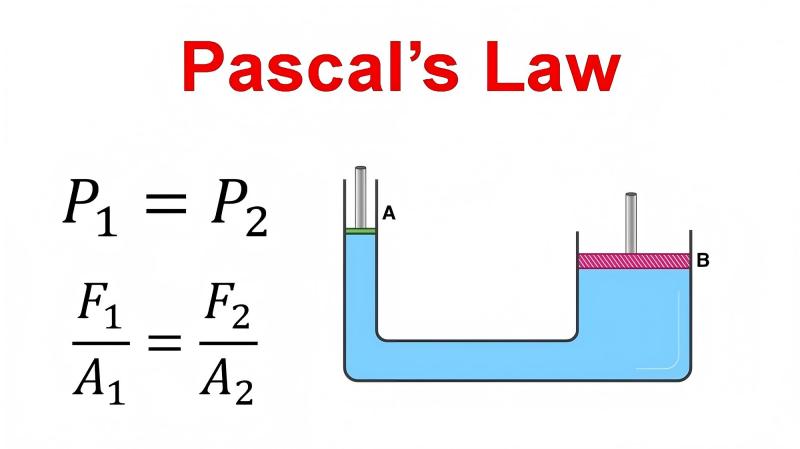
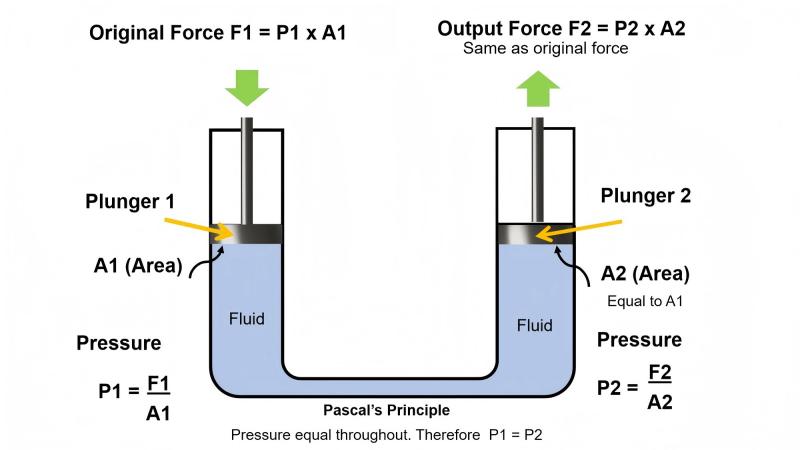
Pascal’s Law, introduced by Blaise Pascal in 1647, states that pressure applied to a confined incompressible fluid is transmitted equally in all directions. In a press brake, this means hydraulic pressure is evenly distributed through the system into the cylinders. Since hydraulic fluid is nearly incompressible, it efficiently transfers power. The key formula is P = F / A, where pressure depends on force and piston area. By applying force to a small area, the system generates pressure that produces a much larger force on a bigger area—this is the principle of hydraulic leverage.
In a standard hydraulic press brake, the system consists of a reservoir, a motor-driven pump, control valves, and two or more main cylinders. When the operator initiates a stroke, the pump forces hydraulic oil through the valves into the top of the cylinders. As the fluid fills the chamber, the pressure increases according to the resistance met by the workpiece. Because the piston area in the ram cylinders is large, even moderate system pressures of 200 to 300 bar can result in massive tonnage capacity. This allows for the controlled deformation of materials ranging from thin aluminum to high-tensile armored plating.
Why Pascal’s Law in Press Brake Design Ensures Precision
The practical value of Pascal’s Law in sheet metal fabrication goes beyond force—it ensures precision and repeatability. Unlike mechanical press brakes, hydraulic systems provide continuous and adjustable pressure control throughout the stroke. This allows the CNC system to accurately control ram movement by regulating fluid pressure and flow. Such control is essential when handling different material thicknesses or maintaining consistent bending angles. Additionally, hydraulic principles enable crowning systems to compensate for frame deflection under load, ensuring uniform bending results across the entire workpiece.
The transition from mechanical to hydraulic power was the single most significant advancement in metal forming, allowing for the marriage of massive force and surgical precision through fluid control.
Key Factors to Consider in Fluid Power Bending
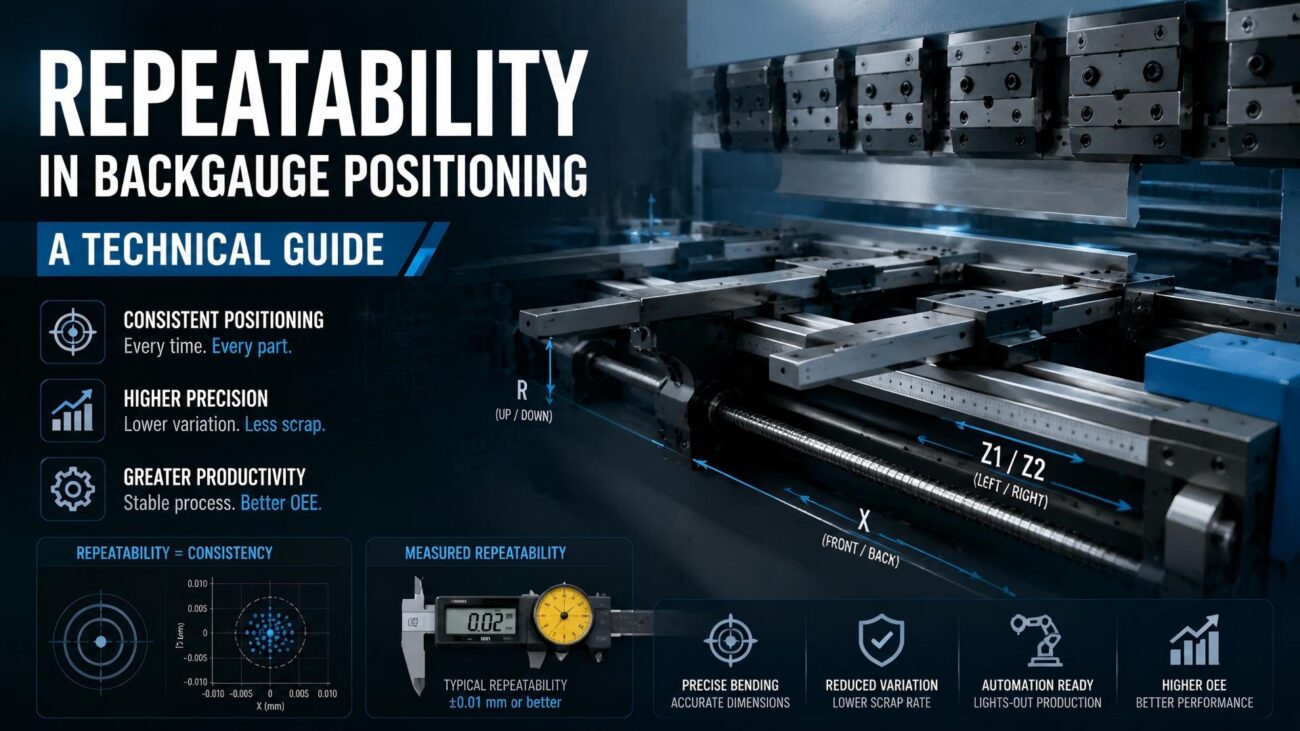
To fully utilize Pascal’s Law in press brake operations, several key factors must be controlled. System pressure is critical, typically up to 300 bar—exceeding it may cause seal failure or structural damage. Cylinder bore size determines tonnage, where larger diameters increase force but may reduce speed. Hydraulic fluid viscosity must be balanced, as improper oil can lead to leakage or poor performance. Finally, precise synchronization of the Y1 and Y2 axes ensures even pressure distribution, preventing ram tilt and maintaining consistent bending accuracy.
Calculating Force: Applying Pascal’s Law in Press Brake Operations
Calculating required tonnage is a key engineering task in press brake operations. For V-bending, the force is calculated using: F = (1.42 × UTS × L × t²) / V, where UTS is material strength, L is bend length, t is thickness, and V is die opening. This formula helps determine the force needed for accurate bending. Once calculated, the hydraulic system must generate sufficient pressure to meet this force. For example, producing 100 tons of force with a piston area of 500 cm² requires at least 200 kg/cm² of pressure to operate effectively.
| Material Type | Tensile Strength (N/mm2) | Recommended V-Opening | Bending Force Multiplier |
|---|---|---|---|
| Aluminum (Soft) | 200-250 | 6t – 8t | 0.5 |
| Mild Steel (S235) | 370-450 | 8t | 1.0 |
| Stainless Steel (304) | 550-700 | 10t – 12t | 1.5 |
| High Strength Steel | 1000+ | 12t+ | 2.0+ |
Comparison of Press Brake Drive Systems
While Pascal’s Law dominates hydraulic systems, other press brake technologies exist. Mechanical press brakes offer high speed but lack flexibility in stopping mid-stroke or adjusting pressure. Servo-electric press brakes are efficient and fast for thin materials, but they cannot match the force output of hydraulic systems. Hydraulic press brakes remain the most versatile, delivering full tonnage at any point in the stroke. This capability, based on fluid power transmission, makes them ideal for heavy-duty applications, especially when bending plates thicker than 10mm.
Step-by-Step Guide to Optimizing Hydraulic Bending Performance

Step 1: Verify material specifications by checking tensile strength and sheet thickness, as they determine required tonnage. Step 2: Select proper tooling, typically using a die opening of V = 8t for mild steel. Step 3: Calculate tonnage to ensure it stays within 80% of machine capacity for safety. Step 4: Check hydraulic fluid condition, maintaining proper temperature and clean filters to avoid performance issues. Step 5: Calibrate the backgauge and ram to ensure accurate positioning and consistent bending results.
Common Mistakes to Avoid in Hydraulic Operations
A common mistake is ignoring oil temperature, as viscosity changes can affect valve response and bending accuracy. Another issue is neglecting hydraulic seals—internal leakage reduces pressure and prevents the machine from reaching full tonnage. Contaminated oil is also a risk, as particles or moisture can damage sensitive components like proportional valves. Finally, using an incorrect V-opening increases tonnage demand, placing unnecessary stress on both the hydraulic system and machine frame.
Industry Applications of High-Force Hydraulic Bending
The physics of hydraulic bending find applications across a wide spectrum of industries. In the heavy equipment sector, hydraulic press brakes are used to form the chassis and booms of excavators and cranes, where sheet thickness often exceeds 20mm. In the aerospace industry, the precision control of hydraulic pressure allows for the forming of large wing ribs and fuselage panels with high-strength alloys. The automotive industry utilizes high-speed hydraulic systems to create structural frame components. Even in the production of simple items like electrical enclosures or kitchen equipment, the reliability and consistency of Pascal’s Law-based systems ensure that thousands of parts can be produced with identical dimensions.
True engineering mastery is not found in the brute force of the machine, but in the elegant control of the fluid that drives it.
Conclusion and Recommendations
The marriage of Pascal’s Law and modern CNC technology has made the hydraulic press brake an indispensable tool in the fabrication industry. By understanding that pressure is distributed equally in a confined fluid, engineers can better appreciate the mechanics of tonnage capacity, cylinder synchronization, and material deformation. To maximize the value of your press brake, it is recommended to maintain a strict hydraulic service schedule, use high-quality oils, and always operate within the calculated tonnage limits of both the machine and the tooling. As we look toward the future, the integration of hybrid servo-hydraulic systems continues to refine these centuries-old principles, offering even greater efficiency without sacrificing the raw power that only hydraulics can provide.
FAQ
How does oil viscosity affect Pascal’s Law in a press brake?
While Pascal’s Law assumes an ideal fluid, real-world viscosity affects the speed and efficiency of pressure transmission. High viscosity can cause slow ram movement and increased friction, while low viscosity may lead to internal leakage, reducing the effective tonnage.
Can a press brake generate more force than its rated tonnage?
Technically, the hydraulic system can be forced to higher pressures, but relief valves are installed to prevent this. Exceeding rated tonnage risks permanent structural deformation of the side frames and damage to the hydraulic seals.
Why is air in the hydraulic system a problem for bending?
Pascal’s Law relies on the fluid being incompressible. Air is highly compressible; if trapped in the lines, it causes the ram to move unevenly or ‘spongy,’ making it impossible to achieve a consistent bending angle.
What role do proportional valves play in this physics?
Proportional valves act as the gatekeepers of the fluid. They precisely control the flow rate and pressure into the cylinders, allowing the CNC to synchronize the Y1 and Y2 axes based on the mathematical requirements of the bend.
How often should hydraulic fluid be changed to maintain precision?
In most industrial environments, hydraulic oil should be tested annually and replaced every 2,000 to 4,000 hours of operation to ensure that contaminants do not interfere with the pressure transmission described by Pascal’s Law.