Comprehensive Shearing Machine Preventive Maintenance Guide for Metal Fabrication Shops


The Critical Role of Preventive Maintenance in Metal Fabrication
In the high-stakes environment of modern metal fabrication shops, the shearing machine stands as a cornerstone of production. Whether you are operating a hydraulic swing beam shear or a variable rake guillotine, the precision of your initial cuts dictates the quality of every subsequent process, from bending to welding. Implementing a robust Shearing Machine Preventive Maintenance Metal Fabrication Shops strategy is not merely a recommendation; it is a financial necessity. Without a structured maintenance plan, shops face the looming threats of unplanned downtime, expensive emergency repairs, and compromised operator safety.
Preventive maintenance (PM) involves a systematic approach to inspecting, cleaning, and servicing machinery before failures occur. For shearing machines, this means ensuring that the blades remain sharp, the hydraulic pressures are balanced, and the mechanical linkages are free of excessive play. When a machine is well-maintained, it operates at peak efficiency, consuming less energy and producing cleaner cuts with minimal burrs. This efficiency directly translates to higher throughput and lower scrap rates, which are essential for maintaining a competitive edge in the metalworking industry.
Furthermore, the longevity of your capital investment depends heavily on how well it is treated during its service life. A HARSLE shearing machine, for instance, is engineered for durability, but even the most robust industrial equipment is subject to wear and tear. By adhering to a strict maintenance schedule, fabrication shops can extend the lifespan of their machinery by years, if not decades. This guide provides a comprehensive roadmap for establishing a world-class maintenance culture within your facility, focusing on technical depth and practical application.
Finally, we must consider the safety implications. A shearing machine is a powerful piece of equipment capable of exerting hundreds of tons of force. Mechanical failures, such as a malfunctioning hold-down cylinder or a faulty emergency stop circuit, can lead to catastrophic accidents. A thorough preventive maintenance program ensures that all safety features are functional, protecting your most valuable asset: your workforce. By prioritizing maintenance, you are choosing a path of reliability, safety, and long-term profitability.
Daily Inspection: The First Line of Defense
The daily inspection is the most fundamental aspect of Shearing Machine Preventive Maintenance Metal Fabrication Shops. It should be performed at the start of every shift by the operator. This routine check is designed to identify obvious signs of wear or potential failure before the machine is put under load. The first step is a visual sweep of the machine’s exterior. Operators should look for oil leaks around hydraulic fittings, loose bolts on the backgauge, and any debris that may have accumulated in the throat of the machine or around the foot pedal.
Cleanliness is paramount. Metal dust and scale are abrasive and can quickly degrade seals and bearing surfaces if left unchecked. Using compressed air or a soft brush to clear the cutting area and the rear of the machine prevents these particles from entering sensitive components. After cleaning, the operator should verify the functionality of all safety devices. This includes testing the emergency stop buttons, checking the integrity of the light curtains (if equipped), and ensuring that the finger guards are securely in place and not bent or damaged.

Next, the operator must check the hydraulic oil level via the sight glass. Operating a shear with low oil levels can lead to cavitation in the pump, causing permanent damage and erratic cutting behavior. If the oil appears milky or dark, it may indicate water contamination or oxidation, requiring immediate attention from the maintenance department. Additionally, the nitrogen return cylinders should be checked for proper pressure. If the upper blade beam returns slowly or fails to reach the top of its stroke, the nitrogen pressure may be low, which can strain the hydraulic system.
The final part of the daily check involves a “dry run.” Cycle the machine several times without material to listen for unusual noises. Squealing, grinding, or heavy thumping sounds often indicate a lack of lubrication or a mechanical misalignment. The backgauge should also be moved through its full range of travel to ensure smooth operation and accurate positioning. By catching these minor issues early, operators can prevent them from escalating into major breakdowns that halt production for days.
Hydraulic System Maintenance: The Heart of the Shear
The hydraulic system is the lifeblood of a shearing machine, providing the force necessary to cut through thick steel plates. Maintaining this system requires a deep understanding of fluid dynamics and component care. The most critical factor is oil cleanliness. Over 70% of hydraulic system failures are caused by contaminated fluid. In Shearing Machine Preventive Maintenance Metal Fabrication Shops, it is vital to replace hydraulic filters according to the manufacturer’s interval—usually every 1,000 to 2,000 hours of operation, or sooner if the filter bypass indicator is triggered.
Oil temperature management is another key aspect. Hydraulic systems generate heat during operation, and if the oil becomes too hot (typically above 60°C or 140°F), its viscosity drops, leading to increased wear and internal leakage. Ensure that the cooling fans or heat exchangers are clean and functioning correctly. If the machine is operating in a particularly hot environment, consider upgrading the cooling system or using a high-viscosity index oil that maintains its properties at higher temperatures. Conversely, in cold climates, the oil must be allowed to warm up before the machine is used at full capacity to prevent pump damage.
Regularly inspect all hydraulic hoses and connections. Look for signs of weeping, bulging, or cracking. A high-pressure hose failure can be extremely dangerous and messy. It is a best practice to replace hoses every five years, regardless of their outward appearance, as the rubber degrades internally over time. Furthermore, check the solenoid valves for proper shifting. If the machine hesitates during the cutting stroke or fails to reverse, a sticking valve or a burnt-out coil is often the culprit. Keeping the electrical connections to these valves clean and tight is essential for consistent performance.
Finally, the hydraulic pump itself requires periodic monitoring. Listen for increased noise levels, which can indicate air entering the system (aeration) or mechanical wear. Checking the system pressure with a calibrated gauge ensures that the relief valves are set correctly. If the pressure is too high, it can stress the frame and cylinders; if it is too low, the machine will struggle to cut materials within its rated capacity. Proper hydraulic maintenance ensures that the shear delivers a smooth, powerful stroke every time.
Electrical and Control System Integrity
Modern shearing machines are equipped with sophisticated CNC or NC controllers that manage everything from backgauge positioning to rake angle adjustment. Maintaining the electrical system is critical for precision and reliability. Start by inspecting the main electrical cabinet. Dust and metallic particles are conductive and can cause short circuits if they accumulate on circuit breakers or PLC modules. Ensure the cabinet door seals are intact and that the cooling fans are drawing filtered air into the enclosure.
Check all wiring for signs of fraying or heat damage. Loose terminals are a common cause of intermittent faults; periodically tightening the screw terminals on contactors and relays can prevent many common electrical issues. Pay close attention to the cables that travel with moving parts, such as the backgauge motor cables. These are subject to constant flexing and are prone to internal wire breakage over time. Using high-flex “robotic” grade cabling can mitigate this risk in high-production environments.
The sensors and limit switches are the “eyes” of the machine. In a shearing machine, these sensors detect the position of the blade beam and the backgauge. If they are coated in oil or grime, they may provide false readings or fail to trigger, leading to mechanical crashes. Clean these sensors with an appropriate electronic cleaner and ensure they are securely mounted. For machines with CNC controllers, it is also wise to regularly back up the machine parameters and programs to an external drive. In the event of a controller failure, having a backup can save hours of reconfiguration time.
Grounding is another often-overlooked aspect of electrical maintenance. A poor ground connection can lead to “ghost” errors in the controller and can even pose a safety risk. Ensure the machine is properly grounded according to local electrical codes and the manufacturer’s specifications. If your shop experiences frequent power surges or brownouts, installing a dedicated surge protector or a voltage stabilizer for the machine’s control circuit can protect sensitive electronics from damage, ensuring the Shearing Machine Preventive Maintenance Metal Fabrication Shops plan covers all bases.
Mechanical Components and Blade Care
The mechanical integrity of a shearing machine determines the accuracy and quality of the cut. The most important mechanical components are the blades. Shearing blades have multiple cutting edges (usually two or four) and must be rotated or sharpened when they become dull. A dull blade doesn’t just produce a poor cut; it increases the load on the hydraulic system and the machine frame. Inspect the blades weekly for chips or excessive wear. If you notice a significant increase in the burr height on your workpieces, it is time to flip or grind the blades.
Blade gap adjustment is the secret to a perfect cut. The gap between the upper and lower blades must be set according to the thickness and tensile strength of the material being cut. If the gap is too wide, the material will fold; if it is too tight, you risk damaging the blades and the machine. Many HARSLE shears feature manual or automatic blade gap adjustment. Maintenance should include verifying that the gap remains consistent across the entire length of the bed. Use feeler gauges to check the gap at multiple points and adjust the gibs if necessary to maintain parallelism.
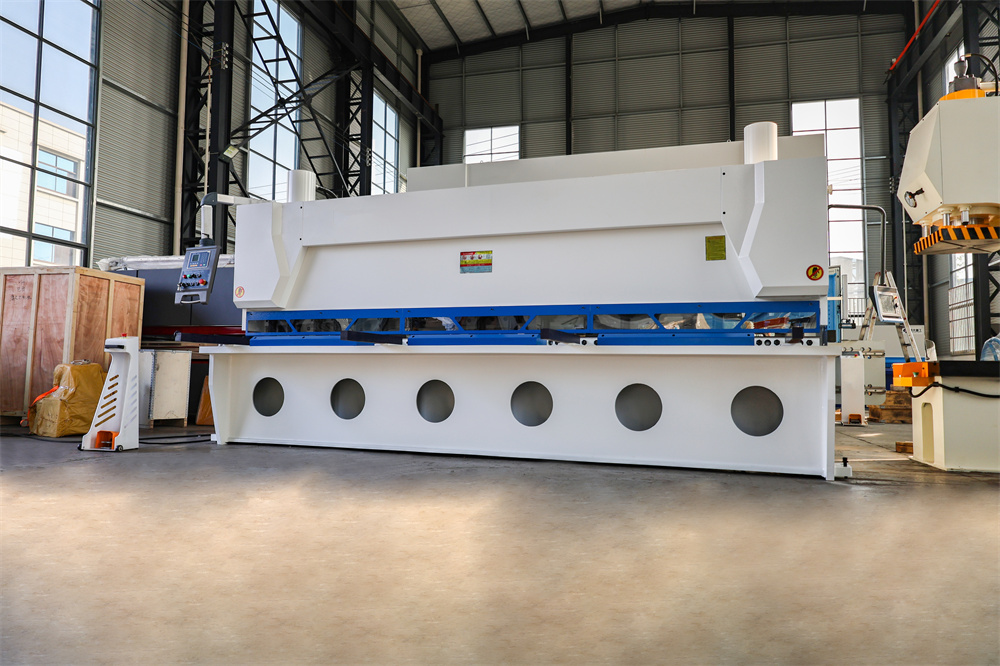
The backgauge system is another critical mechanical area. It typically consists of lead screws or ball screws driven by a motor. These screws must be kept clean and lightly lubricated to ensure smooth movement. Check for any “backlash” or play in the backgauge nut; excessive play will lead to dimensional inaccuracies in your parts. Additionally, inspect the hold-down cylinders. These hydraulic rams hold the sheet metal firmly against the table during the cut. If the rubber pads on the bottom of the hold-downs are worn or missing, they can mar the surface of the material or allow it to slip during the shear.
Finally, examine the main pivot points and bushings. In swing beam shears, the upper beam rotates on large bearings or bushings. These points endure massive forces and must be checked for signs of wear or lack of lubrication. If the beam feels loose or if there is visible movement in the pivot pins, the bushings may need replacement. Keeping these mechanical connections tight and well-lubricated is essential for maintaining the structural rigidity of the machine, which is a core goal of Shearing Machine Preventive Maintenance Metal Fabrication Shops.
Lubrication Plan: Reducing Friction and Wear
A comprehensive lubrication plan is the simplest yet most effective way to prevent premature wear in a shearing machine. Friction is the enemy of precision, and without proper lubrication, metal-to-metal contact will quickly destroy expensive components. The first step is to identify all lubrication points, which are typically marked in the machine’s manual. These usually include the backgauge screws, the blade beam guides (gibs), the pivot pins, and the motor bearings. Using the correct type of lubricant is just as important as the frequency of application.
For most shearing machines, a high-quality lithium-based grease is used for bearings and pivot points, while a specialized way oil is used for the sliding guides. Way oil contains additives that prevent “stick-slip” motion, ensuring that the blade beam moves smoothly even under heavy loads. If your machine is equipped with a centralized lubrication system, your primary task is to keep the reservoir filled and to check that all lines are delivering grease to their respective points. A blocked line in a centralized system can be catastrophic, as the operator may assume the machine is being lubricated when one specific bearing is actually running dry.
The frequency of lubrication depends on the machine’s usage. In a high-volume shop running multiple shifts, daily lubrication of the guides and backgauge may be necessary. In a lower-volume environment, weekly service might suffice. It is helpful to create a color-coded chart near the machine that indicates which points need daily, weekly, or monthly attention. This visual aid helps ensure that no points are missed, even if different operators are using the machine.
Don’t forget the motor and pump couplings. These often require a small amount of grease periodically to prevent wear on the splines or spiders. Also, keep an eye on the condition of the lubricant. If grease appears black and gritty, it has become contaminated and should be purged and replaced. Proper lubrication not only reduces wear but also helps to seal out dust and moisture, providing an extra layer of protection for the machine’s internal components. A disciplined lubrication schedule is a hallmark of successful Shearing Machine Preventive Maintenance Metal Fabrication Shops.
Troubleshooting Signals: Listening to Your Machine
Even with the best preventive maintenance, components will eventually wear out. The key is to recognize the early warning signs of failure before they lead to a total breakdown. One of the most common signals is a change in the sound of the machine. A high-pitched whine from the hydraulic pump often indicates cavitation or air in the lines. A deep rumbling sound during the cut might suggest that the blades are extremely dull or that the material exceeds the machine’s capacity. Learning to “listen” to the machine allows operators to catch issues early.
Visual cues are equally important. If you notice that the cut edge of the metal is becoming increasingly rough or that there is a significant “roll-over” on the top edge, your blade gap is likely too wide or the blades are rounded. If the backgauge dimensions are inconsistent, check for loose mounting bolts or a failing encoder. Another red flag is excessive heat. If the hydraulic tank feels hot to the touch or if the electrical motors are running unusually warm, there is an underlying efficiency problem that needs to be addressed immediately.
Watch for changes in the machine’s cycle time. If the blade beam is returning to the top position more slowly than usual, it could indicate a loss of nitrogen pressure in the return cylinders or a restriction in the hydraulic return line. Similarly, if the hold-downs are not engaging with their usual speed and force, the pressure-reducing valve for the hold-down circuit may need adjustment or repair. These subtle changes in performance are often the first indicators of a developing problem.
Finally, pay attention to the controller’s error logs. Most modern NC and CNC systems record faults and warnings. Regularly reviewing these logs can reveal patterns, such as frequent “overload” warnings or “positioning errors,” that point toward specific mechanical or electrical issues. By treating these signals as diagnostic tools rather than mere nuisances, maintenance teams can perform targeted repairs that minimize downtime and keep the Shearing Machine Preventive Maintenance Metal Fabrication Shops running smoothly.
Maintenance Schedule Table
| Frequency | Component | Action Required |
|---|---|---|
| Daily | Safety Systems | Test E-stops, light curtains, and finger guards. |
| Daily | Hydraulic Oil | Check level and temperature; inspect for leaks. |
| Daily | Machine Bed | Clean off all scrap, scale, and dust. |
| Weekly | Blades | Inspect for chips and check blade gap consistency. |
| Weekly | Lubrication Points | Apply grease to manual nipples and check auto-lube reservoir. |
| Monthly | Backgauge | Clean and lubricate lead screws; check for play. |
| Monthly | Electrical Cabinet | Vacuum dust and check for loose wire connections. |
| Quarterly | Hydraulic Filters | Replace return line and suction filters. |
| Quarterly | Nitrogen Pressure | Check and refill return cylinders to spec. |
| Yearly | Hydraulic Oil | Perform oil analysis or replace fluid entirely. |
| Yearly | Structural Bolts | Torque all foundation and frame bolts to specification. |
Frequently Asked Questions (FAQ)
How often should I sharpen my shearing machine blades?
The frequency of sharpening depends on the material type, thickness, and volume of cuts. Generally, for mild steel, blades should be inspected every 1,000 hours. If you primarily cut stainless steel, the blades will wear significantly faster. A good rule of thumb is to rotate or sharpen the blades as soon as the cut quality degrades or the burr height exceeds 10% of the material thickness.
What type of hydraulic oil is best for a HARSLE shearing machine?
Most industrial shearing machines require an anti-wear (AW) hydraulic oil, typically ISO VG 46 or ISO VG 68, depending on your ambient shop temperature. Always refer to your specific machine manual, as using the wrong oil can lead to seal failure or pump damage. In very cold environments, a multi-grade oil with a high viscosity index may be required.
Why is my shearing machine making a loud banging noise at the end of the stroke?
A loud bang at the end of the stroke often indicates that the mechanical buffers or hydraulic cushions are worn out. It could also mean that the nitrogen return pressure is too high, causing the beam to slam into the upper stops. Check the nitrogen pressure and inspect the rubber or hydraulic shock absorbers for damage.
Can I cut material that is thicker than the machine’s rated capacity?
No. Attempting to cut material thicker than the rated capacity can cause catastrophic failure of the blades, the hydraulic cylinders, or even the machine frame. It also poses a severe safety risk to the operator. Always stay within the manufacturer’s specified limits for thickness and tensile strength.
How do I know if my backgauge is out of calibration?
If your finished parts are consistently longer or shorter than the programmed dimension, or if the cut is not square, your backgauge likely needs calibration. You can check this by cutting a test piece and measuring it with a calibrated vernier caliper. Most CNC controllers have a simple calibration routine where you can input the actual measured value to offset the error.
What is the benefit of a variable rake angle on a shearing machine?
A variable rake angle allows you to adjust the angle of the upper blade. A higher rake angle reduces the required cutting force, allowing the machine to cut thicker material. However, a lower rake angle reduces the twist and distortion in thin materials. Proper maintenance of the rake adjustment mechanism is essential for achieving high-quality cuts across a range of thicknesses.