Hydraulic Shearing Machine Maintenance Schedule for Peak Production Efficiency

The Critical Importance of a Hydraulic Shearing Machine Maintenance Schedule for Peak Production Efficiency
In the high-stakes world of metal fabrication, the reliability of your equipment is the backbone of your profitability. A hydraulic shearing machine is a workhorse, often running for multiple shifts to meet demanding production deadlines. However, without a rigorous Hydraulic Shearing Machine Maintenance Schedule for Peak Production Efficiency, even the most robust HARSLE machine can succumb to wear and tear, leading to costly downtime and compromised cut quality. Maintenance is not merely a chore; it is a strategic investment in the longevity of your assets and the safety of your operators.
When we discuss peak production efficiency, we are referring to the machine’s ability to deliver precise, burr-free cuts at maximum speed with zero unplanned interruptions. A well-maintained machine ensures that the hydraulic pressure remains consistent, the blades stay sharp, and the mechanical tolerances are tight. This consistency reduces waste, as fewer parts are rejected due to dimensional inaccuracies or poor edge quality. Furthermore, a proactive maintenance approach allows floor managers to schedule repairs during planned downtime, rather than reacting to a catastrophic failure in the middle of a high-priority order.
Safety is another paramount reason for adhering to a strict maintenance schedule. Hydraulic systems operate under immense pressure, and mechanical components move with significant force. A failure in a hydraulic hose or a malfunction in the electrical safety circuit can lead to severe industrial accidents. By following a comprehensive maintenance guide, you ensure that all safety guards, emergency stops, and structural components are in optimal condition, protecting your most valuable asset: your workforce.
Finally, the resale value of industrial machinery is heavily dependent on its maintenance history. A HARSLE shearing machine that has been serviced according to a documented Hydraulic Shearing Machine Maintenance Schedule for Peak Production Efficiency will command a much higher price on the secondary market. It demonstrates to potential buyers that the machine has been cared for and is likely to provide many more years of reliable service. In the following sections, we will break down the specific tasks required to keep your shearing machine performing at its best.
Daily Inspection Protocol: The First Line of Defense
The daily inspection is the most frequent and perhaps the most important part of your Hydraulic Shearing Machine Maintenance Schedule for Peak Production Efficiency. It should be performed at the start of every shift before the machine is powered on. This routine helps identify minor issues before they escalate into major problems. The first step is a visual sweep of the machine and the surrounding area. Look for any signs of oil leaks on the floor or around the hydraulic cylinders. Even a small drip can indicate a failing seal or a loose fitting that could lead to a loss of pressure or a fire hazard.
Next, check the hydraulic oil level via the sight glass on the reservoir. Operating a shearing machine with low oil levels can cause cavitation in the pump, leading to permanent damage and overheating. The oil should be clear and at the recommended level. If the oil appears milky or dark, it may be contaminated with water or oxidized, requiring a more thorough investigation. Additionally, ensure that the worktable is clean and free of metal chips, scale, or debris. Accumulated waste can scratch the workpiece or interfere with the backgauge movement, affecting the accuracy of your cuts.
Testing the safety systems is a non-negotiable daily task. Verify that the emergency stop buttons are functional and that the light curtains or physical guards are properly aligned and responsive. Check the foot pedal and the control panel for any signs of physical damage or unresponsive buttons. A quick test of the backgauge movement is also recommended to ensure it travels smoothly across its full range without any unusual noises or vibrations. These simple checks take less than ten minutes but are essential for maintaining a high-performance production environment.
Hydraulic System Maintenance: The Heart of the Machine
The hydraulic system is the lifeblood of the shearing machine, providing the force necessary to cut through thick steel plates. To maintain a Hydraulic Shearing Machine Maintenance Schedule for Peak Production Efficiency, you must pay close attention to the quality and temperature of the hydraulic fluid. Over time, hydraulic oil breaks down due to heat and pressure, losing its lubricating properties and ability to transfer power efficiently. We recommend a complete oil change every 2,000 to 4,000 operating hours, or at least once a year, depending on the intensity of your production.
Filters play a critical role in keeping the hydraulic circuit clean. Microscopic metal particles and dust can act as abrasives, wearing down the internal components of valves and pumps. Replace the suction and return line filters according to the manufacturer’s specifications, or whenever the filter clog indicator suggests. It is also vital to monitor the operating temperature of the oil. Most hydraulic systems are designed to run between 35°C and 55°C. If the temperature exceeds 60°C, the oil’s viscosity drops, leading to internal leakage and reduced shearing force. Ensure that the cooling system—whether it is an air-cooled heat exchanger or a water-cooled system—is clean and functioning correctly.
Inspect all hydraulic hoses and steel pipes for signs of wear, bulging, or cracking. Hoses are subject to constant pulsing and can fatigue over time. A burst hose not only stops production but also poses a significant safety risk. Tighten any loose connections, but be careful not to over-tighten, as this can damage the fittings. If you notice the machine is losing power or the cutting speed has slowed down, it may be time to check the pressure settings on the relief valves. However, adjustments to the hydraulic pressure should only be performed by trained technicians using calibrated pressure gauges to avoid overloading the machine’s structure.

Electrical System and Control Checks
Modern HARSLE shearing machines are equipped with sophisticated CNC or NC controllers and electrical components that require regular attention. Dust is the primary enemy of electrical systems. In a metal fabrication shop, fine metallic dust can settle inside the electrical cabinet, leading to short circuits or overheating of sensitive components like PLCs and motor drives. As part of your Hydraulic Shearing Machine Maintenance Schedule for Peak Production Efficiency, use low-pressure compressed air or a vacuum to clean the electrical cabinet monthly. Ensure the cabinet door seals are intact to prevent further dust ingress.
Check all electrical connections for tightness. Vibrations from the shearing process can cause wires to loosen over time, leading to intermittent faults or arcing. Pay special attention to the power cables for the main motor and the backgauge servo motors. Inspect the limit switches and proximity sensors that control the stroke length and backgauge positioning. If these sensors are dirty or misaligned, the machine may over-travel or produce inaccurate cuts. Cleaning the sensors with a soft cloth and ensuring they are securely mounted will prevent many common control errors.
Software and parameter backups are often overlooked but are crucial for peak efficiency. If your machine uses a CNC controller, regularly back up the machine parameters and cutting programs to an external drive. In the event of a controller failure or a power surge that wipes the memory, having a backup will save hours or even days of reconfiguration time. Additionally, check the cooling fans on the motor and inside the electrical cabinet to ensure they are spinning freely and are not clogged with grease or dust.
Mechanical Components and Blade Care
The mechanical integrity of the shearing machine directly dictates the quality of the finished product. The most critical mechanical aspect is the blade clearance (the gap between the upper and lower blades). This gap must be adjusted based on the thickness and material type of the plate being cut. If the gap is too wide, the metal will bend rather than shear, leaving a heavy burr. If it is too tight, you risk damaging the blades and putting excessive strain on the hydraulic system. Regularly verify that the manual or automatic gap adjustment mechanism is moving smoothly and accurately.
Blade sharpness is the next priority. Dull blades require more force to cut, which increases energy consumption and wear on the machine’s bearings and cylinders. Inspect the cutting edges for chips or rounding. Most HARSLE shearing blades are rectangular and have four cutting edges; when one edge becomes dull, the blade can be flipped to a fresh edge. Once all edges are worn, the blades must be professionally reground. Keeping a spare set of sharpened blades on hand is a hallmark of a Hydraulic Shearing Machine Maintenance Schedule for Peak Production Efficiency, as it minimizes downtime during blade changes.
The backgauge system, which determines the length of the cut, must be kept in perfect alignment. Check the lead screws and linear guides for any play or backlash. If the backgauge is not parallel to the cutting line, every piece produced will be tapered. Use a precision square or a laser alignment tool to verify the backgauge’s accuracy monthly. Also, inspect the hold-down cylinders. These hydraulic plungers must apply uniform pressure to the plate to prevent it from shifting during the cut. If the rubber pads on the hold-downs are worn or missing, they can mar the surface of sensitive materials like stainless steel or aluminum.
Comprehensive Lubrication Plan
Proper lubrication is the simplest yet most effective way to prevent premature wear in a shearing machine. Without a film of oil or grease, metal-on-metal contact will quickly destroy bearings, bushings, and guideways. Your Hydraulic Shearing Machine Maintenance Schedule for Peak Production Efficiency should include a detailed map of all lubrication points. The backgauge lead screws and nut assemblies should be greased weekly to ensure smooth and precise positioning. Use a high-quality lithium-based grease that can withstand the pressures and temperatures of an industrial environment.
The pivot points of the swing beam (in swing-beam shears) or the vertical guides (in guillotine shears) require daily or weekly lubrication depending on the workload. Many modern machines feature a centralized lubrication system, which can be manual or automatic. If your machine has an automatic system, check the reservoir level daily and ensure that the pump is functioning. It is a common mistake to assume an automatic system is working when a line might be blocked, leaving a critical bearing dry. Periodically check the discharge at each lubrication point to confirm that grease is actually reaching the intended surface.
Don’t forget the smaller moving parts, such as the hinges on safety guards and the adjustment mechanisms for the stroke counter. While these don’t bear heavy loads, keeping them lubricated prevents rust and ensures they remain easy to operate. Always clean the grease nipples before applying the grease gun to avoid forcing dirt into the bearings. A clean, well-lubricated machine runs quieter, uses less power, and experiences significantly less mechanical fatigue.
Troubleshooting Signals: Identifying Problems Early
Even with a perfect Hydraulic Shearing Machine Maintenance Schedule for Peak Production Efficiency, components will eventually wear out. The key to maintaining efficiency is recognizing the early warning signs of failure. Unusual noises are often the first indicator. A high-pitched squeal from the hydraulic pump may indicate air in the system or a failing bearing. A heavy thumping sound during the cutting stroke could suggest that the blade bolts are loose or that the machine is being overloaded beyond its rated capacity.
Vibration is another red flag. If the machine starts to vibrate excessively during operation, check the foundation bolts to ensure the machine is still level and securely anchored to the floor. Excessive vibration can also be caused by an unbalanced motor or a misaligned drive coupling. Monitor the quality of the cut edges; a sudden increase in burr height or a change in the shear angle usually points to a mechanical shift or blade wear. If you notice the hydraulic oil turning dark or smelling burnt, it is a sign of extreme overheating and requires immediate attention to prevent pump failure.
Pay attention to the cycle time. If the machine takes longer to complete a stroke than it used to, there may be internal leakage in the cylinders or a drop in pump efficiency. By training operators to be sensitive to these changes in the machine’s “behavior,” you can catch issues in the embryonic stage. Documenting these observations in a maintenance log helps technicians diagnose problems faster and ensures that the Hydraulic Shearing Machine Maintenance Schedule for Peak Production Efficiency is adapted to the specific needs of your production environment.
Maintenance Schedule Table
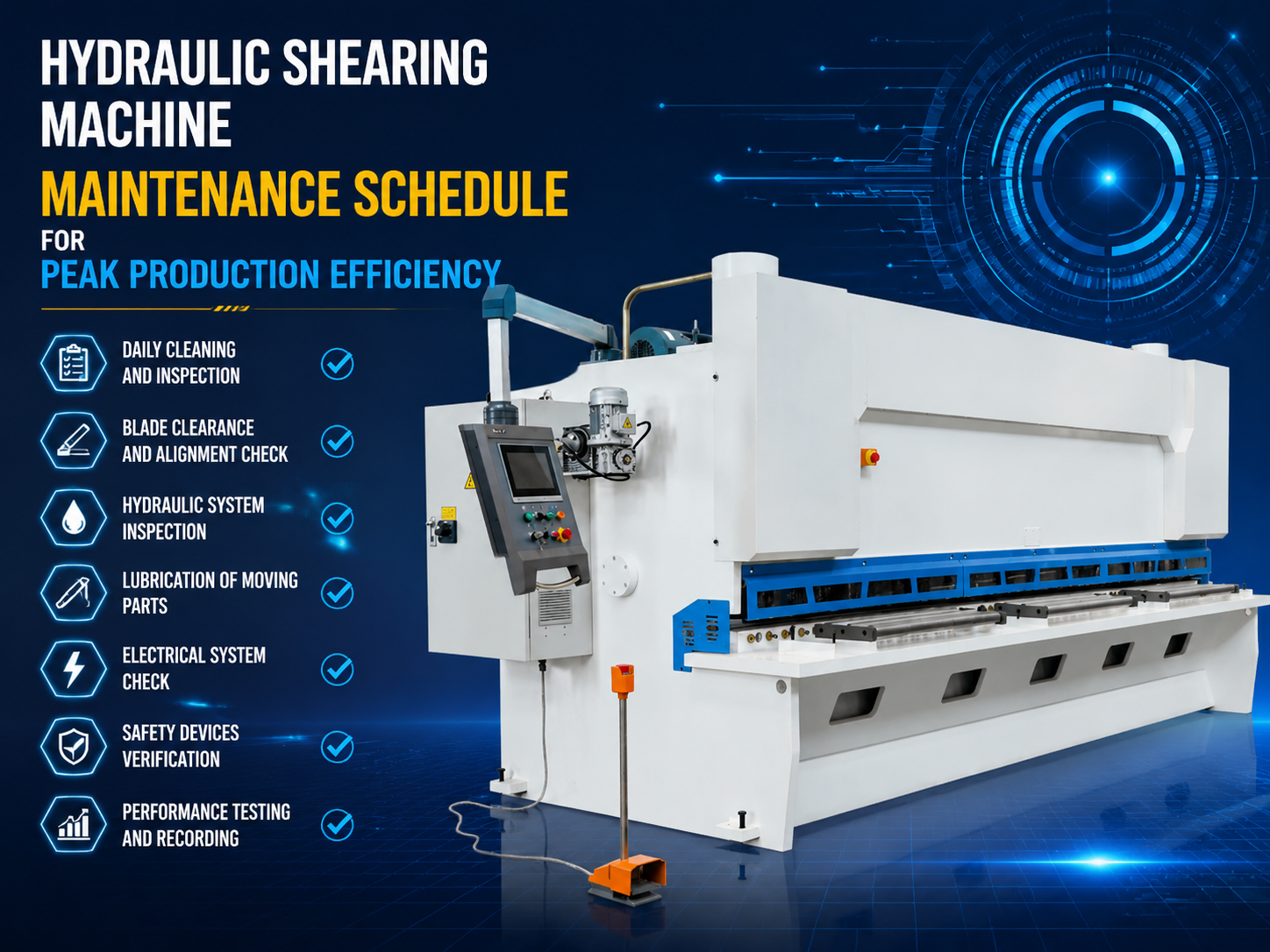
To help you implement these practices, here is a summarized Hydraulic Shearing Machine Maintenance Schedule for Peak Production Efficiency. Use this as a template for your workshop’s maintenance log.
| Frequency | Component | Action Required |
|---|---|---|
| Daily | Hydraulic Oil | Check level and temperature; look for leaks. |
| Daily | Safety Systems | Test E-stops, light curtains, and foot pedal. |
| Daily | Worktable | Clean debris and metal chips. |
| Weekly | Lubrication | Grease backgauge screws and pivot points. |
| Weekly | Blades | Inspect for chips and check clearance gap. |
| Monthly | Electrical Cabinet | Clean dust and check for loose connections. |
| Monthly | Backgauge | Verify alignment and parallelism. |
| 6 Months | Hydraulic Filters | Replace suction and return line filters. |
| Yearly | Hydraulic Fluid | Complete oil change and reservoir cleaning. |
| Yearly | Structural | Check foundation bolts and frame integrity. |
Frequently Asked Questions (FAQ)
1. How often should I sharpen the blades on my hydraulic shearing machine?
The frequency of blade sharpening depends on the material you are cutting and the volume of production. For standard carbon steel, blades may last for thousands of cuts before needing a flip or regrind. However, cutting stainless steel or high-tensile alloys will dull the blades much faster. Monitor the cut quality; if you see excessive burrs or the machine struggles to cut, it’s time to service the blades.
2. What type of hydraulic oil is best for HARSLE shearing machines?
Most hydraulic shearing machines use ISO VG 46 or ISO VG 68 anti-wear hydraulic oil. The specific grade depends on your local climate and the machine’s operating temperature. Always refer to your HARSLE user manual for the exact specification to ensure optimal pump performance and seal longevity.
3. Why is my shearing machine making a loud banging noise during the cut?
A loud banging noise can be caused by several factors: the blade clearance might be too large for the material thickness, the hold-down cylinders may not be gripping the plate firmly, or the blade mounting bolts could be loose. Stop the machine immediately and inspect these areas to prevent structural damage.
4. Can I perform maintenance while the machine is running?
Absolutely not. All maintenance, except for certain diagnostic tests that require power, must be performed with the machine powered down and locked out (LOTO). Ensure the upper beam is either in the fully down position or securely blocked to prevent accidental descent due to gravity or hydraulic pressure loss.
5. How do I know if my hydraulic pump is failing?
Common signs of pump failure include increased noise (aeration or cavitation), a significant drop in operating pressure, slower cycle times, and an increase in oil temperature. If you suspect pump failure, a flow and pressure test should be conducted by a qualified technician to confirm the pump’s efficiency.