Case Study: Reducing Material Waste with a High-Precision Laser Cutting Machine


Introduction: The Economic Impact of Material Waste in Metal Fabrication
In the competitive landscape of modern metal fabrication, the margin between profit and loss often rests on the efficiency of material utilization. For many manufacturers, raw material costs represent between 50% and 70% of the total production expense. Consequently, even a minor reduction in scrap can lead to significant annual savings. This Case Study: Reducing Material Waste A High-Precision Laser Cutting Machine explores how transitioning from traditional cutting methods to advanced fiber laser technology can transform a workshop’s bottom line.
Traditional methods such as plasma cutting, waterjet, or mechanical shearing often suffer from wider kerfs, larger heat-affected zones (HAZ), and lower positioning accuracy. These limitations necessitate larger ‘skeletons’ or margins between parts, leading to substantial material waste. Furthermore, the lack of sophisticated nesting software in older systems means that the layout of parts on a sheet is rarely optimized for maximum yield. As global metal prices fluctuate, the ability to squeeze every millimeter of value out of a stainless steel or aluminum sheet becomes a critical competitive advantage.
HARSLE has worked with numerous clients globally to implement high-precision fiber laser solutions designed specifically to address these inefficiencies. By integrating high-speed CNC controls with ultra-stable laser sources, these machines allow for tighter part spacing and more complex geometries that were previously impossible to achieve without excessive scrap. This article details the technical and operational shifts required to achieve zero-waste goals in a high-volume production environment.
Key Considerations for Minimizing Material Waste
Reducing waste is not merely a matter of buying a new machine; it involves a holistic approach to the cutting process. The first major consideration is Intelligent Nesting Software. Modern laser cutting systems, like those provided by HARSLE, utilize advanced algorithms to arrange parts on a sheet. This software considers part-in-part nesting (placing smaller components inside the cutouts of larger ones) and common-line cutting, where two parts share a single cut path. This alone can reduce material consumption by 10% to 15% compared to manual nesting.
Another critical factor is the Kerf Width. The kerf is the width of the material removed during the cutting process. Fiber lasers produce an incredibly narrow beam, often resulting in a kerf of only 0.1mm to 0.2mm. In contrast, plasma cutting can have a kerf width exceeding 2mm. A narrower kerf allows parts to be placed closer together on the sheet. When multiplied across hundreds of parts on a standard 1500mm x 3000mm sheet, the space saved translates directly into additional parts per sheet.
The Heat Affected Zone (HAZ) also plays a vital role in waste reduction. Excessive heat can cause thin metal sheets to warp or distort. If a part warps during the cutting process, it may fall out of tolerance and become scrap. High-precision fiber lasers deliver energy so quickly and accurately that the HAZ is minimized, ensuring the structural integrity of the remaining skeleton and the dimensional accuracy of the parts. This allows for ‘edge-to-edge’ cutting where parts are placed very close to the sheet boundary without fear of thermal deformation.
Finally, Edge Quality and Secondary Processing must be considered. If a cutting method produces a rough edge with heavy dross, the part must undergo grinding or milling. This secondary process removes more material and increases the risk of part rejection. High-precision laser cutting produces a ‘ready-to-use’ edge, eliminating the need for further material removal and reducing the overall scrap rate of the production cycle.
Technical Details of High-Precision Laser Systems
To understand how a Case Study: Reducing Material Waste A High-Precision Laser Cutting Machine achieves such results, we must look at the underlying technology. At the heart of the system is the Fiber Laser Source. Unlike CO2 lasers, fiber lasers are delivered through a flexible fiber optic cable, which maintains beam quality over long distances. This stability ensures that the cutting precision at the far corner of a large 6-meter bed is identical to the precision at the starting point.
The CNC Control System is the brain of the operation. Modern HARSLE machines utilize high-bus systems that process data at microsecond intervals. This allows for ‘Fly-Cutting’ capabilities, where the laser head does not stop between cuts but moves in a continuous, fluid motion. This reduces the ‘pierce points’—the spots where the laser first penetrates the metal. Since every pierce point creates a small amount of splatter and potential material damage, reducing the number of pierces through continuous cutting paths saves material and improves the surface finish.
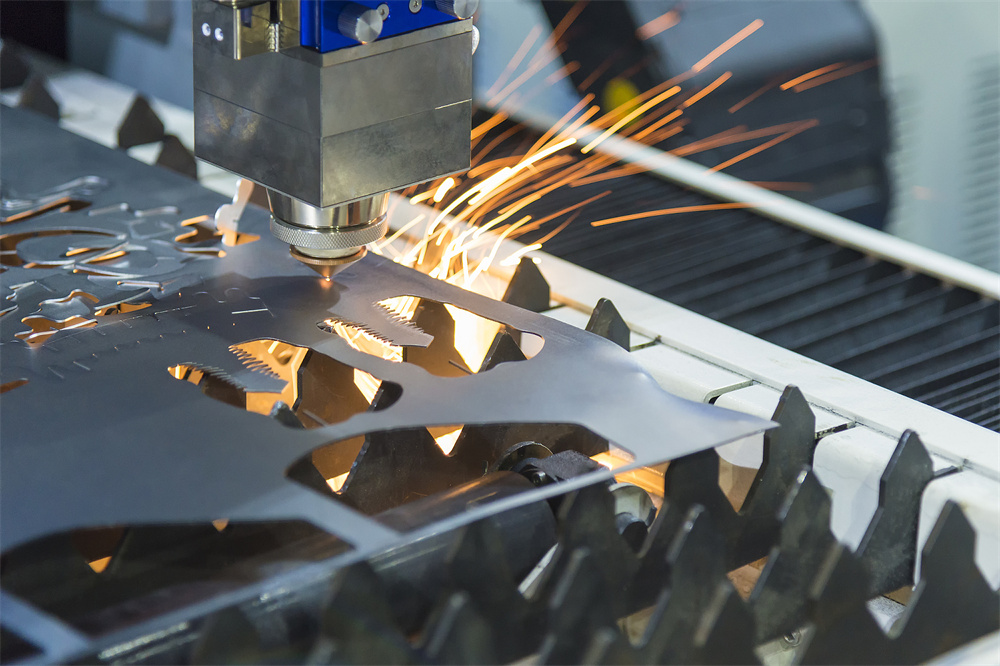
The Motion Control System, including the motors and drive mechanisms, dictates the machine’s positioning accuracy. High-precision machines typically use helical rack and pinion systems or linear motors combined with high-resolution encoders. This allows for a positioning accuracy of ±0.03mm and repeatability of ±0.02mm. When the machine knows exactly where it is within a hair’s breadth, the software can safely nest parts with minimal gaps, confident that the laser will not deviate and ruin adjacent components.
Furthermore, Automatic Gas Control is essential for material conservation. The type and pressure of the assist gas (Oxygen, Nitrogen, or Compressed Air) affect the kerf and the cleanliness of the cut. Advanced systems automatically adjust gas pressure based on the material thickness and the specific geometry being cut. This prevents ‘blow-outs’ on sharp corners, which are a common source of scrap in less sophisticated machines. By maintaining a stable cutting environment, the machine ensures that the first part is as perfect as the thousandth.
Comparison of Cutting Technologies and Material Yield
| Feature | Fiber Laser (High Precision) | Plasma Cutting | Waterjet Cutting |
|---|---|---|---|
| Kerf Width | 0.1mm – 0.3mm | 1.5mm – 3.0mm | 0.5mm – 1.0mm |
| Heat Affected Zone | Minimal | Large | None |
| Positioning Accuracy | ±0.03mm | ±0.5mm | ±0.1mm |
| Material Yield | Highest (up to 95%) | Moderate (70-80%) | High (85-90%) |
| Operating Cost | Low (High Efficiency) | Moderate | High (Abrasives) |
Selection Advice: Choosing the Right Machine for Waste Reduction
When selecting a laser cutting machine with the goal of reducing material waste, the first step is to evaluate your Material Profile. If you primarily work with thin gauge sheets (under 5mm), a 1kW to 3kW fiber laser offers the best balance of precision and speed. For thicker materials, higher wattage (6kW to 12kW+) is necessary to maintain a clean cut without excessive dross. Choosing a machine that is underpowered for your thickest material will lead to failed cuts and significant waste.
The Machine Bed Stability is often overlooked but is crucial for precision. Look for a machine with a heavy-duty, heat-treated frame. HARSLE uses a stress-relieved welding bed that prevents structural deformation over years of use. If the bed shifts even slightly due to thermal expansion or mechanical vibration, your nesting precision is compromised, leading to parts overlapping or cutting into the skeleton.
Consider the Software Ecosystem. Does the machine come with proprietary software, or is it compatible with industry standards like CypCut or Lantek? The ability to import complex CAD files and automatically apply nesting strategies is the single most effective way to reduce waste. Ensure the software supports ‘Common Line Cutting’ and ‘Bridge Cutting’ (connecting parts with small tabs to prevent them from tipping and causing a machine collision).
Finally, evaluate the After-Sales Support and Calibration Services. A high-precision machine only stays precise if it is maintained correctly. Regular calibration of the laser head and the motion system ensures that the accuracy specs remain true over the machine’s lifespan. Ask the manufacturer about their maintenance schedules and the availability of replacement nozzles and lenses, as worn consumables can degrade cut quality and increase scrap rates.
Frequently Asked Questions (FAQ)
How much material can I realistically save by switching to a high-precision laser?
While results vary by industry, most shops see a 10% to 20% improvement in material utilization. This is achieved through tighter nesting, common-line cutting, and the reduction of scrap caused by thermal distortion or inaccurate positioning. For high-value materials like stainless steel or brass, this saving can pay for the machine’s financing costs alone.
Does high-precision cutting slow down the production process?
On the contrary, high-precision fiber lasers are significantly faster than plasma or waterjet for most thicknesses. The precision allows for ‘Fly-Cutting’ and faster rapid-traverse speeds between cuts. Because the parts require less post-processing (grinding/deburring), the total ‘lead-to-part’ time is drastically reduced.
Can I use a high-precision laser for reflective materials like copper and aluminum?
Yes, modern fiber lasers are designed to handle reflective materials. Older CO2 lasers struggled with back-reflection, which could damage the machine. Fiber lasers use different wavelengths and protective optical coatings, allowing you to cut aluminum and copper with high precision and minimal waste.
What is ‘Common Line Cutting’ and how does it help?
Common line cutting is a technique where two adjacent parts share a single cut line. This reduces the total cutting distance, saves gas, and saves material because there is no ‘gap’ between the parts. It requires a high-precision machine to ensure the shared edge meets the tolerances for both parts simultaneously.
Is the software difficult to learn for operators used to older machines?
Most modern CNC laser software is highly intuitive, featuring graphical interfaces and automated ‘one-click’ nesting. While there is a learning curve for optimizing advanced strategies, basic operation is often simpler than older manual or semi-automated systems. HARSLE provides comprehensive training to ensure operators can maximize the machine’s waste-reduction features.
Conclusion: The Future of Sustainable Metal Fabrication
As we have seen in this Case Study: Reducing Material Waste A High-Precision Laser Cutting Machine, the transition to high-precision technology is no longer a luxury—it is a necessity for sustainable and profitable manufacturing. By focusing on narrow kerf widths, intelligent nesting, and superior motion control, fabricators can significantly lower their material overhead while increasing the quality of their output.
The environmental impact should also not be ignored. Reducing material waste means fewer raw materials need to be mined and processed, and less energy is spent on recycling scrap. In an era where ‘green manufacturing’ is becoming a requirement for many Tier-1 contracts, a high-precision laser cutting machine serves as both an economic and an environmental asset. HARSLE remains committed to providing the tools and expertise necessary for workshops to achieve these high standards of efficiency. Investing in precision today ensures a more resilient and profitable tomorrow for the metal fabrication industry.