How a Laser Cutting Machine Improved Custom Enclosure Manufacturing Efficiency


Introduction to Modern Enclosure Fabrication
In the competitive landscape of industrial manufacturing, the production of custom enclosures—ranging from electrical cabinets and server racks to specialized medical equipment housings—demands a rigorous balance of precision, speed, and cost-effectiveness. Traditionally, these components were produced using mechanical punching presses, shearing machines, and manual layout techniques. However, as designs became more intricate and lead times shorter, the industry reached a bottleneck. This is where the integration of advanced fiber laser technology revolutionized the floor. Understanding how a laser cutting machine improved custom enclosure manufacturing efficiency requires a deep dive into the transition from mechanical contact to high-energy photon processing.
Custom enclosures are rarely simple boxes. They often feature complex ventilation patterns, precise cutouts for connectors, and varied mounting holes that must align perfectly with internal components. Traditional methods often required multiple tool changes and secondary deburring processes, which added significant labor costs and time. By adopting fiber laser technology, manufacturers have been able to consolidate these steps into a single, automated process. This article explores the technical and operational shifts that occur when a facility upgrades its workflow, highlighting why the laser cutting machine has become the cornerstone of modern sheet metal shops.
HARSLE has observed that clients who transition to high-power fiber lasers often see a dramatic reduction in scrap rates and a significant increase in throughput. The ability to move from a CAD drawing to a finished part in minutes, rather than hours of setup, is the primary driver behind the statement that a laser cutting machine improved custom enclosure manufacturing efficiency. In the following sections, we will break down the specific considerations, technical specifications, and selection criteria that define this industrial evolution.

Key Considerations: Why Efficiency Matters in Enclosure Production
When evaluating how a laser cutting machine improved custom enclosure manufacturing efficiency, one must first look at the limitations of legacy systems. Mechanical turret punches, while effective for repetitive holes, struggle with complex geometries and require expensive tooling for every unique shape. In the world of custom enclosures, where every client might require a different port configuration, the cost of tooling can quickly erode profit margins. Laser cutting eliminates the need for physical tools, using software-controlled paths to cut any shape imaginable without additional hardware costs.
Precision is another critical factor. Enclosures often serve as the protective shell for sensitive electronics. If a mounting hole is off by even a fraction of a millimeter, the entire assembly process can grind to a halt. Fiber lasers offer positioning accuracies often within ±0.03mm, ensuring that every part produced is a perfect replica of the digital model. This level of consistency reduces the need for quality control reworks and ensures that downstream processes, such as bending on a press brake or welding, proceed without fitment issues.
Material utilization is a third pillar of efficiency. Modern laser cutting software includes advanced nesting algorithms that arrange parts on a sheet of metal to minimize waste. Because the laser beam has a very narrow kerf (the width of the cut), parts can be placed much closer together than is possible with mechanical punching or shearing. For high-volume enclosure production, saving even 5-10% of material per sheet can result in tens of thousands of dollars in annual savings. This optimization is a core reason why a laser cutting machine improved custom enclosure manufacturing efficiency across the board.
Finally, the reduction of secondary operations cannot be overstated. Traditional cutting methods often leave burrs or sharp edges that require manual grinding or tumbling. A well-tuned fiber laser produces a clean, smooth edge that is often ready for the paint line or assembly immediately after cutting. By removing the deburring station from the workflow, manufacturers can reallocate labor to more value-added tasks, further boosting the overall productivity of the plant.
Technical Details: The Mechanics of High-Speed Cutting
The technical superiority of fiber lasers lies in their wavelength and delivery system. Unlike CO2 lasers, which use mirrors and gas mixtures, fiber lasers generate the beam through a solid-state medium and deliver it via a flexible fiber optic cable. This results in a beam that is more concentrated and more easily absorbed by metals, particularly reflective materials like aluminum and stainless steel, which are common in enclosure manufacturing. This high absorption rate translates directly into faster cutting speeds, especially in the 1mm to 4mm thickness range typical of most enclosures.
The motion control system of a modern laser cutting machine is equally important. High-end machines utilize linear motors or high-precision rack-and-pinion systems driven by AC servo motors. These systems allow the cutting head to move at speeds exceeding 100 meters per minute with rapid acceleration. When cutting an enclosure with hundreds of small ventilation holes, the ability of the machine to accelerate and decelerate quickly between cuts is what determines the total cycle time. This rapid-fire processing is a key technical reason why a laser cutting machine improved custom enclosure manufacturing efficiency.
| Feature | Traditional Punching/Shearing | Fiber Laser Cutting |
|---|---|---|
| Setup Time | High (Tooling changes) | Low (Software loading) |
| Design Flexibility | Limited by tool inventory | Unlimited (CAD-based) |
| Edge Quality | Requires deburring | Clean, smooth finish |
| Material Waste | High (Skeleton requirements) | Low (Advanced nesting) |
| Maintenance | Frequent tool sharpening | Low (Solid-state source) |
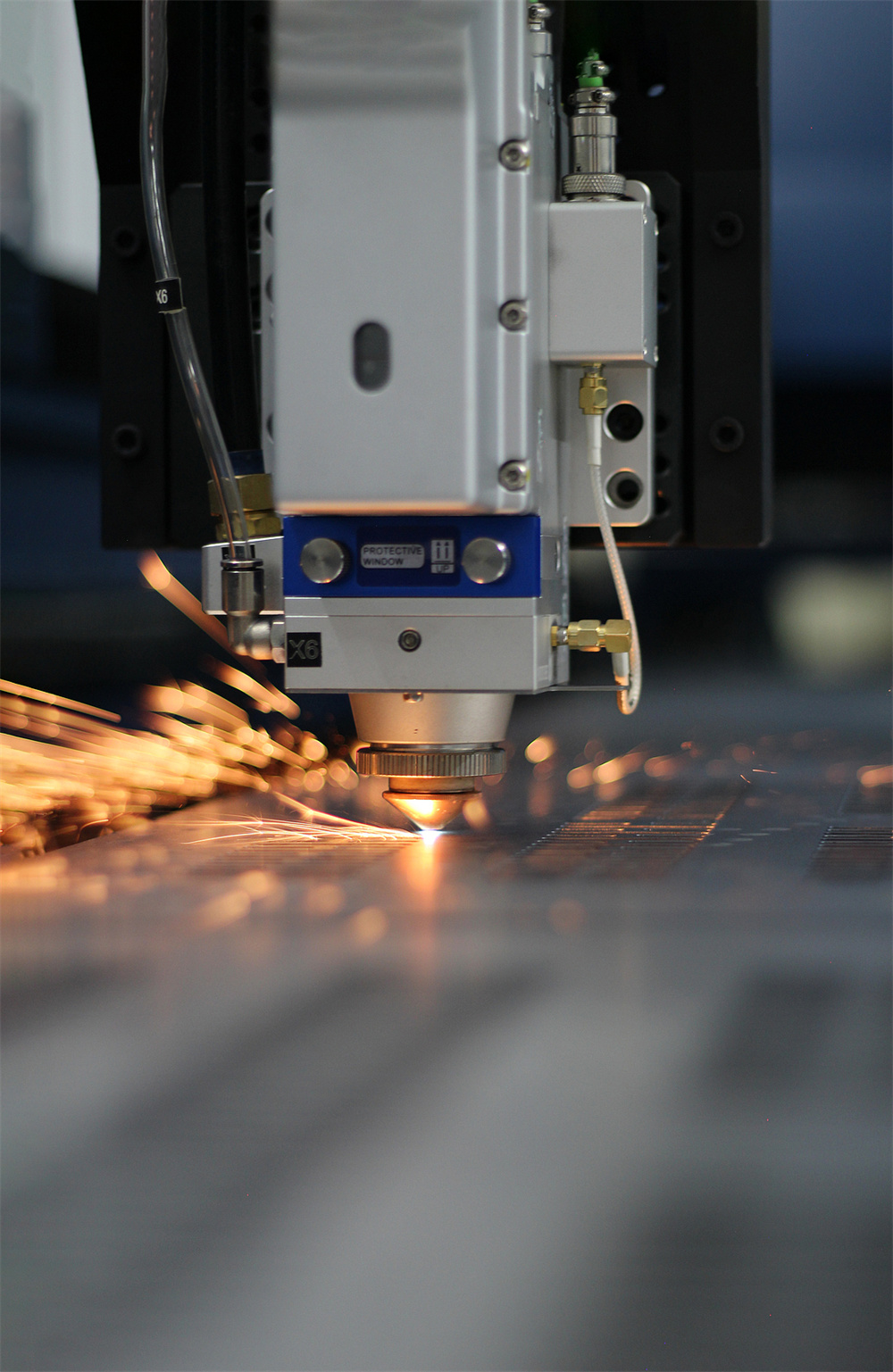
Another technical advancement is the use of intelligent cutting heads with autofocus capabilities. As the laser moves across the sheet, sensors detect any slight warping in the metal and adjust the focal height in real-time. This ensures a consistent cut quality across the entire workbed. Furthermore, the choice of assist gas—Nitrogen or Oxygen—allows manufacturers to tailor the finish. Nitrogen is typically used for stainless steel enclosures to prevent oxidation, leaving a bright, weld-ready edge, while Oxygen can be used for thicker carbon steel frames to increase cutting speed through exothermic reactions.
Selection Advice: Choosing the Right Machine for Your Shop
Selecting the right equipment is the first step in ensuring that a laser cutting machine improved custom enclosure manufacturing efficiency in your specific environment. The first criteria should be the power rating. For most enclosure manufacturers working with 16-gauge to 10-gauge steel, a 3kW to 6kW fiber laser is the “sweet spot.” It provides enough power to cut quickly through thin materials while maintaining the capability to handle thicker structural frames if needed. Investing in excessive power (e.g., 20kW+) may not yield a significant ROI if your primary throughput is thin-gauge sheet metal.
The bed size is the next consideration. Standard enclosures often start from large sheets (e.g., 3000mm x 1500mm). A dual-pallet changer is highly recommended for enclosure production. This feature allows the operator to unload finished parts and load a new sheet while the machine is still cutting on the other pallet. This nearly eliminates idle time, ensuring the laser is firing for the maximum percentage of the shift. In a high-volume environment, a pallet changer can increase daily output by 30% or more.
Software integration is often overlooked but is vital for efficiency. Ensure the machine you select is compatible with industry-standard CAD/CAM software like Lantek or SigmaNEST. These programs allow for seamless importing of 3D enclosure models, automatic unfolding of sheet metal parts, and optimized nesting. The ability to go from a customer’s 3D file to a nested cutting program in a few clicks is a major component of how a laser cutting machine improved custom enclosure manufacturing efficiency.
Finally, consider the manufacturer’s support and the machine’s build quality. A heavy-duty, heat-treated machine bed is essential for maintaining accuracy over years of high-speed operation. Lightweight frames may vibrate at high accelerations, leading to jagged cuts and premature wear. Look for components from reputable brands—such as Raycus or IPG for the laser source, and Raytools or Precitec for the cutting head. Reliable components mean less downtime, which is the ultimate enemy of efficiency.
The Role of Automation and Future Trends
As we look deeper into how a laser cutting machine improved custom enclosure manufacturing efficiency, we must discuss the role of automation. Beyond the pallet changer, many modern facilities are integrating robotic loading and unloading systems. These “lights-out” manufacturing setups allow the machine to run unattended through the night, significantly increasing the capacity of the shop without adding to the headcount. For standardized enclosure lines, this level of automation provides a competitive edge that is impossible to match with manual processes.
The integration of AI and IoT (Internet of Things) is the next frontier. Modern HARSLE machines can be equipped with sensors that monitor the health of the laser source, the cleanliness of the protective lens, and the temperature of the cutting head. This data is fed back to a central dashboard, allowing for predictive maintenance. Instead of waiting for a component to fail and stopping production, the system alerts the maintenance team to perform service during scheduled downtime. This proactive approach ensures that the efficiency gains provided by the laser are sustained over the long term.
Furthermore, the trend toward “Industry 4.0” means that the laser cutting machine is no longer an island. It is connected to the company’s ERP system, providing real-time data on job progress, material usage, and machine efficiency. This transparency allows management to make data-driven decisions about pricing, scheduling, and future investments. When every second of machine time is accounted for, the true impact of how a laser cutting machine improved custom enclosure manufacturing efficiency becomes visible on the company’s bottom line.
FAQ: Common Questions About Laser Cutting for Enclosures
1. What is the best laser power for cutting electrical enclosures?
For standard electrical enclosures made of 1mm to 3mm mild or stainless steel, a 3kW fiber laser is usually sufficient. If you frequently cut thicker materials for heavy-duty industrial cabinets (6mm+), a 6kW or 12kW machine would be more efficient to maintain high travel speeds.
2. Can a laser cutting machine handle reflective materials like aluminum?
Yes, modern fiber lasers are specifically designed to handle reflective materials. Unlike older CO2 lasers, which could be damaged by back-reflection, fiber lasers use a different wavelength and optical isolators to safely and efficiently cut aluminum and brass, which are often used for specialized enclosures.
3. How does laser cutting compare to CNC punching for enclosures?
Laser cutting is generally faster for complex shapes and requires no tooling, making it better for custom or low-to-medium volume work. CNC punching can be faster for simple patterns with many identical holes but lacks the flexibility and edge quality of a laser.
4. What maintenance is required to keep the machine efficient?
Daily maintenance includes cleaning the slats, checking the protective lens, and ensuring the gas supply is adequate. Monthly tasks include lubricating the guide rails and checking the chiller’s water levels. Fiber lasers require significantly less maintenance than CO2 lasers because they have no internal mirrors or blowers.
5. Does laser cutting affect the ability to powder coat the enclosures?
If cut with Nitrogen, the edge remains clean and unoxidized, which is perfect for powder coating. If cut with Oxygen, a thin layer of scale may form on the edge, which should be removed or accounted for to ensure proper paint adhesion. Most enclosure manufacturers prefer Nitrogen for this reason.
Conclusion: The ROI of Precision
In conclusion, the evidence is clear: a laser cutting machine improved custom enclosure manufacturing efficiency by addressing the core challenges of the industry—precision, flexibility, and speed. By eliminating the need for physical tooling, reducing material waste through intelligent nesting, and providing a superior edge finish that removes the need for secondary processing, fiber lasers have transformed the economics of sheet metal fabrication. For manufacturers looking to stay competitive in a market that demands faster turnaround times and higher quality, the transition to laser technology is no longer an option; it is a necessity.
Investing in a HARSLE fiber laser cutting machine provides a future-proof solution that scales with your business. Whether you are producing small electronic housings or massive industrial power distribution cabinets, the efficiency gains translate directly into higher profit margins and more satisfied customers. As technology continues to evolve, the gap between those using traditional methods and those leveraging the power of the laser will only continue to grow. The journey toward manufacturing excellence starts with the right equipment, and for enclosure fabrication, that equipment is undoubtedly the fiber laser.