Hydraulic Press Brake vs Hydraulic Press: Understanding the Core Differences


Comparison Summary: Navigating the World of Hydraulic Force
In the realm of metal fabrication, the terms “hydraulic press” and “hydraulic press brake” are often used interchangeably by those outside the industry. However, for professionals at HARSLE and fabrication shops worldwide, these two machines represent distinct engineering philosophies designed for specific tasks. While both utilize hydraulic fluid to generate immense pressure, their mechanical structures, tooling configurations, and primary functions are vastly different. Understanding these nuances is critical for any business looking to optimize its production line and ensure the highest quality in metal forming.
At its most basic level, a hydraulic press brake is a specialized machine designed primarily for bending sheet metal and plate material. It features a long, narrow bed and a matching ram that moves vertically to press a workpiece into a V-shaped or U-shaped die. Conversely, a hydraulic press is a more generalized category of machinery that includes H-frame, C-frame, and four-column designs. These machines are built to deliver high-tonnage force over a specific area for tasks such as stamping, deep drawing, punching, straightening, and assembly. While a press brake is a type of press, its specialization in linear bending sets it apart from the broader category of hydraulic presses.
The choice between these two machines often comes down to the geometry of the final product. If your workflow involves creating long, straight bends in sheet metal—such as for enclosures, brackets, or structural profiles—the press brake is the indispensable tool. If your process requires compressing material into a mold, punching holes in thick plate, or assembling heavy components, a standard hydraulic press is the superior choice. This article will delve deep into the technical specifications, operational mechanics, and economic considerations of both machines to help you make an informed investment decision.
Hydraulic Press Brake Overview: The Master of Precision Bending
A hydraulic press brake is the backbone of any sheet metal shop. Its primary function is to perform precise, repeatable bends across varying lengths of metal. The machine consists of a heavy-duty frame, a lower bed where the die is placed, and an upper ram that holds the punch. The synchronization of the hydraulic cylinders is what allows the ram to descend with perfect parallelism, ensuring that a 3-meter long bend is consistent from one end to the other. Modern CNC (Computer Numerical Control) press brakes, like those manufactured by HARSLE, have revolutionized this process by automating the depth of the stroke and the positioning of the workpiece.
One of the defining features of a press brake is the backgauge system. This is a motorized assembly located behind the machine that moves in multiple axes (X, R, Z1, Z2). The operator or the CNC program positions the backgauge so that the metal sheet rests against it, ensuring the bend occurs at the exact required dimension. Without a backgauge, achieving the tolerances required for modern aerospace or automotive components would be nearly impossible. The versatility of the press brake is further enhanced by its tooling; by simply swapping out the punch and die, a fabricator can switch from a sharp 90-degree bend to a large-radius curve or even a hemming operation.
The hydraulic system in a press brake is engineered for control rather than just raw power. While tonnage is important, the ability to control the ram’s position to within microns is what defines a high-quality machine. Proportional valves and linear encoders work in tandem to monitor the ram’s descent in real-time. This level of control allows for “air bending,” where the material does not bottom out in the die, but is instead bent to a specific angle based on the depth of the punch’s stroke. This method reduces the force required and allows a single set of tools to produce a wide range of angles, making the press brake an incredibly flexible asset.
Furthermore, the structural design of a press brake is elongated. This allows it to handle workpieces that are several meters long. However, this length introduces the challenge of “deflection.” When a press brake applies force in the center, the bed and ram tend to bow slightly. To counteract this, HARSLE integrates crowning systems—either mechanical or hydraulic—that apply a compensating curve to the bed, ensuring the bend remains straight across the entire length of the part. This technical detail is a major differentiator from standard hydraulic presses, which typically have more compact, square work areas where deflection is managed differently.
Hydraulic Press Overview: The Powerhouse of Metal Forming
The term “hydraulic press” encompasses a wide variety of machines designed to apply a crushing or forming force to a workpiece. Unlike the press brake, which is optimized for linear bending, a hydraulic press is designed for vertical compression. These machines are built to withstand massive amounts of pressure, often ranging from 10 tons to over 5,000 tons. The frame of a hydraulic press is typically more compact and rigid than that of a press brake, designed to concentrate force over a specific surface area rather than along a long beam.
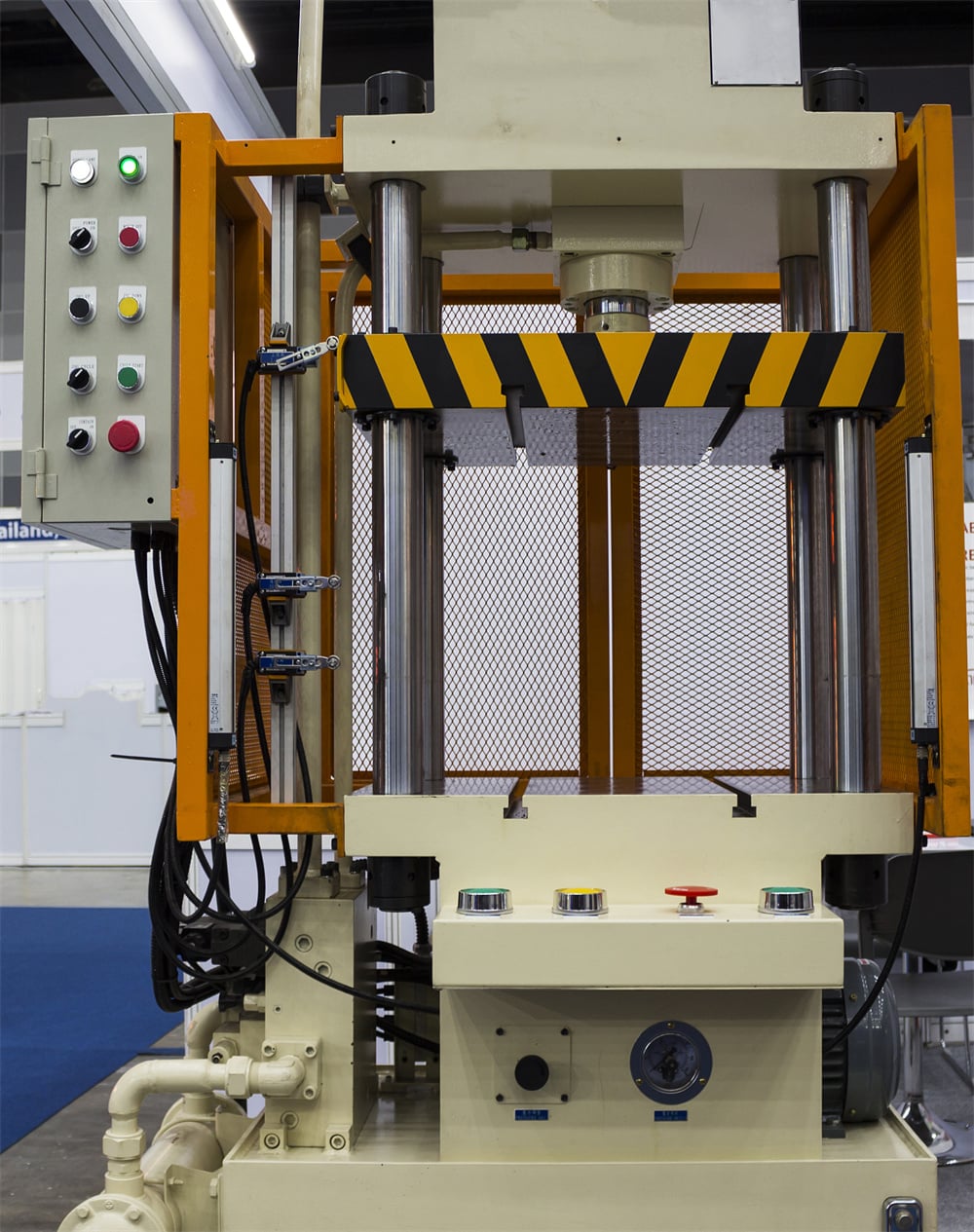
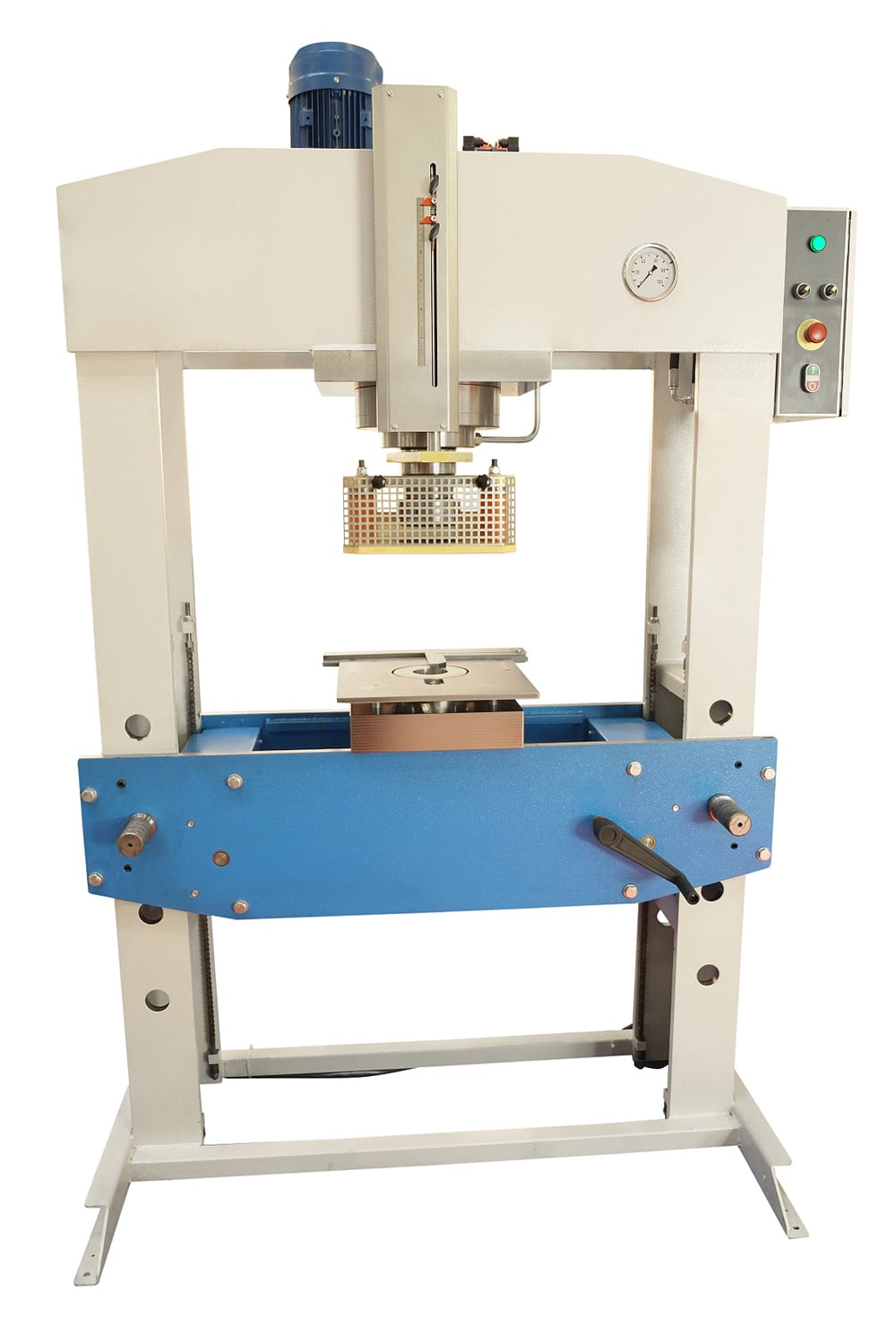
Hydraulic presses come in several common configurations. The H-frame press is a versatile, all-purpose machine used in maintenance shops for pressing bearings, straightening shafts, and light forming. The C-frame (or gap-frame) press offers three-sided access to the work area, making it ideal for high-speed stamping and assembly tasks where operators need to move parts in and out quickly. The four-column press provides the highest level of stability and pressure distribution, making it the preferred choice for deep drawing, where a flat sheet of metal is stretched into a three-dimensional shape like a kitchen sink or an automotive body panel.
The mechanics of a hydraulic press are based on Pascal’s Law, which states that pressure applied to a confined fluid is transmitted undiminished in every direction. In a press, a small pump moves hydraulic fluid into a large cylinder, creating a massive downward force. Because these machines are often used for “bottoming” operations—where the tool and die fully close on the material—they are built with extreme rigidity. Unlike the air bending of a press brake, a hydraulic press often relies on the physical limits of the tooling to define the final shape of the part.
In addition to metalworking, hydraulic presses are used in a vast array of industries. They are used to compress scrap metal into bales, to mold plastic and rubber components, and even in the laboratory for testing the strength of materials. In a fabrication context, they are the go-to machine for “punching” operations where multiple holes need to be created simultaneously in a thick plate. The stroke of a hydraulic press is often longer than that of a press brake, allowing it to accommodate deep molds and large assemblies. While it lacks the specialized backgauge of a press brake, it makes up for it with sheer force and structural versatility.
Specification Comparison Table
To better understand the technical divergence between these two machines, the following table highlights the key specifications and operational differences.
| Feature | Hydraulic Press Brake | Hydraulic Press (General) |
|---|---|---|
| Primary Function | Linear bending of sheet/plate metal. | Stamping, deep drawing, punching, assembly. |
| Work Area Shape | Long and narrow (up to 6+ meters). | Square or rectangular (compact). |
| Tooling Type | V-dies and punches (standardized). | Custom molds, stamping dies, platens. |
| Precision Control | High (CNC-controlled ram and backgauge). | Moderate to High (Stroke and pressure control). |
| Force Distribution | Distributed along the length of the beam. | Concentrated over a central platen area. |
| Common Tonnage | 30 to 1000+ tons. | 10 to 5000+ tons. |
| Key Components | Backgauge, Crowning system, CNC controller. | Ejectors, Die cushions, Rigid columns. |
| Material Handling | Manual or robotic sheet manipulation. | Often automated with coil feeders or transfer bars. |
Best-fit Applications: Choosing the Right Tool for the Job
Identifying the “best-fit” application is the most practical way to distinguish between a hydraulic press brake and a hydraulic press. For a company like HARSLE, helping clients match their production goals to the right machine is a top priority. Let’s look at where each machine shines in a real-world production environment.
When to Choose a Hydraulic Press Brake
The press brake is the undisputed king of custom fabrication and sheet metal work. If your product line involves boxes, cabinets, ductwork, or any component that requires multiple bends on a single piece of metal, the press brake is essential. Because the tooling is relatively universal, you can produce a wide variety of parts without investing in expensive custom dies for every new project. This makes it ideal for small to medium batch production and prototyping. Industries such as HVAC, telecommunications (server racks), and commercial kitchen equipment rely heavily on the precision and flexibility of the CNC press brake.
When to Choose a Hydraulic Press
The hydraulic press is the preferred choice for high-volume manufacturing of complex shapes. If you need to produce 50,000 identical automotive oil pans, a four-column hydraulic press with a deep-drawing die is the only way to go. The press can apply the necessary force to stretch the metal into the mold in a single stroke. Additionally, for heavy-duty industrial tasks like forging large steel components or straightening massive I-beams, the concentrated power of an H-frame or four-column press is required. It is also the standard for “blanking” operations, where a shape is punched out of a metal sheet in one quick motion.
Cost and Maintenance Comparison
Investing in industrial machinery requires a clear understanding of both the initial capital expenditure and the long-term operational costs. Both machines represent significant investments, but their cost structures differ based on their complexity and usage patterns.
Initial Investment: Generally, a high-end CNC press brake will have a higher entry price than a basic hydraulic press of similar tonnage. This is due to the sophisticated electronics, the multi-axis backgauge system, and the precision-ground tooling required for press brakes. However, a specialized high-tonnage hydraulic press used for deep drawing or heavy stamping can easily exceed the cost of a press brake due to the sheer size of the hydraulic components and the custom engineering required for the frame.
Tooling Costs: Press brake tooling is often more affordable because it is standardized. A shop can own a library of punches and dies that work for hundreds of different parts. In contrast, hydraulic presses often require custom-made dies for specific parts (especially in stamping and drawing). These dies can cost tens of thousands of dollars and take weeks to manufacture, making the hydraulic press more suited for long production runs where the cost of the die can be amortized over thousands of units.
Maintenance Requirements: Both machines share common hydraulic maintenance needs, such as regular oil changes, filter replacements, and seal inspections. However, press brakes require more attention to calibration and alignment. Because the precision of the bend depends on the synchronization of the cylinders and the accuracy of the backgauge, regular software updates and mechanical leveling are necessary. Hydraulic presses, being more robust and less focused on micron-level positioning, often have longer intervals between major mechanical overhauls, though they may require more frequent maintenance of the hydraulic pumps and valves due to the high-cycle nature of stamping operations.
Recommendation: How to Decide
If you are standing at a crossroads, unsure of which machine to add to your floor, consider the following checklist provided by HARSLE’s technical experts:
- Analyze your part geometry: Is it a flat sheet that needs to be folded (Press Brake) or a part that needs to be molded, punched, or compressed (Hydraulic Press)?
- Evaluate production volume: Are you making 10 different parts a day in small quantities (Press Brake) or 1,000 identical parts (Hydraulic Press)?
- Consider material thickness: While both can handle thick materials, the press brake is limited by the length of the bend, whereas the hydraulic press is limited only by its total tonnage.
- Assess your budget for tooling: Do you have the capital to invest in custom dies for every part, or do you need the versatility of universal tooling?
In many modern fabrication facilities, the answer is not “one or the other” but rather “both.” A press brake and a hydraulic press often work in tandem; for example, a hydraulic press might blank out a complex shape from a sheet, which is then moved to a press brake to have its edges folded. By integrating both machines, a shop can handle almost any metal forming challenge that comes its way.
Frequently Asked Questions (FAQ)
1. Can I use a hydraulic press brake as a regular hydraulic press?
Technically, yes, but it is not recommended. While you can put a small punching die in a press brake, the machine is designed for off-center loading and linear force. Using it for heavy concentrated pressing can cause the ram to tilt or damage the precision guides. It is an expensive way to do a job that a much cheaper H-frame press could do better.
2. Which machine is safer to operate?
Both machines require strict adherence to safety protocols. Modern press brakes are equipped with laser guarding systems that stop the ram if an object enters the work zone. Hydraulic presses often use light curtains or two-hand tie-down controls to ensure the operator’s hands are clear of the die. Safety depends more on the machine’s safety features and operator training than the type of machine itself.
3. What is the lifespan of a HARSLE hydraulic machine?
With proper maintenance, including regular oil filtration and component checks, a HARSLE hydraulic press or press brake can last 20 to 30 years. The hydraulic components are built for industrial durability, though the CNC electronics on a press brake may require an upgrade after 10-15 years to stay current with modern software.
4. Does a press brake require a special foundation?
High-tonnage press brakes and large hydraulic presses both require a reinforced concrete floor. Because these machines generate immense force and are very heavy, a standard factory floor may crack or settle, leading to misalignment. Always consult the manufacturer’s foundation plan before installation.
5. Can a hydraulic press do bending?
Yes, a hydraulic press can perform bending if it is fitted with a bending die. However, it will lack the precision of a press brake’s backgauge and the ability to handle long workpieces. It is suitable for simple, small-scale bending but not for professional sheet metal fabrication.