Shearing Machine in Action: Solving Batch Cutting Bottlenecks for Metal Fabricators


Introduction: The High-Stakes World of Batch Metal Cutting
In the fast-paced environment of modern metal fabrication, efficiency isn’t just a goal—it’s a survival requirement. For many shops, the primary obstacle to scaling production is the cutting stage. When orders for hundreds or thousands of identical components arrive, manual or outdated cutting methods quickly become a liability. This is where the Shearing Machine In Action: Solving Batch Cutting Bottlenecks Metal Fabricators encounter becomes a transformative case study in industrial optimization. A high-quality shearing machine, such as those engineered by HARSLE, serves as the backbone of the production line, ensuring that raw sheets are converted into precise blanks with minimal downtime.
The bottleneck usually manifests as a pile-up of raw materials waiting to be processed, leading to delayed downstream operations like bending, welding, and finishing. By integrating a high-performance hydraulic shear, fabricators can achieve a level of throughput that laser or plasma cutters—while precise—often cannot match in terms of pure linear cutting speed for straight edges. This article explores the mechanics, strategic advantages, and technical nuances of utilizing shearing machines to eliminate production hurdles and drive profitability.

Key Considerations for Overcoming Production Bottlenecks
When a metal fabricator identifies a bottleneck in their batch cutting process, the first step is to analyze the variables that contribute to the slowdown. It is rarely just about the speed of the blade; it involves the entire workflow from material handling to the final stack of cut parts. To truly see a Shearing Machine In Action: Solving Batch Cutting Bottlenecks Metal Fabricators must consider the following factors:
1. Material Type and Thickness Consistency
Not all shears are created equal. A machine optimized for 6mm mild steel will struggle and potentially sustain damage if forced to cut 6mm stainless steel regularly due to the higher tensile strength of the latter. Fabricators must evaluate their most common material grades. HARSLE machines are designed with robust frames to handle the stresses of various alloys, but selecting the right blade material (such as 6CrW2Si or Cr12MoV) is crucial for maintaining a clean edge over thousands of cycles.
2. Precision and Repeatability
A bottleneck isn’t just caused by slowness; it’s also caused by errors. If a batch of 500 plates is cut with a 2mm variance, the subsequent bending process will fail, leading to expensive scrap and rework. Modern shearing machines utilize CNC-controlled backgauges and precision ball screws to ensure that every cut is identical. This repeatability is what allows a shop to move from “cutting and checking” to “continuous production.”
3. Operator Ergonomics and Safety
Human fatigue is a significant factor in production bottlenecks. If a machine is difficult to load or requires complex manual adjustments for every sheet, the operator will naturally slow down over an eight-hour shift. Features like front support arms with rollers, shadow line lighting for visual alignment, and intuitive foot-pedal controls allow the operator to maintain a high pace safely. Safety light curtains and emergency stop buttons are not just regulatory requirements; they provide the operator with the confidence to work efficiently without fear of injury.
4. Cycle Time and Stroke Adjustment
One of the most overlooked features in solving bottlenecks is the ability to adjust the stroke length. If you are cutting 500mm wide strips on a 3200mm machine, the blade does not need to travel the full width. By limiting the stroke, the cycle time per cut is drastically reduced, effectively doubling the output for smaller parts. This adaptability is a hallmark of advanced hydraulic shearing systems.
Technical Details: The Mechanics of Efficiency
To understand how a Shearing Machine In Action: Solving Batch Cutting Bottlenecks Metal Fabricators rely on works, one must look under the hood. The engineering behind a HARSLE shear is focused on rigidity, hydraulic stability, and control precision.
Swing Beam vs. Guillotine Design
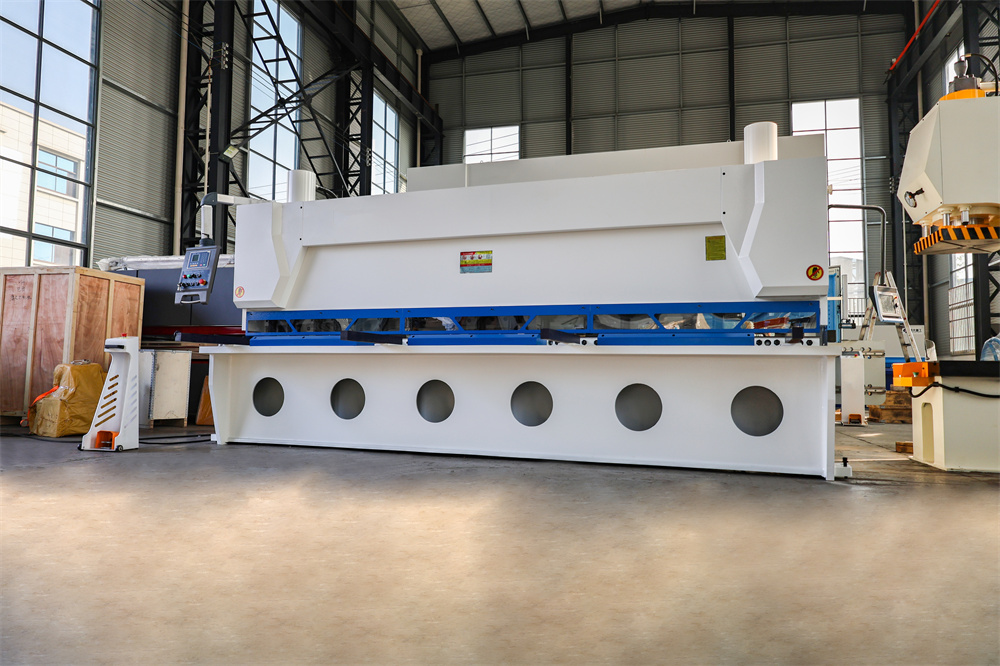
There are two primary types of hydraulic shears: the Swing Beam (QC12Y series) and the Guillotine (QC11K series). The Swing Beam shear uses a pivoting motion, which is excellent for general-purpose cutting and is generally more cost-effective. However, for high-precision batch work where the rake angle needs to be adjusted to prevent “twist” or “bow” in thin strips, the Variable Rake Guillotine is superior. The guillotine moves in a straight vertical path, allowing for adjustable cutting angles that minimize material distortion—a critical factor when the cut blanks are destined for high-precision CNC press brakes.
Hydraulic System and Nitrogen Return
Efficiency in shearing is largely dependent on the return stroke. HARSLE machines typically employ a nitrogen cylinder return system. Unlike older mechanical systems or dual-acting hydraulic systems, nitrogen return is faster and smoother, reducing the idle time between cuts. The integrated hydraulic valve block (often sourced from Rexroth or similar high-end manufacturers) ensures that pressure is applied evenly across the hold-downs, preventing the sheet from slipping during the shear.
The Role of the CNC Controller
The brain of the machine is the controller. For simple batch tasks, an E21S digital display might suffice, controlling the backgauge position and cut counting. However, to truly solve complex bottlenecks, a DAC-310T or DAC-360T CNC system is recommended. These controllers can automatically calculate the required blade gap and rake angle based on the material thickness and type entered by the operator. This automation eliminates the “guesswork” and manual adjustment time that often stalls production lines.
Selection Advice: Choosing the Right Shear for Your Shop
Selecting a machine to solve a bottleneck requires a strategic approach. It is not always about buying the largest machine available, but rather the one that fits the specific workflow of the fabricator. Here is a guide to making the right choice:
Assess Your Maximum and Minimum Requirements
While it is tempting to buy a machine based on the thickest material you might ever cut, doing so can be inefficient if 90% of your work is much thinner. A machine designed for 20mm plate will be slower and less precise on 1mm sheet than a dedicated light-gauge shear. Look for a “sweet spot” that covers your core business while providing a 20% buffer for occasional heavy tasks.
Evaluate the Backgauge Range
For batch cutting, the backgauge is the most used component. Ensure the backgauge range (typically 500mm to 1000mm) is sufficient for your largest parts. Furthermore, look for a “swing-away” backgauge feature, which allows the operator to cut strips longer than the backgauge depth by letting the material pass through the back of the machine.
Blade Quality and Maintenance Access
Blades are the primary consumable. High-quality 4-edged blades (for the bottom) and 2-edged blades (for the top) provide longevity. Ensure the machine design allows for easy blade gap adjustment. If it takes an hour to adjust the gap for a different material thickness, that is an hour of lost production. HARSLE’s quick-adjust mechanisms are designed to keep the Shearing Machine In Action: Solving Batch Cutting Bottlenecks Metal Fabricators face daily to a minimum.
Consider the Total Cost of Ownership (TCO)
The purchase price is only one part of the equation. Consider energy consumption, hydraulic oil requirements, and the availability of spare parts. A machine that is easy to service and has a reliable support network will provide a much better ROI by avoiding long-term downtime.
Maintenance Strategies for High-Volume Shearing
To keep a shearing machine performing at peak efficiency and preventing the return of bottlenecks, a rigorous maintenance schedule is essential. A machine that is poorly maintained will eventually produce burred edges or inconsistent dimensions, leading to a halt in production.
- Daily Lubrication: Ensure all sliding guides and pivot points are lubricated. This reduces friction and prevents premature wear on the bronze bushings.
- Blade Inspection: Check the sharpness of the blades weekly. Dull blades increase the required shearing force, straining the hydraulic system and leaving a poor finish on the workpiece.
- Hydraulic Oil Management: Monitor oil levels and temperature. Overheated oil loses viscosity, leading to sluggish performance. Change the hydraulic filters every 6 months to prevent valve contamination.
- Backgauge Calibration: Periodically verify that the digital readout matches the physical measurement of the cut piece. Vibration over time can occasionally cause slight drifts in calibration.
FAQ: Common Questions About Shearing Machine Efficiency
Q1: Can a shearing machine replace a laser cutter for batch work?
A: For straight-line cutting of rectangular or square blanks, a shearing machine is significantly faster and more cost-effective than a laser. However, it cannot perform complex shapes or internal cutouts. Many shops use a shear to create the basic blanks and then use a laser for secondary features to maximize efficiency.
Q2: What causes the “twist” in sheared strips, and how can it be fixed?
A: Twist is usually caused by a rake angle that is too high for the material thickness. By using a variable rake guillotine shear, you can lower the angle for thinner materials, which significantly reduces the twisting effect and ensures the parts are ready for the next stage of fabrication.
Q3: How often should I rotate the blades?
A: This depends on the material. Cutting stainless steel will dull blades faster than mild steel. Generally, once you notice a significant burr on the edge of the cut that cannot be resolved by adjusting the blade gap, it is time to rotate to a fresh edge of the blade.
Q4: Is CNC control necessary for a shearing machine?
A: While not strictly necessary for simple tasks, CNC control is highly recommended for solving bottlenecks. It allows for rapid setup changes, stores cutting programs for recurring jobs, and automates the blade gap and rake angle, which reduces operator error and increases speed.
Conclusion: Transforming Your Production Floor
The Shearing Machine In Action: Solving Batch Cutting Bottlenecks Metal Fabricators experience is a testament to the power of choosing the right tool for the job. By moving away from slow, manual processes and investing in a high-performance hydraulic shear, fabricators can unlock new levels of productivity. The ability to process large batches of material with speed, precision, and consistency allows a business to take on larger contracts, reduce lead times, and improve the overall quality of their output.
HARSLE remains committed to providing the metalworking industry with machinery that isn’t just powerful, but also intelligent and reliable. Whether you are a small job shop or a large-scale industrial manufacturer, the right shearing machine will act as the catalyst for your growth, ensuring that your cutting stage is never the weak link in your production chain. Invest in quality, prioritize maintenance, and watch as your fabrication bottlenecks become a thing of the past.