Case Study: Selecting the Right Shearing Machine for High-Accuracy Sheet Cutting


Introduction: The Pursuit of Precision in Metal Fabrication
In the competitive landscape of modern metal fabrication, the difference between a successful project and a costly failure often comes down to a fraction of a millimeter. As industries like aerospace, electronics, and high-end automotive manufacturing demand tighter tolerances, the role of the shearing machine has evolved from a simple cutting tool to a high-precision instrument. This case study explores the journey of a mid-sized fabrication shop—PrecisionMetals Corp—as they navigated the complex process of selecting a shearing machine capable of delivering high-accuracy sheet cutting for their specialized production line.
The challenge faced by many fabricators is the balance between speed, cost, and accuracy. Traditional mechanical shears, while fast, often lack the finesse required for delicate materials or complex assemblies. Conversely, laser cutting, while precise, can be prohibitively expensive for simple straight-line cuts in high volumes. This case study focuses on why a high-accuracy hydraulic shearing machine was the optimal solution for PrecisionMetals Corp and provides a roadmap for other businesses facing similar equipment procurement decisions.
HARSLE, a leader in metal fabrication machinery, has observed that the most common pitfall in selecting a shearing machine is underestimating the impact of machine rigidity and control systems on the final output. Through this detailed analysis, we will examine the technical specifications, the decision-making criteria, and the ultimate performance results that define a successful high-accuracy shearing operation.

Key Considerations for High-Accuracy Shearing
When PrecisionMetals Corp began their search, they identified four primary pillars of consideration: material versatility, tolerance requirements, operational efficiency, and long-term durability. High-accuracy sheet cutting is not just about the blade hitting the metal; it is about the entire system’s ability to maintain stability under pressure.
1. Material Properties and Thickness
The first step in any selection process is a thorough audit of the materials to be processed. PrecisionMetals worked primarily with 304 stainless steel and 6061 aluminum, ranging from 0.5mm to 6mm in thickness. Different materials react differently to the shearing force. Stainless steel, for instance, requires higher cutting forces and more durable blade materials compared to mild steel. The machine selected needed to have an adjustable rake angle to prevent the ‘bowing’ or ‘twisting’ effect often seen in thin, high-strength materials.
2. Tolerance and Edge Quality
For this specific case study, the client required a cutting tolerance of ±0.1mm over a 3000mm length. Achieving this level of precision requires a machine with a robust backgauge system and a rigid frame that does not deflect during the cutting stroke. Furthermore, the edge quality—specifically the minimization of burrs—was critical, as the sheared parts were destined for robotic welding where clean edges are paramount for consistent bead quality.
3. The Role of the Control System
In the past, manual adjustments were the norm. However, for high-accuracy sheet cutting, a CNC (Computer Numerical Control) system is indispensable. PrecisionMetals looked for a system that could automatically calculate the blade gap and rake angle based on the material type and thickness entered by the operator. This reduces human error and ensures that every cut is optimized for the specific task at hand.
4. Production Volume and Cycle Time
While accuracy was the priority, the machine also had to keep up with a high-volume production schedule. This meant looking at the strokes per minute (SPM) and the speed of the backgauge movement. A slow machine would create a bottleneck, while an overly fast machine might sacrifice accuracy if the vibration isn’t properly dampened.
Technical Details: Guillotine vs. Swing Beam
One of the most critical technical decisions in this case study was choosing between a Hydraulic Swing Beam Shear and a Hydraulic Guillotine Shear. Both have their merits, but for high-accuracy applications, the differences are significant.
Hydraulic Swing Beam Shears
Swing beam shears feature a blade that moves in an arc. They are generally more affordable and have fewer moving parts, making them easier to maintain. However, because the blade moves in a circular motion, the rake angle is usually fixed. This can lead to distortion in thicker materials or very narrow strips. For PrecisionMetals, the swing beam was considered but ultimately passed over because of the need for variable rake angles to handle their diverse material range.
Hydraulic Guillotine Shears
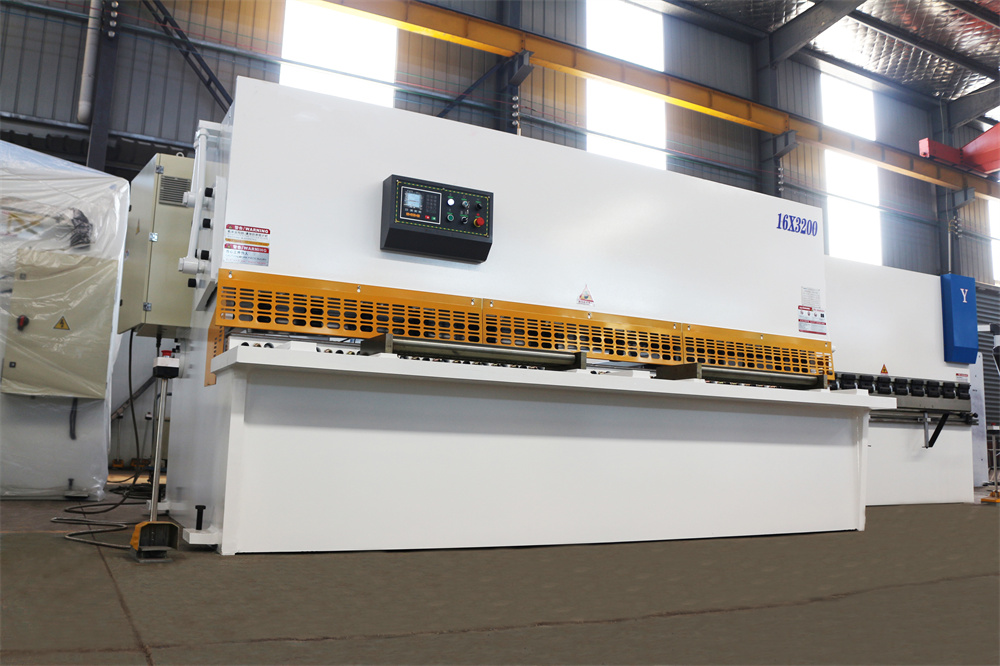
The guillotine shear moves the upper blade in a strictly vertical plane. This design allows for an adjustable rake angle. By reducing the rake angle for thinner materials, the machine can produce cuts with almost zero distortion. Additionally, guillotine shears typically offer greater rigidity, which is essential for maintaining the ±0.1mm tolerance over years of operation. PrecisionMetals opted for a CNC Hydraulic Guillotine Shear, specifically a model featuring a 4-edged high-carbon, high-chrome blade set.
Blade Gap Adjustment and Rake Angle
The technical heart of high-accuracy cutting lies in the blade gap adjustment. If the gap is too wide, the metal will bend between the blades, creating a large burr. If it is too tight, the blades will wear prematurely and the machine will require more power. The selected machine featured a motorized blade gap adjustment controlled by the CNC system, ensuring that for every sheet of 2mm stainless steel, the gap was perfectly calibrated to 0.16mm (8% of thickness).
Selection Advice: How to Choose Your Shearing Machine
Based on the findings of this case study, here is a structured approach for selecting a shearing machine for high-accuracy sheet cutting:
- Define Your Maximums: Don’t just buy for what you cut today. If your thickest material is 6mm, consider an 8mm capacity machine to ensure the frame is never stressed to its absolute limit, which preserves accuracy over time.
- Prioritize the Backgauge: The backgauge is the most active part of the machine. Look for ball screw backgauges with AC servo motors. These provide the highest positioning accuracy and repeatability.
- Check the Hydraulic System: High-quality valves (such as Bosch-Rexroth) and reliable pump systems ensure consistent pressure. Inconsistent pressure leads to inconsistent cutting speeds and potential deviations in the cut line.
- Evaluate the Frame Construction: A heavy, welded steel plate construction that has been stress-relieved is vital. A lighter frame will vibrate and flex, destroying your chances of high-accuracy cutting.
- Software and Interface: Ensure the CNC interface is user-friendly. A complex system that operators find difficult to use will lead to shortcuts and errors. Look for systems like the DELEM DAC-360T which offers clear graphical displays and easy programming.
Furthermore, consider the after-sales support. A shearing machine is a long-term investment. Access to spare parts, such as replacement blades and hydraulic seals, as well as technical support for the CNC system, is just as important as the initial purchase price.
Frequently Asked Questions (FAQ)
What is the difference between a mechanical and a hydraulic shear?
Mechanical shears use a flywheel and clutch system to deliver a fast, high-energy stroke. They are excellent for high-speed, low-thickness applications but lack the control and adjustability of hydraulic shears. Hydraulic shears use fluid power to move the ram, allowing for adjustable stroke lengths, variable speeds, and much higher cutting forces, which are necessary for high-accuracy work on thicker materials.
How often should shearing blades be sharpened?
The frequency of sharpening depends on the material being cut. Cutting stainless steel will dull blades much faster than mild steel or aluminum. Generally, blades should be inspected every 500-1,000 hours of operation. High-accuracy cutting requires sharp blades; once the edge rounds off, the burr height increases and the accuracy of the cut dimensions may drift.
Can a shearing machine cut plastic or composite materials?
Yes, but with caution. The blade gap and rake angle must be specifically adjusted for non-metallic materials to prevent cracking or shattering. Some composites may also be abrasive, requiring specialized blade coatings to prevent rapid wear.
Why is the rake angle important?
The rake angle is the slope of the upper blade relative to the lower blade. A higher rake angle reduces the force required to cut the metal but increases the likelihood of the cut strip twisting or bowing. For high-accuracy sheet cutting, the ability to adjust the rake angle to the lowest possible setting for the material thickness is crucial for flat, straight parts.
What is ‘shadow line’ lighting?
Shadow line lighting is a feature that casts a precise shadow on the material where the blade will strike. This is incredibly useful for operators who need to align a pre-marked line on a sheet of metal with the cutting edge, ensuring manual accuracy when the backgauge is not being used.
Conclusion: The Result of Informed Selection
In the case of PrecisionMetals Corp, the selection of a CNC Hydraulic Guillotine Shearing Machine transformed their production capabilities. By focusing on the technical nuances of blade gap control, rake angle adjustability, and a high-precision backgauge, they were able to reduce material waste by 15% and eliminate the need for secondary edge grinding on 90% of their parts. This not only improved their bottom line but also allowed them to take on higher-tier aerospace contracts that were previously out of reach.
Selecting the right shearing machine for high-accuracy sheet cutting is a process that requires a deep understanding of both your current needs and your future goals. By treating the machine as a precision system rather than a simple commodity, fabricators can ensure long-term success and a significant return on investment. Whether you are cutting thin aluminum or heavy stainless steel, the principles of rigidity, control, and proper calibration remain the cornerstones of high-accuracy fabrication.
HARSLE remains committed to providing the industry with the tools and knowledge necessary to achieve these results. As technology continues to advance, the integration of smarter CNC controls and more efficient hydraulic systems will only further the possibilities of what can be achieved in the world of metal shearing.