Shearing Machine Not Cutting Straight? Common Causes and Troubleshooting Tips


Introduction to Precision Shearing Challenges
In the world of metal fabrication, precision is the cornerstone of quality. Whether you are producing components for the aerospace industry, automotive parts, or simple structural brackets, the accuracy of your initial cut dictates the success of every subsequent process. When a shearing machine begins to produce crooked or uneven cuts, it creates a ripple effect of inefficiency. Not only does it lead to material waste, but it also increases the workload for secondary processes like grinding, welding, and assembly. For operators and shop managers, the question ‘Why is my shearing machine not cutting straight?’ is one that requires immediate and technical attention.
HARSLE has spent years refining the technology behind hydraulic and mechanical shearing machines, and we understand that a ‘bad cut’ is rarely the result of a single factor. It is often a combination of mechanical wear, improper settings, and material variables. A shearing machine is a high-force instrument that relies on the perfect synchronization of the upper and lower blades, the stability of the workpiece, and the accuracy of the positioning system. When any of these elements fall out of alignment, the result is a cut that deviates from the intended line.
This comprehensive guide is designed to help you diagnose the root causes of shearing inaccuracies. We will explore the technical nuances of blade clearance, the physics of material deformation, and the mechanical components that must be regularly maintained to ensure peak performance. By the end of this article, you will have a clear roadmap for troubleshooting your equipment and restoring the precision that your fabrication projects demand.
Key Considerations for Straight Shearing
1. Blade Gap and Clearance Settings
The most common culprit behind a shearing machine not cutting straight is an incorrect blade gap. The gap, or clearance, is the distance between the upper and lower blades as they pass each other. If the gap is too wide, the material will not be sheared cleanly; instead, it will be pulled into the gap, resulting in a ‘folded’ edge or a significant burr. This pulling action often causes the sheet to shift during the cut, leading to a crooked line. Conversely, if the gap is too tight, it creates excessive friction and heat, which can cause the blades to chip or the machine to stall, also resulting in an uneven finish.
As a general rule of thumb, the blade gap should be approximately 8% to 10% of the material thickness for mild steel. However, this percentage changes when working with harder materials like stainless steel or softer materials like aluminum. Modern CNC shearing machines often feature automatic blade gap adjustment, but manual machines require the operator to use feeler gauges and adjustment bolts to ensure the gap is uniform across the entire length of the bed.
2. Blade Sharpness and Condition
A dull blade does not cut; it tears. When the cutting edge of a shearing blade becomes rounded or nicked, it requires significantly more force to penetrate the metal. This increased force can cause the material to ‘creep’ or move under the hold-downs. Furthermore, a dull blade creates a larger ‘fracture zone’ in the metal. In a perfect shear, the blade penetrates about one-third of the material thickness before the remaining two-thirds fracture cleanly. A dull blade increases the penetration depth, which distorts the metal and leads to a curved or ‘bowed’ cut.
3. Material Properties and Preparation
Not all metal sheets are created equal. Internal stresses within the material, often caused by the rolling process at the mill, can be released during shearing. This release of stress can cause the metal to twist or bow as soon as the cut is made. Additionally, if the material is not flat—if it has ‘oil canning’ or waves—it will not sit flush against the shearing table. This lack of stability allows the material to shift the moment the upper blade makes contact, resulting in a cut that is anything but straight.
Technical Details: Understanding Bow, Twist, and Camber
The Phenomenon of ‘Bow’
Bow occurs when the sheared strip curves upward or downward, resembling an arch. This is typically caused by the rake angle of the upper blade. A higher rake angle reduces the force required to cut the metal but increases the likelihood of bowing, especially on narrow strips. If your machine is consistently bowing the material, you may need to adjust the rake angle (if your machine allows it) or check if the hold-down pressure is sufficient to keep the material flat against the table during the shearing stroke.
The Phenomenon of ‘Twist’
Twist is a rotational distortion where the ends of the sheared strip move in opposite directions. This is often a result of the material being ‘squeezed’ between the blades. Technical causes include excessive rake angles or insufficient hold-down force. In some cases, the geometry of the blade itself or the way the material is fed into the machine can contribute to twist. High-quality shearing machines from HARSLE are designed with optimized rake angles to minimize this effect, but operator settings still play a vital role.
The Phenomenon of ‘Camber’
Camber is perhaps the most frustrating issue, where the edge of the sheet curves horizontally (like a banana). This is almost always a result of the material moving during the cut. If the back gauge is not perfectly parallel to the blade, or if the hold-down cylinders are leaking and not providing uniform pressure, the material will pivot slightly as the blade descends. Even a fraction of a millimeter of movement at the start of the cut can result in a several-millimeter deviation by the end of a long sheet.

Selection Advice: Choosing the Right Machine to Prevent Inaccuracy
Swing Beam vs. Guillotine Shears
When purchasing a shearing machine, the design of the ram movement is critical. Swing beam shears (like the QC12Y series) move the upper blade in an arc. While they are robust and excellent for many applications, the arc movement can sometimes contribute to a slight ‘bow’ in very thin or very narrow strips. Guillotine shears (like the QC11Y series), on the other hand, move the blade in a straight vertical line. This vertical movement generally provides a cleaner, straighter cut with less distortion, making it the preferred choice for high-precision fabrication shops.
The Importance of the Back Gauge System
The back gauge is the heart of your machine’s positioning accuracy. When selecting a machine, look for a back gauge system that utilizes ball screws and linear guides rather than simple lead screws. Ball screws provide much higher precision and are less prone to ‘backlash’ or play. A CNC-controlled back gauge allows for repeatable accuracy, ensuring that every piece is cut to the exact same dimensions. If your current machine is not cutting straight, the first thing to check is whether the back gauge is still square to the cutting edge.
Hold-Down System Quality
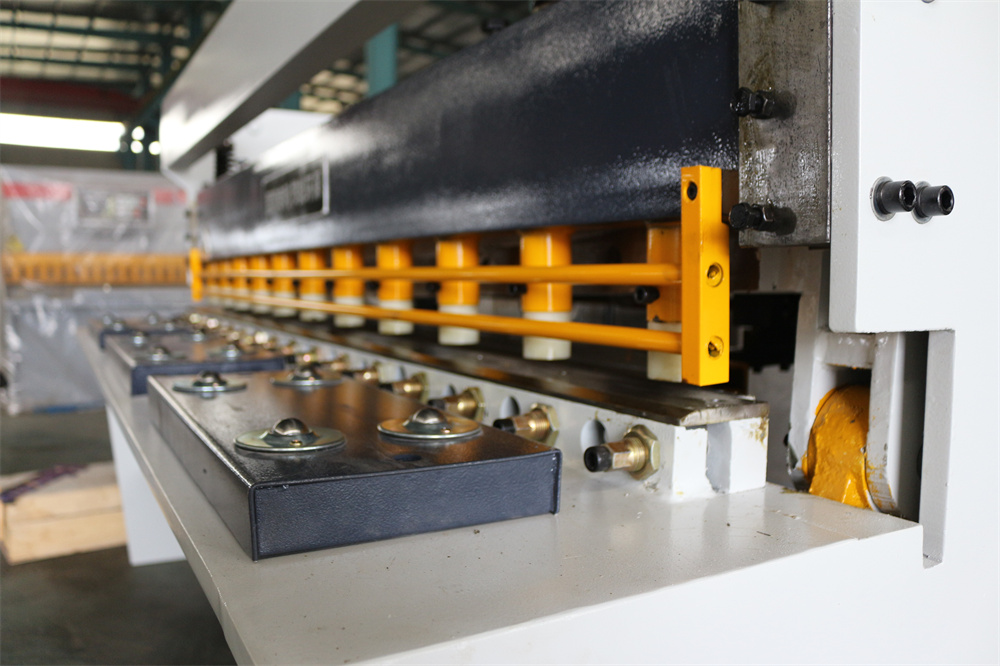
The hold-down system consists of a series of hydraulic cylinders that clamp the material before the blade starts to cut. If these cylinders are worn out or if the pressure is uneven, the material will shift. When buying a machine, ensure the hold-downs are equipped with non-marring pads (to protect the material) and that they are spaced closely enough to provide uniform pressure across the entire length of the blade. A machine with fewer hold-downs is more likely to suffer from material slippage.
Troubleshooting Tips: A Step-by-Step Guide
| Problem | Potential Cause | Recommended Solution |
|---|---|---|
| Camber (Banana Cut) | Back gauge out of alignment or material slippage. | Re-calibrate back gauge parallelism; check hold-down pressure. |
| Heavy Burrs | Blade gap too wide or dull blades. | Adjust blade clearance to 10% of thickness; flip or sharpen blades. |
| Twisted Strips | Rake angle too high for the material thickness. | Reduce the rake angle (on adjustable machines) or increase hold-down force. |
| Inconsistent Lengths | Back gauge ‘creep’ or loose mechanical connections. | Tighten all back gauge mounting bolts; check ball screw for wear. |
Step 1: Inspect the Blades
Start by cleaning the blades thoroughly. Remove any metal dust or oil buildup. Inspect the edges for nicks or rounding. Most shearing blades have four cutting edges; if one is dull, you can rotate the blade to a fresh edge. If all edges are worn, the blades must be sent to a professional grinding service. Never attempt to sharpen shearing blades with a hand grinder, as this will destroy the required flatness and parallelism.
Step 2: Verify the Blade Gap
Use a feeler gauge to check the gap at both ends of the machine and in the middle. The gap should be consistent across the entire length. If the middle of the blade has a wider gap than the ends, the ‘bed’ or the ‘ram’ may be deflected. This is a serious structural issue that may require shimming the blades or adjusting the tie-rods of the machine frame.
Step 3: Check the Hold-Downs
Place a piece of material in the machine and initiate the cycle, but stop it just as the hold-downs engage. Try to move the material by hand. If it moves easily, your hold-down pressure is too low or the seals in the cylinders are failing. Check the hydraulic pressure gauge for the hold-down circuit; it should typically be set higher than the shearing pressure to ensure the material is locked in place before the cut begins.
Step 4: Align the Back Gauge
Use a precision square to check if the back gauge bar is perfectly perpendicular to the side squarring arm. Then, use a dial indicator to ensure the back gauge is parallel to the bottom blade. If the back gauge is tilted even slightly, every cut will be tapered. Adjust the timing belts or the coupling between the two back gauge screws to bring them back into synchronization.
Frequently Asked Questions (FAQ)
How often should I sharpen my shearing blades?
The frequency of sharpening depends on the material you are cutting. If you primarily cut mild steel, blades can last for thousands of cycles. However, cutting stainless steel or high-carbon alloys will dull the blades much faster. A good indicator is the appearance of the ‘burr’ on the sheared edge; once the burr exceeds 10% of the material thickness, it is time to flip or sharpen the blades.
Can I cut material that is thicker than the machine’s rated capacity?
Absolutely not. Exceeding the rated capacity of a shearing machine can cause catastrophic failure of the hydraulic system, crack the machine frame, or shatter the blades. It also guarantees a crooked cut because the machine will flex under the excessive load. Always check the manufacturer’s specification plate before attempting to cut thick or high-tensile materials.
Why does my machine make a loud ‘bang’ when cutting?
A loud bang is often the result of the ‘shock’ when the material finally fractures. While some noise is normal, an excessively loud bang can indicate that the rake angle is too low or that the nitrogen return cylinders (on hydraulic machines) are under-pressurized. It can also be a sign that the blade gap is too tight, causing the blades to ‘clash’ slightly.
Does the temperature of the hydraulic oil affect cutting accuracy?
Yes, it can. As hydraulic oil heats up, its viscosity decreases. This can lead to slight changes in the speed of the ram and the responsiveness of the hold-down cylinders. If your machine is in a non-climate-controlled shop, you may notice that the accuracy changes from the morning to the afternoon. High-quality machines include oil coolers to maintain a consistent temperature and ensure repeatable accuracy.
What is the ‘Squaring Arm’ and why is it important?
The squaring arm is a long bar mounted to the side of the shearing table, perpendicular to the blades. It is used to ensure that the side of the sheet is square to the cut. If the squaring arm is bumped or misaligned, every cut will be out of square, even if the back gauge is perfectly parallel. It should be checked regularly with a large machinist’s square.
Conclusion: Maintaining the Edge in Metal Fabrication
A shearing machine that does not cut straight is more than just a mechanical nuisance; it is a drain on your shop’s productivity and profitability. By understanding the technical relationship between blade clearance, material stability, and mechanical alignment, you can transform a frustrating troubleshooting process into a routine maintenance task. Precision shearing is a science, and like any science, it requires the right tools and the right settings.
At HARSLE, we pride ourselves on manufacturing shearing machines that are built for longevity and precision. From our robust frame designs to our intuitive CNC control systems, every element is engineered to minimize distortion and maximize accuracy. However, even the best machine requires a knowledgeable operator. Regular inspections of the blades, consistent calibration of the back gauge, and attention to the condition of the hydraulic system are the keys to ensuring that every cut is as straight as the first one.
If you have followed these troubleshooting steps and are still experiencing issues, it may be time to consider whether your current equipment is right for your evolving production needs. Sometimes, the ’cause’ of a crooked cut is simply a machine that has reached the end of its service life or is being asked to perform beyond its original design parameters. In such cases, investing in modern, high-precision shearing technology is the most cost-effective solution for the future of your business.